


When people plan a trip to Naples, their day trip list usually stops at Pompeii, Herculaneum and maybe Capri. Yet just 30 to 40 minutes from central Naples, Pozzuoli offers Roman ruins to rival the big names, easy ferry links to Ischia and Procida, and a frontline view of the restless Campi Flegrei volcanic area. With recent headlines about earthquakes and “supervolcano” risks, many travelers are asking a simple question: is Pozzuoli still worth visiting, and for whom does it really make sense?
Get the latest updates straight to your inbox!
Where Pozzuoli Fits Into a Naples Itinerary
Pozzuoli sits on the western edge of the Bay of Naples, in the heart of the Campi Flegrei volcanic caldera. In practical terms, it feels like an outer suburb of Naples, but the vibe is noticeably slower. From Napoli Centrale station, most visitors either take the metro on Linea 2 to Pozzuoli Solfatara, which takes around 35 minutes, or use a regional train from Napoli Campi Flegrei, adding only a few minutes more. A taxi or ride-hailing car from central Naples typically takes 25 to 40 minutes depending on traffic and can cost in the region of 35 to 45 euros one way.
For a short city break focused on Naples’ historic center, pizza and the classic day trips to Pompeii or Capri, Pozzuoli is best seen as an optional add-on rather than a core stop. It works particularly well on a second or third day in the region, when you have already visited at least one of the major archaeological parks. Many travelers pair Pozzuoli with a relaxed evening back in Naples’ Spanish Quarter or on the Lungomare, treating it as a low-pressure day out.
Where Pozzuoli really shines is in itineraries that foreground archaeology and geology. If you are already planning to visit Cuma, Baia or the Piscina Mirabilis, Pozzuoli becomes an obvious hub, since these sites are all within a short drive or local bus ride. Tour operators in Naples increasingly sell “Campi Flegrei” day tours that combine the Flavian Amphitheatre in Pozzuoli with the underwater ruins at Baia and viewpoints over the caldera. Independent travelers can recreate similar routes with public transport, but having a rental car or private driver makes a big difference.
Finally, Pozzuoli can serve as a strategic departure point for the islands of Ischia and Procida. Car ferries and passenger ferries leave from the port with regular daily connections, often at lower prices and shorter crossing times than from central Naples. For budget-conscious travelers or those picking up a rental car at Naples airport, driving to Pozzuoli and boarding a ferry there is often more straightforward than navigating downtown Naples traffic and port formalities.
The Main Reasons Travelers Choose Pozzuoli
The headline reason most visitors detour to Pozzuoli is the Flavian Amphitheatre, a massive Roman arena that is one of the three largest in Italy. Unlike the Colosseum in Rome, its underground corridors and animal pens are remarkably intact and far less crowded, so you can often wander through vaulted passages almost alone. Entry is managed as part of the Campi Flegrei Archaeological Park, with tickets typically costing only a few euros for adults and free or discounted admission for children and European Union residents under 25. Compared with the crowds and tour prices at Pompeii, the value for serious history fans is high.
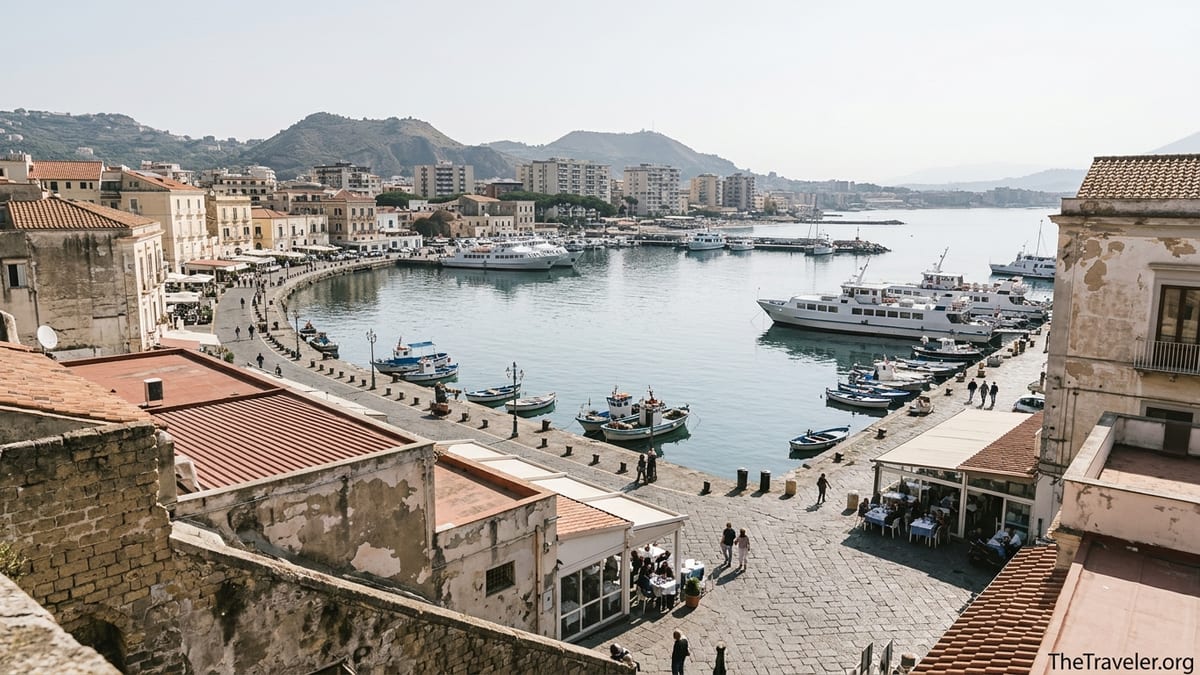
Beyond the amphitheatre, Pozzuoli’s compact historic center around the port rewards slow wandering. The seafront promenade is lined with simple seafood trattorie where locals linger over plates of fried anchovies, spaghetti alle vongole and grilled fish. Prices are often a notch lower than in central Naples; for example, a generous seafood pasta and a glass of house white wine might come to 18 to 22 euros at a casual harbor-side restaurant, compared with mid-20s in some more touristy Naples spots.
Another strong draw is the port itself, one of the main ferry gateways to Ischia and Procida. Travelers who are continuing on to an island stay often plan a half day in Pozzuoli, combining a morning at the amphitheatre with an afternoon ferry departure. With crossing times of roughly 35 to 60 minutes to Procida or Ischia depending on the route and vessel, the journey from Pozzuoli is both shorter and less exposed to choppy seas than some of the options from central Naples.
Lastly, Pozzuoli offers a more grounded look at everyday life in the Campi Flegrei area. The town feels lived-in rather than packaged for visitors. You may pass school groups on field trips to the ruins, grandparents chatting on benches in Rione Terra, or office workers grabbing espresso at the bar before catching a ferry. Travelers who enjoy seeing how modern communities coexist with deep history and geological risk often find this daily-life aspect as compelling as the classic sights.
Campi Flegrei, Earthquakes and Safety Considerations
Any honest discussion about visiting Pozzuoli now has to address the Campi Flegrei volcanic system. The town sits above part of a large caldera that has been experiencing ongoing ground uplift and swarms of small earthquakes, a phenomenon known as bradyseism. Studies published in 2024 and 2026 describe accelerating uplift and increased seismicity, suggesting the system is in an active phase. Italian civil protection authorities monitor the area very closely, with a color-coded alert system and emergency plans that can include evacuations if needed.
For visitors, the practical reality is nuanced. On an average day in Pozzuoli, you are more likely to notice roadworks or scaffolding than any direct volcanic phenomena. Occasional small tremors may be felt, particularly by locals accustomed to reading the signs, but there is no routine evacuation in place as of June 2026. Local life continues, schools operate and ferries run on their usual schedules. Most reputable tour companies and hotels follow official guidance: if civil protection raises the alert or closes certain zones, tours are rerouted or rescheduled rather than operating in defiance of instructions.
Travelers who are extremely anxious about natural hazards, or who are responsible for people who would find sudden disruption very difficult, such as those with mobility issues or very young children, should factor this into their decision. Someone choosing between a relaxed day in Sorrento and an exploration of the Campi Flegrei might reasonably decide that the added geological uncertainty is not worth it. Others, especially those with an interest in volcanology or earth sciences, see Pozzuoli as a rare opportunity to experience a living caldera under careful scientific observation.
From a planning perspective, the key is flexibility. It is wise to avoid nonrefundable prepayments for tours in the Campi Flegrei, book accommodation with reasonable cancellation policies and keep a backup plan. For instance, if a planned day in Pozzuoli is disrupted by a local seismic event, you could pivot to a museum day in central Naples, a food tour, or a train trip to Caserta’s royal palace. Travel insurance that covers trip interruption due to natural events can provide additional peace of mind, though the wording of policies varies and should be checked carefully.
Key Sights: Amphitheatre, Rione Terra and the Waterfront
The Flavian Amphitheatre is usually the first stop. Located a short walk from the Pozzuoli Solfatara train station, it sits embedded in the modern town rather than isolated in open countryside. Visitors typically spend one to two hours wandering through the seating tiers and exploring the extensive underground corridors that once held gladiators and animals. Information panels explain how the structure was built under the emperors Vespasian and Titus, the same dynasty responsible for Rome’s Colosseum, and how parts of the building were later quarried for stone.
A short walk downhill leads to the seafront and the historic district of Rione Terra. This headland has been inhabited since ancient times, and large sections were evacuated during bradyseismic crises in the 20th century, then progressively restored. Guided routes lead through layers of Roman streets and buildings preserved beneath later constructions, giving a vivid sense of how the ancient city once looked. When tours are running, they often need to be prebooked, and schedules can change with conservation work, so it is sensible to confirm availability close to your travel dates.
Along the waterfront, the modern port of Pozzuoli combines commercial ferry operations with a pleasant promenade. Fishing boats still unload here in the early morning, and you will see locals queueing at simple fish stalls for the day’s catch. Cafes line the harbor with outdoor tables that fill up on sunny weekends. In warm months, it is common to see Neapolitan families arrive from the city by car, have a leisurely grilled fish lunch by the water, and then either return home or continue to Procida on an afternoon ferry.
Nearby, the relocated Roman market known as the Macellum, with its partially submerged columns, offers another reminder of the area’s volcanic restlessness. Changes in ground level have caused parts of the ancient structure to dip below modern sea level. The site is relatively compact, so most visitors spend about 30 minutes walking around, making it an easy add-on if you are already exploring the lower town.
Using Pozzuoli as a Gateway to Ischia and Procida
One of Pozzuoli’s biggest practical advantages is its port. Ferries from here connect regularly to Procida and to the ports of Ischia, particularly Ischia Porto and Casamicciola. Crossing times are often around 35 minutes to Procida and about 60 minutes to parts of Ischia, depending on the company and whether there are intermediate stops. Operators such as Gestour, Medmar and Caremar run car ferries, which is especially helpful if you are traveling with your own vehicle or a rental car picked up at Naples airport.
Compared with central Naples, Pozzuoli’s port generally feels less hectic. Drivers heading for the islands appreciate the more straightforward access, especially in high season when traffic on the main roads into Naples can be heavy. If you arrive by train, it is feasible to walk or take a short taxi ride from Pozzuoli Solfatara station to the port, then board a passenger ferry without a car. Timetables can shift seasonally, with more frequent departures in summer and slightly reduced services in winter, so checking dates close to your trip is important.
Prices vary by route and season, but as a rough guide, foot passenger fares on ferries from Pozzuoli to Procida or Ischia commonly start in the low tens of euros one way, with car plus driver tickets costing more depending on vehicle size. It is usually easiest to buy tickets online in advance for summer weekends and August holidays, when island routes can sell out, especially for cars. At quieter times of year, many travelers simply purchase tickets at the port ticket offices on the day of travel.
Because crossings are relatively short, Pozzuoli works well as a flexible staging post. Some visitors stay in Naples for several nights, then move to Pozzuoli for a night before catching an early-morning ferry to Ischia, fitting in a sunset stroll by the harbor and dinner at a local trattoria. Others base themselves on Ischia or Procida and come back through Pozzuoli for a day trip to the amphitheatre and Rione Terra, combining island life with a dose of mainland history without having to deal with downtown Naples each time.
Who Will Get the Most Out of a Visit to Pozzuoli
Pozzuoli is particularly rewarding for travelers who are already enthusiastic about Roman history but want to escape the crowds that dominate places such as Pompeii. Students of archaeology, history buffs and anyone who has enjoyed exploring the Colosseum or Verona’s arena often find the Flavian Amphitheatre here even more atmospheric, precisely because it is quieter and more intact underground. Photography enthusiasts also appreciate the interplay of light and shadow in the amphitheatre’s corridors and the views across the Bay of Naples from Rione Terra.
It also suits travelers who like to see contemporary life layered over ancient foundations. If your idea of a satisfying day involves people-watching in a local cafe, browsing fish stalls and watching ferries come and go, Pozzuoli offers this in a compact, walkable setting. Couples on longer trips sometimes use it as a slower interlude between busier days in central Naples and the more polished settings of Capri or Sorrento.
On the other hand, Pozzuoli may feel underwhelming for visitors with very limited time or a strong preference for polished, postcard-perfect destinations. The town is a working community, with some buildings in need of maintenance, construction sites and the occasional closed-off area linked to bradyseismic monitoring. Travelers who want manicured streets, designer boutiques and a strong nightlife scene will likely find more of what they are looking for in central Naples, Positano or Capri.
Families with young children may appreciate the amphitheatre’s open spaces and the excitement of watching ferries depart, but they should weigh this against the extra transport time compared with simpler outings within Naples. For those sensitive to news about earthquakes or volcanoes, the psychological impact of visiting an active caldera region should not be underestimated. Reading local civil protection information in advance and discussing it calmly with older children can help set expectations.
Practical Tips for Planning a Visit
For a straightforward day trip, many travelers leave central Naples around 9 or 10 in the morning, reach Pozzuoli by 10:30 or 11, visit the Flavian Amphitheatre for an hour or two, then walk down to the waterfront for lunch. After a relaxed meal, they spend an hour exploring Rione Terra and the port area before returning to Naples by late afternoon. This pace leaves room for delays on the metro or regional trains without feeling rushed.
Footwear matters more than you might expect. The amphitheatre involves walking on uneven stone surfaces and stairs, while Rione Terra’s streets can be steep. Comfortable shoes with good grip are advisable, especially in wet weather when stones become slippery. In summer, the amphitheatre’s stone seating and exposed areas heat up quickly under the sun, so a hat, water bottle and sunscreen make a big difference. Spring and autumn offer milder temperatures and fewer crowds, often making them the best seasons for a visit.
In terms of costs, Pozzuoli is generally friendlier to the budget than central Naples’ tourist hotspots. A coffee at a local bar typically costs around 1 to 1.50 euros, a simple pizza between 6 and 9 euros and a seafood main course 12 to 20 euros in casual trattorie. Public transport from Naples to Pozzuoli using metro or regional trains is inexpensive, often just a few euros each way. Entrance to major archaeological sites is set by the Campi Flegrei Archaeological Park and may occasionally change, so confirming prices on official platforms shortly before your trip is wise.
Language is rarely a barrier. While English is not as widespread as in central Naples’ main tourist areas, many younger locals and people working in hospitality speak at least basic English. Learning a few phrases in Italian, such as ordering food or asking for directions, is appreciated and can lead to warmer interactions. As in any working port town, standard urban safety precautions apply: watch your belongings in crowded areas, avoid leaving valuables visible in cars and stick to well-lit streets at night.
The Takeaway
Whether Pozzuoli is worth visiting on a trip to Naples depends largely on your interests and your comfort with traveling in an active volcanic area. For travelers drawn to Roman history, lived-in neighborhoods and the idea of seeing how modern life unfolds on the rim of a caldera, it offers rewards out of proportion to the modest time and cost involved. The Flavian Amphitheatre, Rione Terra and the bustling port together create a picture of continuity between ancient and contemporary Campania that you will not get from the more polished settings of Capri or the Amalfi Coast.
For those with very limited time, or who feel uneasy about news of Campi Flegrei unrest, skipping Pozzuoli in favor of classic trips to Pompeii, Herculaneum or Capri is a reasonable decision. The key is to make a conscious choice rather than treating Pozzuoli as a generic stop. If you value quieter ruins, local seafood, easy access to Ischia and Procida and a close-up view of how people live with geological risk, then Pozzuoli deserves serious consideration on your Naples itinerary.
FAQ
Q1. Is Pozzuoli safe to visit given the Campi Flegrei volcanic activity?
As of June 2026, Pozzuoli is under continuous monitoring by Italian authorities. Small earthquakes and ground uplift occur, but daily life continues and there is no ongoing evacuation. Visitors who are particularly anxious about natural hazards should follow official updates and prioritize flexible, refundable arrangements.
Q2. How long do I need to see the main sights in Pozzuoli?
A well-planned day trip of six to eight hours is enough to visit the Flavian Amphitheatre, stroll Rione Terra, enjoy a waterfront lunch and explore the port. Travelers with more time might add nearby sites in the Campi Flegrei, such as Baia or Cuma, which would merit an additional half or full day.
Q3. Is Pozzuoli a good alternative to Pompeii or should I do both?
Pozzuoli complements rather than replaces Pompeii. Pompeii offers a vast, open archaeological city, while Pozzuoli provides a more compact experience, a major amphitheatre and insights into life in the caldera. If time allows, doing both gives a richer picture of Roman Campania; if you must choose, first-time visitors usually prioritize Pompeii.
Q4. Can I visit Pozzuoli and still make a ferry to Ischia or Procida the same day?
Yes, many travelers combine a morning in Pozzuoli with an afternoon ferry. A typical pattern is to arrive by late morning, tour the amphitheatre, have lunch at the harbor and board a mid-afternoon ferry to Ischia or Procida. Checking current ferry schedules and allowing a buffer of at least an hour before departure is advisable.
Q5. What is the easiest way to get from Naples to Pozzuoli without a car?
The simplest option is the metro-style Linea 2 train from central Naples to Pozzuoli Solfatara station, taking roughly 35 minutes. Regional trains from Napoli Campi Flegrei offer similar timing. From the station, you can walk to the amphitheatre and then down to the port, or take a short taxi ride if you prefer.
Q6. Are there good food options in Pozzuoli for a lunch stop?
Yes, the waterfront near the port is dotted with seafood trattorie and pizzerias popular with locals. Expect fresh fish, classic dishes such as spaghetti alle vongole and reasonably priced house wines. Prices are often slightly lower than in central Naples, making Pozzuoli a pleasant and good-value lunch stop.
Q7. Is Pozzuoli suitable for families with children?
Pozzuoli can work well for families, especially those with school-age children interested in history. The amphitheatre’s open spaces and tunnels are engaging, and watching ferries and fishing boats in the port is appealing. Parents should be prepared for stairs and uneven ground, and consider children’s comfort with the idea of being in a volcanic area.
Q8. When is the best time of year to visit Pozzuoli?
Spring and autumn are generally the most comfortable times, with mild temperatures and fewer crowds. Summer offers long days and lively waterfront scenes but can be hot, especially in the stone amphitheatre. Winter visits are possible, but some ferry schedules and tour options may be reduced.
Q9. Can I base myself in Pozzuoli instead of Naples?
Some travelers choose Pozzuoli as a quieter base, especially if they plan multiple trips to Ischia or Procida or want to focus on the Campi Flegrei area. However, central Naples offers more museums, nightlife and transport connections. For most first-time visitors, Pozzuoli works best as a day trip or a one- or two-night stay rather than the main base.
Q10. Do I need to book tours in advance for Pozzuoli’s archaeological sites?
The Flavian Amphitheatre can often be visited independently without a guided tour, buying tickets on arrival. For more specialized experiences, such as underground routes in Rione Terra or combined Campi Flegrei excursions, advance booking is recommended, particularly in high season and on weekends when spaces may be limited.