


Most visitors pass through Pozzuoli on a quick half-day trip from Naples, ticking off the Flavian Amphitheater and a seafood lunch on the harbor before rushing back. Yet this compact port, set inside the restless Campi Flegrei volcanic caldera, rewards anyone willing to wander a little farther and stay a little later. Beneath its surface lie forgotten Roman streets, myth-drenched lakes, humble shrines and family-run kitchens that rarely make it into guidebooks, but linger in a traveler’s memory for years.
Get the latest updates straight to your inbox!
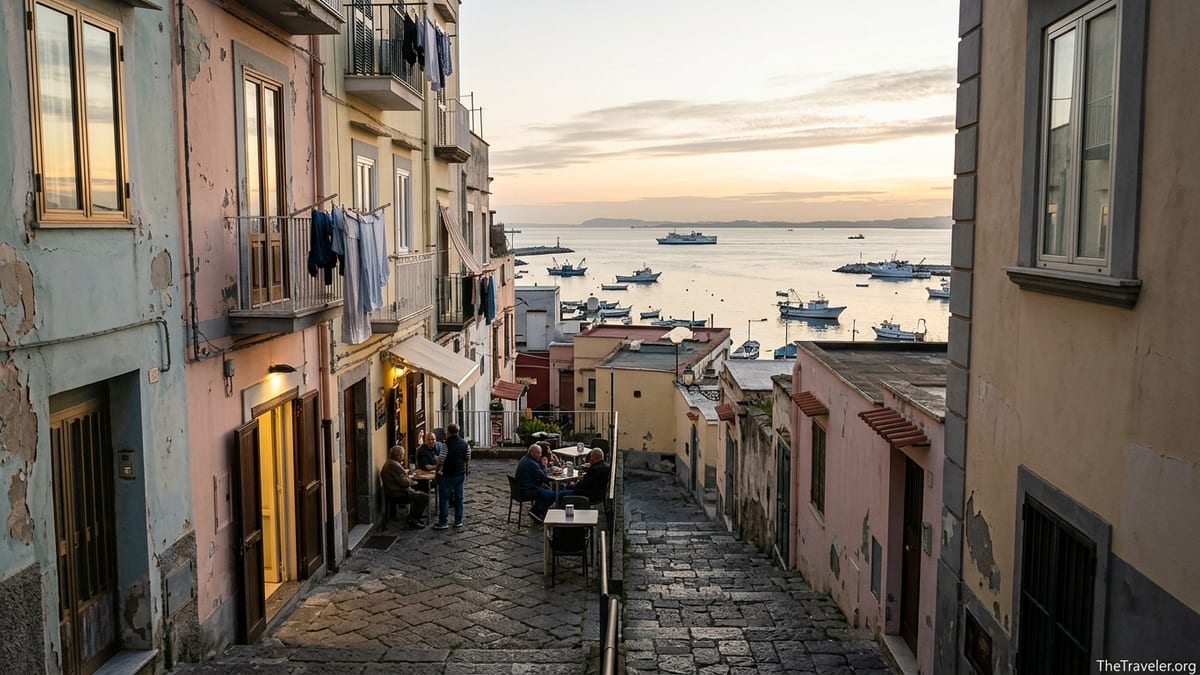
Rione Terra After Hours: A Hilltop Quarter Coming Back to Life
Perched on a tufa promontory above the bay, Rione Terra is the oldest part of Pozzuoli, inhabited since at least the 2nd century BC. For decades this cliff-top quarter was largely abandoned after seismic unrest forced residents out in the 1970s, leaving a ghostly grid of alleys and shuttered facades. Today, restoration has slowly reopened parts of the neighborhood, but it still feels surprisingly quiet compared with Naples’ historic center, especially in the late afternoon and early evening.
Walk up from the modern lower town toward the cathedral, and you will notice how the noise of scooters fades. Narrow lanes reveal laundry strung across tiny courtyards, a bar with just three tables looking out to sea, and weathered doorways that speak of earlier centuries. Much of the Roman city survives beneath your feet, and guided underground tours reveal streets, shops and warehouses preserved below the current level of the quarter. These tours are usually small-group and reservation-based, which keeps the atmosphere intimate rather than touristy.
Even without going underground, the views alone justify the climb. From the belvedere near the cathedral, the entire curve of the Bay of Pozzuoli unfolds, with fishing boats, ferries to Procida and Ischia, and the hazy outline of Capri on clear days. Arrive close to sunset on a weekday and you might share the scene with just a handful of locals out for a stroll. Prices in the nearby bars reflect the predominantly local clientele: an espresso typically costs around 1.20 to 1.50 euros, and a glass of house wine rarely exceeds 4 euros, a reminder that this is still a lived-in neighborhood rather than a polished open-air museum.
Practical tip: Because restoration work is ongoing and opening times can change, it is worth checking locally or with the tourist office in town to confirm when underground visits and the cathedral interior are accessible. Even when some areas are closed, simply wandering the lanes of Rione Terra offers one of Pozzuoli’s most atmospheric, least-discovered experiences.
Lake Averno: Walking the Ancient “Gate to the Underworld”
A short taxi or bus ride from central Pozzuoli brings you to a very different world: the volcanic crater lake of Lago d’Averno. In Roman times this sheltered, almost perfectly circular lake was associated with the underworld; ancient writers described its shores as a gateway to Hades, and the area later became part of a vast military harbor complex. Today, most visitors to Naples never make it as far as Averno, which means the path circling the water remains largely a local playground for joggers, anglers and families.
The lakeside path is mostly flat and takes around an hour to walk at a relaxed pace, longer if you stop to photograph the reflections of vineyards and umbrella pines in the water. Under your feet, the soil is dark and rich, evidence of the volcanic ash that made this area a historic wine-growing region. You will still find small wineries on the crater slopes, some of which organize tastings of local falanghina and piedirosso wines by prior arrangement. Expect a simple tasting with snacks to start at around 15 to 25 euros per person, usually hosted by the owner or a family member rather than a polished guide.
Along the northern shore, keep an eye out for Roman remains half-swallowed by vegetation: arches of ancient tunnels, fragments of walls and bits of brickwork peeking through the undergrowth. Information panels are limited, so it pays to bring a basic guidebook or downloaded notes to understand what you are looking at. That slight sense of neglect, however, is part of the charm. You are far more likely to encounter a local walking their dog than a tour group following a flag.
For a low-key afternoon, buy picnic supplies in Pozzuoli’s market area before heading out: fresh bread, olives, sliced provolone, sun-dried tomatoes and seasonal fruit rarely come to more than 8 to 10 euros per person. Find a quiet bench on the lakeshore, watch the light change over the crater walls and feel how far you are, in spirit if not in distance, from the urban intensity of central Naples.
Monte Nuovo and the Silent Forests of a Young Volcano
If Lake Averno represents ancient volcanic history, Monte Nuovo showcases something far more recent. This compact cone, cloaked in Mediterranean scrub and forest, was created by an eruption in the 16th century. It rises just above the coastal plain near Lucrino and is today a protected nature reserve crisscrossed by unpaved trails and shaded paths. Despite being within easy reach of Pozzuoli, it rarely appears on standard itineraries, which makes it a genuine hidden escape for walkers.
The main trail climbs gently to the rim of the crater, taking around 20 to 30 minutes for someone of average fitness. The path can be uneven in places and dusty in dry weather, so trainers or light hiking shoes are preferable to sandals. From the top, you can peer down into the forested crater, listen to birdsong and, on clearer days, look out across the Campi Flegrei coastline to the islands. There are few formal facilities: no cafés inside the reserve, minimal signage, and limited shade at the very top. This simplicity is exactly what many visitors find appealing.
Because Monte Nuovo is a protected area, there may be specific opening hours and occasional closures related to fire risk or volcanic monitoring. Entry, when permitted, is typically free or involves only a small contribution. Locals often come here in the early morning for exercise, while in the late afternoon you may have sections of the trail almost to yourself. Bring a refillable water bottle and perhaps a small snack, as you will not find kiosks once you start climbing.
Combining Monte Nuovo with Lake Averno makes for a rewarding half-day outside the city, linked by short taxi rides or an e-bike rental from Pozzuoli. The contrast between the tranquil crater forest and the lakeshore scene gives a tangible sense of the living geology beneath the Campi Flegrei region, a dimension many visitors miss when they only skim the coastline.
Forgotten Shrines and Tiny Churches Above the Harbor
While the grand cathedral in Rione Terra attracts occasional tour groups, some of Pozzuoli’s most evocative sacred spaces are its small, often overlooked churches scattered across the hillsides. As you climb the streets above the waterfront, you will find modest facades squeezed between apartment blocks, small sanctuaries with just a handful of pews, and shrines to local saints tucked into stairways and corners. These places rarely appear on English-language maps, yet they are central to neighborhood life.
Step inside during a weekday morning or early afternoon and you may find just a single person at prayer, or no one at all. Candles flicker below statues of the Madonna, the air smells faintly of incense, and faded ex-votos line the walls: photographs, little painted tablets and hand-written notes thanking a saint for surviving illness, childbirth or a risky sea voyage. There is often no explanatory signage, and the parish priest may speak limited English, but a simple “buongiorno” and quiet respect go a long way.
These churches are also a window into how locals experience Pozzuoli’s volatile landscape. Some shrines contain references to past episodes of bradyseism, the gradual rising and sinking of the ground that has repeatedly reshaped the waterfront and forced evacuations. Look for plaques mentioning years when the sea flooded basements or when residents were rehoused to new suburbs inland. In a city balanced on restless ground, faith and geology intersect in ways visitors do not always notice.
When exploring, dress modestly with covered shoulders and avoid interrupting services, particularly around Sunday mass or major feast days. Donations, if you choose to leave one, are generally informal: a few coins in a box rather than a fixed fee. In return, you gain a glimpse into a side of Pozzuoli that is deeply local, fragile and rarely photographed.
Eating Like a Local: Backstreet Trattorie and Waterfront Corners
Food is one of Pozzuoli’s great pleasures, but many travelers limit themselves to the most visible seafood spots along the main harbor promenade. Venture just a few streets inland or uphill, and you will find eateries that feel more like extended living rooms than restaurants. These places often have plain interiors, handwritten menus and a clientele of neighbors greeting each other by name.
Around the upper town near the Flavian Amphitheater, a new generation of trattorie has emerged that blend traditional recipes with a slightly contemporary touch. Expect menus centered on dishes like genovese (a slow-cooked onion and beef sauce over pasta), polpette al sugo (meatballs in tomato sauce) and parmigiana di melanzane, often using family recipes. A full meal of antipasto, pasta and a glass of house wine can still come to around 20 to 30 euros per person, particularly at lunch. Weekday pranzo deals are common, with a fixed-price menu offering two courses and water for a modest sum.
On the waterfront, look for smaller places just beyond the busiest strip where hosts stand outside trying less aggressively to pull people in. Menus may not be translated, but servers are usually happy to explain. Grilled catch of the day, like pezzogna or orata, priced by weight, is a typical choice. Ask for seasonal side dishes: friarielli (a local broccoli rabe) in winter, simple salads with sun-ripened tomatoes in summer. Avoid the temptation to order every seafood antipasto at once, which can quickly multiply the bill; instead, share a couple of plates and leave room for a first course.
One of the most rewarding experiences is to accept whatever the kitchen recommends that day. If the server suggests a pasta with clams because they “just arrived from the boats,” take it as a sign. These backstreet and waterfront corners serve mostly repeat customers from the area, meaning quality has to stay high. Reservations are advisable on weekends, but on a midweek evening in the shoulder seasons you can often walk in and find a table among locals winding down after work.
Underwater Pozzuoli: Submerged Ruins and Quiet Beaches
Few visitors realize that parts of ancient Pozzuoli now lie beneath the sea. Due to centuries of bradyseism, sections of the Roman shoreline gradually sank below water, preserving structures that can be explored today by divers and, in some places, snorkelers. Dive centers based in Pozzuoli and neighboring towns organize boat trips to submerged archaeological sites, where columns, paving stones and remnants of villas are visible in the clear shallows.
These excursions usually cater to small groups and require at least a basic Open Water certification for the deeper dives. Prices vary with season and operator but often start at around 80 to 120 euros for a two-dive outing, including equipment. Briefings emphasize both safety and respect for the fragile ruins: you are visiting an open-air museum without barriers, so touching or disturbing artifacts is strongly discouraged. Visibility can depend on weather and sea conditions, so operators may adjust destinations at short notice.
For those who prefer to stay closer to the surface, calm days in late spring and early autumn are ideal for snorkeling off quieter stretches of coast near Pozzuoli. Simple masks and fins can be purchased in local shops for modest prices, or rented from some beach clubs. While you will not see the full extent of the submerged city without a boat, you may still catch glimpses of stone blocks, fish darting between shards of pottery and the shifting patterns of sunlight on the seabed.
Reaching the departure points often involves a short walk from central Pozzuoli or a brief ride on local transport. Many travelers find that combining a morning dive or snorkel with a leisurely seafood lunch on the return creates a balanced day that connects the modern town with its drowned Roman past.
Living with a Supervolcano: Sensible Awareness for Curious Travelers
Recent scientific studies have kept Campi Flegrei in the news, with researchers monitoring ground uplift, small earthquakes and gas emissions across the caldera. For residents of Pozzuoli, living above a vast volcanic system is part of daily reality, but for visitors the headlines can sometimes sound alarming. In practice, local and national authorities maintain an ongoing monitoring network, and any changes in alert level are widely communicated through official channels and local media.
As a traveler, the most practical step is to stay informed without becoming anxious. Before your trip, check recent updates from Italian civil protection services or reputable news outlets to understand the current status of the area. Hotels and guesthouses in Pozzuoli are accustomed to guests’ questions about the volcano and can usually provide basic information in English about what, if anything, has changed. If there were to be any significant escalation in volcanic activity affecting safety, tour operators, transport services and accommodations would adjust operations accordingly.
During your stay, you may notice small signs of the underlying geothermal system: warm patches on the pavement near fumaroles, steam rising from vents on cooler mornings, or information boards describing past episodes of ground uplift. These are reminders that Pozzuoli’s beauty is inseparable from its geology. Treat potentially active areas, such as closed sections around the Solfatara crater, with respect by obeying fences, warning signs and closure notices. They are in place not only for your safety, but also to protect sensitive scientific monitoring.
For many visitors, understanding this context deepens rather than diminishes Pozzuoli’s appeal. Few cities combine everyday life, Roman ruins, mythic landscapes and active geoscience in such a compact area. Approached with awareness and common sense, the volcanic backdrop becomes part of the story you bring home.
The Takeaway
Pozzuoli is more than a side trip from Naples; it is a place where everyday routines and extraordinary landscapes meet. The hilltop lanes of Rione Terra, the crater rim of Monte Nuovo, the mirror surface of Lake Averno and the quiet chapels above the harbor all reveal a city shaped by forces both human and geological. None of these places require special tickets or long queues, only time and curiosity.
What keeps these corners relatively hidden is not secrecy, but the tendency of itineraries to rush. Slowing down enough to walk instead of ride, to step into a side street instead of following the crowds, and to ask a server what they would order themselves will open Pozzuoli in unexpected ways. You may leave without having photographed every famous sight, but with a far richer sense of how people actually live in the shadow of Campi Flegrei.
Give yourself at least a full day, ideally a night or two, to let these hidden layers surface. Watch the sunset from Rione Terra, listen to the evening bells ring out across the bay, and remember that beneath and around you, history and geology are still quietly reshaping the ground. In Pozzuoli, the most memorable discoveries are often the ones that never appeared in your guidebook.
FAQ
Q1. Is Pozzuoli safe to visit given its location in the Campi Flegrei caldera?
Yes, Pozzuoli is generally considered safe to visit, and the area is continuously monitored by Italian authorities. Travelers should simply stay informed through official updates before and during their trip, just as they would check weather or transport conditions.
Q2. How many days should I spend in Pozzuoli to see these hidden gems?
A minimum of one full day is enough to visit Rione Terra, Lake Averno or Monte Nuovo and enjoy a local meal, but two nights allow you to explore more slowly and experience the town after day-trippers leave.
Q3. Do I need a car to reach Lake Averno and Monte Nuovo from Pozzuoli?
No, a car is not essential. Both areas can be reached by a combination of local buses, taxis or, for confident cyclists, e-bikes. However, a car can add flexibility if you want to combine several stops in one day.
Q4. Are the underground tours in Rione Terra suitable for children and older travelers?
Most underground tours are guided, relatively short and on even surfaces, making them accessible to many visitors. However, there may be steps and humid conditions, so travelers with mobility issues should confirm details with the tour provider in advance.
Q5. Can I swim or snorkel near Pozzuoli to see submerged ruins without being a certified diver?
Yes, on calm days some shallow areas near archaeological marine parks can be explored with just a mask and snorkel, often via organized boat trips that do not require scuba certification. For deeper, more extensive sites, a diving license is usually necessary.
Q6. What is the best time of year to explore Pozzuoli’s outdoor sites?
Late spring and early autumn are ideal, with milder temperatures and fewer crowds. Summer can be hot and busy, while winter offers quieter streets but shorter daylight hours and a higher chance of rain.
Q7. Are prices in Pozzuoli lower than in central Naples?
In many backstreet trattorie and neighborhood bars, prices are slightly lower than in the most tourist-focused parts of Naples. Simple meals and drinks remain good value, especially at lunchtime and in areas where locals make up most of the clientele.
Q8. How should I dress when visiting Pozzuoli’s small churches and shrines?
Dress modestly, covering shoulders and avoiding very short shorts, as these spaces are active places of worship. This approach shows respect for local customs and ensures you are welcome to step inside for a quiet visit.
Q9. Do I need to speak Italian to enjoy the less touristy areas of Pozzuoli?
No, though even a few basic Italian phrases help. In most restaurants and accommodations, someone will speak at least some English, and locals are generally patient with gestures and simple words when helping visitors.
Q10. Can I visit Pozzuoli as a day trip from Naples by public transport?
Yes, frequent regional trains and suburban lines link Naples and Pozzuoli in around 30 to 40 minutes, making day trips straightforward. Staying overnight, however, gives you more time to experience the quieter evening and early morning atmosphere.