


Naples is packed with big-name sights, from Pompeii to the National Archaeological Museum, but just across the bay lies a smaller, sleepier neighbor that quietly combines ancient ruins, volcanic landscapes and serious seafood. Pozzuoli, in the heart of the volcanic Campi Flegrei, is close enough for a spontaneous hop yet different enough to feel like a real escape from the city. For travelers obsessed with Roman history and long, leisurely meals, it can be one of the most satisfying day trips from Naples.
Get the latest updates straight to your inbox!
How Easy Is It to Reach Pozzuoli From Central Naples?
For a day trip, practicality matters. On that score, Pozzuoli is almost as simple as riding the metro across town. Metro Line 2, which functions as part of Naples’ suburban railway network, runs directly between Napoli Centrale / Piazza Garibaldi and Pozzuoli in around 35 to 45 minutes, depending on the train. Trains are frequent at peak times, and you ride it just like an ordinary metro, buying a standard ticket covering the Naples urban area or a Cumana / Campi Flegrei ticket at the machines or newsstands in the station.
Most visitors get off at Pozzuoli station, signposted “Pozzuoli” or “Pozzuoli Solfatara” depending on the service. From the station it is roughly a 10-minute walk downhill to the port and old town, and a similar walk to the Flavian Amphitheater. The route is straightforward: you simply follow the flow of people down towards the sea. If you are staying closer to Montesanto in central Naples, you can also take the Cumana suburban railway from Montesanto station to “Pozzuoli” in about 30 minutes, which is often less crowded than Line 2 at rush hour.
For those who prefer the flexibility of a car, Pozzuoli is about 30 minutes’ drive from central Naples in light traffic, but congestion and parking constraints in and around the port can make driving more stressful than the train. Several private garages around the historic center offer day rates, but for most travelers the rail connection is cheaper, easier and avoids the anxiety of navigating tight streets and ZTL zones you might not fully understand as a visitor.
In practical terms, the straightforward rail link means Pozzuoli slots neatly into even a short Naples itinerary. You can comfortably leave after breakfast, have a full day of sightseeing and eating, and be back in the city in time for an evening passeggiata or late-night pizza.
Roman Pozzuoli: Amphitheaters, Markets and a Hidden Quarter
For history lovers, the main draw is how compact and layered Pozzuoli’s ancient core is. Within a short walk you can see a major Roman amphitheater, the remains of a vast marketplace and an entire ancient quarter now partially revealed beneath the modern town. You get the sense of a working Roman port city rather than a frozen-in-time archaeological park.
The headline act is the Flavian Amphitheater, Italy’s third-largest Roman arena after the Colosseum and the amphitheater at Capua. Built in the first century under the same Flavian emperors who commissioned the Colosseum, it could host tens of thousands of spectators from the bustling port. Today, the upper seating is partly ruined, but the underground corridors, cages and machinery spaces are remarkably well preserved and open to visitors, allowing you to wander through the spaces where gladiators and wild animals once waited for their turn in the arena.
Entry to the Flavian Amphitheater is very good value compared with better-known sites. A single-site ticket is typically around the low single digits in euros per adult, and many visitors opt for the “Phlegraean Fields” combined ticket at roughly 10 euros. That pass covers four major sites in the wider Campi Flegrei area over three days, including the amphitheater, Cuma Archaeological Park, Baiae’s thermal complex and the Archaeological Museum of the Phlegraean Fields in nearby Bacoli. Even if you only visit Pozzuoli on your day trip, the small price difference can be worthwhile if you are considering Baiae or Cuma on another day.
History fans should also carve out time for the so-called Macellum, better known as the Temple of Serapis, a monumental marketplace beside the port. The standing columns, stained by marine organisms, tell an extraordinary geological story: the entire floor of the complex has slowly risen and fallen over centuries because of bradyseism, the vertical movement of the ground caused by volcanic activity. Few sites make the link between human history and a restless earth as visually clear as watching boats bobbing in Pozzuoli’s harbor while you stand amid a sunken Roman marketplace.
Rione Terra and the Living Layers of a Port City
While the amphitheater and macellum are easy wins, the most atmospheric historical experience in Pozzuoli may be Rione Terra, the ancient acropolis that juts out over the sea. This compact headland was the original Roman settlement of Puteoli and later the medieval core of the town. After repeated episodes of bradyseism, a damaging quake and safety concerns, it was evacuated in the 1970s and stood eerily abandoned for decades, its palazzi empty and overgrown.
In recent years, careful restoration has reopened parts of Rione Terra to visitors. Under guided routes, you walk through a honeycomb of ancient streets and vaulted spaces preserved beneath the later buildings. Above, the cathedral incorporates the shell of a Roman temple, its classical columns partially visible inside baroque and modern restoration. The effect is deeply stratified: Greek and Roman foundations, medieval and Spanish-era houses, and twentieth-century damage all layered into a single neighborhood.
Access arrangements can change seasonally, but in general the Rione Terra area is open to wander in the mornings, with the cathedral and underground sections accessible via guided tours that must be booked in advance or at the on-site information point. Tours are usually in Italian, with some English explanations and interpretive panels, so visitors keen on details may want to read a little background before arriving. Even without a deep dive into the archaeology, standing on the edge of the headland and looking back towards Naples across the bay is one of the most memorable viewpoints in the area.
For travelers already planning to visit Pompeii or Herculaneum, Rione Terra offers a different scale and mood. Instead of a vast ruined city, you encounter a compact historic quarter where modern life has cautiously re-entered, cafes and homes butt up against excavation sites, and the sense of a port that never truly stopped operating is palpable.
Eating in Pozzuoli: A Serious Seafood Detour
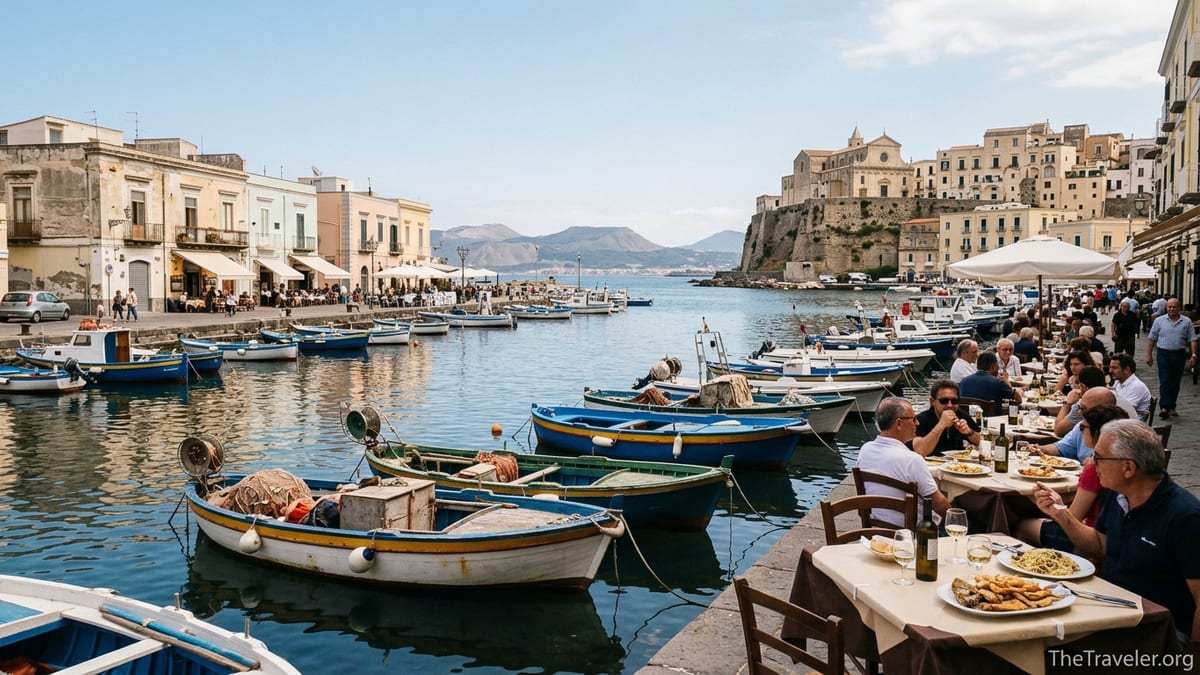
For food lovers, Pozzuoli’s biggest argument as a day trip is its tight concentration of seafood restaurants right on the water. The fishing boats that line the harbor in the morning still supply many of the trattorie you will eat in at lunch. Menus feel refreshingly local and change with the catch, though of course you will see Neapolitan stalwarts like spaghetti alle vongole, impepata di cozze and mixed fried seafood platters everywhere.
A typical lunch in one of the family-run trattorie along the port might start with a plate of crudo, raw marinated fish and shellfish, or a simple antipasto of marinated anchovies, octopus salad and local mozzarella. For a main, many visitors gravitate to linguine with clams or scialatielli ai frutti di mare, fresh pasta tangled with mussels, clams and shrimp. Expect to pay around 12 to 18 euros for a generous pasta dish and roughly the same for grilled fish, depending on weight and species. House wine is usually inexpensive and poured freely, with a half liter carafe often costing less than a single glass in more polished city restaurants.
Among the better-known options near the waterfront are informal, mid-priced trattorie that emphasize freshness over formality. One long-established family restaurant near the port, for example, is praised in recent reviews for its carbonara di mare, a seafood riff on the Roman classic, and its huge plates of fried local fish served on paper. Places like this are busy on weekends with Neapolitans who drive out just to eat, which is always a promising sign for travelers hunting for the real thing rather than a tourist menu.
There is good eating away from the port too. Around Piazza della Repubblica and the streets leading up towards the amphitheater, you will find bars serving thick, creamy espresso, bakeries turning out still-warm sfogliatelle and local spots that offer lunchtime menus of the day. Prices here are often a touch lower than in central Naples, and the pace more relaxed. If your idea of a perfect day trip is seeing a major archaeological site in the morning and then lingering over a table groaning with seafood, Pozzuoli delivers on that fantasy with ease.
Planning the Perfect Pozzuoli Day: Sample Itineraries
For most visitors focused on history and food, a single day in Pozzuoli feels well balanced rather than rushed. A realistic itinerary might begin with a mid-morning train from Naples, arriving in Pozzuoli around 10:00. From the station, walk first to the Flavian Amphitheater to enjoy the relative quiet before tour groups arrive. Allow at least 60 to 90 minutes to explore the upper levels and the dramatic underground passages, especially if you like to stop for photographs or to read interpretive panels.
From there, it is an easy stroll down through the town towards the port, stopping for a quick coffee or a pastry in one of the bars along the way. At the waterfront, detour to the Temple of Serapis to grasp the scale of the Roman marketplace and the traces of volcanic uplift and subsidence on the columns. This does not take long but adds a powerful context to what you saw in the amphitheater.
By now it is probably time for lunch. Choose a trattoria facing the harbor or on one of the side streets just behind it and settle in for a seafood-heavy meal. Many restaurants serve lunch straight through from roughly 12:30 to 3:00, but peak local dining time is around 1:30 to 2:00, so arriving a little before that improves your chances of getting a sea-view table without a reservation, especially on weekdays. After lunch, climb up to Rione Terra for a guided visit if you have one booked, or simply wander its lanes and viewpoints.
If you are especially interested in the volcanic side of Pozzuoli, you might instead use the afternoon to explore the Solfatara area or, time and energy permitting, hop a bus or taxi to nearby Baiae for its extraordinary terraced thermal baths. Travelers with limited energy can just as happily spend the afternoon strolling the seafront promenade, grabbing a gelato and watching the ferries and fishing boats come and go before riding the train back to Naples before dinner.
Is Pozzuoli Worth It Compared With Pompeii or Herculaneum?
Many travelers planning a first trip to Naples worry about whether Pozzuoli is “worth it” when the region already offers heavyweight sites like Pompeii, Herculaneum and Paestum. The answer depends on your interests and how long you have. If you are in the area for only two or three days, Pompeii and at least one of Herculaneum or the Archaeological Museum in Naples will rightly take priority. Those sites are globally unique and more extensive than anything in Pozzuoli.
However, if you have four or more days in the city or are a repeat visitor, Pozzuoli starts to look very compelling. Where Pompeii can feel like an all-day, energy-draining undertaking, Pozzuoli is human-scale. The Flavian Amphitheater, Temple of Serapis and Rione Terra can be comfortably visited in half a day, leaving generous time for long lunches and unfussy exploration. You still get major Roman architecture and an understanding of how a port town functioned, but without the pressure to tick off a vast list of structures.
For food-focused travelers, Pozzuoli arguably offers an edge even over many parts of Naples, because its restaurant scene remains so tightly linked to the local catch and weekend dining habits of Neapolitans themselves. If you love the idea of a working harbor with seafood restaurants steps from the boats, it is hard to replicate that vibe within Naples proper, where the waterfront is more dominated by ferries and car traffic than low-key trattorie.
There is also the novelty factor of the Campi Flegrei region itself, a lesser-known volcanic landscape compared with Vesuvius but geologically fascinating and still considered active. Even a cursory visit to Pozzuoli gives you glimpses of fumaroles in the distance, steaming hillsides and signage indicating evacuation routes, reminders that you are standing inside the caldera of a supervolcano. For some visitors, that alone makes the detour memorable.
The Takeaway
As a day trip from Naples, Pozzuoli sits in a sweet spot. It is close enough to feel easy and low-stress, yet distinct enough in atmosphere, history and cuisine to justify a full day on your itinerary. The combination of the Flavian Amphitheater, the haunting Temple of Serapis and the layered streets of Rione Terra give history lovers plenty to chew on without the fatigue of tackling a colossal site.
For food lovers, the picture is even clearer. A lunch overlooking the harbor, built around whatever came off the boats that morning, can hold its own against many better-known gastronomic experiences in Campania, often at friendlier prices. When you can move from exploring Roman underground corridors to twirling fresh seafood pasta within a few blocks, you know you have found a destination made for curiosity and appetite.
If your time in Naples is extremely tight, you may rightly stick to the marquee names. But if you have a spare day and an interest in Roman architecture, volcanic landscapes and honest, unfussy seafood, Pozzuoli is more than just a good day trip. It is a compact lesson in how history, geology and daily life continue to intersect around the Bay of Naples, best appreciated one archway and one plate of clams at a time.
FAQ
Q1. How long does it take to get from Naples to Pozzuoli by train?
From central Naples, the Metro Line 2 or regional trains typically take around 35 to 45 minutes to reach Pozzuoli, depending on the specific service and time of day.
Q2. Is one day enough to see the main sights in Pozzuoli?
Yes. In a single day you can comfortably visit the Flavian Amphitheater, the Temple of Serapis and Rione Terra, and still have time for a relaxed lunch by the harbor.
Q3. Do I need to book tickets to the Flavian Amphitheater in advance?
For most periods, you can simply buy tickets on arrival, as the site is rarely overcrowded. During peak summer weekends or holidays, checking for updated guidance and potential reservations before your trip is sensible.
Q4. Is Pozzuoli a good option if I have already seen Pompeii and Herculaneum?
Absolutely. Pozzuoli offers a more compact, less crowded look at Roman urban life, with atmospheric underground corridors and a working harbor that give it a different character from the larger ruins.
Q5. Are the main attractions in Pozzuoli within walking distance of each other?
Yes. The train station, Flavian Amphitheater, Temple of Serapis, Rione Terra and the harbor area are all within a roughly 15-minute walking radius, though some streets are sloped and paved with uneven stone.
Q6. What kind of food is Pozzuoli best known for?
Pozzuoli is especially known for seafood: dishes like spaghetti alle vongole, fried mixed fish, grilled local catch, octopus salad and other preparations that reflect the town’s active fishing fleet.
Q7. Is Pozzuoli suitable for travelers with mobility issues?
The town center and harbor are relatively compact, but there are hills, cobblestones and steps, especially in Rione Terra and inside the amphitheater. Travelers with limited mobility may need to prioritize flatter areas and check current accessibility information in advance.
Q8. Can I combine Pozzuoli with Baiae or Cuma in the same day?
It is possible but can feel rushed. Many visitors who want a deeper experience dedicate one full day to Pozzuoli and use a separate half or full day for Baiae, Cuma or other Campi Flegrei sites.
Q9. Is Pozzuoli safe for tourists?
Like most towns around the Bay of Naples, Pozzuoli is generally safe in the central and waterfront areas frequented by visitors. Normal city precautions apply, such as keeping an eye on bags in crowded spots and avoiding poorly lit backstreets late at night.
Q10. When is the best time of year to visit Pozzuoli?
Spring and early autumn are ideal, with milder temperatures for exploring outdoor sites and comfortable conditions for long seaside lunches. High summer can be very hot in the middle of the day, especially inside the stone amphitheater.