


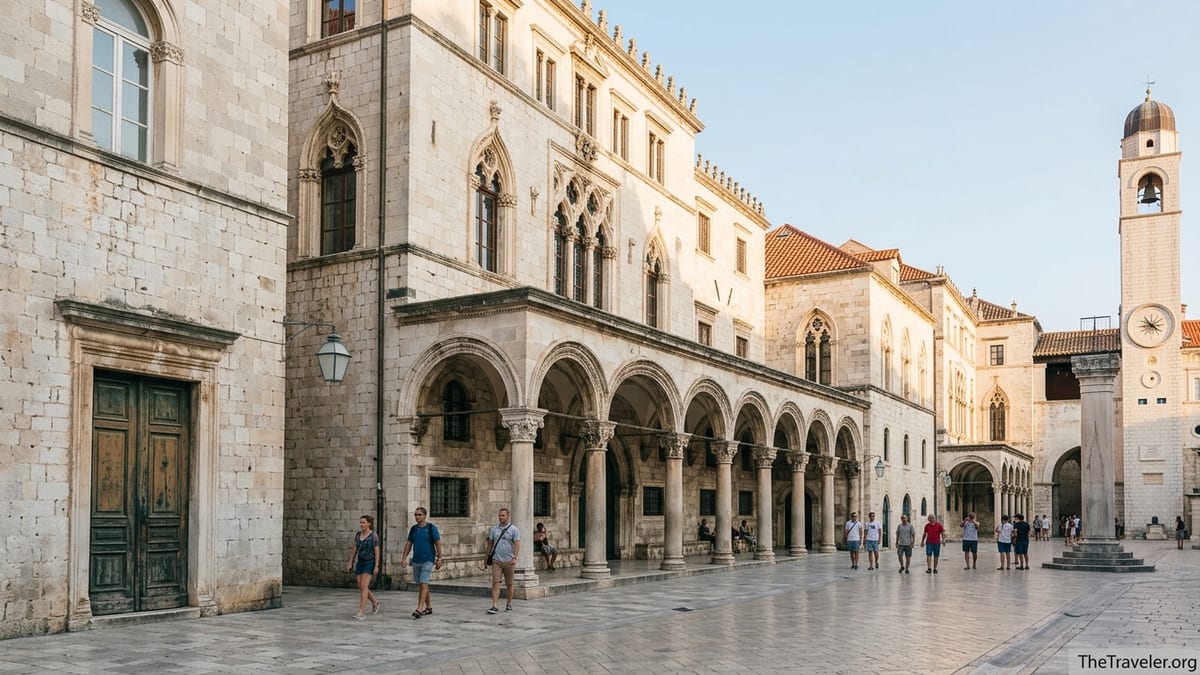
Walk the length of Dubrovnik’s main street, Stradun, and you will almost inevitably end up in front of Sponza Palace. Its arcaded façade, carved stone columns and elegant loggia make it one of the most photogenic corners of the Old Town. Yet many visitors pause for a quick snapshot and move on without stepping inside. If you are planning a self-guided walk through Dubrovnik’s Old Town, it is worth asking whether Sponza Palace deserves a proper stop on your route or just a glance as you pass.
Get the latest updates straight to your inbox!
Where Sponza Palace Fits Into Your Old Town Route
Sponza Palace sits at the eastern end of Stradun on Luža Square, directly opposite Orlando’s Column and a few steps from the bell tower and St Blaise Church. In practical terms, that means you will pass it several times during any Old Town wander: when you head to the city walls entrance by Ploče Gate, when you cross the square on the way to the Rector’s Palace, or when you join a walking tour. You do not need to make a special detour to see it. It is already on the natural pedestrian axis of the Old Town.
Because of its location, Sponza works well as a short cultural pause between bigger-ticket sights. For example, many visitors start the day on the city walls as soon as they open, then descend near the Old Port, walk across Luža Square, step into Sponza for 15 to 20 minutes, and then continue to the Rector’s Palace and the cathedral. Others time a stop at Sponza in the late afternoon, when the square is bathed in softer light and the loggia offers welcome shade after hours on the stone streets.
Most guided Old Town tours point out Sponza Palace from the outside, explaining its history as a customs house and archive, but do not always include a proper interior visit. That is an argument for returning on your own later, especially if you are interested in architecture or Dubrovnik’s more recent wartime history. Since entrance is typically free or only a small fee depending on the season and exhibitions, you can drop in spontaneously without reorganizing your day or budget.
If your time in Dubrovnik is very short, Sponza still works as an efficient micro-stop. You can step off Stradun, walk through the quiet atrium, visit the small Memorial Room of the Defenders of Dubrovnik, and be back outside in under 20 minutes. For those who like to punctuate a city walk with short, meaningful interiors rather than long museum visits, Sponza is exactly that type of stop.
What You Actually See Inside Sponza Palace
From the outside, Sponza looks like a grand palace. Inside, it is more intimate. The building functions today as the State Archives of Dubrovnik, which means most of the upper floors are working spaces for archivists and researchers rather than museum galleries. For visitors, the focus is on the ground floor: the shaded portico looking onto Luža Square, the open atrium with its stone columns and carved capitals, and a handful of side rooms used for exhibitions and commemorations.
The highlight for many travelers is the Memorial Room of the Defenders of Dubrovnik just inside the entrance. Here, hundreds of black and white photographs line the walls, each one showing a local defender who died during the siege of Dubrovnik in the early 1990s. The room is small and simple but emotionally powerful. Stepping in from the bright atrium into the cool half-light, you move from postcard Dubrovnik to the city’s lived experience of war within seconds. Most visitors spend 5 to 10 minutes quietly reading names and dates, absorbing the human stories behind the Old Town’s immaculate stonework.
Architecturally, the atrium is where Sponza truly shines. Built between 1516 and 1522 in a blend of late Gothic and early Renaissance styles, it gives you a sense of what many Ragusan palaces looked like before the 1667 earthquake. The slender columns, ornate capitals, and decorative stone tracery invite close inspection. It is a pleasant place to pause, gaze up at the gallery level, and imagine merchants and officials negotiating trade deals here when the palace served as a customs house, mint, and treasury for the Republic of Ragusa.
Depending on when you visit, you may also encounter temporary exhibitions, small cultural events, or festival-related displays in the atrium or adjoining rooms. In summer, parts of the Dubrovnik Summer Festival use Sponza as a setting for concerts or theatrical performances. Even if there is nothing scheduled during your stay, you may see sound equipment, stage lighting, or chairs arranged in the courtyard, which hints at the building’s ongoing cultural role rather than leaving it as a frozen monument.
How Much Time to Allow and When to Go
For most visitors, 20 to 30 minutes is enough to see the accessible parts of Sponza Palace at a comfortable pace. That allows time to look around the atrium, read some of the inscriptions, step into the Memorial Room, and perhaps take a few photos without feeling rushed. If you are particularly drawn to architecture or history, you might stretch this to 40 minutes, especially if there is a temporary exhibition in place.
Opening hours can vary slightly by season and event schedule, but the palace and Memorial Room generally follow daytime hours that are extended in summer. In practice, if you stop by between mid-morning and early evening in high season, you are likely to find the doors open. In winter, mornings and early afternoon are typically safer. If you are planning a very tight schedule, check locally at the Dubrovnik Tourist Board office on arrival for the current week’s opening times, as staff can confirm exact hours and any closures.
Timing your visit in relation to the wider Old Town rhythm can improve the experience. Luža Square is quieter early in the morning before cruise groups reach full strength, which makes the palace and Memorial Room more contemplative. Late afternoon and early evening, when the sun is lower and the stones are cooler, is another pleasant window. Midday, particularly in July and August, the square can be crowded and hot, and you may prefer to save interiors like Sponza for breaks from the sun.
If you are in Dubrovnik for only one day, a simple strategy is to visit Sponza directly after walking the city walls. Most wall routes exit near the Old Port or Ploče Gate; from there, it is a short stroll back along Stradun to Luža Square. The contrast between seeing Dubrovnik from above, then stepping into a serene courtyard that survived both earthquake and war, helps you connect the panoramic views with the stories of the people who have lived and defended this city.
Costs, Tickets, and the Dubrovnik Pass
One practical advantage of Sponza Palace is that it will not significantly dent your travel budget. Entrance to the ground floor spaces and the Memorial Room is often free, or occasionally subject to a small fee when specific exhibitions are hosted. Policies can change with new programming, so it is sensible to confirm current practice with the tourist office or onsite signage when you arrive. Visitors frequently remark that even when there is a modest charge, the experience represents good value compared with larger museums.
If you are using the Dubrovnik Pass, which combines entry to the city walls with a group of museums and public transport, Sponza Palace is sometimes bundled into the set of included or discounted cultural sites, particularly if there is an official exhibition running in the atrium. Because the city periodically updates which venues are listed, check the latest leaflet or app rather than relying on older guidebooks. In any case, even if Sponza is not explicitly included, your main cost here is your time rather than your wallet.
For context, the city walls ticket is one of the most significant single expenses in Dubrovnik, while flagship museums such as the Rector’s Palace charge moderate standalone entry fees. Seen against that background, Sponza is a low-cost complement to these marquee attractions rather than a competing investment. Travelers trying to manage a tight budget can comfortably add it to their day without having to sacrifice a meal or another paid sight.
Do keep a little flexibility in mind around special events. During festivals, commemorations, or official ceremonies, parts of the atrium may be closed or reserved for ticketed performances. If that happens, you can always return later in the day or on another morning. Because Sponza is centrally located, weaving it into your route at a different moment is straightforward.
Who Will Find Sponza Palace Most Rewarding
Whether Sponza Palace is “worth it” for you depends on what you value when you travel. If you are primarily interested in panoramic views and highly visual experiences, the city walls, Mount Srđ cable car, and boat trips to Lokrum Island will understandably loom larger on your list. Sponza is more about atmosphere, reflection, and historical texture than about big visual drama.
Travelers with an interest in history, especially the history of trade and diplomacy, will appreciate how the building encapsulates Dubrovnik’s former role as a maritime republic. Knowing that this elegant courtyard once handled customs duties, stored valuable cargoes, issued coins, and held state funds gives weight to the carved stonework. You can almost imagine caravans arriving from the Balkans and ships docking in the harbor while officials in this very palace calculated taxes and inspected goods.
Visitors who want to understand Dubrovnik’s recent past will find the Memorial Room indispensable. Many people arrive in the Old Town with a hazy notion that the city was shelled in the 1990s, but leave with a more personal sense of loss after seeing the faces and ages of the defenders on the walls here. It can be especially meaningful for travelers from countries that were not directly involved in the conflict and may have only encountered it in brief television images decades ago.
Sponza also suits those who like quieter, less crowded corners of the Old Town. While Luža Square can be busy, the palace interior often feels remarkably calm compared with, for example, the bottlenecks on the city walls or in front of the cathedral treasury. Solo travelers and couples on self-guided walks often mention appreciating ten minutes of silence here to recharge before diving back into the narrow streets, particularly during peak summer days.
Photography, Atmosphere, and Practical Tips
For photographers, Sponza Palace is a rewarding subject. The façade on Luža Square makes a strong wide-angle shot, especially in early morning when the light skims across the columns and picks out the carved details. Stepping into the portico, you can frame the clock tower, Orlando’s Column, and passing pedestrians through the arches for classic Old Town compositions. Inside the atrium, the interplay of light and shadow on the limestone, along with the repeating columns and upper gallery, creates natural leading lines.
Respectful discretion is important inside the Memorial Room. Many visitors choose not to take photos here at all, instead treating it as a place of remembrance rather than an attraction. If you do decide to photograph, avoid flash, keep your camera or phone unobtrusive, and be mindful of others who may be paying respects. There is no strict dress code, but modest clothing feels appropriate given the nature of the room.
Temperature and acoustics are another subtle advantage of Sponza as a mid-walk stop. Dubrovnik’s stone streets reflect heat in summer, and air-conditioned interiors can be scarce. The thick walls and shaded courtyard of Sponza offer a cool, naturally ventilated refuge. The sound of the crowds outside still filters in, but it is muted, creating the sense of being in a pocket of calm just meters from one of the Old Town’s busiest squares.
In practical terms, you will not find extensive visitor facilities here. There is no large café or shop inside the palace, although cultural events sometimes bring in temporary kiosks or stands. Restrooms are limited and not always accessible for general visitors, so plan to use facilities at other museums, nearby cafés, or the tourist information center. That said, the lack of commercial clutter inside Sponza helps maintain its quiet, historical character.
The Takeaway
If your image of Dubrovnik is all views from the walls and crowded café terraces, Sponza Palace offers a corrective in the best possible way. It invites you into a space that is both architecturally refined and emotionally grounded in the city’s lived history. You step through a Renaissance courtyard that survived a devastating 17th century earthquake, then into a simple room that bears witness to a late 20th century war. Few stops on an Old Town walk connect such distant layers of time in such a compact space.
For visitors who rush from one headline sight to another, Sponza might seem skippable at first glance. Yet its combination of free or low-cost access, central location, and powerful Memorial Room means it delivers a high return on a modest investment of time. Twenty thoughtful minutes here can deepen your understanding of everything else you see in Dubrovnik, from the restored roofs visible on the walls to the scars still faintly visible on some façades.
In the end, whether Sponza Palace is “worth visiting” during your Old Town walk comes down to how you define value. If you are content with exterior snapshots and a checklist of famous landmarks, a brief look at the façade might suffice. But if you travel to feel the weight of a place, not just to see it, then stepping inside Sponza is absolutely worthwhile. Treat it as a pause for reflection in the middle of your circuit around the Old Town, and it may become one of the visits you remember most clearly once you are back home.
FAQ
Q1. Where exactly is Sponza Palace within Dubrovnik’s Old Town?
Sponza Palace stands at the eastern end of Stradun on Luža Square, opposite Orlando’s Column and near the city bell tower and St Blaise Church. You will naturally pass it when walking between the Old Port, the main street, and the Rector’s Palace.
Q2. How much time should I plan for a visit to Sponza Palace?
Most visitors spend 20 to 30 minutes inside. That is enough to see the atrium, read some of the inscriptions, and visit the Memorial Room of the Defenders of Dubrovnik without feeling rushed.
Q3. Is there an entrance fee for Sponza Palace?
Access to the ground floor spaces and Memorial Room is often free, though small charges may apply during specific exhibitions or events. Because policies can change, check the latest information locally at the tourist office or at the entrance when you arrive.
Q4. Is Sponza Palace included in the Dubrovnik Pass?
Sponza is occasionally included or associated with exhibitions covered by the Dubrovnik Pass, but the exact list of venues is updated periodically. For the most accurate answer during your visit, refer to the current Dubrovnik Pass leaflet or app, or ask at the official tourist information center.
Q5. What are the typical opening hours of Sponza Palace?
Opening hours vary by season, with longer daytime hours in summer and shorter ones in winter. As a rule of thumb, visiting between mid-morning and early evening in high season, or in the morning and early afternoon in winter, works well. Confirm current hours locally, especially around holidays or festival events.
Q6. Is Sponza Palace suitable for children?
Children interested in castles and old buildings often enjoy the courtyard and columns, but the Memorial Room is a solemn space that may be emotionally intense. Parents might choose to briefly explain the room’s purpose in age-appropriate terms or skip it with younger children, focusing instead on the architecture and the lively square outside.
Q7. Can I take photos inside Sponza Palace?
You may usually photograph the exterior and atrium for personal use, and these areas are popular for travel photos. In the Memorial Room, visitors are encouraged to be discreet and respectful; many choose not to take photos there at all, treating it as a place of remembrance rather than a photo stop.
Q8. Is Sponza Palace accessible for travelers with limited mobility?
The entrance and ground floor atrium involve only a small threshold, and once inside the surfaces are mostly flat stone, though slightly uneven in places. Upper floors used by the archives are not normally part of a public visit. Travelers who use wheelchairs or have mobility concerns should find the main courtyard relatively manageable but may wish to have assistance on crowded days.
Q9. Do I need to book a guided tour to visit Sponza Palace?
No reservation is required for a typical visit. You can simply walk in during opening hours. Many walking tours include commentary about Sponza from the square but do not always go inside, so if you want to explore the interior it is easy to return independently later.
Q10. Is Sponza Palace worth visiting if I am only in Dubrovnik for one day?
Yes, if you can spare around 20 minutes. Its central location means you can combine it with a city walls walk and a quick circuit of the main sights without losing much time. The brief but powerful Memorial Room and the elegant courtyard add depth to a short Old Town visit.