


Most visitors meet Sponza Palace in Dubrovnik the same way: a quick snap of its graceful arcades at the end of Stradun before moving on to the next sight. Yet this 16th century palace, one of the few to survive the 1667 earthquake intact, contains some of the city’s deepest layers of memory, trade and culture. With a bit of planning, you can turn a two minute photo stop into one of the most meaningful hours of your stay in Dubrovnik.
Get the latest updates straight to your inbox!
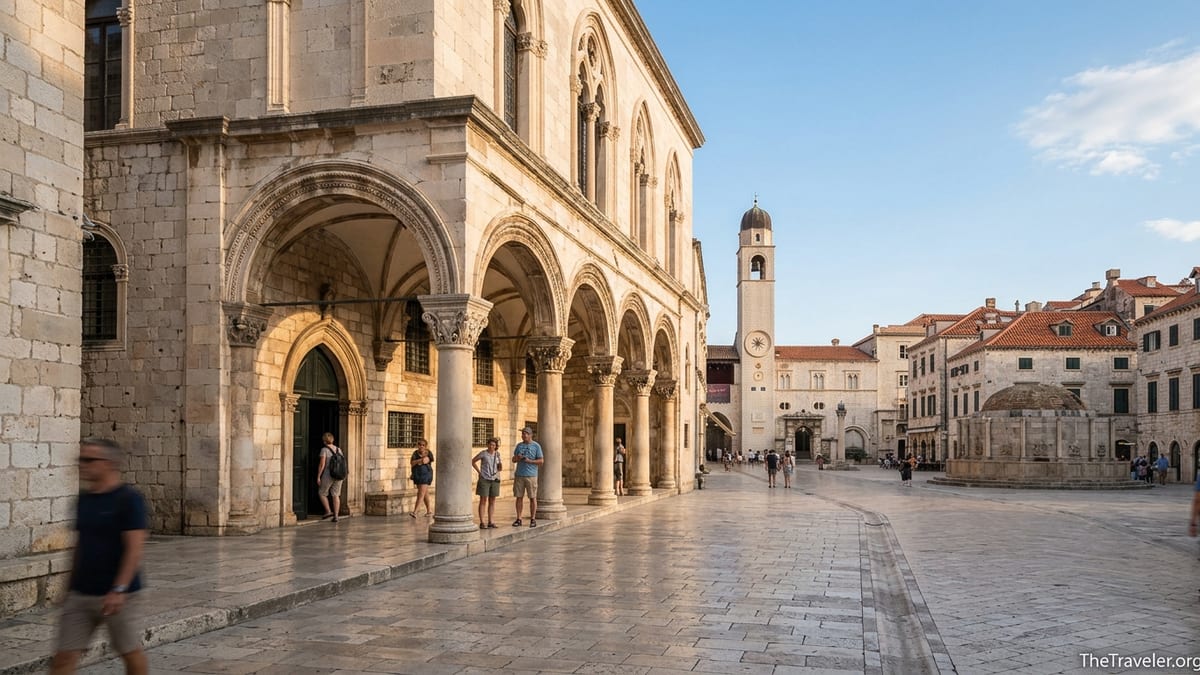
Understanding Sponza Palace Before You Step Inside
Standing at the eastern end of Stradun beside Luža Square and the city bell tower, Sponza Palace once sat at the commercial heart of the Republic of Ragusa. Built between about 1516 and 1522 as a customs house and warehouse, it later served as a mint, treasury and even a small bank, handling the paperwork and money that flowed in from Ragusan ships trading across the Mediterranean. The building’s nickname, Divona, comes from the Italian word for customs, reflecting that original role.
The palace’s architecture mixes late Gothic tracery with clean Renaissance lines. When you look at the façade, notice the carved stone columns, the arcaded loggia at street level and the tall windows above that once lit offices of scribes and customs clerks. An inscription in Latin still visible inside refers to the old set of scales used here and declares that cheating is forbidden because God weighs the goods together with the merchant, a vivid reminder that this was a place where contracts, trust and faith overlapped.
Today, Sponza houses the State Archives of Dubrovnik, with tens of thousands of volumes and documents, some dating back to the 12th century. Most of these are not on open display, but simply knowing that shipping logs, diplomatic letters and notarial contracts relating to Venice, Istanbul and distant Black Sea ports are stored in the rooms above adds weight to a visit. You are not just walking into a pretty courtyard, but into the nerve center of a vanished maritime republic.
Because of its beauty and acoustics, the palace now also functions as a cultural venue. During the annual Dubrovnik Summer Festival, its atrium and the square outside host chamber concerts, exhibitions and opening events, which means that depending on when you visit you may find Sponza quiet and contemplative or buzzing with sound checks and festival staff.
Planning a Visit That Goes Beyond the Facade
To turn Sponza into an experience rather than a backdrop, begin by planning your timing. The Memorial Room of the Dubrovnik Defenders, just inside the entrance, typically keeps similar hours to other Old Town museums, opening in the morning and closing in the late afternoon or early evening. Exact hours can shift between summer and winter, so check at the Dubrovnik Tourist Board office near Pile Gate or ask your accommodation host the day before you go. Aim to arrive early in the day, around 9 or 10 a.m., before cruise groups build up along Stradun.
Entry policies have changed over the years. In recent seasons the Memorial Room itself has often been free to enter, while special exhibitions or festival events in the atrium sometimes require a separate ticket. Prices for those events vary widely; a chamber concert as part of the Dubrovnik Summer Festival might cost in the range of 20 to 40 euros per person depending on the program and seating. If you hold a Dubrovnik Pass, ask whether any current exhibition in Sponza is included, as the pass frequently covers several city museums and can reduce your overall costs if you are exploring over a couple of days.
Dress with respect in mind as well as comfort. The Old Town’s polished limestone gets hot under the midday sun, but the Memorial Room is a place of mourning for the recent war. Shoulders covered and a quiet demeanor feel appropriate here. The interior is cool even in summer, so carrying a light layer can also make a longer, slower visit more comfortable, especially if you plan to linger over displays or sit briefly on a bench in the atrium.
If you are traveling in the peak season of July and August, consider combining Sponza with an early or late walk around the city walls. For example, you might start on the walls at opening time, finish by late morning, then step down into Luža Square while still avoiding the hottest hours. From there you can slip into the shaded loggia of Sponza and allow your day’s pace to slow dramatically.
Experiencing the Memorial Room of the Dubrovnik Defenders
The most powerful reason to go beyond a photo stop is the Memorial Room of the Dubrovnik Defenders. Step through the main door of Sponza and you will find this modest chamber on the side before you reach the central cloister. The space is small, but the effect is immediate. The white walls are lined, almost floor to ceiling, with black-and-white portraits of the men and women who died defending Dubrovnik during the Homeland War of the early 1990s.
Many visitors expecting another historical display are surprised to see modern faces staring back: young conscripts in uniform, middle-aged volunteers in civilian clothes, men in their twenties with the same haircuts and expressions you might notice on the streets outside today. Underneath each photograph is a name and the year of birth and death. In the center of the room, display cases usually contain shell fragments, damaged street signs and maps documenting artillery strikes on the Old Town. Simple captions explain that the UNESCO-protected city was shelled despite clear markings, and that several buildings in the surrounding streets were hit or burned.
This is not a place for phone calls or loud conversation. Guards or attendants rarely need to enforce silence because the tone of the room does it for them. Plan to spend at least 15 to 20 minutes here. Read a few of the names, look for the dates, and locate on the map where the shells fell relative to the streets you have already walked. If you have kids or teens with you, talk with them in advance about what they will see so they are prepared for the emotional weight, then be available to answer their questions afterwards on a nearby bench in Luža Square.
Photography rules vary, but it is generally considered respectful not to photograph the portraits or to share images from inside the Memorial Room on social media. Even if you see others taking pictures, you might choose to experience the space directly and carry it with you in memory rather than pixels. When you step back out into the light of the atrium, the contrast between quiet grief and lively tourism can be jarring and thought provoking in equal measure.
Reading the Courtyard Like a Living History Book
Once you have visited the Memorial Room, let yourself linger in Sponza’s central atrium. Many visitors breeze through in under a minute, but if you stay longer the architecture begins to tell its own story. The cloister arcades on the ground floor, with their slightly pointed arches and carved capitals, show the late Gothic style popular in the early 1500s, while the cleaner lines and symmetry of the upper loggias reflect Renaissance ideals. Taking a few slow circuits of the courtyard allows you to compare arches, columns and decorative details from different angles.
Look up at the stone coats of arms and inscriptions on the walls. Some belong to noble families who held key offices in the Republic of Ragusa, others mark important dates or renovations. On a quieter day you may hear your footsteps echo off the flagstones. Imagine the same sound in the 16th century as merchants, notaries and port officials crossed this space carrying ledgers and sealed letters arriving from ports across the Adriatic and beyond.
The atrium’s proportions and hard stone surfaces create superb acoustics, which is why it is regularly chosen as a venue for classical music performances during the Dubrovnik Summer Festival. If you happen to attend a string quartet concert here in July, you will notice that the notes seem to hang in the air above the courtyard and that even a whisper from the upper loggia carries. Visualising the space as a concert hall during the day can make you more attuned to its shape and volume, even when no music is playing.
Try sitting for five or ten minutes along one of the side walls instead of immediately heading back to Stradun. Watch how sunlight moves across the columns, or how a brief rain shower darkens the stone. You may see a civil servant from the archives walking briskly through with a file, a reminder that this is still a working building and not a frozen museum piece.
Connecting Sponza to the Wider Life of the City
Experiencing Sponza fully also means seeing how it connects to the rest of Dubrovnik’s urban stage. Step back out to Luža Square and you will find yourself at one of the city’s main crossroads. To your right stand the baroque Church of St Blaise and the Orlando Column; ahead is the clock tower and the small loggia where town criers once read out decrees, many of them drafted or recorded in the offices inside Sponza. The square in front of the palace is still used today for major public events.
If you visit in mid July, you may witness the opening ceremony of the Dubrovnik Summer Festival unfolding in front of the palace façade. Actors in historical costumes, festival officials and musicians gather here, with the arcades of Sponza serving as a backdrop for speeches, fanfares and processions that move off through the Old Town. On another evening in August, you might attend a photography exhibition inside the atrium, with images documenting previous decades of the festival or contemporary Croatian art. Checking the current festival calendar before your trip can help you align your visit with a specific event.
Sponza also interacts with newer cultural happenings. Light and sound installations have occasionally transformed the palace and the space in front into temporary artworks, especially during local festivals of light in shoulder seasons. If you come to Dubrovnik in autumn, ask at the tourist office whether any projections or audiovisual events are scheduled around Sponza during your stay. Experiencing the building illuminated at night, accompanied by electronic soundscapes, offers a very different perspective from the daytime crowds of selfie-takers.
Outside the big festivals, Sponza sometimes hosts smaller chamber recitals, poetry readings or official receptions. While many of these are local events, posters near the entrance or at the festival box office can alert you to public performances. Buying a reasonably priced ticket not only supports the city’s cultural life but lets you inhabit the palace more like a 21st century Ragusan than a rushed tourist.
Adding Depth with Archives, Guides and Special Access
For travelers with a strong interest in history, it is possible to go beyond the standard ground floor visit by engaging with the State Archives and local experts. The archive itself is primarily a working institution, but it occasionally organizes small exhibitions of early maps, trade documents or diplomatic correspondence in the atrium or adjoining rooms. If you see temporary panels or glass cases set up in the courtyard, take the time to read the English summaries; they can reveal trade routes, plague regulations or shipbuilding contracts that bring Ragusa’s golden age to life.
Serious researchers and academics can request supervised access to specific documents, usually by arranging an appointment in advance and explaining their project. This is beyond the scope of an average holiday visit, but if you are, for example, tracing family roots along the Adriatic, it may be worth contacting the archive months ahead of your trip to ask what might be possible. Even for non-specialists, simply knowing that shipping manifests and notarial acts from the 1400s are stored upstairs helps frame Sponza as a living archive rather than a decorative shell.
Hiring a licensed local guide for a focused one or two hour Old Town tour that includes Sponza can also add depth. Guides who grew up in Dubrovnik often weave personal or family memories of the 1990s siege into their explanations in the Memorial Room, and some specialize in the economic history of the Republic of Ragusa, explaining how customs duties collected in Sponza funded public works and diplomacy. Expect to pay a bit more for a private guide than for a standard group tour, but the nuance you gain, especially if you are traveling as a couple or family, often justifies the expense.
Another way to experience Sponza differently is to attend a wedding or private event there, which many international couples now arrange through local planners. While this is not something most travelers will organize on a whim, it is useful context: when you see chairs, floral arrangements or audio equipment being set up in the courtyard during the day, you are witnessing how the city continues to use this historical space as a ceremonial heart, just as it did in centuries past.
The Takeaway
Sponza Palace rewards the traveler who slows down. What looks from Stradun like another elegant Renaissance arcade turns out, on closer inspection, to be a palimpsest of Dubrovnik’s commercial success, wartime suffering and ongoing cultural life. By stepping inside, pausing in the Memorial Room of the Dubrovnik Defenders and spending unhurried time in the atrium, you trade a single quick photograph for a layered understanding of the city.
The practical steps are simple: plan your visit for a quieter time of day, allow at least 30 to 60 minutes rather than five, approach the Memorial Room with respect, and look for opportunities to experience Sponza as a performance or exhibition space in the evenings. Whether you are in Dubrovnik for one day or a full week, this small investment of time will likely become one of your most vivid memories of the Old Town.
When you leave Sponza and step back into the noise of Luža Square, glance once more at the palace’s façade. You will no longer see just a backdrop for photos. Instead, you will recognize a building that has quietly held Dubrovnik’s stories for five centuries and continues to anchor the city’s identity today.
FAQ
Q1. Where is Sponza Palace located in Dubrovnik?
Sponza Palace stands at the eastern end of Stradun, beside Luža Square and the city bell tower, right in the heart of Dubrovnik’s Old Town.
Q2. Do I need a ticket to visit Sponza Palace and the Memorial Room?
The Memorial Room of the Dubrovnik Defenders is often free to enter, while special exhibitions or festival events in the atrium may require separate tickets with varied prices.
Q3. How much time should I plan for a meaningful visit?
Plan at least 30 to 60 minutes to visit the Memorial Room, walk the atrium slowly, read inscriptions and, if available, browse any temporary exhibits.
Q4. Are photos allowed inside the Memorial Room of the Dubrovnik Defenders?
Rules can change, but even when photography is not explicitly forbidden, it is generally considered more respectful to avoid photographing the portraits and displays.
Q5. Can I visit the State Archives inside Sponza Palace?
The State Archives primarily serve researchers, but they occasionally mount small public exhibitions in the atrium; full access to archival materials usually requires prior arrangement.
Q6. Is Sponza Palace accessible for visitors with limited mobility?
The ground floor and Memorial Room are relatively level, but historic thresholds and uneven stone may pose challenges; the upper levels of the archive are typically not open to casual visitors.
Q7. What is the best time of day to visit Sponza Palace?
Morning visits, around 9 or 10 a.m., tend to be quieter and cooler, making it easier to experience the Memorial Room and atrium without large tour groups.
Q8. Does Sponza Palace host events during the Dubrovnik Summer Festival?
Yes. During the festival, the atrium and the square outside frequently host concerts, exhibitions and parts of the opening ceremonies, often requiring advance ticket purchase.
Q9. How should I dress for a visit to Sponza Palace?
There is no strict dress code, but modest, comfortable clothing that covers shoulders is recommended, particularly out of respect for the Memorial Room’s commemorative nature.
Q10. Can children visit Sponza Palace and the Memorial Room?
Children are welcome, but the Memorial Room’s subject matter is emotional, so it helps to prepare younger visitors beforehand and discuss what they see in a gentle, age-appropriate way.