


Walk a few hundred meters through Dubrovnik’s Old Town and you pass two of Croatia’s most atmospheric landmarks: Sponza Palace on Luža Square and the former seat of the Republic, Rector’s Palace, tucked just behind the cathedral. Both are beautiful, historic and photogenic, yet they offer very different experiences for travelers. If you only have time or budget for one, the choice matters. Here is a clear, on-the-ground comparison to help you decide which historic palace is better for your style of trip.
Get the latest updates straight to your inbox!
Setting the Scene: Two Palaces, One Compact Old Town
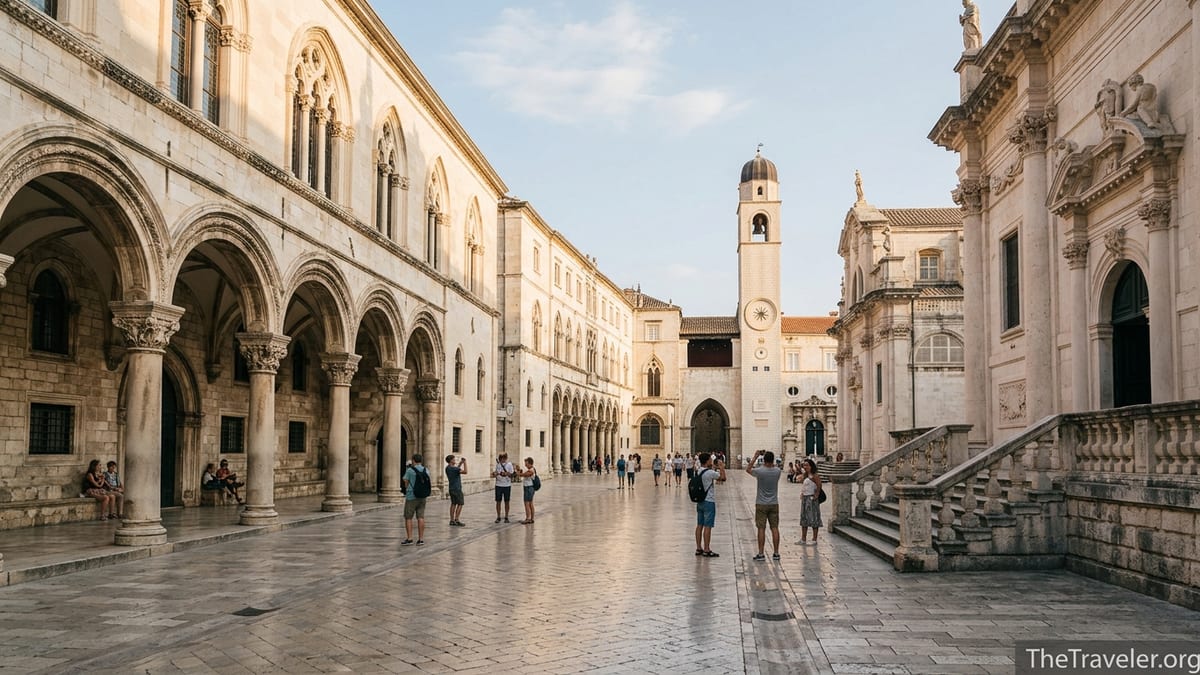
Sponza Palace and Rector’s Palace sit within a five‑minute walk of each other in Dubrovnik’s pedestrian Old Town. Sponza stands at the eastern end of the limestone-paved Stradun, right on Luža Square beside the clock tower and Church of St Blaise, so you almost cannot avoid walking past it on your first stroll through the city. Rector’s Palace lies a short way south, behind the cathedral, on a quieter side square that feels more enclosed and contemplative.
Because Sponza Palace fronts the main artery of the Old Town, it tends to be part of the background of everyday sightseeing. You see its elegant arcades as you watch street musicians, join a Game of Thrones walking tour, or duck into nearby cafes for a quick espresso. Rector’s Palace, by contrast, feels more like a deliberate destination. You step off the main flow of visitors, cross a small square, and enter a world that is closer to a traditional museum, complete with ticket desk, security staff and interpretive displays.
In practical terms, this means many travelers experience Sponza almost by accident, peeking into the atrium between other stops, while a visit to Rector’s Palace is more often planned as a one-to-two-hour deep dive into local history. For time-pressed visitors trying to fit the city walls, a cable car ride and a sea-kayaking tour into a single day, this distinction is important when choosing where to spend your energy.
Both palaces are open most of the year, with extended hours in high season. Sponza’s atrium typically opens around 9 am and runs into the evening in summer, while Rector’s Palace generally operates on a museum schedule from about 9 am to 6 pm, closing earlier in winter months. Exact hours can vary by season and special events, so it is sensible to check the latest information at the Dubrovnik Tourist Board office on Brsalje Square or posted signs at the entrances when you arrive in town.
Architecture & Atmosphere: Gothic Grace vs Political Power
Sponza Palace is widely regarded as one of the finest surviving examples of Dubrovnik’s Gothic–Renaissance style. Built in the early 16th century as a customs house and commercial hub, it miraculously survived the devastating 1667 earthquake that destroyed much of the city, which is part of why architecture buffs regard it so highly. Its defining feature is the open arcaded courtyard, ringed by slender columns, with carved stone details and inscriptions that reward slow, close looking.
Rector’s Palace also mixes late-Gothic and Renaissance elements, but the feeling is more formal and institutional. This was the seat of the Rector, the elected head of the Republic of Ragusa, from the 14th century until 1808. The exterior combines arcades, a loggia and sculpted capitals, while inside the central atrium rises around a grand staircase. Where Sponza feels like a light, airy trading house, Rector’s Palace has the weight of government, with corridors, council chambers and offices that reflect centuries of political life.
In terms of atmosphere, Sponza is quieter and more contemplative for much of the day, especially in the shoulder season. You can slip in from the bustle of Luža Square to find a cool stone courtyard, often with only a handful of other visitors taking photos or reading the carved Latin mottos on the walls. It is a place to pause, listen to your footsteps on the flagstones, and imagine merchants negotiating cargo duties 500 years ago.
Rector’s Palace, by contrast, feels more like a curated experience. Period rooms are furnished with 18th‑century furniture, portraits of Ragusan nobles, religious paintings and civic artifacts. You move from the grand atrium to the council chamber, then down to the dungeons with their heavy doors and barred windows. In high season, groups move through with guides, and on some evenings the atrium hosts chamber music concerts, transforming the space into a performance venue. If you enjoy immersive historic interiors, Rector’s Palace offers more layers than Sponza.
Historical Significance: Archives vs Seat of the Republic
Both palaces played critical roles in the life of the maritime Republic of Ragusa, but in different ways. Sponza functioned primarily as a commercial and administrative hub. It housed customs offices, bonded warehouses, a mint and the office of weights and measures that kept trade honest. Today it is home to the Dubrovnik State Archives, which preserve centuries of notarial and governmental records from the 13th century onward, though the reading rooms are generally reserved for researchers rather than casual sightseers.
Rector’s Palace, on the other hand, was the nerve center of political power. The Rector lived and worked here during his strictly limited one‑month term, a system designed to minimize corruption and ensure that no single noble dominated the republic. The council chamber, audience hall and private apartments all reflect a government that prized order, modesty and public service. Walking these rooms, you can still see the Latin inscription over the entrance reminding officials to put the public good above private interest.
For many visitors, the most emotionally charged part of Sponza today is the Memorial Room of the Defenders of Dubrovnik, a ground-floor space with photographs of local soldiers who were killed during the 1991–1992 siege. Entry is usually free or covered by a modest ticket in summer, and the room offers a sobering, contemporary layer of history that contrasts with the palace’s Renaissance elegance. Travelers often mention spending 15 to 20 quiet minutes here, especially on rainy afternoons when they are exploring Old Town museums.
At Rector’s Palace, the historical narrative is broader and more focused on the republic’s golden age. Exhibits from the Cultural History Museum include legal documents, coats of arms, ceremonial robes and portraits that explain how Ragusa operated as a shrewd trading city-state between Venice and the Ottoman Empire. If your main interest is understanding how Dubrovnik became wealthy and independent, Rector’s Palace offers a more comprehensive story than Sponza’s smaller displays.
Visitor Experience & Exhibits: Quick Stop or Half-Day Highlight?
A visit to Sponza Palace is typically short and focused. Most travelers spend around 15 to 30 minutes wandering the courtyard, examining the carved stonework and visiting the Memorial Room of the Defenders. The accessible areas are limited, since much of the building is occupied by the State Archives, and there is generally less interpretive signage than at larger museums. On the practical side, entry to the atrium is often free outside the main summer season, and in peak months you can expect to pay around 5 euros, with reduced rates for groups. Payment is usually taken at a small desk near the entrance.
Rector’s Palace is closer to a full museum experience. The Cultural History Museum inside usually takes 60 to 90 minutes to explore at a comfortable pace. You can walk through furnished salons with period furniture and tapestries, view paintings from Dubrovnik’s own art school, and descend to the stark stone dungeons that give a visceral sense of medieval justice. Audio guides and printed explanations are more common here than at Sponza, which helps independent travelers understand what they are seeing without joining a tour group.
Ticketing also differs. As of early 2026, an adult ticket purchased on site for Rector’s Palace alone is typically around 10 to 12 euros, while a broader museum ticket or inclusion in the Dubrovnik Pass can raise the face value to roughly 17 euros but add entries to several other city museums such as the Maritime Museum and Ethnographic Museum. Families often find that if they plan to visit the city walls plus at least one or two museums, the Dubrovnik Pass makes Rector’s Palace effectively better value per attraction.
Crowding patterns are another factor. Rector’s Palace sees the heaviest flow from mid-morning to mid-afternoon when cruise excursions are in town. Arriving around opening time or in the last hour before closing can mean quieter rooms and better photos, particularly in summer. Sponza’s small size means it can feel briefly busy when a walking tour stops in the courtyard, but the groups usually move on within 10 minutes, restoring the sense of calm. In the shoulder season of April, May, September and October, both palaces are generally pleasant to visit at almost any time of day.
Practicalities: Prices, Passes, Accessibility and Photography
From a budget perspective, Sponza Palace is the lighter commitment. Outside the peak season you may be able to enter the atrium at no charge, while in high summer the modest standalone ticket typically costs less than a cappuccino on the Stradun. Rector’s Palace, by comparison, is one of the pricier individual museum tickets in Dubrovnik, but when combined with access to other museums through a multi-museum ticket or the Dubrovnik Pass, the effective cost per site can drop notably.
Travelers focused on convenience often opt for the Dubrovnik Pass, particularly the one-day version that includes city walls entry, public bus transport and several museums. Rector’s Palace is reliably included in this pass, which means you can simply present your QR code at the entrance rather than buying a separate ticket. Sponza Palace is generally not included, so you should expect to pay its small fee separately in peak season if you want to go beyond the courtyard when charges apply.
In terms of accessibility, both palaces present the usual challenges of medieval architecture: uneven stone floors, steps and relatively narrow passages. Sponza’s ground-floor courtyard is relatively flat and open, so visitors with limited mobility may find it easier to access at least part of the space. Rector’s Palace has stairs to upper-level rooms and to the dungeons; some sections may be difficult or impossible to reach for those using wheelchairs or with significant mobility issues. If accessibility is a major concern, it is worth asking staff at the ticket desk which areas are currently accessible and whether a reduced ticket is appropriate.
Photography is permitted in both palaces, though flash is often discouraged or prohibited in exhibit rooms. Sponza’s open courtyard is particularly photogenic in soft morning or late-afternoon light when shadows from the arches create strong patterns on the paving stones. At Rector’s Palace, many photographers single out the central staircase and atrium arches as the most striking interior vantage points. For travelers hoping to capture iconic Dubrovnik shots without crowds, arriving just after opening at either palace can make a noticeable difference.
Which Palace Is Better for Different Types of Travelers?
If you are an architecture lover with limited time, Sponza Palace may be your best quick hit. You can absorb its Gothic–Renaissance arcades, read the carved inscriptions and visit the Memorial Room in under half an hour, perhaps between a walk on the city walls and lunch on nearby Prijeko Street. The relatively low or nonexistent entrance fee in shoulder season is a bonus for backpackers or budget-conscious travelers who are already spending heavily on wall tickets and boat excursions.
History enthusiasts, especially those fascinated by the functioning of small maritime republics, will get more out of Rector’s Palace. Its period rooms, council chambers and dungeons together tell a fuller story of how Ragusa was governed, from the daily routine of the Rector to the way justice was administered. Travelers who enjoy similar sites such as Venice’s Doge’s Palace often describe Rector’s Palace as a smaller but still compelling counterpart that makes Dubrovnik’s past come alive.
Families with children might find that Sponza’s short, open visit suits younger attention spans better, especially on hot summer days when everyone is grateful for a bit of shade and a quick cultural stop without a long museum circuit. On the other hand, older children and teens often respond strongly to the dungeons and weapon displays at Rector’s Palace, as well as the tangible idea that the city’s leader was confined to this building for his month-long term.
For photographers and romantics, both palaces reward a visit but in slightly different moods. Sponza offers clean lines, soft light and views out to Luža Square that work beautifully in black-and-white images. Rector’s Palace delivers drama and depth, especially if you attend an evening classical concert in the atrium where the music reverberates off the stone walls. Couples on a short city break might choose Sponza for daytime wandering and Rector’s Palace for a special night out with tickets to a festival performance.
The Takeaway
So which historic landmark is better, Sponza Palace or Rector’s Palace? The honest answer depends on what you are hoping to get from your time in Dubrovnik. If your priority is admiring Dubrovnik’s signature Gothic–Renaissance architecture, taking atmospheric photos and making a brief but meaningful stop amid a packed sightseeing day, Sponza Palace is the more efficient choice. Its arcaded courtyard and poignant Memorial Room are powerful, compact experiences that fit easily into any itinerary.
If you want to understand how the Republic of Ragusa actually worked, from its cautious politics to its sober civic culture, Rector’s Palace offers far more depth. The period interiors, council chambers and dungeons together create a narrative that a guide can easily build into a two-hour private tour, or that you can explore at your own pace with the help of explanatory panels. When combined with other museums through the Dubrovnik Pass, it also becomes better overall value despite the higher face-value ticket price.
For many travelers, the ideal solution is not to choose at all. Start your day early at Sponza, enjoying the quiet courtyard before tour groups arrive, then walk down to Rector’s Palace with a Dubrovnik Pass and spend a leisurely hour or two exploring the Cultural History Museum. You can then emerge in time for a late lunch in the Old Town and an afternoon on the city walls or the nearby island of Lokrum. If time or budget force you to pick only one, let your interests guide you: architecture, atmosphere and a short visit point to Sponza, while deeper historical storytelling and museum-style exhibits point to Rector’s Palace.
Either way, both palaces are key pieces of Dubrovnik’s character. Visiting at least one of them, rather than just admiring the Old Town from the walls or from a kayak, helps turn a pretty city into a place whose past you can feel under your feet and in the cool echo of stone courtyards.
FAQ
Q1. Can I visit both Sponza Palace and Rector’s Palace in one day?
Yes. The two palaces are only a few minutes’ walk apart in Dubrovnik’s Old Town, and most visitors can comfortably see Sponza in 15–30 minutes and Rector’s Palace in 60–90 minutes on the same day.
Q2. Which palace is better if I have very limited time?
If you have less than an hour, Sponza Palace is usually the better choice because you can appreciate its courtyard and Memorial Room quickly without committing to a full museum visit.
Q3. Which palace offers more detailed historical exhibits?
Rector’s Palace. It houses the Cultural History Museum, with furnished rooms, paintings, documents and artifacts that explain how the Republic of Ragusa was governed over several centuries.
Q4. Is either palace included in the Dubrovnik Pass?
Rector’s Palace is generally included in the Dubrovnik Pass or multi-museum tickets, often alongside the Maritime and Ethnographic Museums, while Sponza Palace is typically not included and may require a small separate fee in high season.
Q5. How much should I budget for tickets?
Expect around 10–12 euros for a standalone adult ticket to Rector’s Palace, or a higher price if bundled with other museums, and a modest fee of a few euros for Sponza Palace’s atrium in peak season, with free or cheaper access at quieter times of year.
Q6. Which palace is better for families with children?
For younger children, Sponza’s short, open visit is often easier, while older kids and teens usually find Rector’s Palace more engaging thanks to its dungeons, weapons and vivid sense of past political life.
Q7. Are the palaces accessible for visitors with limited mobility?
Both buildings have uneven stone floors and staircases. Sponza’s ground-floor courtyard is relatively accessible, but upper areas of Rector’s Palace and the dungeons may be difficult or impossible to reach; it is best to ask staff on site about current access.
Q8. When is the best time of day to visit to avoid crowds?
Early morning soon after opening or the last hour before closing generally offer the quietest experience at both palaces, especially in summer when midday cruise ship excursions are common.
Q9. Can I take photos inside Sponza Palace and Rector’s Palace?
Yes, photography is usually allowed in both, although flash and tripods are often restricted in exhibit rooms. The courtyards and staircases are particularly popular photo spots.
Q10. If I am mainly interested in architecture, which palace should I choose?
If you are focused on architecture, Sponza Palace is the purer example of Dubrovnik’s Gothic–Renaissance style and ideal for studying stonework and proportions, while Rector’s Palace offers a more complex building but with a stronger emphasis on historical interiors and exhibits.