


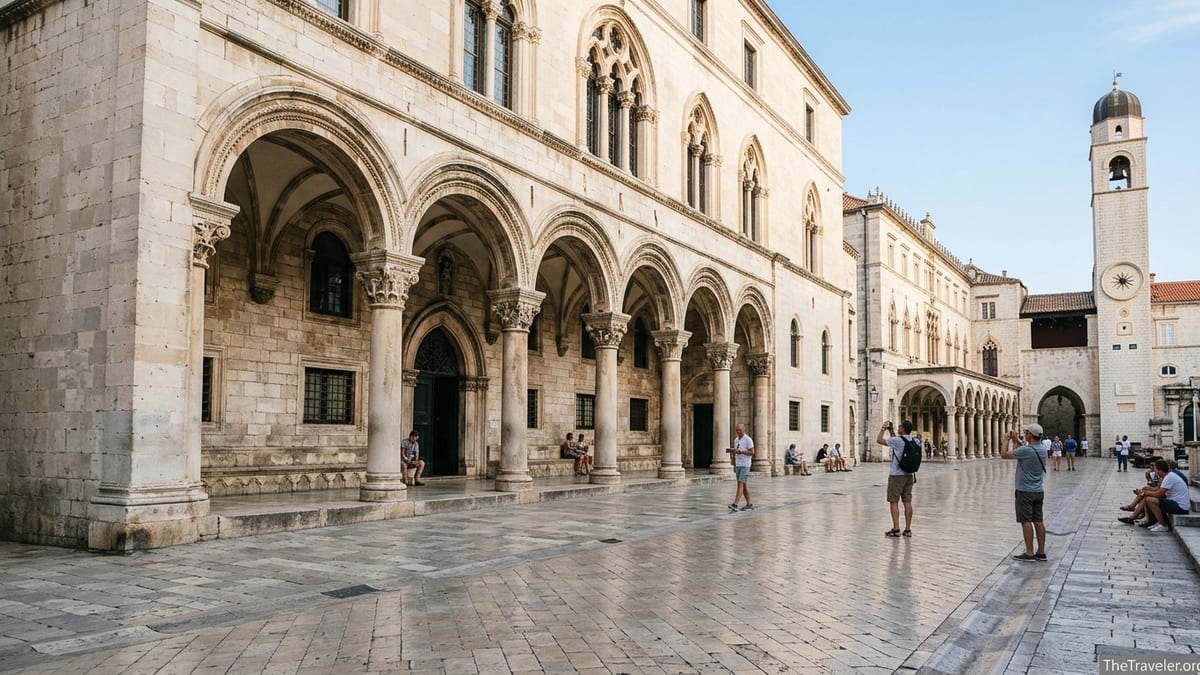
At the eastern end of Dubrovnik’s marble main street, Stradun, Sponza Palace opens onto Luža Square with elegant stone arcades and cool shade that feels almost cinematic after the glare outside. It is one of the few major buildings to survive the devastating 1667 earthquake largely intact, and today it combines three identities at once: a Gothic Renaissance landmark, the home of the Dubrovnik State Archives, and a deeply moving war memorial. Before you step under its arches, a bit of practical context goes a long way toward making this short stop one of the most memorable parts of your time in Dubrovnik.
Get the latest updates straight to your inbox!
Understanding Sponza Palace and Why It Matters
Sponza Palace, known locally as Palača Sponza or Divona, was built between 1516 and 1522 in a blend of late Gothic and early Renaissance styles. Its graceful loggia, slender columns and carved stone balcony are typical of the wealth and confidence of the old Republic of Ragusa, the maritime city-state that once rivaled Venice. Unlike much of Dubrovnik, Sponza survived the 1667 earthquake and later wars, which is why travelers today still see almost the same façade that 16th century merchants and diplomats knew.
Historically, this was not a royal residence but a working building. Sponza started life as a customs house and bonded warehouse where ships arriving in the harbor were taxed, and where valuable goods were stored under the watch of the Republic. Over time it also housed the mint, the arsenal, the treasury, the city’s bank and a school. For visitors this matters, because it explains why the interior still feels more like a civic courtyard than a furnished palace, and why most of the building is now reserved for archival storage rather than decorative showpieces.
Today the main tenant is the Dubrovnik State Archives, which keeps centuries of documents related to Ragusa’s trade treaties, ship logs and diplomatic correspondence. Travelers will not see rows of parchment in climate-controlled vaults, but knowing they are behind the upper walls gives context to the palace’s quieter, almost bureaucratic feel compared to better-known showpieces like the Rector’s Palace. In practice, a visit to Sponza is about atmosphere, architecture and its powerful memorial room rather than a long, object-filled museum circuit.
Most travelers experience Sponza Palace as a focal point on their first walk along Stradun. You will likely pass it walking from Pile Gate to the eastern end of the Old Town, where Luža Square opens by the City Bell Tower and St Blaise’s Church. Because it sits in the middle of this cluster of sights, Sponza is easy to include whether you are in Dubrovnik for a quick cruise stop or a several-day stay.
Location, Layout and How a Visit Typically Works
Sponza Palace stands on the left side of Luža Square as you approach from the Pile Gate side of Stradun, right next to the tall City Bell Tower. In front of it is Orlando’s Column; across the square are St Blaise’s Church and the Rector’s Palace is just around the corner. The position makes Sponza a natural pause point as you move between the main street and side alleys leading to the port and the cathedral.
The most striking part of the building is the open loggia facing the square. Visitors step up a short flight of stone steps and pass through a series of arches into a rectangular inner courtyard. Around this courtyard are arcades, stone columns, and a deep well of shade that feels especially welcome in July and August. Most self-guided visits involve a slow lap around the courtyard, a few minutes spent studying the carved capitals and Latin inscriptions, and then a quiet visit inside the Memorial Room of the Defenders of Dubrovnik, which opens off the ground floor.
Unlike some European palaces, there is no long, signed route through furnished chambers. You will not be ushered through royal apartments or period salons. Instead, access tends to focus on the courtyard, the memorial room, and occasionally small, temporary exhibitions. This means that even at busy times, most visitors spend roughly 15 to 30 minutes inside, unless they linger in the memorial or join a themed tour that uses the space to illustrate wider city history.
A typical sequence for many travelers is to walk the city walls in the morning, descend near the harbor, wander along Stradun, and then step into Sponza Palace in the early afternoon for a brief, shaded break before continuing towards the Rector’s Palace or the cable car to Mount Srđ. If you are visiting Dubrovnik on a tight schedule, think of Sponza as a compact but emotionally rich stop that sits neatly between other headline sights.
Tickets, Opening Hours and How to Budget Time
Practical details around Sponza Palace can be slightly confusing because the building serves primarily as an archive rather than a full museum. Exact opening hours and ticketing arrangements can change from season to season, so it is wise to check once you arrive in Dubrovnik at the official tourist information offices around Pile Gate or on Luža Square itself. Staff there can give current hours for Sponza, the city walls and nearby museums on a single printed leaflet.
As a rule of thumb, Sponza Palace generally keeps daytime hours that broadly follow other Old Town attractions, with longer opening in the main summer season and shorter hours or partial closures outside it. In practice, many travelers find Sponza open for casual visits from late morning through the afternoon in high season, while shoulder season visitors sometimes encounter reduced access or sections used for events. Because of this, it is smart not to leave your visit for the very end of the day if it is important to you.
Admission policies also vary. At times, entry to the courtyard and Memorial Room has been free, while at other points there has been a modest standalone ticket or inclusion within broader city passes that cover several museums and the walls. If you already plan to walk the walls and visit institutions like the Rector’s Palace or the Maritime Museum, ask about a combined Dubrovnik Pass at the tourist office or city wall ticket booth. For many visitors in high season it works out cheaper than buying individual entries and also gives access to museum restrooms, which is a practical plus on a hot day.
In terms of time budget, most independent travelers allow around 20 minutes for Sponza Palace, plus more if they want to spend longer in the memorial or photograph details in the courtyard once group tours move on. If you are visiting during a festival or cultural event, such as classical music performances in the atrium on summer evenings, you might easily stay an hour instead. Check local posters in Luža Square and at the city’s culture center to see if any performances are scheduled while you are in town.
The Memorial Room of the Defenders of Dubrovnik
The most affecting part of Sponza Palace for many visitors is the Memorial Room of the Defenders of Dubrovnik, which commemorates the men and women who died defending the city during the Croatian War of Independence in the early 1990s. The room is relatively small, entered from the ground floor off the courtyard, but it carries substantial emotional weight. The walls are lined with portraits of the fallen, usually arranged in neat grids, each name and date a reminder that the photogenic streets outside were under siege not long ago.
In addition to photographs, the room often contains objects from the siege, such as pieces of shrapnel, damaged shells and maps showing positions of attacks around Dubrovnik. For travelers who know the city mainly from Game of Thrones scenes or social media images of the terracotta rooftops, this space can be a jarring but important counterpoint. You walk in from a bright square full of gelato stands and souvenir stalls and suddenly face the recent human cost behind the city’s restoration.
Etiquette is important here. Even though Sponza Palace itself can feel like a public thoroughfare, the Memorial Room is treated locally almost like a chapel. Photography may be technically allowed or tolerated, but many Croatian visitors choose not to take pictures out of respect, and speaking loudly or answering a phone call would feel out of place. A good approach is to enter quietly, spend several minutes looking at the faces and reading the captions, and then step back into the courtyard if you need to talk or debrief with travel companions.
Families traveling with children might want to prepare them for what they will see. The portraits are not graphic, but the number of young faces and the explanation that they died during the defense of the city can be powerful. Parents often choose to time this visit after the children have already walked part of the walls or seen short historical panels elsewhere, so they have basic context about the siege before they confront its personal side here.
Architecture, Photography and What Not to Miss
Even if you know little about architectural history, Sponza Palace is a rewarding place to slow down with your camera or phone. The arcaded loggia facing Luža Square is one of the most photogenic spots in the Old Town. If you stand back near Orlando’s Column in the late afternoon, the sun tends to cast soft, angled light across the façade, highlighting the carved reliefs and the tracery of the upper windows while the interior shadows deepen behind the arches. Early morning, on the other hand, is quieter and better for wide shots without tour groups.
Inside the courtyard, look up. From the flagstones, you can see how the upper floors enclose a rectangle of sky, and how the mix of Gothic pointed arches and Renaissance proportions gives the space an almost cloister-like calm. Travelers interested in details often hunt for the Latin inscription above the loggia, which describes the palace as a place where trade takes place without deceit and where those who bring lawsuits must leave their private quarrels outside. It is a glimpse of the stern, mercantile ethics that underpinned Ragusa’s wealth.
One practical photography tip is to push toward the back corners of the courtyard and shoot diagonally across the space rather than straight on. This avoids the flat, postcard look and better captures the depth of the arcades. On rainy days, the polished stone gleams and reflections double the columns, creating atmospheric shots even when the sky is gray. If you have already walked the walls, you might also look out for Sponza’s roof from above; the regular layout stands out among the tangle of surrounding houses.
While Sponza does host occasional exhibitions, the building itself is the main attraction. Travelers accustomed to large, interpretive museums sometimes expect a series of panels in multiple languages. Here you are more likely to find a handful of short descriptions and perhaps a temporary display of archival facsimiles or archaeological fragments. This can be liberating if you prefer to absorb a place visually rather than reading long labels, but if you want deeper historical narrative, consider pairing your visit with a guided Old Town tour that stops at Sponza.
Practical Tips: Crowds, Weather and Accessibility
Dubrovnik’s Old Town can be extremely busy in peak season, especially when multiple cruise ships are in port. Because Sponza Palace sits on one of the main routes from Pile Gate to the harbor and the cathedral, its loggia is a natural bottleneck. Mid-mornings between roughly 10:00 and noon in July and August often see clusters of tour groups gathered under the arches while guides explain the history of the Republic. If you prefer a quieter feel, aim for early morning before 9:30 or late afternoon after most cruise groups have reboarded.
The palace courtyard offers welcome shelter from the weather. In high summer it is noticeably cooler than Stradun, making it a good place to pause, refill your water bottle and sit for a moment on the stone ledges if there is space. In spring and autumn showers, the covered loggia keeps you dry while you wait for the rain to ease before continuing to the cathedral or harbor. Some travelers use Sponza as a meeting point because it is so easy to find in Luža Square.
In terms of accessibility, the entrance from the square up to the loggia involves a short rise and some steps, which can be a barrier for visitors with mobility difficulties. The courtyard itself is paved with historic stone slabs that can be uneven and slippery when wet. If you use a stroller or have limited mobility, take your time and watch your footing, especially near the edges of the steps. There is no escalator or modern lift visible for public use, and most of the publicly accessible experience is confined to the ground level.
Facilities inside Sponza Palace are limited. This is not a large museum with a café and gift shop. Restrooms, if available to visitors, are basic. Many travelers instead rely on facilities connected with bigger museums like the Rector’s Palace or nearby cafés along Stradun. Plan accordingly by having some cash or a card ready for a quick coffee break at one of the terraces on Luža Square if you need a bathroom or a rest.
Fitting Sponza Palace Into Your Dubrovnik Itinerary
Because Sponza Palace is compact and centrally located, it works into almost any Dubrovnik itinerary. If you only have a few hours in the city, such as on a cruise stop, the classic loop is to enter through Pile Gate, walk Stradun, visit Sponza and nearby St Blaise’s Church, then either continue to the Old Port or climb the Jesuit Steps before circling back. In that scenario, Sponza gives you both architectural flavor and a sober reminder of the 1990s siege in a relatively short stop.
Travelers staying at least one or two full days often combine Sponza with the city walls and the Rector’s Palace. One practical sequence is to start the walls right when they open, to avoid heat and crowds, then descend near the harbor and wander to Luža Square for a mid-morning coffee. After that, step into Sponza Palace before moving on to the Rector’s Palace just behind it. In the afternoon, you can ride the cable car to Mount Srđ or take a boat to Lokrum Island, returning in the evening for a stroll through the Old Town when it is cooler.
If you are particularly interested in contemporary history, consider timing your visit to Sponza on the same day as a stop at Mount Srđ’s museum in the Imperial Fort, which also covers the siege of Dubrovnik, or at smaller exhibitions about the war that sometimes appear in Old Town galleries. Seeing the Memorial Room first can make the physical damage and strategic positions described elsewhere feel more personal.
For repeat visitors, Sponza Palace can be a place you simply pass by and admire from the outside each evening. Locals sometimes use the loggia as a shaded shortcut across the square or as shelter during sudden showers. Even if you do not go inside on every trip, the palace becomes part of your mental map of Dubrovnik: a fixed point you orient around between the bells of the City Tower and the steps of St Blaise’s Church.
The Takeaway
Sponza Palace is not the sort of palace filled with gilded furniture and endless picture galleries. Instead, it is a working civic building that has quietly anchored Dubrovnik’s public life for five centuries, from the days when Ragusan merchants negotiated trade deals with distant ports to the recent past when the city endured siege and shelling. For modern travelers, its value lies in that continuity. You step into the same cool courtyard that traders, scribes and clerks once crossed, then into a memorial that brings the late 20th century into sharp focus.
Before you visit, the most useful things to know are simple: its location on Luža Square is central and unavoidable, access focuses on the courtyard and memorial rather than lavish interiors, hours and ticketing can vary so it pays to ask locally, and etiquette in the Memorial Room calls for quiet respect. If you treat Sponza as a meaningful pause in your day rather than a major, time-consuming museum, it often becomes one of those places you remember most clearly long after you have left Dubrovnik’s walls behind.
FAQ
Q1. Where exactly is Sponza Palace in Dubrovnik’s Old Town
Sponza Palace stands on Luža Square at the eastern end of Stradun, right beside the City Bell Tower and opposite St Blaise’s Church, in the heart of the pedestrian Old Town.
Q2. How long do I need to visit Sponza Palace
Most visitors spend about 15 to 30 minutes exploring the courtyard and Memorial Room, longer if they pause for reflection or photography once tour groups move on.
Q3. Is there an entrance fee for Sponza Palace
Access policies can change, with some periods of free entry and others using a small ticket or inclusion in broader city passes, so it is best to confirm current details at a Dubrovnik tourist office when you arrive.
Q4. What is the Memorial Room of the Defenders of Dubrovnik
The Memorial Room is a space inside Sponza dedicated to those who died defending Dubrovnik in the early 1990s, with walls lined by their portraits and some objects from the siege.
Q5. Can I take photos inside Sponza Palace
Photography is generally possible in the courtyard and loggia, but in the Memorial Room many visitors choose not to photograph out of respect, and it is important to be quiet and considerate.
Q6. Is Sponza Palace suitable for children
Children are welcome, but parents may want to explain the nature of the Memorial Room in advance, since the many portraits of those killed in the war can be emotionally intense even though the displays are not graphic.
Q7. Is Sponza Palace accessible for visitors with limited mobility
The entrance involves steps up from the square and the stone paving can be uneven and slippery, so access may be challenging for some visitors and there is no obvious public lift to upper levels.
Q8. Are there guided tours of Sponza Palace
There is no standard, standalone palace tour, but many Old Town walking tours stop at Sponza’s loggia or courtyard to explain its history as a customs house and archive during broader city itineraries.
Q9. What is the best time of day to visit Sponza Palace
Early morning and late afternoon are usually quieter than mid-morning, when large tour groups and cruise passengers often crowd Luža Square and gather under the arches.
Q10. Can I combine a visit to Sponza Palace with other nearby attractions
Yes, Sponza sits beside St Blaise’s Church and the City Bell Tower and just a short walk from the Rector’s Palace, the cathedral and the harbor, making it easy to include in any Old Town route.