


Stradun, the polished limestone spine of Dubrovnik’s Old Town, is one of the most photographed streets in Europe. Most visitors walk it at least once on their way from Pile Gate to the old port, ticking off the experience in under ten minutes. But if you slow down, pay attention to timing, and know where to step away from the crowds, Stradun can be much more than a quick walk. It can be the frame for some of the most memorable hours of your time in Dubrovnik.
Get the latest updates straight to your inbox!
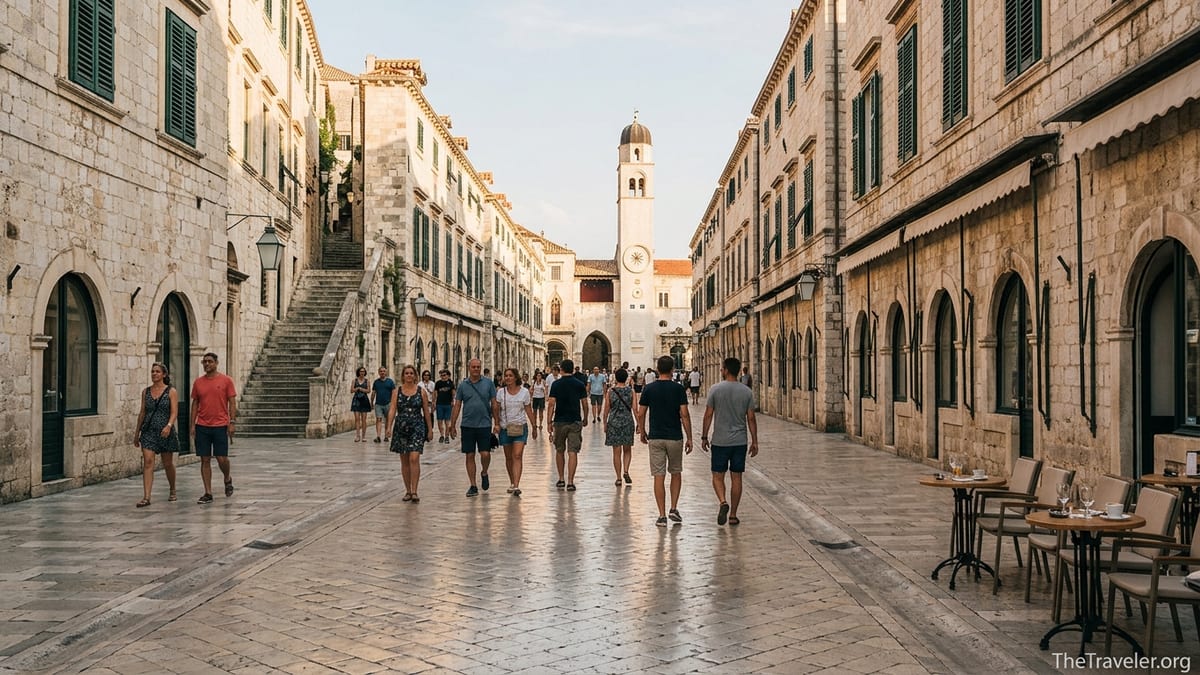
What Stradun Actually Is, Beyond the Postcard
Stradun, known locally as Placa, runs for just under 300 meters from Pile Gate on the west side of the Old Town to Luža Square and the old port on the east. Its wide, marble-smooth paving stones, uniform stone houses, and baroque fountains at each end were largely rebuilt after the 1667 earthquake, which is why the facades look strikingly harmonious compared with the tangle of alleys running uphill on either side.
Historically, this gleaming promenade was once a seawater channel dividing the mainland settlement from the island of Ragusa. As Dubrovnik grew rich on maritime trade, the channel was filled in and formalized as the city’s central artery. Today, almost every alley in the Old Town still funnels you down toward Stradun, which is why it can feel like everyone in Dubrovnik eventually ends up here at the same time.
At street level, you can still spot the practical shopfront design that defined Stradun’s mercantile past: a single stone arch framing both door and window, with a sill that once doubled as a counter. Many of these spaces are now boutiques, souvenir shops, and cafes, but if you look closely, the layout reveals the continuity between the medieval trading street and the modern tourist promenade.
Because Stradun links key sites such as Onofrio’s Fountain, the Franciscan Monastery, Sponza Palace, and the Church of St Blaise, even travelers who think they are just “cutting through” are moving through a concentrated slice of Dubrovnik’s history. The question is whether you treat it only as a corridor, or as an experience in its own right.
The Case for “Just a Walk”: Crowds, Prices and Performance
If you arrive in mid-summer around midday, when several cruise ships have already disgorged their passengers, it is easy to dismiss Stradun as something to march through quickly. At these times, the street fills with tour groups following raised umbrellas, lines of visitors queuing for gelato, and hawkers offering Game of Thrones walking tours every few meters. For many travelers, that kind of density erodes any sense of atmosphere.
Prices can reinforce the impression that Stradun is more show than substance. A simple espresso at a terrace directly on the main street often runs about 4 to 5 euros, while just one or two alleys away a similar coffee may cost closer to 2.50 to 3.50 euros. Dinner at a marquee address facing the street can easily reach 25 to 35 euros per main course, while family-run konobas tucked into the side streets offer grilled fish or a hearty peka-style dish at more moderate prices.
Some visitors report that they enjoy Dubrovnik far more once they mentally separate Stradun from “real Croatia.” After a quick walk to appreciate the architecture and a few photos looking up toward the city walls and Minčeta Tower, they head to less hectic parts of town such as Lapad, Gruž, or nearby islands like Lokrum, where prices and pace feel gentler. For travelers on tight budgets or those who dislike overtly touristy environments, limiting Stradun to a short, purposeful stroll can be a rational choice.
There is also the performance factor. Street musicians, costumed tour guides, and staged photo opportunities can sometimes make Stradun feel more like a theme park than a lived-in city. If your idea of a worthwhile visit is quiet authenticity, you may instinctively retreat after one pass from gate to gate. Yet this is only one version of Stradun, and it appears at very specific times of day.
When Stradun Becomes Magical: Timing Your Visit
The atmosphere on Stradun changes dramatically with the clock. At dawn, when shutters are still down and only a few locals are hosing down the pavement or walking dogs, the street feels almost intimate. The limestone glows softly in the early light, and you can hear the echo of your own footsteps. Photographers often come at this hour to capture empty views of the Baroque facades without having to crop out crowds.
By late morning, especially on days when two large cruise ships are in port, the density can make the street feel like a moving carpet of people. Local authorities have tried to manage this by limiting the number of cruise passengers allowed into the Old Town at once, but on busy summer days, you will still feel the pressure. If you prefer a more relaxed experience, plan your Stradun time before 9 am or after 5 pm, when many day-trippers have moved on to cable cars, boat excursions, or their ships.
In the early evening, just before sunset, Stradun can be its most seductive. The stone, polished by centuries of feet, reflects the fading golden light, and the air cools enough that locals start to appear for their nightly korzo, the casual promenade that is as much about seeing friends as it is about walking. This is when you might see families dressed neatly, older couples arm in arm, and students lingering around Onofrio’s Fountain, giving the street a sense of everyday life that disappears during the midday rush.
After dark, the mood shifts once more. Soft lighting spills from the arches of the cafes, buskers fill Luža Square with music, and the long perspective from Pile Gate toward the bell tower creates a theatrical backdrop for evening strolls. If you want to experience Stradun as more than a thoroughfare, choosing one of these quieter windows can transform your opinion of whether it was worth lingering.
Sitting Still on Stradun: Cafes, People-Watching and What You Get for the Price
Many seasoned travelers argue that the real value of Stradun emerges when you stop walking and simply sit for a while. Yes, you pay a premium, but what you are buying is not just a coffee or a glass of wine. It is a front-row seat to watch the city move. Think of it the way you might think of paying extra for a window table on Paris’s Boulevard Saint-Germain or Rome’s Piazza Navona.
A typical scenario might look like this: you sit down at one of the terrace cafes near Onofrio’s Fountain in late afternoon, order an espresso for around 4.50 euros or a local white wine such as Pošip for 7 to 9 euros a glass, and spend an hour just observing. You will see tour groups thinning out, uniformed schoolchildren cutting across the stone in clusters, and locals greeting each other with quick handshakes as they pass. The price per minute of entertainment starts to feel more acceptable.
For specialty coffee and a slightly less “on-display” feel, some travelers prefer to grab a flat white from a roastery like Cogito Coffee in the Old Town, then carry it to a quieter step or low wall just off the main drag. You are technically no longer “on Stradun,” but the soundscape and views are almost the same, and the price is closer to what you would pay in a modern European city.
If you are sensitive to cost but still want the Stradun experience, a practical compromise is to do your sit-down splurge at breakfast. A simple pastry and cappuccino at a terrace can run around 10 to 14 euros per person, which is far less than a three-course dinner with wine. You still get to watch the day start, you avoid the heaviest heat, and you free up your budget for better-value meals elsewhere in town.
Looking Up and Stepping Aside: Architecture, Side Alleys and Hidden Corners
Even if you decide not to eat or drink directly on Stradun, it is worth slowing your pace long enough to look up and then to step aside. From almost any point along the street, a quick tilt of the head reveals a vertical world of steep staircases, hanging laundry, stone balconies, and the looming city walls. These layers are what make Dubrovnik instantly recognizable in films and photographs.
One rewarding way to “upgrade” a simple walk is to treat Stradun as your base line and pick two or three nearby detours. For example, halfway along the street, you can duck north up the narrow lane toward the Jesuit Stairs, whose sweeping stone steps starred in a famous scene from a fantasy TV series. Climb to the top, turn around, and you will see Stradun from above while still hearing its hum below. Another short detour leads you to the tiny lanes on the southern side that suddenly open to sea views and hidden bars perched above the rocks.
Look closely at the facades themselves as you wander. Many of the ground-floor openings still follow the centuries-old pattern of shop and storage, even if they now house modern brands or souvenir stands. Occasionally, you will find a niche with a saint’s statue, a family crest, or a weathered inscription that locals scarcely notice anymore. These small details can shift your visit from “just another pretty street” to a scavenger hunt for traces of the republic that once rivaled Venice.
For photographers, one of the best vantage points is not on Stradun at all but on the city walls that ring it. Once you climb up to the ramparts and look down, the street’s full geometry reveals itself: a shining strip bisecting a dense stone grid, with terracotta roofs step-laddering up behind. The ticket for the walls is significant, roughly the cost of a nice dinner, but if you are on the fence about whether Stradun is worthwhile, seeing it from above often seals the relationship.
Stradun as a Hub, Not the Whole Story
One of the simplest ways to decide whether Stradun deserves more of your time is to think of it as a hub rather than a destination. From its western end at Pile Gate, you can branch off to climb the city walls, explore the Franciscan Monastery and its historic pharmacy, or head out to the small park above the gate for a breather from the crowds. From the eastern end near the bell tower, you are only a few steps from the old port, where boats leave for Lokrum Island and evening cruises along the walls.
Imagine a day laid out like this: you enter through Pile Gate at opening time, walk Stradun while it is still relatively empty, detour up a staircase to explore the quiet back lanes, then climb the walls before the sun is too strong. After descending near the eastern end, you cool off with a quick swim from the rocks below the Old Town or by catching a short boat ride to Lokrum. Later, after resting back at your accommodation in Lapad or Babin Kuk, you return in the evening for a relaxed dinner in a side street and a final stroll along the now softly lit Stradun.
Seen this way, Stradun anchors your Dubrovnik experience without monopolizing it. You pass through several times, in different lights and moods, but you do not spend all your energy and money right on the main drag. Many travelers who follow this pattern report that they appreciate Stradun far more than those who only hit it once in peak heat and peak crowding.
It also helps to adjust expectations. Dubrovnik is one of the most visited cities in Europe relative to its size, and Old Town prices reflect that. Going in prepared for higher costs on Stradun itself, while planning to balance them with more affordable meals and activities elsewhere, can make the street feel like a deliberate splurge rather than an unwelcome surprise.
Pros, Cons and Who Will Enjoy Lingering
Whether Stradun is worth more than a quick walk depends heavily on your travel style. If you love people-watching, architecture, and the subtle theater of daily life in historic cities, Stradun rewards any extra time you give it. Sitting at a cafe for an hour, watching the light shift on the stone, and noticing how locals move differently from visitors can be as satisfying as checking off multiple attractions.
If, on the other hand, you prioritize quiet nature, uncrowded spaces, or off-the-beaten-path authenticity, then Stradun’s high prices and density may simply feel like a tax you pay to reach the ferry pier or the cable car station. In that case, there is no shame in treating it as a corridor, capturing a few photos, and investing your limited time in the Elafiti Islands, the Konavle countryside, or lesser-known coastal towns where tourism feels less compressed.
Families with young children often find that a middle ground works best. A quick morning gelato on Stradun, a short stop to let kids chase pigeons near Onofrio’s Fountain, and then a retreat to the shade of a park or a beach keeps everyone’s energy up without spending too much money or patience. Couples on a short romantic getaway, meanwhile, may decide that an expensive but atmospheric glass of Dingač red wine at a Stradun terrace at sunset is exactly the kind of memory they came for.
The key is to be intentional. Do not let Stradun happen to you by accident at the worst possible time of day. Decide in advance whether you want a single, efficient crossing or several deliberately chosen encounters, and you will come away far clearer on whether it was “worth it” for you personally.
The Takeaway
Stradun is both Dubrovnik at its most spectacular and Dubrovnik at its most commercial. Seen only once, at midday in peak season, it can feel like an overpriced corridor of souvenir shops and tour groups. Seen at dawn, at sunset, or from a quiet cafe table, it becomes a luminous stage set for one of Europe’s most dramatic historic cities.
Is it worth visiting beyond a quick walk? For most travelers, yes, but not all in the same way. Some will cherish an hour nursing a coffee and watching the world go by. Others will prize the view from the city walls or the detours up narrow alleys more than any time spent on the main drag. A few will decide that their relationship with Stradun is a respectful nod on the way to somewhere less intense.
If you approach it with realistic expectations about crowds and prices, good timing, and a plan that treats Stradun as a flexible hub rather than the whole trip, it can add texture and depth to your Dubrovnik stay. Whether you linger or stride through, understanding what the street offers on its own terms is what ultimately makes it worth your time.
FAQ
Q1. Is Stradun worth visiting if I only have one day in Dubrovnik?
If you have just one day, walking Stradun from Pile Gate to the old port is essential, but try to do it early in the morning or in the evening to avoid peak crowds and heat.
Q2. How expensive is it to eat or drink on Stradun?
Prices on Stradun are among the highest in Dubrovnik. Expect to pay around 4 to 5 euros for a basic espresso and significantly more for full meals than in nearby side streets.
Q3. When is the best time of day to walk Stradun?
The most pleasant times are early morning, before about 9 am, and early evening, after the hottest part of the day and once most cruise visitors have left.
Q4. Can I experience Stradun without spending a lot of money?
Yes. You can simply stroll the length of the street, enjoy the architecture, and then head into side alleys for more reasonably priced cafes, bakeries and konobas.
Q5. Is Stradun suitable for families with children?
Stradun is flat, pedestrian-only, and stroller-friendly, but it can be very crowded. Visiting in the morning or evening and limiting time in the busiest stretch works best for families.
Q6. How does Stradun compare to other parts of Dubrovnik for atmosphere?
Stradun offers the most dramatic historic backdrop but also the most tourist traffic. Neighborhoods like Lapad or the Gruž waterfront feel more relaxed and local.
Q7. Do I need to see Stradun from the city walls as well?
You do not need to, but viewing Stradun from the walls gives a powerful perspective on the Old Town’s layout and many travelers consider it one of the city’s highlights.
Q8. Are there good photo spots on or near Stradun?
Yes. Classic angles include shooting toward the bell tower from Pile Gate, capturing reflections on the polished stone after rain, and climbing side staircases for elevated views.
Q9. Is Stradun very different in the low season?
Outside the peak summer months, Stradun is noticeably quieter and feels more like a lived-in city street, although many seasonal restaurants and shops may have shorter hours.
Q10. Should I stay in accommodation directly off Stradun?
Staying just off Stradun is convenient for sightseeing and atmosphere, but expect higher prices and more noise. Many visitors choose quieter streets a few minutes’ walk away instead.