


Few hikes in the American Southwest spark as much word-of-mouth buzz as the Navajo Loop Trail in Bryce Canyon National Park. At just 1.3 miles, it is short enough for many visitors to attempt, yet dramatic enough to define how people remember Bryce. But is the Navajo Loop actually worth your limited time and energy, or has it become a victim of its own popularity? Here is what hikers love, what frustrates them, and what you should realistically expect before stepping onto those famous switchbacks.
Get the latest updates straight to your inbox!
What Makes the Navajo Loop Trail So Famous?
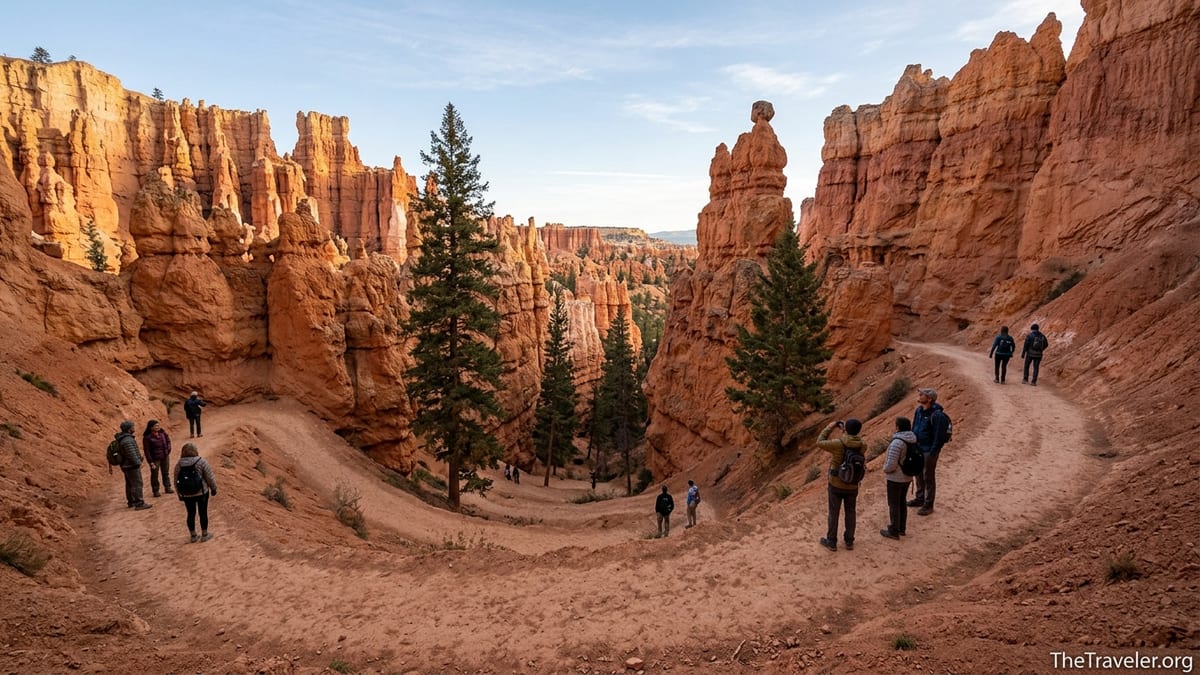
The Navajo Loop is the park’s signature hike for a reason. Starting at Sunset Point on the main Bryce Amphitheater rim, the trail drops roughly 500 to 550 feet into a maze of crimson and orange hoodoos, then climbs back to the rim in a compact 1.3-mile loop. Official National Park Service descriptions rate it as a moderate hike that typically takes one to two hours, which lines up with most visitor reports. In that short distance you pass Bryce icons such as Thor’s Hammer, Twin Bridges, and the narrow sandstone corridor known as Wall Street.
The loop is split into two “arms”: Wall Street on one side and Two Bridges on the other. Both begin at Sunset Point and meet on the canyon floor. Wall Street is the tighter, steeper set of switchbacks that zigzag through a slot-like chasm lined with towering Douglas fir trees. Two Bridges offers slightly more open views and close-up angles on Thor’s Hammer, the most photographed hoodoo in the park. Many hikers doing the classic Queen’s Garden plus Navajo combination descend from Sunrise Point and then climb out via the Navajo side to finish at Sunset Point.
For many travelers, especially first-time visitors, this is the hike that turns Bryce Canyon from a pretty viewpoint into a fully immersive experience. You trade the distant, postcard-style vistas on the rim for the feeling of standing at the base of rock walls hundreds of feet high. Even hikers who normally stick to easy, paved paths often describe Navajo Loop as the one “real” trail they were glad they pushed themselves to do.
Because of this concentration of scenery in a short, accessible package, the Navajo Loop has become not just popular but almost synonymous with Bryce Canyon itself. Guidebooks and travel planners routinely list it alongside the park’s must-do viewpoints, and you will hear it mentioned repeatedly in ranger talks and trip reports from recent seasons.
Is It Really Worth the Hype?
The short answer from most hikers is yes, the Navajo Loop is worth it if you are able to handle a steep, sustained climb at high elevation. Many people driving in from lower-elevation cities like Las Vegas or St. George are surprised by how different Bryce feels at around 8,000 feet above sea level. That thinner air is a major part of why a 1.3-mile, 500-foot climb feels more intense than the stats suggest, especially on the way back up.
Visitors who arrive early and hike the loop before 9 a.m. frequently call it the highlight of their Utah road trip. In recent seasons, travelers have reported starting from the Sunset Point parking area around 7:30 a.m., finishing the loop in about 75 minutes with many photo stops, and still having energy to continue on the Queen’s Garden or Rim Trail afterward. They talk about the light filtering between the hoodoos, the cool air in Wall Street, and the near-silence once they are below the rim, even on a busy day.
On the other hand, hikers who underestimate the climb or start late in the day sometimes finish with a very different opinion. Midday in peak season, especially between June and September, temperatures on the exposed switchbacks can feel punishing, and the trail becomes a slow procession of people stopping to catch their breath and wait for photos. During busy weeks, parking at Sunset Point can fill by late morning, forcing visitors to circle for a space or rely on the park shuttle system from the main visitor center and Bryce Canyon City.
This split in experiences explains the mixed reviews you might see online. Travelers who plan around the crowds and conditions typically find the Navajo Loop unforgettable and well worth the effort. Those who arrive in the heat of the afternoon, carrying little water and expecting a quick stroll, often describe it as “overrated” or “miserable.” Whether it is worth it for you depends much more on timing, expectations, and fitness than on the trail itself.
Trail Conditions, Closures, and Seasonal Surprises
One of the most important things to know before you go is that the Navajo Loop is not always a complete loop. The National Park Service keeps the Wall Street side closed through the winter months and often into spring because of rockfall risk and lingering ice on the steepest switchbacks. Even in the warmer months, heavy rain can trigger mudslides or rockfall that force temporary closures of one or both arms. In early 2026, for example, hikers arriving in late March and April reported that Wall Street was still closed while the Two Bridges side had recently reopened after winter.
When Wall Street is closed, you can still hike the Navajo “Loop” as an out-and-back on the Two Bridges side or combine it with other trails to create a different circuit. A common workaround is to descend Queen’s Garden from Sunrise Point, follow the connecting trail along the canyon floor, then climb up and back down the Two Bridges arm before returning to the rim. This gives you much of the hoodoo immersion that people expect from Navajo while respecting the safety closures.
In winter, the character of the trail changes dramatically. Snow and ice often pack into the switchbacks, creating slick conditions that even experienced hikers treat with caution. Rangers and seasoned visitors strongly recommend traction devices like microspikes and trekking poles if you plan to hike below the rim any time from late fall through early spring. Some winter visitors report that the park’s rental or nearby outfitters in Bryce Canyon City and Tropic can supply basic gear, but stocks vary, so it is safer to bring your own.
Because closures and surface conditions can change quickly with storms, it is worth checking the latest trail status the morning of your hike. The park maintains a current conditions page and also posts updates at the visitor center and the main amphitheater trailheads. Travelers arriving from Zion or Capitol Reef often stop at the visitor center first to confirm whether the full loop, including Wall Street, is open before committing their limited time.
How Hard Is the Navajo Loop, Really?
On paper, the stats look approachable: around 1.3 miles long, with about 500 to 550 feet of elevation loss and gain, and a typical completion time of one to two hours. The path itself is well maintained, wide enough in most places for two-way traffic, and free of exposure to cliffs or scrambling. For many park visitors, this is their first taste of hiking on dirt rather than pavement, and the infrastructure is forgiving.
The challenge comes mainly from three factors: the steep grade on the switchbacks, the altitude, and the need to climb back to where you started. If you are used to walking at sea level, the thin air above 8,000 feet can leave you breathing hard within minutes. On a warm July afternoon, healthy adults who regularly walk in their hometowns often find themselves stopping every few switchbacks to rest. Families with children and older travelers can absolutely complete the loop, but they generally do better starting early, taking their time, and carrying more water than they think they need.
Hikers used to longer mountain trails often call Navajo moderate and relatively easy, but they frequently point out that the crowding can make the ascent feel slower and hotter. When the trail is busy, you may find yourself stuck in narrow sections of Wall Street or Two Bridges, moving at the pace of the slowest person ahead. That means less airflow and more time in direct sun. On the flip side, if you start just after sunrise in shoulder season, you may find cool air, patches of shade, and plenty of room to move at your own pace.
If you are concerned about fitness, a practical approach is to walk a short distance down from Sunset Point, then reassess. The first segment quickly gives you a sense of the grade and your comfort level, and there is no obligation to complete the full loop. Many visitors walk only the top section to photograph Thor’s Hammer and peer down into the switchbacks, then return to the rim if the descent feels too steep or the altitude too intense.
What Hikers Love Most About the Navajo Loop
For those who do complete it, several elements of the Navajo Loop stand out as reasons they would gladly hike it again. One is the sheer drama of entering the amphitheater from above and descending rapidly into a world of rock towers. The transition from the busy paved overlook at Sunset Point to the cool, echoing narrows of Wall Street is unforgettable. Travelers often compare it to stepping through a door into a different park entirely, trading wide vistas for a canyon floor perspective.
The second highlight is how many classic Bryce formations you encounter in such a short distance. On the Two Bridges side, hikers can pause at multiple bends to photograph Thor’s Hammer from varying angles, as early sun lights its caprock and the hoodoos beyond. Deeper on the trail, the namesake Two Bridges appear as natural rock windows connecting fins overhead. In Wall Street, the towering Douglas firs growing from the canyon floor create a contrast between green needles and orange rock that feels surprisingly lush for such an arid environment.
Another aspect people appreciate is how efficiently the Navajo Loop fits into a Bryce itinerary. A typical one-day visitor might enter the park mid-morning, tour viewpoints like Inspiration Point and Bryce Point, and then tackle the Navajo Loop in the late afternoon as the sun drops lower and colors intensify. Others choose the opposite pattern, hiking Navajo at sunrise before the heat and crowds, then spending the rest of the day on easier rim walks and scenic drives. Because the loop can be done in roughly 60 to 90 minutes by most people, it offers flexibility that longer hikes like the Fairyland Loop or Peekaboo Loop do not.
Finally, there is the emotional impact, which is harder to quantify but mentioned often in recent trip reports. Visitors describe the sense of awe standing at the bottom of Wall Street, craning their necks to see the ribbon of sky above, or pausing on the lower switchbacks to listen to the quiet punctuated only by the crunch of boots on sand. Even experienced hikers who have seen many canyons and rock formations frequently single out this short trail as one of the most memorable of their entire Utah trip.
Crowds, Logistics, and When to Go
The biggest drawback to the Navajo Loop for many travelers is not the terrain but the crowds and logistics. This is the most popular trail in Bryce Canyon, and during peak season it can feel like everyone in the park is trying to hike it between 9 a.m. and 2 p.m. Sunset Point’s parking area often fills by late morning on busy weekends and holidays, which can be frustrating if you have driven in specifically for this hike.
To avoid that, many visitors either arrive very early or take advantage of the seasonal shuttle system that runs from Bryce Canyon City and the visitor center to the main amphitheater viewpoints, including Sunset Point. Riding the shuttle removes the parking stress and is particularly useful if you plan to hike one-way combinations such as descending Queen’s Garden from Sunrise Point and climbing out Navajo, then walking back along the rim. Travelers who use this approach often report a smoother, more relaxed experience even in midsummer.
Time of day also dramatically affects how the trail feels. Early morning usually brings cooler temperatures, softer light on the hoodoos, and smaller crowds, making it the preferred window for most photographers and families. Late afternoon and early evening can be beautiful as well, with warm side light on Thor’s Hammer and the upper amphitheater, but you will want to allow enough time to climb out before dark. Midday is usually the toughest, with the strongest sun and heaviest foot traffic, so if that is your only option, plan accordingly with extra water, a sun hat, and a flexible attitude.
Seasonally, late spring through early fall typically offers the most reliable conditions for the full loop, but it is also the busiest period. Winter and early spring can be spectacular visually, with snow highlighting the red and orange rock, yet they come with the tradeoff of icy paths, traction needs, and likely closure of the Wall Street side. Many repeat visitors say their favorite time for Navajo is shoulder season: May or late September to October, when temperatures are moderate and crowds, while still significant, are more manageable.
Who Should Skip It or Choose an Alternative?
Despite its moderate rating, the Navajo Loop is not ideal for everyone. Visitors with serious knee, hip, or heart issues may find the repeated switchbacks and sustained climb hard on their joints and cardiovascular system. Those with severe fear of heights sometimes feel uneasy on the steeper, more enclosed sections, particularly on busy days when two-way foot traffic is constant. Families with very young children or strollers will also struggle, as the trail is steep, uneven, and not suitable for wheels.
If that sounds like you, there are worthwhile alternatives that still deliver Bryce’s distinctive scenery. The paved Rim Trail between Sunset and Sunrise Points is the easiest option, offering sweeping amphitheater views with minimal elevation change and benches along the way. For a slightly more adventurous but still manageable descent, many people recommend the Queen’s Garden Trail from Sunrise Point, which has fewer steep switchbacks and a gentler grade, making it a popular choice for cautious hikers or those easing into below-the-rim terrain.
For fit hikers who love the idea of Navajo but want a bit more mileage, combining it with Queen’s Garden into a 2.9 to 3-mile route provides an extended tour of the amphitheater without dramatically increasing difficulty. Even more ambitious walkers can link Navajo with the Peekaboo Loop to form the so-called Figure 8, which fills several hours and delivers quieter sections away from the densest crowds near the rim. These combinations are frequently cited by experienced hikers as the best way to get a comprehensive feel for Bryce in a single day.
In all cases, the key is to be realistic about what you enjoy. If the thought of slogging up switchbacks in the heat sounds miserable, you may be happier spending your time at overlooks, on scenic drives, or on longer but less crowded trails like Fairyland Loop. The Navajo Loop is iconic, but it is not mandatory to appreciate Bryce Canyon, and there is no wrong way to structure your visit as long as you prioritize your comfort and safety.
The Takeaway
So, is the Navajo Loop Trail worth it? For most visitors who are reasonably active, plan around the heat and crowds, and go in with realistic expectations, the answer is yes. This compact loop delivers Bryce Canyon’s most famous formations, a dramatic descent below the rim, and a powerful sense of immersion in the amphitheater that roadside viewpoints cannot match. It is the rare short hike that feels like a complete experience rather than just a quick stroll.
At the same time, the loop’s popularity, altitude, and seasonal closures mean it is not a simple, anytime walk. Checking current trail conditions, choosing off-peak hours, bringing adequate water and sun protection, and allowing plenty of time for the climb back to the rim can spell the difference between a magical memory and an exhausting trudge. If you have limited days in Bryce, prioritizing an early or late-day window for Navajo can be one of the best itinerary decisions you make.
If steep climbs or health concerns give you pause, know that Bryce offers excellent alternatives that still showcase its sculpted hoodoos and sweeping views. The park’s beauty does not hinge on any single trail. But for many travelers, stepping onto the Navajo Loop Trail, feeling the temperature drop as walls rise around them, and looking back up at the rim they started from is the moment Bryce Canyon truly comes alive.
FAQ
Q1. How long does it take to hike the Navajo Loop Trail?
Most visitors complete the 1.3-mile Navajo Loop in about 1 to 2 hours, depending on fitness, crowds, and how often they stop for photos or rest on the switchbacks.
Q2. Is the Navajo Loop Trail suitable for beginners?
The trail can work for beginners who are reasonably active and comfortable with hills, but the steep climb and high elevation surprise many first-time hikers, so pacing and breaks are important.
Q3. When is the best time of day to hike the Navajo Loop?
Early morning is generally best for cooler temperatures, softer light, and thinner crowds, while late afternoon can also be pleasant if you allow enough time to finish before dark.
Q4. Is the full loop always open, including Wall Street?
No. The Wall Street side typically closes in winter and sometimes into spring because of rockfall and ice, so the loop may function as an out-and-back on the Two Bridges side during those periods.
Q5. Do I need special gear for the Navajo Loop?
In summer, sturdy walking shoes, water, sun protection, and layers are usually enough. In winter or after storms, traction devices and trekking poles are strongly recommended for icy or muddy sections.
Q6. Can children hike the Navajo Loop?
Many families do the loop with school-age children who are used to walking, but parents should be prepared for frequent breaks on the climb and keep kids close on narrow or crowded switchbacks.
Q7. How crowded does the Navajo Loop get?
In peak season, late morning and midday can be very crowded, with slow-moving lines on the switchbacks. Starting early or using the shuttle to arrive before the rush can make the experience far more pleasant.
Q8. Is the Navajo Loop Trail safe to hike alone?
Yes, solo hikers regularly complete the trail, and it is usually busy enough that you are rarely out of sight of others, but you should still carry water, check conditions, and let someone know your plans.
Q9. What are good alternative hikes if I skip Navajo Loop?
If Navajo is too demanding or closed, consider the Queen’s Garden Trail from Sunrise Point, the paved Rim Trail between Sunrise and Sunset Points, or longer routes like Fairyland Loop for fewer crowds.
Q10. How can I combine the Navajo Loop with other trails for a longer hike?
A popular option is the Queen’s Garden and Navajo combination, roughly 3 miles total. More ambitious hikers often add the Peekaboo Loop to create a Figure 8 route that fills several hours below the rim.