


If you only have time for one signature hike in Bryce Canyon National Park, the choice usually comes down to two classics: the Navajo Loop Trail and the Queens Garden Trail. Both drop you below the rim into the park’s glowing amphitheater of hoodoos, both start near the main viewpoints, and both are often combined into the famous Queens Garden / Navajo Loop combo. Yet they feel different on the ground and suit different types of travelers. This guide breaks down how each hike actually feels, what to expect in current conditions, and which one is likely the better choice for your trip.
Get the latest updates straight to your inbox!
Current Trail Status: What You Need To Know First
Before comparing Navajo Loop and Queens Garden in theory, it is important to look at current conditions. Bryce Canyon’s trails are carved into soft, eroding rock, and sections close regularly for rockfall, mudslides, or winter safety. The Wall Street side of Navajo Loop in particular is famous for seasonal closures, usually through winter and early spring. In 2026, multiple mudslides also temporarily closed more of the Navajo Loop, so you should always check the National Park Service trail updates or ask a ranger at the visitor center on the day you arrive.
Practically, this means you might find that Queens Garden is open while part or all of Navajo Loop is closed, especially between late fall and early spring. Even in summer, you may see signs at Sunset Point indicating that only the Two Bridges side of Navajo Loop is open, or that the trail is out-and-back rather than a true loop. In contrast, Queens Garden, which descends from Sunrise Point, is often one of the first below-the-rim trails to reopen after storms because it has fewer tight, rockfall-prone choke points.
If you are planning months in advance, build flexibility into your Bryce Canyon day. For instance, a traveler visiting in April might aim for the full Queens Garden / Navajo Loop Loop, but also have a backup plan of hiking Queens Garden as an out-and-back and then walking the Rim Trail between Sunrise, Sunset and Inspiration Points. In midsummer, when both trails are usually open, you can decide day-of whether to hike just one or combine them, based on heat, crowds and how your lungs feel at 8,000 feet.
The bottom line: in shoulder seasons and during active closures, Queens Garden often becomes the default choice simply because it is open and more stable. In peak summer, you usually get to choose more freely between the two or combine them.
Navajo Loop Trail: Steep, Iconic and Intense
The Navajo Loop Trail is the dramatic one. Starting from Sunset Point, it plunges about 500 to 550 feet from the rim into the Bryce Amphitheater over a distance of roughly 1.3 to 1.4 miles round trip. On paper that sounds short and manageable, but the switchbacks are steep, the elevation is high, and many hikers underestimate how tough the climb back up feels, especially at midday in July or August.
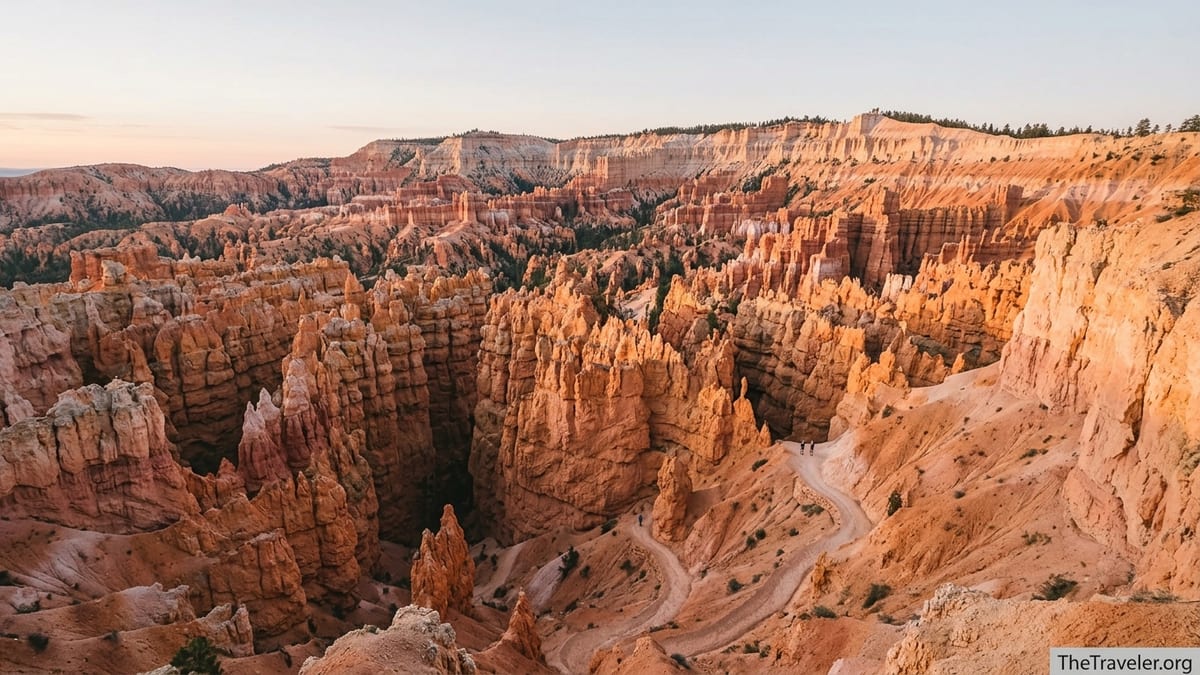
The big draw of Navajo Loop is how quickly it immerses you in Bryce’s most iconic scenery. Within minutes of leaving Sunset Point, you are weaving between towers of orange and salmon-colored rock, walking past Douglas-fir trees that somehow grow straight up from the canyon floor, and staring up at Thor’s Hammer, arguably the park’s most photographed hoodoo. On the Wall Street side, when open, the trail descends through a tight slot-like corridor between towering rock walls, with dramatic zigzagging switchbacks that look like something out of a postcard when viewed from above at sunrise.
Because it is short and directly below Sunset Point, Navajo Loop attracts a huge share of Bryce Canyon’s day visitors. In summer, you will likely find tour buses unloading at the parking lot by mid-morning, and the top of the switchbacks can feel like a steady stream of hikers, from families in flip-flops to well-equipped trekkers with trekking poles. If you are staying in nearby Bryce Canyon City or at Bryce Canyon Lodge, an early start matters. Hitting the trail around 7:30 a.m. not only helps you secure parking, it also gives you softer light for photos in Wall Street and cooler temperatures on the climb out.
Navajo Loop is the better choice if you want a short but intense workout with maximum “wow” factor in the least amount of time. It is especially appealing for photographers keen on the texture of the switchbacks and for travelers doing a quick stop on a drive between Zion and Capitol Reef who can spare only 1 to 2 hours.
Queens Garden Trail: Gentler Descent and Storybook Hoodoos
Where Navajo Loop feels vertical and dramatic, Queens Garden feels more gradual and whimsical. Starting from Sunrise Point, Queens Garden descends about 320 to 450 feet below the rim, depending on where you turn around or connect to other trails. The out-and-back distance to the “garden” area is about 1.8 miles, making it one of the least strenuous ways to get below the rim and walk among the hoodoos.
The scenery here is softer and more spread out than the tight corridors of Navajo. The trail winds across sloping terraces dotted with small hoodoo clusters and windows cut into the rock. Along the way, you pass formations nicknamed Gulliver’s Castle and Queen Victoria, the latter a hoodoo that, with some imagination, looks like a robed figure perched on a throne. There are short passages through sculpted tunnels in the rock, which children usually love and photographers often use to frame wider canyon views behind their subjects.
Because the grade is more forgiving and the exposure less intense, Queens Garden is often recommended for families with school-age kids, casual walkers, and anyone sensitive to heights. You still feel the altitude and the climb back up can leave most visitors winded, but the path never feels as punishingly steep as the tightest section of Navajo’s switchbacks. Many visitors staying at Bryce Canyon Lodge choose Queens Garden as their first below-the-rim hike on arrival day to get a sense of how their body handles the elevation before committing to longer loops.
If you are seeking a more relaxed introduction to Bryce’s amphitheater, with time to stop and take photos or simply sit on a rock and watch the colors shift, Queens Garden is usually the better stand-alone choice. It also pairs naturally with a leisurely walk along the Rim Trail back to Sunrise or on toward Inspiration Point if you want to extend your outing without adding a brutal climb.
The Combo Loop: Why Many Hikers Do Both
Ask rangers at the Bryce Canyon visitor center which single hike to do if you have just half a day, and they will often point you to the Queens Garden / Navajo Loop Combination. This figure-eight option, usually about 2.9 miles with around 600 to 650 feet of total elevation gain, lets you descend on the gentler Queens Garden and climb out on Navajo, hitting both sets of highlights in one circuit.
In practice, that might look like this: You park near Sunrise Point around 8:00 a.m., walk out to the overlook to admire the amphitheater, then follow the Queens Garden trail down through windows and past named hoodoos for about 0.9 miles. At the junction at the bottom, you continue on the connector toward Navajo, eventually reaching the canyon floor below the Wall Street area. From there, you climb out via the Two Bridges side when Wall Street is closed, or via Wall Street when it is open and safe. You end at Sunset Point, then stroll the relatively flat Rim Trail for about half a mile back to Sunrise Point and your car.
This loop is popular with travelers making a one-night visit. A couple staying at a mid-range hotel in Bryce Canyon City often checks into their room in late afternoon, drives into the park around golden hour, and hikes the loop in 2 to 3 hours before dinner at the lodge or one of the roadside diners. Families on a Southwest road trip frequently plan it as their main Bryce activity before continuing to Zion the next morning.
If both trails are open and you have the fitness for a moderate hike, the combination loop is usually a better experience than hiking either Navajo or Queens Garden alone. You get the best of both: the mellow, scenic descent of Queens Garden and the dramatic, photogenic climb of Navajo. The tradeoff is that it can feel busy in peak season, especially in the late morning. Starting early or timing it for late afternoon helps you avoid the most intense heat and crowds.
Difficulty, Crowds and Safety: Which Feels Harder?
On paper, Navajo Loop and Queens Garden are both classified as moderate hikes, but they feel very different to most people. Navajo’s short, steep switchbacks condense much of the effort into a relatively brief section. Many visitors report needing frequent breaks on the climb out, especially if they begin late in the morning when temperatures are rising and the sun reflects off the pale trail surface. Trekking poles and plenty of water make a noticeable difference here, particularly for older travelers or those with knee issues.
Queens Garden spreads the elevation change over a longer distance. The descent is easier on the joints, and the climb back to Sunrise Point, while still a workout, rarely feels as punishing as Navajo’s most concentrated pitches. However, the park’s elevation still catches visitors off guard. A traveler who easily hikes 5 miles at sea level in California might find themselves stopping every few minutes to catch their breath on the final slope back to the rim.
Crowd patterns differ slightly too. Sunrise Point and Queens Garden see a steady flow of hikers but can feel more spacious because the trail is less constricted. Sunset Point and the top of Navajo Loop, especially near Wall Street when open, can feel congested, with bottlenecks where people pause for photos on the narrow switchbacks. If you are nervous in crowds on steep terrain, Queens Garden may feel less stressful.
Safety-wise, both trails are well-maintained and suitable for most reasonably fit visitors in dry conditions, but you will want sturdy footwear with good traction. After monsoon storms in late summer, clay-like mud on steeper sections of Navajo can be slick; in winter and early spring, both trails can hold ice, turning shaded switchbacks into short skating rinks. In those seasons, traction devices and checking with rangers about current hazards are especially important. For travelers with vertigo, Queens Garden’s broader ledges and fewer tight drops usually feel more comfortable.
Scenery and Photography: Where Are the Better Views?
When it comes to pure scenery, there is no wrong answer, but each trail shines in different ways. Navajo Loop is all about drama and vertical relief. The classic shots from Wall Street capture a ribbon of trail cutting through towering orange walls, with tall pine trees improbably rooted on the canyon floor. From the Two Bridges side, you get postcard views of Thor’s Hammer standing against the sky. Photographers with wide-angle lenses love how Navajo’s tight spaces exaggerate the height of the hoodoos and the depth of the canyon.
Queens Garden, by contrast, offers more open compositions. The trail curves around clusters of hoodoos and through low tunnels where you can frame the distant amphitheater in a window of rock. Many visitors find the colors here especially pleasing in the hour after sunrise and the last two hours before sunset, when the low sun brings out soft pinks and golds in the rock. If you are traveling with a smartphone, you will find plenty of spots to capture both intimate close-ups of textures and wide panoramas that still include the sky and horizon.
For a real-world example, imagine you are shooting with a mirrorless camera and a 24–70 mm lens. On Navajo, you might spend more time at the 24 to 35 mm end to fit the walls of Wall Street into the frame and emphasize the steepness of the switchbacks. On Queens Garden, you might zoom toward 50–70 mm to isolate Queen Victoria or a single hoodoo group against a backdrop of eroded hills. Both trails reward slow, deliberate walking, with time to step off to the side and let faster hikers pass while you look for compositions.
If you are particularly focused on iconic Bryce images, Navajo Loop edges ahead, especially when the Wall Street side is open. If you value quieter, slightly more contemplative scenes and space to experiment with different compositions, Queens Garden may feel more creatively satisfying. Many serious photographers hike both, often doing Queens Garden at sunrise and Navajo in late afternoon to take advantage of changing light angles.
Logistics, Parking and When Each Trail Fits Best
From a logistics standpoint, Navajo Loop and Queens Garden are about as convenient as it gets in a national park. Both start near the heart of Bryce’s main amphitheater area, with trailheads at Sunset Point (Navajo) and Sunrise Point (Queens Garden). In peak season, the free park shuttle stops at both viewpoints, making it easy to park at the visitor center or a satellite lot and avoid the often-full lots at the points themselves after mid-morning.
If you are visiting in the busy summer months and staying outside the park, plan to arrive before 9:00 a.m. to improve your chances of finding parking close to your chosen trailhead. A family driving in from Springdale near Zion, for example, might leave their hotel before 6:30 a.m. to reach Bryce around opening time, hike Queens Garden / Navajo Loop, then enjoy lunch at the lodge cafeteria before continuing to viewpoints farther south on the scenic drive.
Seasonality matters too. In winter, access roads and viewpoints can remain open while below-the-rim trails are icy or closed. During these months, many visitors content themselves with walking short sections of the Rim Trail between Sunrise and Sunset Points, saving Queens Garden and Navajo for a future summer or fall visit. In shoulder seasons like April and November, a flexible mindset is useful. You might arrive to find Queens Garden open but only part of Navajo available, in which case hiking Queens Garden out-and-back and combining it with additional rim walking still gives you an excellent feel for the park.
As for when each trail “fits best” into a wider Southwest itinerary, Navajo Loop is ideal when you are short on time but want a serious, memorable taste of hiking below the rim. Queens Garden is better when you have kids, older relatives, or group members who are nervous about very steep trails, or when closures affect Navajo. The combination loop is the go-to if you can devote 2 to 3 hours and want to feel that you experienced the quintessential Bryce hike before moving on.
The Takeaway: Which Hike Is Better for You?
If both trails are open and you only do one, your choice should come down to your comfort with steep climbs and what kind of experience you want. Choose Navajo Loop if you are relatively fit, comfortable with a short but intense ascent at high elevation, and particularly excited about Bryce’s most dramatic, high-walled scenery. The trail’s steep switchbacks and the chance to walk below Thor’s Hammer make it unforgettable, especially for first-time visitors who want that punch of “I am really in Bryce Canyon” in under two hours.
Choose Queens Garden if you prefer a more gradual descent, are hiking with kids or grandparents, or simply want more time to wander among hoodoos without feeling rushed. It still provides outstanding views and a real sense of being in the amphitheater, but with less psychological and physical pressure on the climb back out. And if you have the time and energy, the Queens Garden / Navajo Loop Combination remains the gold standard: a compact circuit that blends the strengths of both trails into one rewarding hike.
In reality, many travelers find that conditions decide for them. If Navajo Loop is fully or partially closed during your visit, do not hesitate to give Queens Garden your full attention. Combined with a stroll along the rim between Sunrise and Sunset Points, it offers a rich, satisfying introduction to Bryce Canyon. If everything is open and you can start early, aim to hike both trails as a loop. Whichever you choose, bring more water than you think you need, wear real hiking shoes instead of sandals, and build a little extra time into your schedule so you can sit on a rock, feel the mountain air on your face, and appreciate the improbable beauty of Bryce’s eroded maze below the rim.
FAQ
Q1. Which trail is better for beginners, Navajo Loop or Queens Garden?
Queens Garden is generally better for beginners. Its descent from Sunrise Point is more gradual, and the climb back out, while still a workout, feels less intense than Navajo’s steep switchbacks. It is a good choice for first-time visitors who want to try a below-the-rim hike without committing to the steepest grades.
Q2. If I only have two hours, which hike should I choose?
With about two hours, you can comfortably do either Navajo Loop or Queens Garden as a stand-alone hike. If both are open and you are reasonably fit, the Queens Garden / Navajo Loop Combination in a clockwise direction is often manageable in two to three hours and gives you the best highlights of both, but you should start early and watch your pace.
Q3. Is the Queens Garden / Navajo Loop Combination really worth it?
Yes, for most visitors the combination loop is the single best use of limited hiking time in Bryce Canyon. It lets you descend on the gentler Queens Garden, walk through the heart of the amphitheater, then climb out via the dramatic Navajo switchbacks, finishing at a different viewpoint on the rim and returning along the Rim Trail.
Q4. Are these trails safe for children and older adults?
Both trails can be safe for children and older adults who are reasonably mobile and used to walking, provided you go slowly, stay together, and avoid the hottest part of the day. Families often find Queens Garden more comfortable because of its gentler grade and more open feel. Trekking poles, sun protection and extra water help older hikers manage the climbs more comfortably.
Q5. What is the best time of day to hike Navajo Loop or Queens Garden?
The best times are early morning and late afternoon. Starting around sunrise gives you cooler temperatures, softer light on the hoodoos, and easier parking at Sunrise or Sunset Points. Late afternoon into early evening can also be beautiful, but avoid starting the hike at midday in peak summer, when heat and crowds are at their worst.
Q6. How should I handle current closures or changing conditions?
Always check the latest trail status on park information boards or at the visitor center before you hike. If the Wall Street side of Navajo Loop is closed, you may still be able to hike the Two Bridges side as an out-and-back or link it with Queens Garden in modified ways. If Navajo is fully closed, focus on Queens Garden and the Rim Trail, which still offer excellent scenery and a memorable experience.
Q7. Do I need special gear for these hikes?
You do not need technical gear, but sturdy footwear with good tread is important. In summer, bring at least one to two liters of water per person, a hat, sunscreen, and sunglasses. In colder months or when ice may be present, small traction devices for your shoes and trekking poles can make a big difference on the steeper sections, especially on Navajo’s switchbacks.
Q8. Which trail is better for photography?
Navajo Loop offers more dramatic, vertical scenes, especially in the Wall Street section and around Thor’s Hammer, making it slightly better for classic Bryce Canyon shots. Queens Garden excels at wider, more open compositions and playful rock windows. Many photographers hike both, using Queens Garden for sunrise light and Navajo for late-afternoon or early-evening contrasts.
Q9. Can I use the shuttle to access these trails?
Yes. In the main season, the free Bryce Canyon shuttle stops at both Sunrise Point and Sunset Point, giving you easy access to Queens Garden and Navajo Loop without worrying about crowded parking lots. A common approach is to park at the visitor center, ride the shuttle to your chosen trailhead, and then ride it back after your hike.
Q10. How does altitude affect these hikes?
Bryce Canyon’s rim sits around 8,000 feet above sea level, which can make any climb feel harder than similar hikes at lower elevation. Visitors coming from lower altitudes should expect to move more slowly, take frequent breaks, and drink plenty of water. Even fit hikers can feel winded on the final ascent, so plan extra time and avoid rushing, especially on Navajo’s steeper sections.