


Spend enough time driving the Northeast corridor and the New Jersey Turnpike starts to feel inevitable. Stretching roughly 122 miles from the Delaware River to the approaches of New York City, this tolled spine of Interstate 95 is the default choice for everyone from vacationing families to long-haul truckers. Its reputation, though, is split. Some swear it is the fastest way to cross the state. Others call it a white-knuckle gauntlet of speeding trucks, sudden slowdowns and tollbooth anxiety. The truth, as usual, sits in between. Whether the Turnpike is the smartest choice for you depends on where you are going, what time you travel and how much stress you are willing to trade for a few minutes saved.
Get the latest updates straight to your inbox!
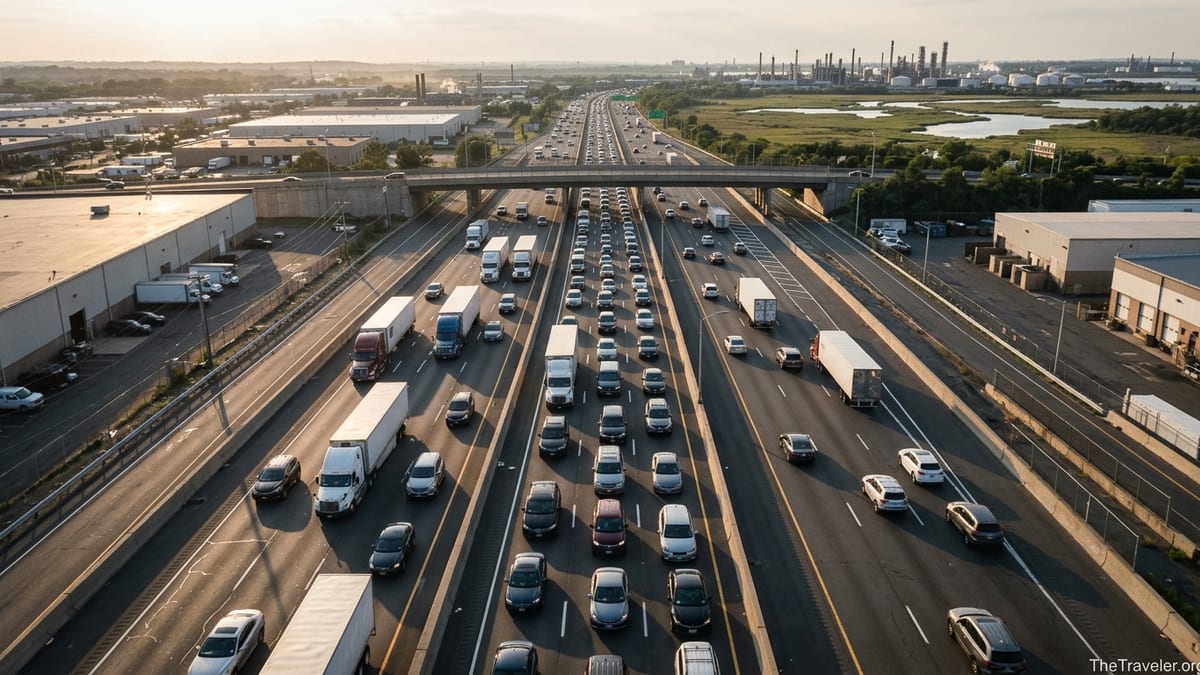
What Makes the New Jersey Turnpike Seem So Fast?
The New Jersey Turnpike was built for through-traffic: long, straight stretches, limited access, and relatively high posted limits compared with most local New Jersey roads. Large portions of the mainline are posted at 65 miles per hour, while many parallel state routes and arterials default closer to 45 to 50 miles per hour or less in built-up areas. In light traffic, that simple difference can turn a two-hour cross-state trip into something closer to 90 minutes, especially if you are driving from Delaware toward New York or Boston without many intermediate stops.
The design helps too. For much of its length, especially between about Exit 6 and Exit 14, the Turnpike offers separate roadways for cars and for cars plus trucks and buses. In theory this keeps heavy freight traffic from constantly mingling with faster passenger vehicles. The road is also fully controlled access, which means no traffic lights, turning vehicles or crosswalks. For drivers used to crawling up Route 1 through every strip mall between Trenton and Woodbridge, the ability to cruise at a steady highway speed can feel dramatically faster.
Tolls can also indirectly make the Turnpike feel quicker. Because you are paying to be on it, many drivers perceive it should deliver a time savings and will structure trips accordingly, choosing direct Turnpike exits that connect to major destinations such as Newark Liberty International Airport at Exit 13A or the Meadowlands complex near Exit 16W. E‑ZPass users rarely even need to slow down at mainline toll gantries, which further reinforces the sense of steady movement compared with stop-and-go on free local roads.
On a good day the Turnpike can live up to its promise. A midmorning southbound run from Exit 14 in Newark to Exit 4 in Mount Laurel, roughly 50 miles, might take about 45 minutes in free-flow conditions. By contrast, using a patchwork of Route 1, Route 130 and local connectors could easily stretch to 70 minutes or more once you factor in traffic signals, lower limits and local congestion near town centers.
Where the Turnpike Loses Its Time Advantage
The Turnpike’s speed advantage starts to erode quickly as soon as congestion appears, and some segments are routinely clogged. Northern stretches around Newark, Elizabeth and the approach to the George Washington Bridge are particularly notorious, with complex interchanges and volumes of trucks feeding the ports, the airport and cross-Hudson crossings. During weekday rush hours, a short three- or four-mile hop through this zone can take 25 minutes, which is not much better than crawling on parallel Routes 1&9 or the Garden State Parkway.
Weekend travel can be just as challenging. On summer Fridays, northbound traffic toward New York mixes with southbound vacationers heading to the Jersey Shore or points south, and backups frequently form near major junctions such as the split between the Eastern and Western Spurs, or around exits that feed shore routes like Interstate 195. By midafternoon, the posted 65 mile per hour signs become optimistic; actual speeds can drop below 30 for stretches, especially after minor fender-benders or lane closures.
Construction zones further complicate the picture. Like any aging major highway, the Turnpike is in near-constant maintenance somewhere along its length. Temporary narrowing of lanes, reduced limits and shifting traffic patterns can erase whatever advantage the road’s original design might have offered. Drivers heading from New York to Philadelphia might find that detouring to the Garden State Parkway for a section, or using I‑295 on the western side of the state, results in similar or even better travel times with less abrupt braking and weaving.
There are also trips for which the Turnpike was never the best option. If you are going from a suburb near Princeton to the beach in Ocean County, the Parkway or state routes may keep you on a more direct line with fewer backtracks to reach Turnpike interchanges. In such cases you can end up paying to travel extra distance on the Turnpike while local drivers on parallel roads arrive just as quickly or ahead of you.
Why the Turnpike Feels So Stressful Behind the Wheel
Even when the Turnpike is moving well, many drivers describe it as stressful. One reason is the mix of vehicles. Heavy freight traffic is a constant presence; long lines of tractor-trailers run between the ports of Newark and Elizabeth, distribution centers in central New Jersey and destinations south and west. Sharing a crowded six-lane roadway with these massive vehicles, especially in rainy or foggy conditions, can be intimidating for less confident motorists.
The speed differential adds tension. Some drivers hover near the speed limit in the right or center lanes, while others travel 10 to 15 miles per hour faster in the left lanes, jockeying for position around trucks and buses. Sudden lane changes, vehicles cutting across two or three lanes to make an exit, and last-minute merges from on-ramps are all common. Even if you personally drive calmly, the constant need to anticipate other people’s abrupt moves demands attention and raises stress levels.
The road’s visual environment can heighten that feeling. North of about Exit 12, the Turnpike cuts through one of the densest industrial and logistics landscapes in the country. Drivers pass tank farms, rail yards, power lines and stacks of warehouses, often with narrow shoulders and close concrete barriers. For some it is fascinating; for others it feels confined and relentless. Add in large overhead sign structures and a convergence of major interchanges near Newark Airport and the Pulaski Skyway, and the mental load of simply choosing the correct lane can be significant for visitors.
Finally, the stakes feel high. You are traveling fast, surrounded by large vehicles, sometimes just feet from a concrete wall, on a road you paid to use. A missed exit can mean several miles of backtracking and extra tolls. It is no surprise that out-of-state visitors, especially those unused to dense East Coast traffic, report white-knuckle drives on the Turnpike even when conditions are technically routine for local commuters.
Comparing the Turnpike to Alternatives Like the Garden State Parkway
The main competitor to the Turnpike for north-south trips is the Garden State Parkway, which runs closer to the coast and serves more local traffic. Large parts of the Parkway are also posted at 65 miles per hour and, like the Turnpike, it is a limited-access toll road with E‑ZPass. From a pure speed-limit standpoint, it can be just as fast, especially on stretches in Ocean and Monmouth counties where traffic is lighter outside peak summer weekends.
The experience, however, feels different. The Parkway generally carries fewer heavy trucks, particularly on its northern portion where larger vehicles are restricted. That alone lowers perceived stress for many drivers, who would rather deal with impatient sedans and SUVs than 18-wheelers in every lane. Scenery also varies more, shifting from pine forest near Atlantic County to suburban tree-lined sections in central and northern New Jersey. For road-trip travelers heading to shore towns like Point Pleasant, Asbury Park or Cape May, this route often feels more pleasant and still reasonably efficient.
On the other hand, the Parkway can bog down in its own way. Commuter traffic near major employment centers in Union, Essex and Bergen counties can be punishing at rush hour, especially where the Parkway narrows or passes through lane shifts for construction. Summer Friday evenings can see miles of slow-moving traffic southbound toward the beaches, while Sunday afternoons bring the reverse. In those windows, a driver heading from, say, New Brunswick to Newark Airport might actually prefer the Turnpike’s straighter geometry and separated truck lanes, even if both routes show similar predicted arrival times on navigation apps.
Local interstates such as I‑295 along the Delaware River provide another alternative for some trips. They avoid tolls and can be significantly calmer than the Turnpike, though posted limits and occasional congestion through suburban areas can lengthen travel time. For example, a business traveler going from the Philadelphia suburbs to Trenton might opt for I‑295 to avoid both the cost and intensity of the Turnpike, accepting a slightly slower pace in exchange for a more relaxed drive.
Real-World Trip Scenarios: When the Turnpike Wins and When It Does Not
Consider a classic Northeast run: driving from Baltimore to New York City. A typical route uses I‑95 to the Delaware Memorial Bridge, then follows the Turnpike almost end-to-end to reach the Hudson River crossings. Leaving at 9 p.m. on a Tuesday, traffic volumes drop, and the Turnpike’s design really shines. You might cover the 120-plus miles from the Delaware River to the George Washington Bridge in under two hours of smooth cruising, with only brief slowdowns at major merges. In this scenario the Turnpike is clearly the fastest and probably not very stressful for a confident highway driver.
Change the timing and the picture flips. Leave Baltimore at 2 p.m. on a Friday in July, hit the Delaware Memorial Bridge at 4 p.m., and you may join a rolling jam of trucks, weekend travelers and commuters. The same Turnpike stretch can easily balloon toward three hours or more, as minor crashes or disabled vehicles ripple queues along the mainline. A navigation app might suggest diverting to I‑295 for part of the way or even hopping between local routes around bottlenecks near Newark. You might still stick with the Turnpike for simplicity, but the speed advantage largely vanishes, while the stress level spikes.
For a more local example, picture a family leaving Princeton for a Sunday afternoon flight from Newark Airport. The direct Turnpike path is to head east to Exit 8A, then north to Exit 13A for the airport. Midday on a weekend outside holiday periods, that 40-odd mile segment can take about 45 minutes, consistent enough that you can plan airport arrival confidently. Trying to thread up Route 1 and then over local connectors into the airport might save a toll but exposes you to more unpredictable traffic lights and suburban congestion. Here, the Turnpike is both reasonably fast and reassuringly consistent if you budget some extra time for unexpected slowdowns.
By contrast, imagine a summer Saturday morning drive from Montclair to a rental house near Seaside Heights. A navigation app might suggest cutting over to the Parkway early and staying on it most of the way, avoiding the industrial sections of the northern Turnpike entirely. You will likely encounter heavy shore traffic either way, but you might spend a little longer moving at steady, slower speeds on the Parkway than sitting in fits of stop-start by the Newark interchanges. The journey might take similar clock time via either route, but many drivers prefer the Parkway’s mix of scenery and traffic for this kind of leisure trip.
Managing Stress If You Do Choose the Turnpike
There are ways to make the Turnpike feel less intimidating. Timing is the most powerful lever. If your schedule allows, avoid the heaviest rush periods: roughly 7 to 9 a.m. and 4 to 7 p.m. on weekdays, particularly near exits serving major employment centers and bridges into New York and Pennsylvania. For long-distance trips, consider traveling early morning or late evening when freight traffic is more predictable and commuter flows have eased. Even shifting a departure by an hour can noticeably reduce both travel time and lane-changing chaos.
Technology can help. Real-time navigation apps that factor in live traffic and incidents are almost essential on a road as busy as the Turnpike. They can warn you of sudden slowdowns, suggest swapping from the car-truck lanes to the car-only roadway where available, or divert you temporarily to alternatives like I‑295 or the Parkway when major crashes block lanes. For anxious drivers, simply having a calm voice in the dashboard narrate upcoming exits and lane choices can ease the cognitive load of complex junctions around the Newark Airport and Meadowlands.
Driving habits matter too. Holding a steady, legal speed in a middle lane, leaving extra following distance, and planning lane changes well before your exit all reduce your own stress, even if other drivers are more aggressive. If you are uncomfortable beside large trucks, use opportunities to pass decisively in good visibility, then return to a lane where you feel more comfortable. If you are traveling with another adult, consider having them handle navigation and toll questions so the driver can focus solely on the road.
Finally, use the service areas wisely. Placed every 20 to 30 miles or so, they offer a chance to stretch, use restrooms and grab a snack without navigating off the highway through unfamiliar towns. On longer drives, planning a brief stop at a mid-route plaza can break up the journey and reset frayed nerves. If a particular rest area looks crowded, you can usually continue to the next one rather than forcing a stressful merge back into traffic from a jammed parking lot.
The Takeaway
The New Jersey Turnpike is neither a guaranteed time-saver nor an unavoidable nightmare. It is a heavily used, purpose-built freight and passenger corridor whose performance depends heavily on when and how you use it. In light traffic, particularly outside peak commute and holiday windows, its higher limits and controlled design often make it the fastest practical route between the Delaware River and the New York metropolitan area.
In congested periods, the advantage narrows or disappears altogether. At those times, alternatives such as the Garden State Parkway or I‑295 may deliver similar arrival times with a different blend of scenery, vehicle mix and stress. For many trips within New Jersey, especially those oriented toward the shore, the Parkway will feel more pleasant, while the Turnpike remains the workhorse for long-haul Northeast travel.
Ultimately the best route is the one that balances your priorities. If shaving 20 minutes off a long interstate run matters more than a relaxing drive, the Turnpike used at off-peak times can still be a smart choice. If you are a nervous driver, traveling with kids, or simply prefer a calmer experience, planning around rush hours, leaning on navigation tools, and sometimes choosing an alternate route can transform what might have been a white-knuckle ordeal into just another leg of the journey.
FAQ
Q1. Is the New Jersey Turnpike usually the fastest way across the state?
The Turnpike is often fastest for long-distance north–south travel, especially outside rush hours, but in heavy congestion its time advantage over routes like I‑295 or the Garden State Parkway can disappear.
Q2. How bad is Turnpike traffic during weekday rush hour?
Morning and evening peaks around major interchanges near Newark, Elizabeth and the Hudson River crossings can produce long slowdowns, sometimes adding 30 minutes or more to typical travel times.
Q3. Are there fewer trucks on the Garden State Parkway than on the Turnpike?
Yes, particularly on the northern Parkway where larger trucks are restricted, which makes it feel less intimidating than the Turnpike’s heavy freight mix for many drivers.
Q4. What is the best time of day to drive the Turnpike to avoid stress?
Late morning, early afternoon and later evening on weekdays, as well as mid-morning on weekends outside holiday periods, tend to offer lighter traffic and a calmer experience.
Q5. Is the Turnpike safe for new or anxious drivers?
It is engineered as a modern highway and is statistically comparable to other major interstates, but the speed, traffic volumes and truck presence can feel overwhelming, so traveling off-peak and with an experienced companion is wise.
Q6. Do navigation apps give reliable advice about when to avoid the Turnpike?
Most major apps incorporate live traffic and incident data, so they are generally useful for spotting major jams and suggesting temporary detours, though they cannot predict sudden crashes or weather-related slowdowns.
Q7. Are the tolls worth paying compared with free alternatives like I‑295?
For long trips the Turnpike often saves time and offers more direct access to major destinations, but if you value lower stress and do not mind a somewhat slower pace, toll-free I‑295 can be a good alternative in southern and central New Jersey.
Q8. How do I handle confusing lane splits and spurs on the Turnpike?
Study your route ahead of time, use a navigation app that announces lane choices, and move into the correct lane early, particularly near the car-only and car-truck roadway splits in central and northern sections.
Q9. Are service areas on the Turnpike crowded and stressful?
They can be busy at peak travel times, but they are designed for quick in-and-out stops; if one plaza seems overwhelmed, continuing to the next often results in a smoother break.
Q10. For a leisure road trip, should I choose the Turnpike or the Parkway?
For shore-bound or largely in-state leisure trips, many travelers prefer the Parkway’s lighter truck traffic and more varied scenery, while the Turnpike is better suited to fast interstate hops between major cities.