


Ringed by heavy-hitters like Washington D.C., Virginia, Pennsylvania and the Delaware beaches, Maryland is often treated as a corridor rather than a destination. Trains and interstates cut across it, travelers refuel at service plazas, and then press on toward New York, the Outer Banks, Shenandoah or the Jersey Shore. Yet the self-proclaimed Old Line State quietly packs in ocean beaches, wild barrier islands, working watermen towns, mountain lakes, Civil War battlefields and a major-league city with a serious food scene. The question for most travelers is simple: is Maryland worth a dedicated trip, or is it forever destined to be overshadowed by its better-marketed neighbors?
Get the latest updates straight to your inbox!
Maryland’s Geography Problem: Surrounded by Stars
On a map, Maryland looks like a cartographer changed their mind halfway through. The state stretches from Atlantic barrier islands in the east to Appalachian ridges in the west, with the Chesapeake Bay taking a huge bite out of the middle. It shares the Delmarva Peninsula with Delaware and Virginia, rubs shoulders with Washington D.C., and sits within an easy drive of Philadelphia and New York. That geography is a blessing for locals but a branding headache for tourism officials, because many of Maryland’s strongest experiences are directly comparable to what nearby states already advertise heavily.
Beach travelers, for example, often default to New Jersey’s boardwalk towns, Delaware’s Rehoboth and Bethany beaches, or the wide sands of Virginia Beach. City breaks are more likely to target Washington D.C. museums or Philadelphia historic sites. Outdoor lovers might think first of Shenandoah National Park or the Pennsylvania Poconos rather than Western Maryland’s mountains and lakes. From the outside, Maryland can read as the space in between, a place you cross rather than choose.
Yet that in-between status is also what makes Maryland compelling. In a state where you can breakfast on a crab omelet overlooking the Chesapeake Bay, hike to a mountaintop fire tower by afternoon, then reach a minor-league ballpark or small-city brewery before dark, you get a dense sampler of the Mid-Atlantic in one compact package. Travelers with limited time or those flying into Baltimore or D.C. can stack coastal, urban and rural experiences in just a long weekend.
Practically, that means you do not have to choose between, say, a city-focused trip and a nature-focused one. It is entirely reasonable to spend a morning in Baltimore’s Inner Harbor, drive about three hours to the wild horses of Assateague Island on the Atlantic, and still be back near D.C. suburbs by the next evening. Few neighboring states offer that level of variety in such short driving distances.
Baltimore vs. D.C. and Philadelphia: Underrated Urban Stop
When travelers plan Mid-Atlantic city breaks, Washington D.C. and Philadelphia usually top the list. But Baltimore, Maryland’s largest city, offers a more relaxed, often more affordable alternative that pairs well with either. The city’s compact Inner Harbor is a historic seaport ringed by attractions such as family-friendly science museums, an acclaimed national aquarium, and tourable historic ships. Waterfront promenades link neighborhoods like Federal Hill and Fells Point, so visitors can move between cobblestone streets, harbor views and modern developments largely on foot.
In terms of price, visitors frequently find that midweek hotel rates in downtown Baltimore or the Inner Harbor area undercut those in central D.C. by a noticeable margin, especially during peak political or convention weeks in the capital. A casual dinner of crab cakes and local beer in a neighborhood like Canton or Hampden often comes in lower than similar meals in central Philadelphia. For budget-conscious travelers, that difference can easily cover admission to a museum or a harbor cruise.
What Baltimore does not have is the monumental gravitas of the National Mall or the dense colonial history of Philadelphia’s Old City. Instead, it leans into its waterfront identity and arts scene. A day might include a water taxi ride between harbor neighborhoods, a visit to a contemporary art museum, and an Orioles game at Camden Yards, one of Major League Baseball’s most admired retro-style ballparks. For travelers who appreciate grit alongside charm, Baltimore’s rowhouse streets, murals and corner taverns feel more lived-in than stage-set.
Logistically, Baltimore is easy to plug into a broader regional itinerary. Trains connect it directly to Washington D.C. in roughly 40 minutes and to Philadelphia in about an hour and a half, making it straightforward to land at Baltimore/Washington International Airport, spend a night in the city, then continue via rail. That flexibility helps Maryland hold its own against its larger urban neighbors and makes Baltimore a worthwhile base rather than a mere rail stop.
Chesapeake Bay vs. Coastal Rivals: A Different Kind of Waterfront
For travelers who picture the coast solely as open ocean and rolling waves, Maryland’s Chesapeake Bay can initially feel like a consolation prize compared with New Jersey or Delaware’s Atlantic-facing beaches. Yet the Bay offers a different kind of waterfront experience centered on inlets, working harbors, and low-key towns where watermen still head out at dawn to check crab pots and oyster cages.
Places such as Annapolis, St. Michaels, and Oxford trade in charm rather than spectacle. Annapolis, the state capital and home to the U.S. Naval Academy, mixes 18th-century brick streets with sailboats bobbing just off the city dock. St. Michaels, a favorite weekend escape for Washington and Baltimore residents, draws visitors with its maritime museum, inns on quiet coves, and restaurants serving steamed blue crabs by the tray. Many crab houses still spread brown paper on picnic tables and deliver platters of Old Bay–dusted crabs and pitchers of beer, a ritual as much about lingering conversation as eating.
Compared with resort towns like Virginia Beach or Ocean City, these Chesapeake communities skew quieter and more adult, though families with kids who enjoy boats and small beaches still find plenty to do. Prices reflect their popularity, particularly in summer weekends, when harborside inns and short-term rentals command a premium. Travelers on a budget can often do better by booking Sunday through Thursday, visiting in shoulder seasons like May or late September, or basing themselves a few miles inland in less touristy county seats and driving in for the day.
Maryland’s stretch of the Chesapeake does compete with Virginia’s Northern Neck or the riverside retreats of southern Delaware. What sets it apart is access. From the D.C. suburbs, Annapolis is often under an hour’s drive in light traffic, and even farther-flung Eastern Shore towns can usually be reached in about two hours. For travelers already in the region for work or family visits, tacking on a day or two on the Chesapeake is logistically much easier than reaching the Outer Banks or more distant coastal regions.
Ocean City and Assateague: How Its Beaches Stack Up
On the Atlantic front, Maryland’s best-known resort is Ocean City, a high-rise-fringed, family-oriented beach town with a long boardwalk, amusement rides, mini-golf courses and casual seafood joints. Travelers used to Rehoboth or Wildwood will find the vibe familiar: thick clusters of rental condos, bike rentals by the hour, and beachfront hotels that fill up fast on summer weekends. Nightly rates in peak July and August can rival or exceed those in neighboring Delaware, although off-season deals are common, particularly for midweek stays.
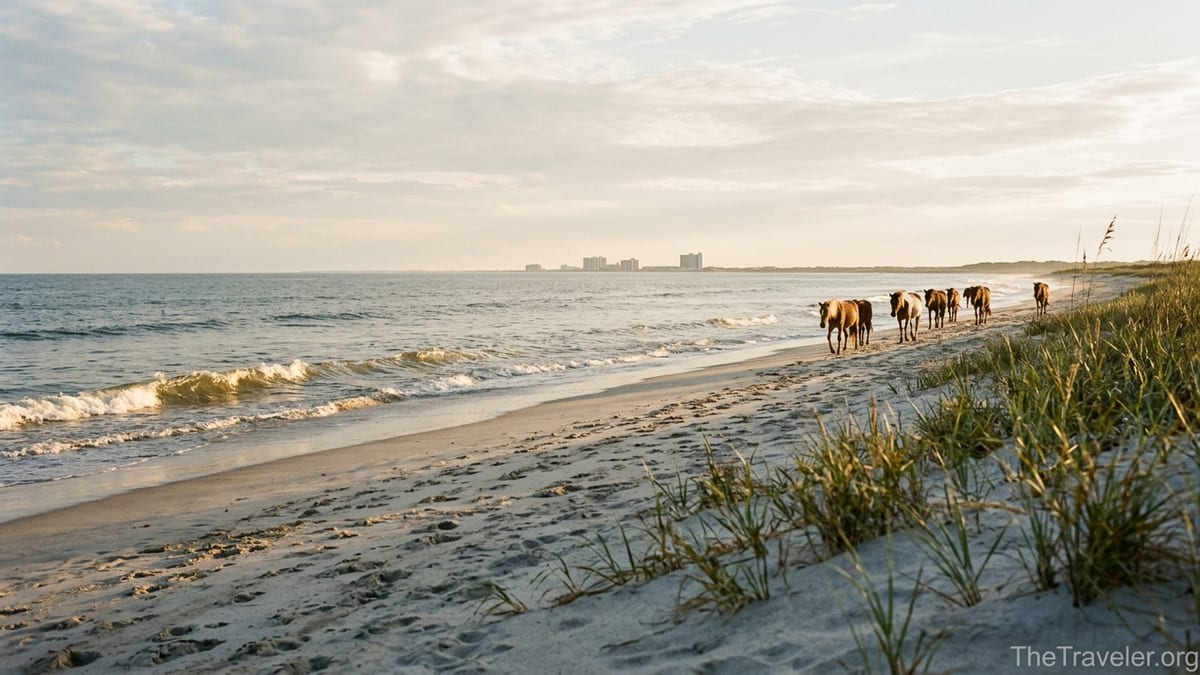
What makes Maryland’s coast stand out is what lies just a short drive south: Assateague Island, a barrier island shared with Virginia and protected as both a national seashore and a state park. Unlike the dense development of Ocean City, Assateague offers long, undeveloped beaches, low dunes and, most famously, herds of wild horses that roam the Maryland portion of the island. Visitors regularly see small bands of these horses grazing near marshes, walking along the sand, or stepping through campground loops. Regulations require people to stay well away and never feed or touch them, but simply watching them move across the landscape is often a trip highlight.
For travelers choosing between Maryland and the Delaware beaches, this contrast can be decisive. Rehoboth and Bethany offer polished boardwalks, boutique shopping and a strong restaurant scene. Assateague, by comparison, feels raw and elemental: basic campgrounds that can book out months ahead, simple parking lots behind the dunes, and beaches where you are as likely to share space with shorebirds and ghost crabs as with volleyball nets. Ocean City bridges the two worlds, giving families easy access to both a lively resort town and a wild seashore in a single long weekend.
Practical considerations matter. Summer traffic onto the Delmarva Peninsula, particularly on Friday evenings and Saturday mornings, can be heavy, regardless of whether you aim for Ocean City, Assateague or the Delaware beaches. Some travelers manage costs by renting a condo or house slightly inland, packing coolers for beach days, and doing one or two meals out at classic boardwalk institutions like old-school pizza counters or crab shacks. For those willing to trade nightlife for nature, a few nights of camping on Assateague, listening to waves and wind instead of traffic, can make Maryland’s coastline feel distinctly different from its neighbors.
Mountains, Lakes and Trails: Western Maryland vs. Virginia and Pennsylvania
Head west from Baltimore or Washington and Maryland narrows into a ribbon of ridges and river valleys. This is Western Maryland, a region that competes directly with Pennsylvania’s Laurel Highlands and Virginia’s Blue Ridge for weekend hikers, cyclists and leaf-peepers. Though it may lack the name recognition of Shenandoah National Park, it holds its own in terms of scenery and access, especially for travelers who prefer trailheads without crowds.
Deep Creek Lake, near the town of McHenry, is Maryland’s largest inland body of water and a four-season resort area. In summer, families rent cabins with private docks, go tubing and paddling, and hike to waterfalls in the adjacent state park. In winter, a nearby ski area offers downhill runs and snow tubing. Lodging prices in peak July and during fall foliage weekends can climb, but shoulder seasons often see better value than prominent resorts in neighboring states. A couple renting a small lakeside condo for a long September weekend typically pays less than they would for a similar setup in high-profile lake destinations further north.
Farther east, the C&O Canal towpath parallels the Potomac River from Cumberland all the way to Washington D.C., offering over 180 miles of largely flat trail for cyclists and walkers, dotted with lockhouses, aqueducts and canal-era ruins. Riders often break the route into segments, staying in simple cabins or small-town motels. This corridor competes with Virginia’s Skyline Drive or Pennsylvania’s rail trails for active travelers’ attention, but the combination of river views, history and proximity to the capital makes it particularly convenient.
Compared with nearby states, Western Maryland tends to feel a bit quieter and more low-key. There are no sprawling mega-resorts or crowded outlet villages, but there are small breweries in former railroad towns, family-run diners, and viewpoints where you can look out over three states at once. For travelers who prefer an under-the-radar mountain getaway within a day’s drive of major East Coast cities, that lower profile is more feature than bug.
Cultural Depth and History: More Than a Civil War Detour
History buffs often encounter Maryland through specific sites, then move on. Civil War travelers drive to Antietam National Battlefield near Sharpsburg, where one of the war’s bloodiest single days unfolded, or to Monocacy and South Mountain. Others know Maryland primarily from quick stops at the Star-Spangled Banner Flag House in Baltimore or the charming brick streets of Frederick’s historic district. Those sites can feel like appendages to better-known destinations in Pennsylvania or Virginia, rather than ends in themselves.
However, Maryland’s history is deeper and more varied than a single era. In Annapolis, 18th-century state buildings and narrow streets speak to the city’s brief stint as the nation’s capital in the 1780s. Along the Chesapeake, small museums interpret everything from the once-massive oyster harvests to the evolution of skipjack sailboats. African American heritage trails in cities like Baltimore and along the Bay trace stories of slavery, the Underground Railroad and civil rights. Travelers who enjoy pairing scenic drives with historic stops may find they can structure an entire week around Maryland’s museums, battlefields and heritage centers without crossing a state line.
Maryland also has a contemporary cultural life that can surprise visitors. Neighborhoods in Baltimore host arts festivals and open-studio events. College towns such as College Park and Towson bring in touring performances and lectures. On the Eastern Shore, small towns have begun to cultivate galleries and local theater seasons to appeal to second-home owners and long-weekend visitors. While these scenes are smaller than what you find in Philadelphia or D.C., they also tend to be more approachable and less formal, with ticket prices that are friendlier to family budgets.
For travelers deciding whether to devote time to Maryland versus its neighbors, the key is matching expectations. If you want blockbuster museums and headline-grabbing exhibitions, the Smithsonian in D.C. or the museum district in Philadelphia will likely win. If you are content with smaller, focused institutions and enjoy coupling them with walks through historic districts, waterfronts and countryside, Maryland delivers a quieter but still satisfying layer of cultural depth.
Value, Crowds and Practical Tradeoffs
Ultimately, whether Maryland feels worth visiting often comes down to value and friction. How much will you spend, and how much hassle will you shoulder, relative to what you get? Here, the state often stacks up well against its neighbors if you are strategic about timing and location.
Lodging around major events or peak holidays in Baltimore, Annapolis or Ocean City can be expensive, particularly for waterfront properties. Yet outside of those spikes, rates frequently undercut those in similarly positioned cities and resorts next door. A family that might struggle to afford a summer week in a central Rehoboth Beach rental could find a more modestly priced condo a few blocks off the sand in Ocean City, or swap the oceanfront for a Bay-facing town where a bed-and-breakfast plus daily drives to beaches keeps overall costs manageable.
Crowds are another factor where Maryland can shine, especially for those who can travel outside peak July and early August windows. The same Assateague Island beaches that bustle with day-trippers in midsummer become wide and nearly empty on sunny October weekdays, with much lower campground demand. Chesapeake towns that are booked solid for summer weddings and sailing regattas feel calm in shoulder seasons, yet restaurants and shops largely remain open. Western Maryland’s trails are used but rarely overwhelmed, a contrast to some Skyline Drive overlooks or Delaware Water Gap trailheads on prime foliage weekends.
Transportation logistics favor Maryland in some important ways. With a major international airport just outside Baltimore, travelers can often find competitive airfares, then rent a car and reach both mountains and beaches within a half-day drive. Trains along the Northeast Corridor connect Baltimore, BWI Airport and Washington D.C., giving car-free visitors enough mobility to at least sample city and Bay experiences. For trips that must fit into a long weekend, that accessibility can make Maryland a more realistic option than farther-flung coastal or mountain destinations.
The Takeaway
Maryland is not a single big-ticket destination in the way that New York City, Washington D.C. or the Outer Banks are. It does not own the most famous boardwalk, the tallest peaks, or the most iconic national monuments in the Mid-Atlantic. Surrounded by neighbors with sharper tourism brands, it is easy for the state to fade into the background of travel planning.
Yet that very modesty hides a portfolio of experiences that, taken together, can deliver a richly varied trip. In a few days you can eat crabs by the Chesapeake, wander cobblestone harbor streets, ride a water taxi past historic ships, watch wild horses pick their way through dunes on an Atlantic barrier island, then finish with sunset over a mountain lake. You are unlikely to see billboards shouting about any of it from interstate highways, but on the ground, Maryland rarely feels like an afterthought.
For travelers who value variety, relative affordability and ease of access more than high-profile bragging rights, Maryland is absolutely worth a visit in its own right. For those chasing marquee names and single-focus trips, it may still function best as a stylish supporting act to D.C., Virginia or Pennsylvania. Either way, overlooking the Old Line State entirely means missing out on some of the Mid-Atlantic’s most quietly rewarding moments.
FAQ
Q1. Is Maryland worth visiting if I have already been to Washington D.C. and Virginia?
Yes. Maryland offers a mix of Chesapeake Bay towns, Baltimore’s urban waterfront, Atlantic beaches and Western Maryland mountains that feel distinct from both D.C. and Virginia, and you can often experience several of these regions in a single trip.
Q2. How many days do I need to see the best of Maryland?
A long weekend of three to four days lets you sample Baltimore or Annapolis plus either the Chesapeake or the beach. For a fuller picture that includes Western Maryland, plan five to seven days so you are not rushing between regions.
Q3. Are Maryland’s beaches as good as those in Delaware or New Jersey?
They are different rather than better or worse. Ocean City is similar to other Mid-Atlantic boardwalk resorts, while nearby Assateague Island offers undeveloped beaches and wild horses that you will not find in most neighboring states.
Q4. Is Baltimore safe for tourists compared with other East Coast cities?
Baltimore has areas with higher crime rates, but main visitor districts such as the Inner Harbor, Federal Hill and parts of Fells Point are heavily frequented and policed. As in any city, sticking to well-used areas, being aware of your surroundings and using common-sense precautions goes a long way.
Q5. When is the best time of year to visit Maryland?
Late April through early June and September through October are ideal for comfortable temperatures and lighter crowds. Summer is best for swimming and beach trips but comes with higher humidity and busier roads, while winter appeals mainly to those interested in Deep Creek Lake skiing or quiet city breaks.
Q6. Is Maryland expensive compared with neighboring states?
Overall costs are similar, but many visitors find that midweek hotel rates in Baltimore and shoulder-season stays in Chesapeake or mountain towns undercut peak prices in nearby destinations like central D.C. or the most popular Delaware beaches.
Q7. Can I visit Maryland without renting a car?
It is possible in a limited way. Trains link Baltimore, BWI Airport and Washington D.C., and local transit can get you around Baltimore and Annapolis. However, reaching the Chesapeake’s smaller towns, Western Maryland or Assateague Island is far easier with a car.
Q8. How does Maryland compare to Pennsylvania for history-focused trips?
Pennsylvania has headline sites like Gettysburg and Independence Hall, while Maryland offers a broader mix of Civil War battlefields, colonial-era Annapolis and Chesapeake maritime history. Serious history enthusiasts often visit both, but Maryland works well if you prefer to combine historic sites with waterfront or mountain scenery.
Q9. Are there good options in Maryland for outdoor activities besides the beach?
Yes. Western Maryland has hiking, biking and skiing around Deep Creek Lake and along the C&O Canal, while the Chesapeake region offers kayaking, sailing and birdwatching in its rivers and coves.
Q10. Is Maryland a good choice for a family trip?
Maryland suits families well, with the Baltimore aquarium and harbor attractions, Ocean City’s boardwalk rides, Assateague’s beaches and wild horses, and easy, low-elevation hikes in state parks. Travel distances between major sights are relatively short, which helps when traveling with children.