


For many travelers, the name Cannes instantly conjures images of flashbulbs, film stars and that iconic staircase lined with a red carpet. At the heart of it all sits the Palais des Festivals et des Congrès, the modern waterfront convention center that hosts the Cannes Film Festival and dozens of major events each year. But if you are planning a trip to the French Riviera, is visiting the Palais itself really worth carving time out of your itinerary, or is it something you simply admire from a distance as you walk La Croisette?
Get the latest updates straight to your inbox!
What Exactly Is the Palais des Festivals?
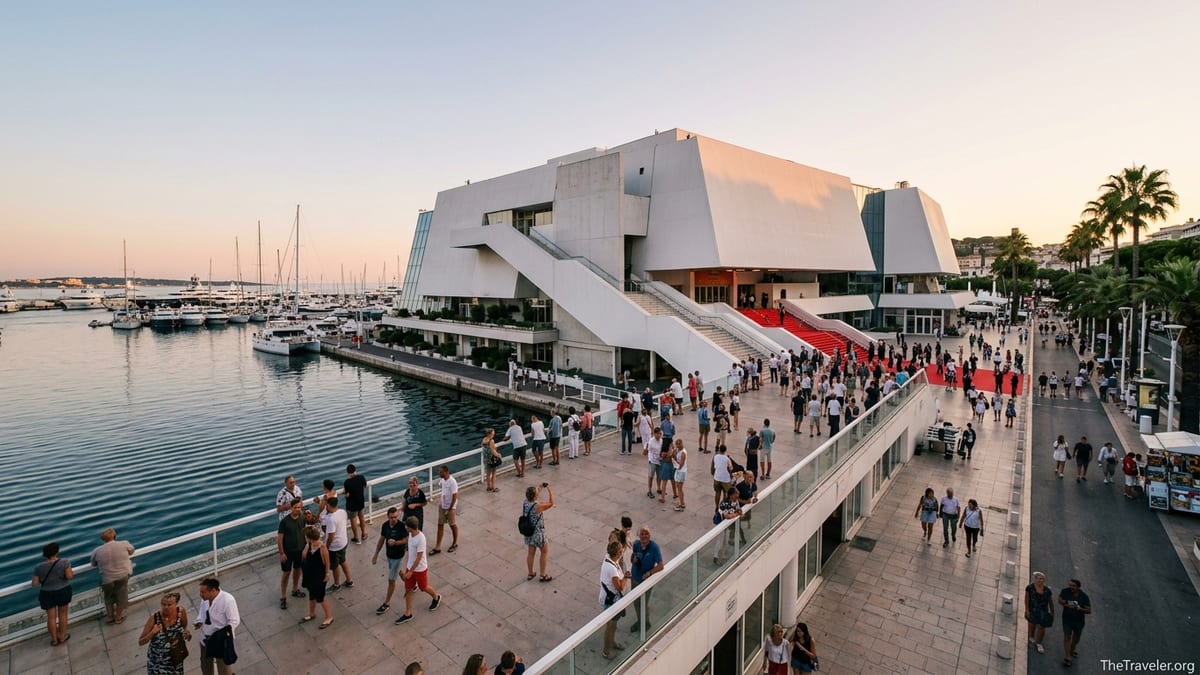
The Palais des Festivals et des Congrès is a large convention and festival complex built on the waterfront at the western end of the Boulevard de la Croisette in central Cannes. The current building, opened in the early 1980s, was purpose designed to host the Cannes Film Festival along with a dense calendar of international congresses and trade fairs that run throughout the year. To most visitors, it is instantly recognizable thanks to its angular white facade, terraces overlooking the harbor and, of course, the broad staircase where the famous red carpet is rolled out.
Inside, the Palais is not a museum but a working venue. It contains major auditoriums such as the Grand Théâtre Lumière, exhibition halls, meeting rooms and press spaces that are constantly reconfigured for events like the Marché du Film, MIPCOM television market, Cannes Lions advertising festival and the NRJ Music Awards. When no large congress is on, parts of the building may feel quiet and business-like rather than glamorous, which can surprise visitors expecting something closer to a Hollywood theme park.
The building also plays a practical civic role. The main Cannes Tourist Office is located on the ground floor of the Palais, meaning almost every traveler will step through its doors at least briefly to pick up maps, bus information or local event schedules. This makes the Palais a natural orientation point even for those who decide against booking a guided visit of the interior.
In 2024 Cannes was named the World’s Leading Festival and Event Destination for the third year running, an accolade that reflects how central the Palais is to the city’s identity as a global gathering place. Yet whether it is “worth visiting” depends heavily on when you come, what is happening during your dates, and what kind of travel experience you are looking for.
Seeing the Palais From the Outside: For Most Travelers, This Is Enough
For many visitors to Cannes, the most satisfying way to experience the Palais des Festivals is from the outside, folded naturally into a stroll along the old harbor and La Croisette. The building sits between the marina and the sandy public beaches, so you will almost certainly pass it when walking between the Vieux Port and the luxury hotels such as the Carlton and Martinez.
The most iconic spot is the main staircase on the sea-facing side, where the red carpet is rolled out during the Cannes Film Festival each May. Outside festival dates, the carpet is often removed or replaced with a plain covering, but tourists still queue to take photos walking up the steps, mimicking the pose of their favorite actors. On a typical summer afternoon you may see a family from the United States in smart-casual outfits asking another couple to snap a picture, or a group of students from northern Europe taking turns to reenact dramatic premieres.
Just in front of the Palais, on the pavement running alongside the waterfront, you will find the “Chemin des Étoiles,” Cannes’ answer to the Hollywood Walk of Fame. Dozens of handprints from famous actors and directors are set into the ground. Visitors often enjoy hunting for names they recognize, from classic cinema legends to contemporary stars, and taking quick photos. It is completely free and can be covered in ten to fifteen minutes as part of a broader walk around the port.
From the terraces above the main entrance, views stretch across the Vieux Port to the old quarter of Le Suquet. Many travelers simply ride the nearby public escalators or climb the gentle ramps to get a better vantage point for photos of the harbor, superyachts and church-topped hill without paying for any specific tour. If your time in Cannes is short, a relaxed circuit around the exterior of the Palais combined with the walk up into Le Suquet gives a memorable feel for the city’s setting with minimal planning or expense.
Guided Tours and Getting Inside: What You Can Realistically See
If you are curious to go beyond the facade, the main structured way to visit the Palais des Festivals is via an official guided tour, generally offered through the Cannes tourist office and local partners. These visits are often in French, with some periods when English-language tours are added depending on demand and the season. They typically last around one hour and give you access to certain foyers, corridors and occasionally an auditorium, depending on what events are being set up or dismantled that day.
Prices for these group tours are usually modest by Riviera standards: as of late 2024 and early 2025, the rate for a guided visit of the Palais was commonly listed in the range of roughly 6 to 10 euros per adult, sometimes bundled into wider walking tours of Cannes that also include the Forville Market and Le Suquet. Families planning a day in town often appreciate that children’s prices and group discounts can keep costs relatively low compared with big-ticket attractions elsewhere on the coast.
What you actually see inside is quite functional. Expect conference foyers with film posters, long carpeted corridors and, if you are lucky, a peek into an auditorium where technicians might be installing lighting rigs or testing sound. Guides usually explain how the Cannes Film Festival operates, pointing out where press conferences take place, how the security perimeter works during May and what happens behind the scenes when a major premiere unfolds. Film fans tend to enjoy hearing practical anecdotes about how stars arrive, where they wait before walking the steps and how the red carpet is changed multiple times a day.
It is important to set expectations: the interior is not lavishly decorated in the way of an opera house such as Palais Garnier in Paris. It is a modern conference center, designed for flexibility and capacity rather than ornate architecture. Travelers who value storytelling and insider information about the festival often come away satisfied, while those who mainly seek striking interiors may feel underwhelmed and feel that seeing the outside was sufficient.
Timing Your Visit: Festival Season vs the Rest of the Year
The experience of the Palais changes dramatically depending on whether you visit during the Cannes Film Festival, another major event, or a quieter period. The film festival usually takes place in May and transforms the entire area around the Palais into a high-security zone. Streets are partially closed, barriers go up, and access to the main staircase is tightly controlled, with security checks and dress codes for those attending official screenings.
For the average traveler without industry accreditation, visiting during the festival can be exciting but also frustrating. You might stand behind barricades in the early evening, vying for a spot from which to glimpse limousines pulling up and celebrities climbing the steps. Throughout the day, the vicinity is packed with journalists, film students, and industry professionals rushing to screenings and meetings. Hotel prices across Cannes rise significantly and restaurant reservations are harder to secure, so including Cannes in a broader Riviera trip at this time requires both a bigger budget and more planning.
Outside the festival period, the Palais continues to host large international trade fairs such as MIPIM (real estate), Cannes Lions (advertising) and various yachting and games festivals. On those dates the town still feels busy and businesslike, with badge-wearing delegates filling the terraces and cafes around the harbor. Room rates tend to be higher and restaurants more crowded. Unless you are directly involved in those industries, the interior of the Palais will not usually be accessible beyond the public tourist office and any pre-arranged tour slots that do not conflict with event security.
If you are mainly visiting for leisure, many travelers find early spring, late autumn or non-congress weekdays more rewarding. At these times, you can approach the staircase easily for photos, stroll the Chemin des Étoiles without jostling, and combine your look at the Palais with relaxed beach time or a short boat trip to the nearby Lérins Islands. In July and August the waterfront is lively but the atmosphere is more about summer holidays than film premieres, which may actually suit travelers who want to enjoy Cannes as a seaside resort rather than a media circus.
Practicalities: Location, Access, Budget and Accessibility
From a logistical standpoint, the Palais des Festivals is one of the easiest landmarks to incorporate into a Riviera itinerary. It sits directly opposite Cannes railway station, just a five-minute walk along flat streets. Travelers staying in nearby Nice, Antibes or even Monaco often take a regional TER train along the coast, step out at Cannes and find themselves looking almost immediately at the Palais and harbor. This makes it an ideal anchor point for a day trip.
Because the tourist office is inside the Palais, it is a useful first stop. Staff can provide free city maps, brochures for boat trips and bus timetables, as well as up-to-date information on any public events, concerts or fireworks organized along the waterfront. For example, during the summer Pyrotechnic Art Festival, spectacular firework displays are launched from barges in the bay and are easily watched from the beaches and promenade near the Palais, without needing paid tickets or reserved seating if you are happy to stand along the seafront.
Budget-wise, simply walking around the exterior, taking photos on the steps and exploring the handprints costs nothing. A guided tour inside is comparatively inexpensive, especially when set against Riviera prices for private boat charters or fine dining. That said, travelers watching their spending sometimes decide to allocate their euros to other experiences such as a boat trip to Île Sainte-Marguerite, a wine tasting in the hills above Cannes or admission to museums in nearby Nice, while limiting their Palais experience to an exterior visit of thirty to sixty minutes.
The Palais is designed to be accessible to visitors with reduced mobility, with ramps, elevators and step-free routes into the main public areas. During major events, security checkpoints and crowding can complicate navigation, so it is wise to arrive early and allow extra time if you use mobility aids. At quieter times, the combination of wide plazas and indoor facilities such as restrooms and seating makes the complex a convenient respite from the heat for travelers of all ages.
How the Palais Compares With Other Things To Do in Cannes
Whether the Palais des Festivals feels “worth it” also depends on how it stacks up against other attractions competing for your limited time in Cannes. The old quarter of Le Suquet offers winding lanes, restaurants and a hilltop view over the bay that many visitors consider the city’s most atmospheric experience. The Forville Market just below Le Suquet is a lively place to sample cheeses, olives and seasonal produce in the morning, while the beaches along La Croisette provide classic Riviera sun and sea.
For culture, Cannes itself has smaller museums and exhibition spaces, but many travelers use the city as a base to explore the Lérins Islands, reachable by frequent ferries from the harbor near the Palais. A half-day trip to Île Sainte-Marguerite, with its pine forests and historic fortress, is often mentioned by visitors as a highlight that feels altogether different from the bustle of the mainland. Compared with such excursions, time inside a modern congress building can seem less compelling unless you are particularly interested in film history or the workings of large-scale events.
Accommodation choices can affect your perception too. Guests staying in seafront hotels close to the Palais will inevitably encounter the complex every day and may feel more drawn to learning about it. Day-trippers from Nice, by contrast, sometimes spend their limited hours walking La Croisette, climbing up to Le Suquet and fitting in a beach stop, leaving the Palais as a quick photo-op rather than a main focus. Your own priorities, whether culinary, cultural or seaside-related, should guide how much time you allocate.
In simple terms, the Palais excels as a symbolic backdrop and orientation landmark. It delivers quick, free thrills for film fans who want to stand where famous directors and actors have posed, but it does not offer the multi-hour, immersive visitor experience of a major museum or theme park. Understanding that in advance helps avoid disappointment and allows you to incorporate it into a broader day that might include markets, viewpoints and swimming.
Who Will Find the Palais Truly Worth Visiting?
Film enthusiasts are the visitors most likely to consider both the exterior and a guided interior tour of the Palais des Festivals essential. For someone who carefully follows festival lineups, knows which films have won the Palme d’Or and reads coverage in publications such as Variety or The Hollywood Reporter, the chance to physically walk the steps and see the spaces where deals are made and press conferences are held has a strong emotional pull. Even outside May, simply being in the building can feel like stepping backstage at a global cultural institution.
Travelers fascinated by mega-events, design and logistics also tend to appreciate the Palais. The complex is a case study in how a medium-sized city can reinvent itself as an international events hub, with infrastructure capable of hosting tens of thousands of delegates for gatherings such as property fairs, advertising festivals and gaming conventions. Listening to guides explain how spaces are reconfigured, how security is managed and how the town’s economy revolves around these cycles can be as interesting as the film glamour itself.
On the other hand, visitors whose main interest lies in historic architecture, art or quiet coastal scenery may find that their trip is better spent elsewhere. If you have limited time, and especially if you are traveling with children who are more excited by beaches and boat rides, you might choose to keep your Palais visit short and informal. A few photos, a look at the handprints and a brief stop at the tourist office can provide a satisfying sense of place without committing to a structured tour.
Ultimately, the Palais is best thought of as a living stage rather than a static attraction. It comes into its own when something is happening: a film premiere, an awards ceremony, fireworks in the bay or a bustling trade fair reception spilling onto the terraces. If your trip coincides with such energy, you may find it one of the most memorable parts of your stay. If you visit on a quiet winter afternoon when no event is on, it may register more as an interesting backdrop to a pleasant walk along the harbor.
The Takeaway
So, is the Palais des Festivals in Cannes worth visiting during your trip? For most travelers, the answer is yes, with the important caveat that “visiting” often means experiencing the exterior rather than dedicating extensive time to the interior. The building’s location at the heart of the seafront, its role as home to the tourist office and its instantly recognizable staircase make it an easy and meaningful stop on any walking circuit of central Cannes.
If you are a passionate film lover or deeply curious about how major festivals and congresses operate, booking a guided tour inside can be a rewarding way to add context to the glitz you see on television each May. The cost is usually modest and the commentary provides behind-the-scenes stories that bring the otherwise functional spaces to life. For most other visitors, a more casual approach that includes photos on the steps, a look at the handprints and perhaps a stroll onto the terraces is enough to feel you have “done” the Palais.
The key is to balance your time. Cannes offers charming old streets, busy markets, easily accessible beaches and nearby islands that together create a rich Riviera experience. Placing the Palais within that wider menu of options, rather than elevating it as a stand-alone attraction, helps ensure your visit feels worthwhile. Think of it as a symbolic gateway to the city: step up the staircase, take in the view, then head off to discover the rest of what Cannes has to offer.
FAQ
Q1. Can I go inside the Palais des Festivals without a ticket?
You can freely enter the public areas that include the tourist office and some ground-floor spaces, but access to auditoriums and event zones is restricted to accredited delegates, ticket holders or participants in official guided tours.
Q2. Is there a regular guided tour of the Palais for visitors?
Yes, the local tourist office and partners usually run guided tours of the Palais, often in French and sometimes in English depending on demand and season. These typically last about an hour and must be booked for specific time slots.
Q3. How much does a guided visit of the Palais des Festivals cost?
Prices can change, but recent examples suggest that a standard group tour is generally in the region of a modest single-digit to low double-digit euro amount per adult, with reduced rates for children and groups.
Q4. Is it worth visiting during the Cannes Film Festival if I do not have accreditation?
It can be thrilling to experience the festival atmosphere, see the red carpet from behind the barriers and watch crowds and camera crews at work, but access is tightly controlled and accommodation and dining costs rise, so you need to be comfortable with crowds, security checks and higher prices.
Q5. What is the best time of year to visit the Palais des Festivals?
If you want easy access to the steps and promenade without major crowds, early spring, late autumn and non-congress weekdays are often ideal. For festival buzz, May brings the Cannes Film Festival, but with far more people and restrictions.
Q6. How long should I plan to spend at the Palais during a day trip to Cannes?
Most day-trippers devote between thirty minutes and an hour to the exterior, including photos on the steps and exploring the handprints. If you book a guided interior tour, allow an additional hour, plus time before or after to enjoy the nearby harbor and La Croisette.
Q7. Is the Palais des Festivals accessible for visitors with reduced mobility?
The complex includes ramps, elevators and step-free routes into the main public areas, and is designed to accommodate large numbers of delegates. During major events, security barriers and crowding can complicate navigation, so allowing extra time is advisable.
Q8. Can children enjoy a visit to the Palais des Festivals?
Children often enjoy climbing the steps, posing for photos and spotting celebrity handprints, but the interior guided tours are more talk-based and may appeal mainly to older children or teenagers interested in films or events.
Q9. Are there other attractions near the Palais that I can combine in one walk?
Yes, the Palais sits between the Vieux Port and La Croisette, within a short walk of the Forville Market and the old hilltop neighborhood of Le Suquet, making it easy to combine waterfront views, historic streets and beach time in a single outing.
Q10. Do I need to dress up to take photos on the steps of the Palais?
No specific dress code applies to visitors taking photos on the exterior steps, so casual clothing is perfectly acceptable. Formal attire and black-tie outfits are only required for those attending official red-carpet premieres and gala screenings inside.