


Two addresses on the French Riviera carry disproportionate weight in the global imagination. In Cannes, the Palais des Festivals et des Congrès, with its 24 red-carpeted steps, is the stage of the world’s most famous film festival. An hour along the coast in Monaco, the Casino de Monte-Carlo has defined Belle Epoque glamour for more than a century. Both buildings promise a brush with the high life, but they deliver very different kinds of memories. For travelers plotting a Riviera itinerary, the question is not just which one to see, but which landmark will leave the bigger impression once the trip is over.
Get the latest updates straight to your inbox!
First Impressions: Two Very Different Icons
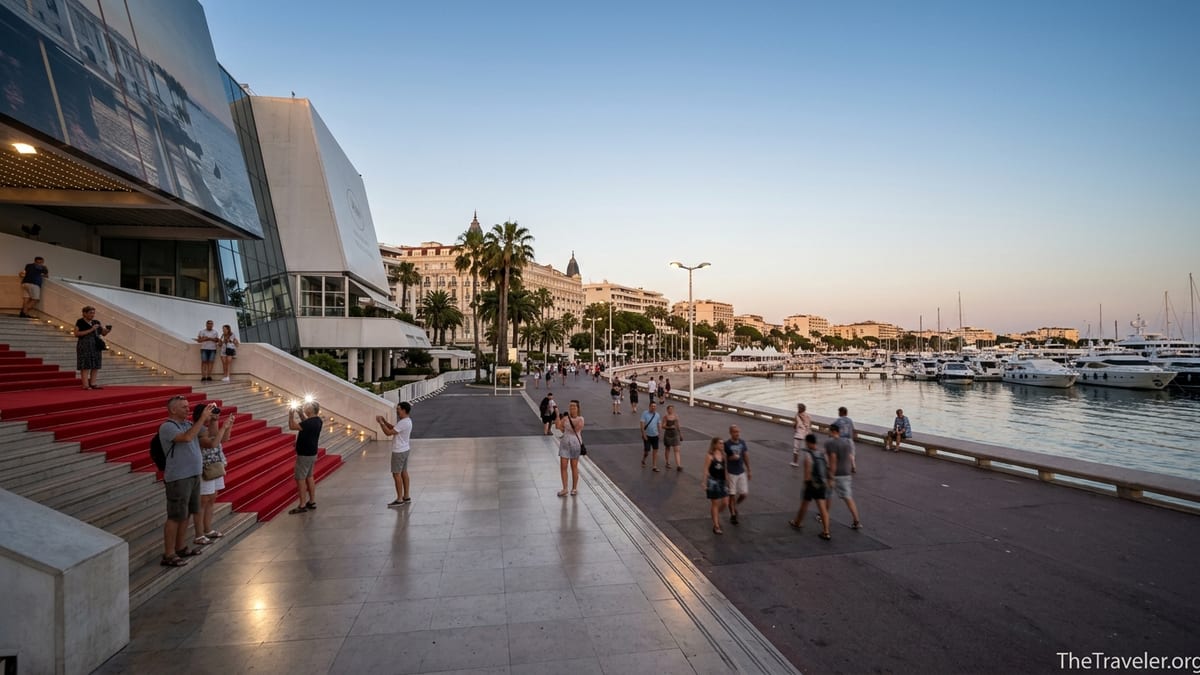
Arriving at the Palais des Festivals in Cannes, many visitors are surprised by the building itself. Unlike the postcard-perfect old port and pastel facades of the Suquet district behind it, the Palais is a low, angular complex of glass and concrete that locals once nicknamed “the bunker.” It sits right on the seafront at the western end of La Croisette, the famous promenade, fronted by a broad forecourt, a sweep of steps and the instantly recognizable red carpet. Outside the film festival, that carpet is often rolled up or replaced by event branding, yet the space still feels charged with cinematic folklore.
By contrast, the Casino de Monte-Carlo in Monaco looks exactly like the picture most people have in their heads. Designed in the 19th century and refined over the decades, its facade is a fantasy of Belle Epoque grandeur, with twin towers, green domes, sculpted stonework and an entrance framed by luxury cars gliding up to the door. The building overlooks the Place du Casino, a circular plaza lined with hotels and designer boutiques, anchored by a reflecting sculpture and carefully manicured flowerbeds. Where the Palais can feel almost businesslike outside festival time, the Monaco Casino seems permanently dressed for a gala.
That first visual impact matters. Many travelers say that, at a glance, Monaco’s casino is the more beautiful of the two, especially at golden hour when the facade catches the last light and the lamps come on around the square. Yet for film lovers, simply standing at the bottom of the Palais steps, imagining camera flashes and actresses in couture gowns, can be equally powerful, even if the architecture itself is more functional than romantic.
What Happens Inside: Cinema vs Gaming
The heart of the Palais des Festivals is not its exterior but what goes on behind the glass. Built to host the Cannes Film Festival, it now spreads over roughly 35,000 square meters of space, with multiple levels of exhibition halls and 18 auditoriums, including the 2,300-seat Grand Théâtre Lumière. During the festival, that main theater hosts gala premieres where the world’s top directors and actors present new films. At other times of year, those same halls welcome trade shows, concerts, television markets and gaming conventions, from the Marché du Film and MIPCOM to large e-sports events.
For ordinary travelers, the experience of the Palais varies dramatically depending on timing. Visit in February during an international tourism fair and you might find yourself with a delegate badge, weaving through stands and scheduled talks, seeing little of the cinematic side. Come in May, when the Cannes Film Festival takes over, and the building turns into an access-controlled fortress of cinema. Getting inside then usually means having professional accreditation, an invitation, or scoring public “last minute” tickets distributed for certain screenings. Travelers who manage it often describe the thrill of climbing the famous steps in borrowed formalwear and watching a film where it had its world premiere only hours earlier.
Inside the Casino de Monte-Carlo, the focus is more constant and more straightforward. Past the ticket desk and security checks, visitors step into marble halls, gilded salons and gaming rooms lined with chandeliers and murals. Some halls are dedicated to slot machines, with lower minimum bets and a more casual atmosphere. Others focus on table games such as roulette, baccarat and blackjack, where minimum bets can climb quickly in the most exclusive rooms. Even travelers who never touch the tables often pay the entry fee simply to stroll through the salons, soak up the atmosphere and admire details like painted ceilings and ornate frescoes.
In practice, the casino offers two overlapping experiences. Daytime tends to attract a mix of sightseeing visitors and more relaxed gamblers, many happy with a small flutter at a low-stakes roulette table. Late evenings, especially in summer, tilt toward a glossier scene of high rollers, formal outfits and guests spilling out to the terrace between hands. Where the Palais is tied to the rhythms of global events and schedules, the casino promises an always-on taste of Riviera glamour whenever you pass through Monaco.
Access, Dress Codes and Practical Realities
From a purely practical standpoint, the Casino de Monte-Carlo is usually easier for a casual visitor to experience fully. The most recent guidance indicates that sightseeing entry during the day is open to adults with valid ID, for a moderate fee that is often waived or reduced for guests of certain Monte Carlo hotels. There is a loose dress code: in the afternoon, smart casual clothing generally suffices, while in the evening jackets and closed shoes are strongly recommended for men and very casual clothing is discouraged. Security staff are more likely to refuse entry for items like sports shorts, beachwear or backpacks than for the fine details of shoes.
Once inside, you can decide how much to spend. Travelers commonly set themselves a modest budget and play a few spins of roulette or try the slot machines, where minimum bets may start from just a few euros. The main limitation is psychological rather than formal. The elegance of the rooms and the presence of higher-stakes tables can make modest players feel slightly out of place, even if they are technically welcome. Photography is heavily restricted in many areas, so you should not rely on snapping elaborate selfies at the tables.
The Palais des Festivals is at once more public and more restricted. Physically, it sits right on the promenade in Cannes, and you can walk up the steps, pose for photos and touch the famous handprints embedded in the pavement outside at almost any time of year. That alone satisfies many visitors. But entering the main building usually requires some form of pass linked to the event currently in residence, whether it is the Cannes Lions advertising festival, an international TV market or a gaming expo. During Cannes Film Festival itself, entry is tightly controlled and most screenings are either for accredited professionals or require invitations won through lotteries and local programs.
For travelers with flexibility and planning, it is possible to register for certain trade shows that use the Palais and thus see its interior, from large exhibition halls overlooking the sea to smaller screening rooms. Companies sometimes host evening receptions inside, offering another route in. Still, the level of planning required means that far more tourists will find themselves admiring the red carpet from the outside than sitting beneath the Grand Théâtre Lumière’s starry ceiling. In terms of access, Monaco’s casino remains more directly “buy a ticket, have the experience” than the complex accreditation culture around the Palais.
Atmosphere: Red Carpet Energy vs Riviera Fantasy
Atmosphere is where opinions often split. During the roughly two weeks of the Cannes Film Festival, the Palais and its surroundings become one of the most intensely photographed places in Europe. Barriers line the street, camera cranes swing above the crowd, and fans gather behind railings to glimpse celebrities on the famous steps. Even travelers without tickets often linger on La Croisette after sunset just to feel the buzz, listening to the roar of fans as limousines pull up and spotlights sweep over the sky. At that moment, the building is a live symbol of global cinema and an unforgettable backdrop to a night on the town.
Outside festival time, the Palais exudes a more subdued energy, even when hosting large congresses. You might see branded banners for a real estate fair or music industry conference, delegates in lanyards and suits smoking on the terrace, and technicians loading trucks at the back. It still feels international and important, but the glamour is quieter, more about the business of culture and commerce than the spectacle of film premieres. The sea views from the Palais’ terraces can be stunning, especially during sunset receptions, yet those vistas are typically reserved for badge holders.
The Casino de Monte-Carlo, by comparison, delivers a steady, carefully curated sense of Riviera fantasy. In the early evening, as the light softens and the square fills with visitors, the polished cars, palm trees and balustrades combine into a scene that feels almost like a film set. Musicians sometimes perform in nearby cafes, and the terraces of the surrounding hotels are busy with guests drinking champagne and watching the crowd. Inside, the hush of the gaming rooms, punctuated by the clatter of chips and soft murmur of croupiers, creates an atmosphere somewhere between a private club and a grand theater.
That mood holds even if you only stay an hour, lose a small stake at the roulette wheel and step back outside. Many travelers remember that moment of emerging from the dim, gilt interior onto the floodlit Place du Casino, with the sound of the fountain, the glow of the hotels and the Mediterranean just beyond the lights. It can feel like a complete capsule of “Monte Carlo” in a single evening, accessible without needing to be part of any professional community or industry event.
Cultural Weight and Storytelling Power
If beauty and atmosphere were the only measures, the Casino de Monte-Carlo might win by a nose. But the Palais des Festivals carries extraordinary cultural weight. This is the home of the Cannes Film Festival, widely regarded as the most prestigious event in cinema. Films that premiere here can change careers, launch global conversations and reshape the art form. The Grand Théâtre Lumière has hosted world premieres from directors such as Federico Fellini, Quentin Tarantino, Jane Campion and Bong Joon-ho, and it continues to be the place where new work is greeted by journalists, critics and industry heavyweights from every continent.
Even when you stand outside the Palais on an ordinary day, that history is present in the handprints embedded in the pavement and the banners celebrating past editions of the festival. Travelers who love film often speak of visiting the Palais the way music fans describe walking past famous recording studios: even without going inside, the building acts as a physical anchor for decades of stories. The steps themselves have witnessed political protests, surprise ovations, controversial premieres and legendary fashion moments, all of which filter into how people feel when they see them for the first time.
The Casino de Monte-Carlo has its own impressive narrative. It has appeared in multiple James Bond films, inspired novels and attracted real-life princes, industrialists and celebrities since the 19th century. Its fortunes have been closely tied to those of Monaco itself, helping to transform the tiny principality from a struggling territory into a modern playground for the wealthy. The building encapsulates the enduring allure of high-stakes gambling and old-world luxury. For travelers who grew up with spy movies and images of tuxedoed gamblers at green tables, simply walking into the atrium can feel like stepping into fiction made real.
In terms of contemporary relevance, though, the Palais is more directly embedded in current creative culture. Each year’s Cannes Film Festival fuels international headlines, social media debates and distribution deals that shape what audiences around the world will see in their local cinemas and on streaming platforms. The Casino, while still prominent, functions more as a timeless backdrop for luxury tourism than as a site where global culture is actively renegotiated. For some visitors, that living cultural role makes the Palais the more meaningful landmark, even if it is less photogenic from the outside.
Costs, Time and Itinerary: How Each Fits a Riviera Trip
Another way to judge lasting impact is to look at how each place fits into a real itinerary. A standard visit to the Casino de Monte-Carlo can be slotted into a single afternoon or evening. Many travelers time their arrival for late afternoon, wander the exterior and neighboring gardens while it is still light, have a drink at a nearby cafe and then enter the casino for an hour or two. Afterward, they might stay for dinner in Monaco or take the short train ride back to Nice. The financial outlay can be modest if you treat the casino as a paid attraction rather than a serious gambling venue, limiting yourself to a small gaming budget or skipping the tables altogether.
The Palais des Festivals can be more of a “swing by and see it” stop unless your visit coincides with a major event. You can easily incorporate it into a day exploring Cannes: start with a walk along La Croisette, pause on the steps for photos, look for the handprints of favorite actors, then continue toward the old town and market. This costs nothing and gives you a sense of the building’s role in city life, framed by the harbor and sandy beaches. The impact is visual and symbolic rather than experiential, unless you have planned ahead to attend a conference, concert or screening inside.
Attending part of the Cannes Film Festival itself is a different proposition. That can involve arranging accreditation, securing accommodation at peak-season rates and navigating a dense schedule of screenings and events. For film students, professionals and dedicated enthusiasts, it can be the trip of a lifetime and the Palais the unquestioned highlight. For many general tourists, though, simply seeing the red carpet and watching the commotion from a distance may suffice, allowing them to invest their time and money in other experiences along the Riviera.
Because Monaco is compact, a visit to the casino often becomes the focal point of a half-day excursion from Nice, Antibes or even Cannes itself. Meanwhile, the Palais tends to be one of several stops on a broader exploration of Cannes, sharing attention with the beaches, the yacht-filled old port and the hilltop viewpoints. In that sense, the casino can feel more like a standalone destination, while the Palais tends to be part of a larger picture of the city.
Which Landmark Leaves a Bigger Impression?
So which of these two Riviera icons tends to leave the deeper impression on travelers: the Palais des Festivals in Cannes or the Casino de Monte-Carlo in Monaco? The answer depends heavily on who you are and what you value. For dedicated cinephiles or anyone professionally involved in film, the Palais is hard to beat. Even if you do not enter during the festival, the symbolism of those steps and the knowledge of what happens inside give the building a gravity that lingers. Travelers who have attended a premiere often describe it as one of the defining memories of their careers or vacations, a night when the Riviera, art and celebrity converged in a single, concentrated moment.
For many other visitors, however, the Casino de Monte-Carlo is the place that feels more like a complete, self-contained experience. The combination of architectural beauty, atmospheric gaming rooms and the glamorous surroundings of the Place du Casino makes it easy to step into a long-standing fantasy of European high life, even if only briefly. Because access is straightforward, the payoff is immediate. You see the exterior, walk through historic halls, perhaps place a few bets and then step back into the night with a story that feels very “Riviera,” no matter your background.
There is also a question of expectations. The Palais, in photographs, often appears during its most heightened moment in May, when it is wrapped in banners and thronged by stars. Visit in October and you may find a more subdued scene that feels closer to a modern convention center than the temple of cinema you imagined. The Casino, by contrast, usually matches the mental image year-round, which can make its impact more consistent. Travelers who crave a sense of magic fulfilled exactly as expected are often more satisfied by Monaco’s landmark.
In practice, most itineraries that allow it benefit from including both. Seeing the Palais connects you to the contemporary engine of global cinema and the modern face of the Riviera as a hub for international events. Visiting the Casino immerses you in the region’s older mythology of princes, fortunes and roulette wheels. Comparing your emotional response to each can be revealing: some travelers are surprised to find that the slightly severe facade of the Palais moves them more than Monaco’s postcard perfection, while others feel the opposite. The biggest impression is often formed not by one building alone but by experiencing the contrast between them.
The Takeaway
On a short Riviera trip, it is tempting to ask which landmark deserves priority: the Palais des Festivals in Cannes or the Casino de Monte-Carlo in Monaco. If your time or budget permits only one, your choice should reflect the kind of story you want to bring home. If you are drawn to the power of cinema, curious about where film history continues to be written and intrigued by the behind-the-scenes world of global festivals and trade shows, the Palais is likely to resonate more deeply, even if you only experience it from outside.
If, instead, you dream of a classic Riviera evening among Belle Epoque architecture, tuxedos, sparkling lights and the soft clatter of roulette balls, the Casino de Monte-Carlo will probably leave the bigger mark. It offers a self-contained, instantly legible experience of luxury that requires no special connections, only a ticket, appropriate clothing and a willingness to step briefly into a more opulent world. Ideally, see both and let your own impressions settle. Together, they show two faces of the modern Riviera: one rooted in the arts and the global circulation of culture, the other in the timeless allure of risk, glamour and architectural beauty.
FAQ
Q1. Can I walk up the red-carpet steps at the Palais des Festivals when the Cannes Film Festival is not on?
Yes. Outside of the festival period and major security closures, the steps at the Palais des Festivals are generally open to the public. Visitors often pose for photos there and explore the surrounding “Chemin des Étoiles,” where cast and crew handprints are set into the pavement.
Q2. Do I need to gamble to visit the Casino de Monte-Carlo?
No. Many visitors pay the entry fee simply to see the historic interiors and gaming rooms without placing a bet. You are free to walk around areas open to the public, admire the decor and then leave without playing, as long as you respect dress code and photography rules.
Q3. Is there a strict dress code at the Casino de Monte-Carlo?
There is a dress code, but it varies by time of day and room. During the day, smart casual clothing is usually acceptable, while evenings call for more formal attire, especially in the most exclusive gaming rooms. Beachwear, sports shorts and very casual outfits are generally not allowed.
Q4. How difficult is it to attend a film screening inside the Palais des Festivals?
During the Cannes Film Festival, entry to screenings in the main theaters is controlled through accreditation, invitations and limited public ticketing. It can be challenging for casual tourists to secure seats at gala premieres, although local initiatives and last-minute ticket releases sometimes make it possible. Outside of the festival, events like concerts and trade shows may offer tickets or registration that allow easier access.
Q5. Which landmark is more photogenic: the Palais des Festivals or the Monaco Casino?
The Casino de Monte-Carlo is generally considered more photogenic, with its ornate Belle Epoque facade and elegant surroundings. The Palais des Festivals is visually striking when dressed for the Cannes Film Festival, but at other times its modern, angular design can appear more functional. That said, the red-carpet steps and seafront setting still make for memorable photos.
Q6. Is there an entrance fee to visit the Palais des Festivals?
There is no fee to walk around the exterior, use the steps or explore the public promenade in front of the Palais. Entry to the interior, including auditoriums and exhibition halls, typically requires accreditation, event registration or a ticket linked to whatever conference, screening or show is taking place at the time.
Q7. How much time should I plan for a visit to the Casino de Monte-Carlo?
Most visitors find that one to two hours is enough to see the main interiors, absorb the atmosphere and, if desired, play a few games. If you add a drink at a nearby bar or stroll through the surrounding gardens and square, the casino can easily anchor a half-day visit to Monaco.
Q8. Can children visit either the Palais des Festivals or the Monaco Casino?
Children and teenagers can freely visit the exterior areas around the Palais des Festivals, including the steps and promenade, and may attend certain public events inside if tickets allow. The Casino de Monte-Carlo, however, restricts entry to adults with valid ID, so children cannot go into the main gaming areas, although they can explore nearby public spaces and squares outside.
Q9. If I have limited time on the Riviera, which landmark should I prioritize?
If you are passionate about film or visiting during the Cannes Film Festival, the Palais des Festivals is likely to feel more meaningful, even from the outside. If your interests lean more toward classic European architecture, nightlife and an easily accessible slice of glamour, the Casino de Monte-Carlo is probably the better choice. Your personal interests should guide the decision.
Q10. Is it realistic to visit both the Palais des Festivals and the Monaco Casino in one day?
Yes, it is possible, especially if you are based in Nice or Cannes and use regional trains. Many travelers spend the morning or early afternoon exploring Cannes and the Palais area, then head to Monaco for a late-afternoon and evening visit to the casino. It makes for a full but manageable day that showcases two contrasting faces of the Riviera.