


For most visitors to Cannes, the Palais des Festivals is a quick photo stop: a flash of the red carpet, a selfie on the steps, and then back to the Croisette. Yet this massive white convention center at the entrance to the bay is more than a backdrop for celebrities. It is a working building, layered with history, technology and small human traces that rarely appear on television. Look a little closer, and the Palais reveals a surprisingly intimate side of the world’s most famous film venue.
Get the latest updates straight to your inbox!
The Building Behind the Glamour
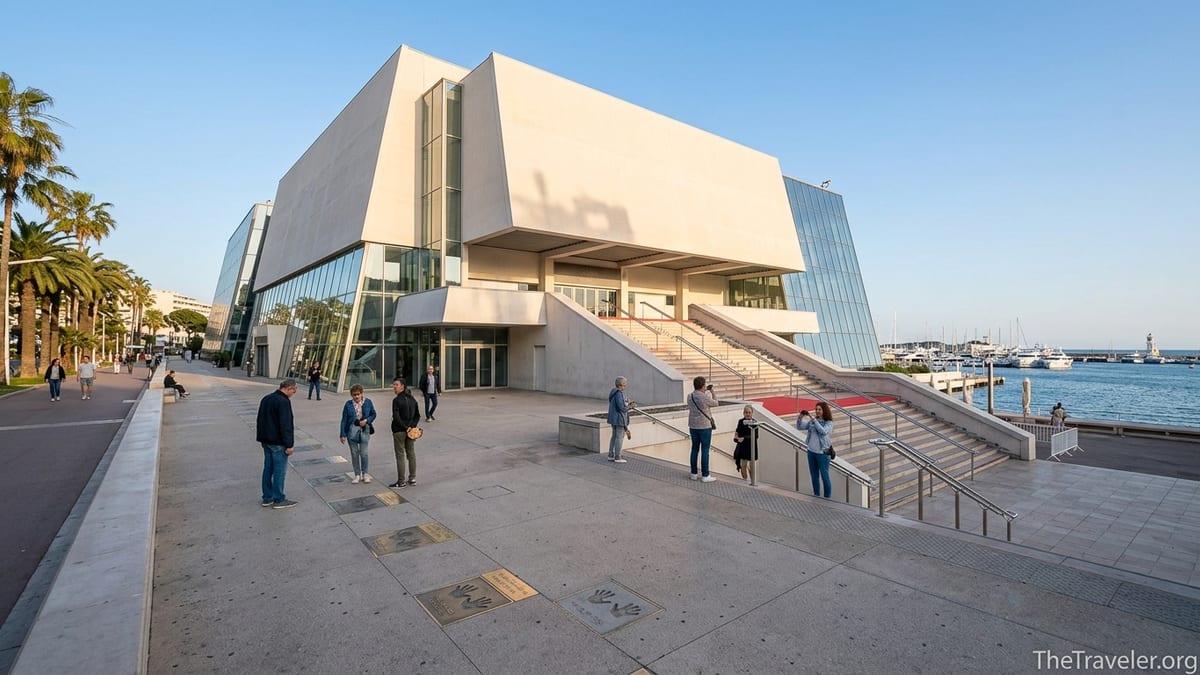
Seen on television, the Palais des Festivals appears almost abstract: a triangular block of light and glass fronted by a staircase lined with perfect scarlet. Up close, the building tells a different story. The structure you see today dates from 1983, built on the site of Cannes’ old municipal casino and designed less as a temple to cinema than as a highly flexible convention center. Its pale, slightly weathered cladding and the way the glass walls angle toward the sea reflect that practical origin as much as any cinematic dream.
Most visitors never realize they are standing in front of one of the busiest congress venues in Europe, used year-round for trade shows like MIPIM, the Cannes Lions advertising festival and major dance and games festivals. Exhibitor banners are often removed or muted during the film festival, but at other times of year you can spot discreet hooks, rails and lighting tracks along the facade that reveal how frequently the exterior is dressed and redressed. Look carefully at the edges of the roofline and you will notice metal rigging points that allow crews to hang giant temporary billboards for film premieres or convention sponsors.
Even small details of the entrance hint at the building’s working life. The red carpet, for example, is not a single monumental fabric but a modular runner that is changed several times during the festival to keep it camera-ready. Outside of May, you will usually find only bare steps or a more muted covering. On quiet days in winter, you may see technicians repainting railings or replacing lighting strips one section at a time, a reminder that for local workers this is a normal job site rather than a permanent movie set.
If you walk around to the seaward side, past the main forecourt, the illusion drops away almost completely. Service ramps, loading bays and a multi-level car park entrance sit directly below the glamorous terraces used for VIP photo calls in May. Delivery vans reverse into bays where, just a few weeks earlier, actors in couture gowns were stepping out of limousines. It is here, in this contrast between backstage logistics and public fantasy, that the real character of the Palais begins to emerge.
The Chemin des Étoiles: Stories Under Your Feet
The most obvious hidden detail at the Palais is literally underfoot. Spreading around the forecourt and along the Croisette side of the building is the Chemin des Étoiles, Cannes’ answer to the Hollywood Walk of Fame. More than 400 concrete slabs bear the handprints and signatures of directors, actors and other festival guests, placed there over several decades. Many day-trippers notice a few famous names near the front steps, snap a photo and move on, but the path continues in several directions, weaving around planters and seating areas that are easy to miss.
These plaques reward slow looking. The signatures tell stories of fashion and ego as much as cinema: some stars press their whole hands deeply into the concrete, others barely touch it. You might find the compact, careful imprint of a French New Wave icon next to the bold scrawl of an American blockbuster director. Slight cracks and discoloration in older plaques show how long Cannes has been hosting this ritual, weathered by salt air and countless footsteps. In quieter months, you can watch local residents cutting through the square, barely glancing down at handprints tourists would happily cross an ocean to see.
The placement of the plaques also reflects the subtle politics of stardom. Big international names are usually clustered near the central staircase and along the most photographed stretches of pavement, while equally important but less widely recognized figures are tucked along the sides. Walk toward the harbor, away from the selfie crowd, and you start to encounter producers, screenwriters and festival organizers whose handprints rarely appear on postcards but who shaped the event from behind the scenes. For cinephiles, tracing this path is like walking through the footnotes of festival history.
Practical details are easy to overlook as well. A small panel from the tourist office near the square sometimes offers a printed map of notable handprints, but you will often get more up-to-date information by asking at the nearby tourism desk inside the Palais when it is open. They occasionally run themed routes, for example highlighting Palme d’Or winners or major French stars, which can turn a casual stroll into a surprisingly rich hour-long walk through the area around the building.
Inside the Louis Lumière Auditorium
Beyond the security lines and glass doors lies one of the least understood spaces in Cannes: the Grand Auditorium Louis Lumière. On television, it appears only as a darkened hall briefly illuminated by camera flashes during premieres. In reality it is a vast, steeply raked theater seating around 2,300 spectators, designed to function both as a cinema and a high-end conference hall. Its dimensions are imposing even when empty; the screen alone is roughly 19 meters by 8 meters, among the largest permanently installed cinema screens in Europe.
What most visitors never see are the technical upgrades that keep this room at the cutting edge of film presentation. Ahead of recent festivals, the auditorium was outfitted with Dolby Atmos immersive sound and a battery of projectors capable of handling a wide range of formats for both festival screenings and commercial events. If you attend a public concert or dance performance here outside May, you might notice slim speaker arrays and lighting rigs permanently integrated into the walls and ceiling, almost invisible during film premieres but clearly visible when the stage is bare.
From certain seats near the back you can glimpse a hint of the projection booth, a floor that doubles as a broadcast hub during the festival. The same room that sends images to that enormous screen is also connected to television trucks outside, relaying red carpet arrivals and ceremony footage to broadcasters around the world. On a normal business conference day, those connections are used instead for live translations, corporate livestreams and simultaneous presentations in other rooms of the Palais.
Travelers rarely realize that it is sometimes possible to experience this legendary auditorium without an industry badge. During the rest of the year, the city programs classical concerts, comedy shows and touring productions that locals can book through the official ticket office, often starting from roughly the price of a standard cinema ticket in France. For a visitor, slipping into a concert or ballet here on a winter evening offers a surprisingly affordable way to sit where Palme d’Or winners have stood, without needing a tuxedo or invitation.
Foyers, Salons and Terraces Few Tourists See
The most photographed part of the Palais is the staircase facing the Croisette, but much of its character lies just above and behind it in a series of foyers and salons. Directly above the Louis Lumière foyer, the Salon Croisette, also known as Salon Pierre Viot, has been extensively refurbished in recent years. It features floor-to-ceiling windows looking out over the bay and the Lérins Islands, with pale wood finishes and modular seating that can be rearranged from press lounge to gala cocktail space in a matter of hours.
During major congresses, these upper levels function as meeting and networking hubs, filled with branded coffee stands, temporary studios and interview corners. At other times, especially in the shoulder seasons, they can be eerily quiet. If you join an official guided tour of the Palais, which the local tourist office occasionally organizes in French and English, you may be led through these spaces and notice small, easily overlooked details: discreet wall sockets for simultaneous translation headsets, ceiling tracks for quick partitioning of rooms, and floor markings that show where temporary walls and camera platforms are usually installed.
Terraces wrapping around the first and second floors are another hidden asset. Many are closed to the general public during ordinary days, but if you attend a trade show or cultural event you might find yourself stepping outside between sessions to panoramic views over the Palais’ angular roof and the harbor marinas, a perspective very different from the seafront promenade below. From here, the famous red carpet staircase appears as just one element in a much larger puzzle of circulation routes, service doors and emergency exits.
Even the artwork in these semi-private spaces tends to escape visitors’ attention. Temporary photography exhibitions related to the festival’s history or to current cultural seasons are often mounted in the foyers and mezzanines. In the off-season you might encounter large black-and-white portraits of directors, or archival images of the very first festivals held in the now-demolished Palais Croisette, displayed in corridors that business travelers stride through without a second glance.
Working Backstage: The Palais as Everyday Workplace
On television, the Palais seems to belong to film stars. In daily life, however, it belongs more to the hospitality staff, technicians and municipal employees who keep it running. Visit on a weekday in January or February and you are more likely to see forklift operators moving crates into exhibition halls than evening gowns on the stairs. The same polished marble floors that reflect camera flashes in May bear the scuff marks of trade show stands the rest of the year.
Subtle signs of this working identity are everywhere if you pay attention. Directional signage mounted high on walls points not only to auditoriums but to loading docks, security offices and staff canteens. Floor plans posted at certain entrances reveal an enormous warren of underground corridors and multipurpose rooms that stretch beneath the streets around the building, largely invisible to casual visitors on the forecourt. During large conventions, temporary badge checkpoints and registration desks spring up in corners that are otherwise bare, leaving small screw holes and faded marks on the floor when they are removed.
Local businesses also interact with the Palais in ways visitors might not notice. A modest McDonald’s across the street does brisk trade in late-night festival snacks, but serves the same role for stagehands and junior staff setting up early-morning events the rest of the year. Small cafés just off the Croisette offer fixed-price lunch menus tailored to congress participants on tight schedules, with service calibrated to the gaps between sessions. If you visit during a quieter period, you can sit at these same tables and overhear technicians comparing lighting setups or interpreters discussing the challenges of a recent multilingual conference.
For travelers, recognizing the Palais as an everyday workplace can change the way you move around it. Arriving a bit earlier for a show or guided visit, you might watch how staff coordinate crowd flows at the main entrance or how security teams quietly check badges while still keeping the atmosphere welcoming. The more you observe, the more the building’s apparent glamour resolves into something more interesting: a shared stage where thousands of unseen professionals make a famously polished event look effortless.
Cinema Beyond the Walls: Murals and Memory Around the Palais
One of the easiest details to miss in Cannes is not inside the Palais at all but scattered around it: the city’s series of painted cinema murals. Several large gables and building sides within walking distance of the festival site are covered with trompe-l’oeil scenes of film history, from giant portraits of Marilyn Monroe to homages to French stars and classic movie posters. These murals are part of an ongoing municipal project celebrating Cannes’ connection to cinema, and together they form an open-air gallery that many visitors never realize exists.
From the steps of the Palais, a short walk toward the old port brings you to walls showing scenes that echo the red carpet ritual itself, with painted figures ascending stylized staircases. Elsewhere, near the market streets, you can spot a mural recalling a famous French film romance or a montage of directors and actors drawn from different eras of the festival. The paintwork is subtly weathered by sea air and traffic, lending it a patina more reminiscent of old cinema posters than fresh street art.
These murals subtly extend the Palais’ influence into the everyday fabric of the town. While the building itself may feel slightly detached from the lived-in streets of Cannes, the painted walls appear above grocery shops, cafés and apartment balconies. Locals pass them on the way to work, and school groups sometimes pause beneath them on walking tours that trace the city’s cinematic heritage. For a visitor, mapping a short route from the Palais through several mural sites can turn a quick detour into a satisfying hour-long exploration that deepens your sense of Cannes as more than a luxury resort.
Many of these murals are best seen at particular times of day: early morning light can make the colors softer and the brushwork clearer, while late afternoon sun throws deep shadows that emphasize the three-dimensional illusions. Bringing a camera with a modest zoom lens allows you to capture details, such as a painted camera or signature, that are hard to appreciate from street level. In this way, the wider streets around the Palais become a kind of extended lobby, filled with visual footnotes to what happens inside.
How Travelers Can See More Than the Red Carpet
For individual travelers, the biggest challenge with the Palais is access. During the Cannes Film Festival itself, most of the building is restricted to accredited guests and security is extremely tight. However, outside those dates, a surprising number of events are open to the general public, often at reasonable prices compared with other Riviera attractions. The city’s cultural season regularly programs concerts, stand-up comedy, ballet and family shows in the main auditoriums, with tickets that can sometimes start around the cost of an ordinary movie ticket in a major European city.
Planning ahead helps. If you know your travel dates, it is worth checking the official ticketing platform for the Palais a few weeks before you arrive to see if any performances coincide with your stay. Because this is a working congress center, there may be days when parts of the building are occupied by private corporate events but evenings remain free for public shows. Locals often snap up the most popular dates quickly, but lesser-known dance performances or touring orchestras can have good availability even a few days before the event.
On days without major events, the public foyer at ground level sometimes functions as an information space, and staff at the tourist office nearby can tell you whether any guided tours of the Palais are scheduled. These tours, when available, are one of the few opportunities for non-industry visitors to see spaces like upper foyers or side auditoriums and to hear explanations of details such as the building’s energy-saving renovations or the logistics of hosting major summits like the G20.
Even if the interior is off-limits during your visit, you can still deepen your experience by approaching the building at different times. Early morning reveals cleaners hosing down the staircase and workers rolling out or removing carpet sections. Late at night, after most crowds have gone, the illuminated glass walls reflect the harbor lights in subtle patterns. Simply circling the complex slowly, following the lines of the Chemin des Étoiles and pausing at viewpoints over the bay, can turn a one-minute photo stop into a more thoughtful encounter with a place that is both mythic and mundane.
The Takeaway
Palais des Festivals is often reduced, in photos and news coverage, to an image of celebrities on a staircase. Yet for visitors willing to slow down, it offers something richer: a layered portrait of how a modern city hosts global spectacle while remaining a place of work, memory and small human gestures. The handprints embedded in its forecourt, the quietly humming projection systems inside, the rooftop terraces and the painted walls nearby all bear marks of people whose names may never appear on a poster.
By looking beyond the obvious view of the red carpet, you begin to see how Cannes has woven cinema into its everyday life. The Palais is not just where prizes are handed out; it is where school groups attend matinees, where technicians test sound systems for trade shows, where locals sit in the back row for a visiting symphony orchestra on a rainy February night. These are the moments that give the building its depth, and that most visitors miss.
If you find yourself in Cannes, give the Palais more than a glance. Walk the full loop of the Chemin des Étoiles, search out a performance or tour, and take time to notice the quiet details in the foyers and around the loading bays. You may discover that the most interesting side of this famous landmark has nothing to do with paparazzi flashes at all, and everything to do with the everyday work and memory that keep its legend alive.
FAQ
Q1. Can I visit inside the Palais des Festivals if I am not attending the Cannes Film Festival?
Yes, at many times of the year the Palais hosts public events such as concerts, dance performances and comedy shows, and tickets are sold through its official ticketing service. On some dates, guided tours are also offered, giving visitors access to selected foyers and auditoriums.
Q2. Is it possible to walk on the red carpet stairs?
Outside of major events, the main staircase is usually open to the public, though the red carpet itself may not always be in place. During the Cannes Film Festival and some congresses, access can be restricted or controlled by security, so it is worth checking locally if you visit in May.
Q3. How long does it take to explore the Chemin des Étoiles handprints?
If you only look at the plaques directly in front of the stairs, it can take just a few minutes. To follow the handprints around the building and along the Croisette, plan for at least 30 to 45 minutes, especially if you like stopping to photograph individual names.
Q4. Are there English-language tours of the Palais des Festivals?
When tours are running, they are often offered in both French and English, especially in peak visitor seasons. Schedules change throughout the year, so it is best to ask at the Cannes tourist office or check the official Palais events information before your visit.
Q5. Do I need to dress formally to attend an event inside the Palais?
For ordinary concerts, dance shows or comedy nights outside the film festival, smart-casual clothing is generally acceptable and you will see many locals dressed that way. The strict formal dress codes you may hear about mostly apply to official festival premieres and high-profile gala evenings.
Q6. Is photography allowed inside the Louis Lumière auditorium?
Policies can vary by event, but in most cases photography during performances is restricted or forbidden to avoid disturbing artists and other audience members. Before or after an event, staff may allow quick photos of the room itself, provided you avoid using flash and follow any instructions from ushers.
Q7. Can I visit the cinema murals near the Palais on my own?
Yes, the murals are painted on building exteriors around Cannes and can be visited freely at any time, like outdoor public art. The tourist office sometimes provides maps or suggested routes, but you can also simply wander the streets between the Palais, the old port and the shopping district to discover them.
Q8. What is the best time of day to see the Palais without big crowds?
Early morning outside peak season is usually the quietest, with only a few joggers and commuters on the Croisette. Late evening can also be calm, especially when there are no major events on the schedule and the forecourt is lit but not crowded.
Q9. Are there any free things to do around the Palais des Festivals?
Yes, walking the Chemin des Étoiles handprints, exploring the nearby cinema murals and enjoying the views over the harbor from the public areas are all free. You can also watch the daily life of Cannes unfold on the adjacent beaches and promenade without spending anything.
Q10. Is the Palais des Festivals accessible for travelers with reduced mobility?
The building is equipped with ramps, elevators and designated seating areas in its major auditoriums to accommodate guests with reduced mobility. If you are attending a specific event, contacting the ticket office in advance can help ensure appropriate seating and assistance at entrances.