


Even if you never set foot inside the Cannes Film Festival, standing at the foot of the famous red carpet at the Palais des Festivals et des Congrès is one of the Riviera’s great travel moments. The building is a working convention center used year-round, but with a little planning you can visit without missing its key highlights, whether you come in the quiet of winter or at the height of the May festival frenzy.
Get the latest updates straight to your inbox!
Understanding the Palais and Its Place in Cannes
The Palais des Festivals et des Congrès sits at the western end of the Boulevard de la Croisette, the seafront promenade that defines Cannes. It has hosted the Cannes Film Festival since 1983 and also anchors major events such as the music industry’s MIDEM, television’s MIPCOM and MIPTV, and the Festival International des Jeux board‑games fair. For most of the year, it feels more like a sleek business venue than a movie palace, yet the red-carpet staircase and the vast Grand Auditorium Lumière have become global shorthand for cinematic glamour.
The current Palais replaced an older venue further along the Croisette and was purpose-built to handle the logistics of one of the world’s largest film markets. Today the complex contains multiple auditoriums, exhibition halls, a rooftop terrace, and direct access to the harbor and beaches. From a visitor’s point of view, this means that even outside the film festival you are likely to see trade-show banners, security checkpoints, and crews setting up for the next event.
For travelers, the key is to remember that this is a working site first and a sightseeing stop second. You can usually access the forecourt, the steps, and the seafront terrace freely, but interior access depends on what is going on. During major congresses, parts of the building can be reserved to badge holders only, whereas on quieter days you may find the ground-floor foyer open with information desks and small exhibitions.
The surrounding area is as much a part of the experience as the building itself. Immediately opposite lie the yacht-filled Old Port and the start of Le Suquet, Cannes’ old town, while to the east the Croisette curves past luxury hotels like the Carlton and the Majestic. If you allow a full morning or afternoon, you can comfortably combine the Palais’ highlights with a stroll through these emblematic neighborhoods.
When to Visit: Festival Season vs the Rest of the Year
Your experience at the Palais will differ dramatically depending on whether you visit during the Cannes Film Festival, usually held over twelve days in May, or at another time. In high festival season, the area around the building is fenced into a “Festival Zone” with security checks and badge-only entrances. As a casual visitor you cannot walk inside the Palais or onto the red carpet, but you can usually approach the base of the steps, watch the crowds, and observe the nightly “montée des marches” from behind the barriers.
Outside May, access is much more relaxed. On a midweek morning in October, for example, you might find only a handful of conference attendees on the forecourt and locals using the steps as a shortcut between the Croisette and the harbor. This is the best time to get clean photos on the staircase, explore the esplanade with its handprints, and step inside if the ground floor is open. Cruise passengers docking in Cannes between March and November often find that the Palais is one of the first landmarks they see when they come ashore by tender.
Prices across the city also fluctuate with the festival calendar. During the film festival and big trade fairs, hotel rates can easily be several times higher than in shoulder seasons like March or late October, and even a basic coffee on the Croisette can feel inflated. If your goal is to see the building and walk the steps without battling crowds or premium prices, consider visiting in late winter or early spring. You will still recognize the red-carpet staircase, even if the actual carpet is only rolled out for major events and premieres.
If you are determined to experience the festival atmosphere itself, you do not need credentials to feel part of it. From mid-afternoon onward, the streets between the train station and the Palais become packed with fans, industry people, and curious onlookers, and free outdoor screenings are usually held each evening on the beach at the Cinéma de la Plage. Many travelers build a day trip around arriving mid-morning by train from Nice, exploring the old town, then joining the crowds near the Palais by early evening to watch the red-carpet arrivals from behind the barriers.
Getting There and Navigating Security
The Palais is straightforward to reach on foot from almost anywhere in central Cannes. The main SNCF train station is roughly a seven-minute walk away along Rue Jean Jaurès and Rue d’Antibes toward the sea. Many visitors base themselves in Nice and come in for the day by regional TER train, which typically takes about 35 to 40 minutes and drops you within walking distance of the Palais. From Nice Côte d’Azur Airport, an express bus runs to Cannes in about 45 minutes, stopping close to the seafront near the Palais.
Local Palm Bus lines also serve the area around the Palais, but for most visitors the building is a natural stop on a walking circuit along the Croisette and into the old quarter of Le Suquet. Taxis and ride-hail cars can drop you near the entrance during normal periods, though during the film festival many streets around the Palais are closed or heavily congested. Drivers report that routes between the Croisette and the station can be gridlocked in the evenings, so if you are arriving by car in May, consider parking further out and walking in.
Because the Palais hosts high-profile events year-round, security screening is a normal part of the landscape. When large conferences or the film festival are in session, expect bag checks and metal detectors at the entrances, and fenced-off sections reserved for badge holders. As a casual visitor, you are usually allowed to approach the base of the steps and the open forecourt, but interior areas, including auditoriums and upper foyers, will often be off limits unless you hold event accreditation or a ticket.
During the Cannes Film Festival, access rules are especially strict. Even accredited guests are required to show both a badge and a separate digital ticket for screenings inside the Palais, and security staff can turn away anyone who does not comply with the dress code for evening red-carpet events. For general travelers, the simplest strategy is to enjoy the spectacle from the public side of the barriers, arrive with minimal bags to speed up any checks, and avoid bringing glass bottles or bulky tripods that might be refused near the security perimeter.
Red-Carpet Steps, Handprints and the Best Photo Spots
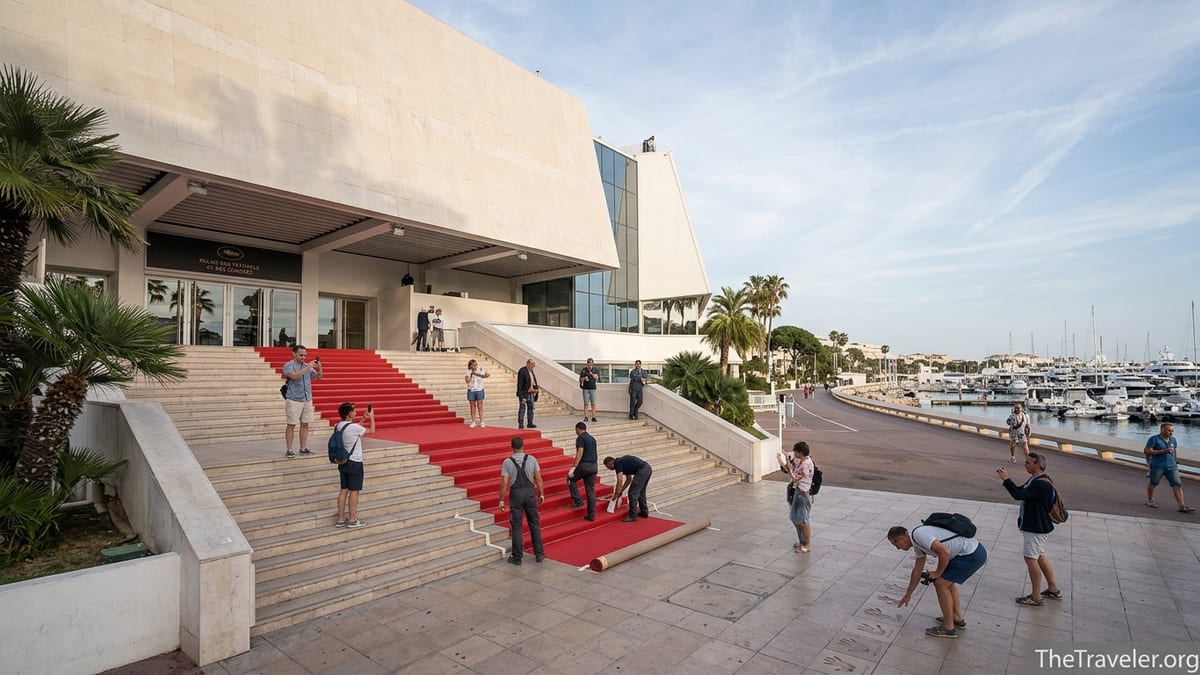
For most visitors, the main objective is to see and photograph the famous red-carpet staircase, known locally as the “marches.” The staircase rises from the forecourt on the Croisette side of the building and is visible from a distance as you approach from either direction. Outside official events, the steps are surprisingly informal: locals sit on them to chat, children run up and down, and tour groups pause for a few minutes so everyone can get their “Cannes premiere” photo.
Do not worry if the carpet itself is missing when you arrive. The iconic red runner is typically laid out only for significant premieres, awards shows, and certain festival screenings. The rest of the time the staircase is a light stone color. If work crews are preparing for an event, you might see them rolling out or cleaning the carpet in the afternoon, which can be an interesting behind-the-scenes glimpse. Either way, the angle of the staircase framed by the glass facade and the Croisette behind it makes for a recognizable shot.
Just beside the steps on the forecourt you will find a series of concrete slabs embedded in the pavement, each bearing the handprints and signatures of film stars and directors who have attended the festival. This “Chemin des Étoiles” works much like the handprints outside Grauman’s Chinese Theatre in Hollywood, and spotting familiar names can be a fun way to linger a bit longer. Many visitors do not realize the handprints are there until they almost trip over them, so if you are leading a small group, it is worth pointing them out explicitly.
For wide-angle photos, the best vantage points are across the street toward the harbor, where you can capture the entire facade of the Palais with the steps, or slightly elevated from the corner of the square near the carousel looking back toward the building. For people shots, ask a companion to stand halfway up the staircase facing down toward the Croisette, so that the person fills the foreground and the curve of the bay forms the background. Early morning and late afternoon usually offer softer light and fewer crowds.
Inside the Palais: Tours, Events and Practical Details
Unlike many historic theaters, the Palais is not permanently open for self-guided interior visits. Access to its main spaces, including the Grand Auditorium Lumière and the Debussy and Bazin theaters, normally comes through event tickets or guided tours arranged by the local tourism office. In some years, the Cannes tourism board has offered paid guided visits that include backstage areas and a peek into the projection booths, typically scheduled outside major congress dates. These sell out quickly when available, so check current offerings at the Palais-based tourist office when you arrive in town.
More commonly, visitors experience the interior during another event, such as a concert, dance performance, comedy show, or a public film screening connected to local festivals. Tickets are sold through the official Cannes ticketing platform and at the tourist office desk inside the Palais. Prices vary with the event, but it is possible to find evening performances under the vaulted ceilings for sums that are comparable to midrange theater tickets in other French cities, making this one of the more atmospheric ways to see the building at work.
The ground-floor foyer, when open to the public, usually houses information counters, promotional exhibitions, and practical services such as a ticket desk and small boutique. You may find displays about Cannes’ festival history, photo exhibitions of past red-carpet moments, or scale models of the building itself. If you are attending a ticketed event, arrive at least 30 minutes early to clear security, find your seat, and explore these exhibits without rushing.
Facilities inside the Palais are on par with a major convention center: expect cloakrooms during large events, accessible restrooms, and concessions or bars serving drinks and snacks at intermission. Dress codes for regular concerts or shows are relaxed, but if you have secured a ticket to a gala screening or awards ceremony, plan on conservative evening wear in line with published festival guidelines. Even then, photography inside the auditoriums is tightly controlled, and you should not expect to take pictures during the event itself.
Combining the Palais with a Cannes Walking Itinerary
Because of its central location, the Palais works well as the anchor point for a half-day exploration of Cannes. One popular approach is to start at the train station, walk down toward the sea via the shopping street Rue d’Antibes, then emerge onto the Croisette with the Palais rising to your right. After taking photos on the steps and exploring the handprints, you can stroll along the harbor front to see fishing boats and sleek yachts side by side.
From there, continue up into the old quarter of Le Suquet, a fifteen- to twenty-minute walk that rewards you with cobbled lanes, small wine bars, and panoramic views back toward the Palais and the curve of the bay. Many visitors time their climb so that they are at the hilltop near the church of Notre-Dame d’Espérance around golden hour, when the light softens over the harbor. This gives you a beautiful overhead perspective on the Palais that contrasts with the up-close experience of the red-carpet steps.
If you prefer to stay by the water, turn east along the Croisette instead. Within ten to fifteen minutes you will pass several of Cannes’ legendary hotels and private beach clubs, many of which set up temporary pavilions and branded terraces during the film festival. Even outside May, their striped loungers, white parasols, and outdoor bars make for a postcard-style Riviera setting. You can easily see the Palais from multiple angles along this curve of shoreline, which helps you appreciate its integration into the cityscape.
Visitors with more time might add a boat trip to the Lérins Islands, visible from the Palais forecourt. Ferries depart from the nearby terminal and reach the islands in about fifteen minutes, making them a popular half-day escape from the bustle of the Croisette. Returning to the mainland in late afternoon, you will once again pass the Palais from the water, giving you yet another perspective on the building’s size and its relationship to the harbor and promenade.
Visiting During the Cannes Film Festival Without a Badge
Many travelers worry that visiting Cannes during the film festival without accreditation will be frustrating, but with the right expectations the Palais and its surroundings can still be the centerpiece of a memorable day. The key is to accept that you will not be going inside the Palais for gala screenings and instead focus on the public-facing experiences. These include watching arrivals on the red carpet from behind the barriers, spotting celebrities outside the nearby hotels, and attending the free outdoor screenings on the beach in the evening.
Plan to arrive by midday to get your bearings before the late-afternoon peak. Streets between the station and the Palais are busy but walkable, and you will pass festival posters, pop-up photo booths, and branded installations. Near the Palais, large screens are often set up to show live footage of press conferences and red-carpet entrances, so even if you are several rows back from the barriers you can still see the action. Fans gather hours in advance for prime spots, especially for high-profile premieres, so if your goal is to witness the main arrivals, be prepared to stand your ground.
The red-carpet dress code and security checks apply only to those actually entering the Palais for screenings, which means the crowd outside is much more relaxed in appearance. You will see everything from evening gowns to T-shirts and sneakers among onlookers. That said, local authorities still enforce general safety rules, and large backpacks, glass bottles, or bulky camera equipment may be restricted near the densest sections of the crowd. Keep your valuables close, stay hydrated, and factor in extra time to move through the packed streets when heading back to the station at night.
For many visitors, the most accessible way to feel part of the festival is to attend a free evening screening at the Cinéma de la Plage, the open-air cinema set up on the beach within walking distance of the Palais. These shows typically start after dark and can include restored classics, cult favorites, or films from the festival’s official selection. Arriving an hour early with a light jacket and something to sit on will usually secure you a place, and watching the screen with the lights of the Croisette and the silhouette of the Palais in the background is a highlight that rivals going inside.
The Takeaway
Whether you come to Cannes in the quiet months or at the height of the film festival, the Palais des Festivals is more than just a photo stop. Understanding that it is a working convention center, knowing when access is relaxed and when the Festival Zone is sealed behind security, and having a sense of where to stand for the best views can transform a brief visit into a memorable experience. Even without accreditation, you can climb the famous steps between events, trace your fingers over actors’ handprints in the pavement, and feel the buzz of red-carpet nights from just beyond the barriers.
For most travelers, the smartest approach is to treat the Palais as the anchor to a broader exploration of Cannes. Combine your time on the forecourt with a walk up to Le Suquet, an amble along the Croisette past the grand hotels, or a short boat hop out to the Lérins Islands. If a public concert or screening inside the Palais coincides with your dates, take advantage of it to see the interior working at full scale. With a bit of planning and realistic expectations, you can visit this modern symbol of movie glamour without missing any of its essential highlights.
FAQ
Q1. Can I walk up the red-carpet steps at the Palais des Festivals?
Yes, outside of major events and while the Festival Zone is not sealed, the staircase is usually open to the public, although the actual red carpet is only rolled out for specific premieres and ceremonies.
Q2. Is it possible to visit inside the Palais without accreditation?
Sometimes. Interior access is typically tied to specific events, guided tours, or ticketed performances. On ordinary days you may be able to enter only the ground-floor foyer, not the main auditoriums.
Q3. Do I need a ticket to see the Palais from the outside?
No. The forecourt, base of the steps, and surrounding promenade are public spaces, so you can see and photograph the exterior freely at any time of year.
Q4. How close can I get to the Palais during the Cannes Film Festival?
You can normally approach the public side of the security barriers around the Festival Zone, watch the crowds and red-carpet arrivals, and move along the Croisette, but entrance to the building itself is restricted to accredited guests with tickets.
Q5. Are there English-language tours of the Palais des Festivals?
When guided visits are offered, they often include English-language departures, but availability varies through the year, so it is best to check with the tourist office inside the Palais after you arrive in Cannes.
Q6. What is the best time of day to photograph the Palais?
Early morning and late afternoon usually provide softer light, fewer crowds on the steps, and clearer views of the facade and harbor, making it easier to frame both the building and the bay.
Q7. How long should I plan for a visit to the Palais and nearby sights?
If you are only interested in photos on the steps, thirty minutes may be enough, but combining the Palais with a walk along the Croisette or up to Le Suquet works well as a half-day outing.
Q8. Is the area around the Palais safe at night?
Yes, the surroundings are generally busy and well lit, especially during events and festival season, though you should take normal city precautions with valuables and late-night transport.
Q9. Can children visit the Palais and enjoy the experience?
Children are welcome in the public areas, and many enjoy climbing the steps, spotting stars’ handprints in the pavement, and watching the bustle of the harbor right in front of the building.
Q10. Do I need special clothes to visit the Palais?
For daytime visits to the exterior and public foyer, casual attire is fine, but evening gala screenings inside the Palais during the festival typically require formal or at least smart dress for those with tickets.