


More news on this day
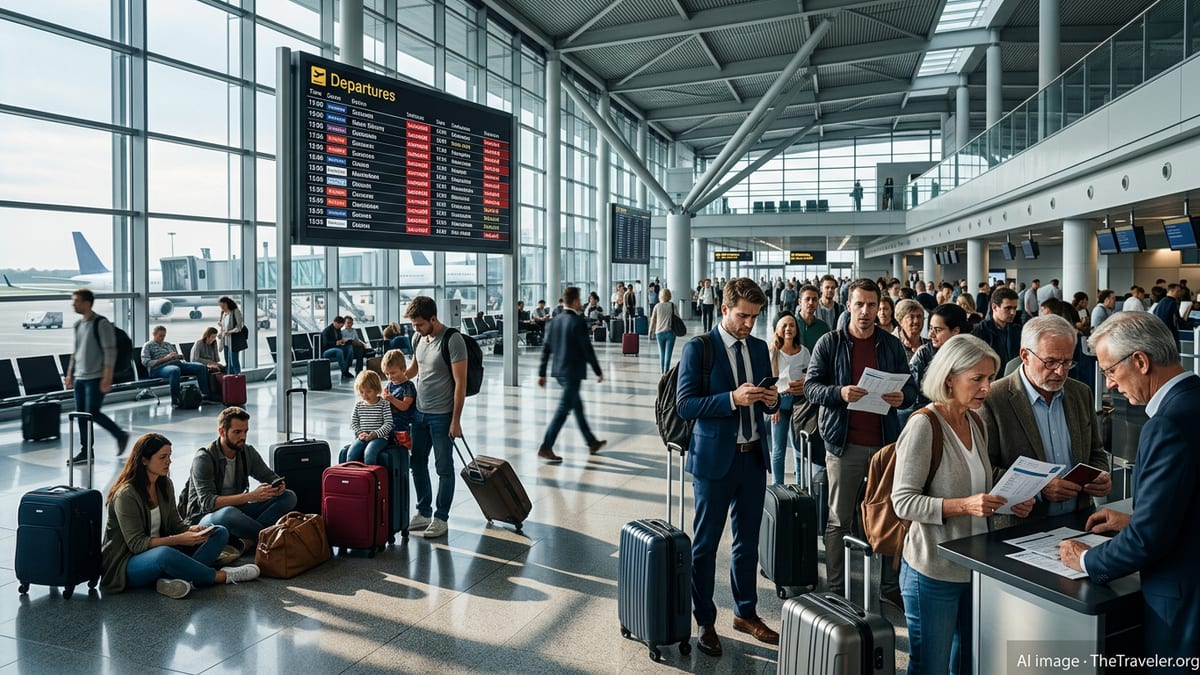
Thousands of passengers have been stranded across Italy as a new wave of flight disruption sweeps through major hubs in Catania, Rome, Milan, Venice and other cities, with 223 flights cancelled and 704 delayed in a single day, according to aggregated operational data and industry reports.
Get the latest news straight to your inbox!
Major Italian Hubs Buckle Under Heavy Disruptions
Published operational snapshots from flight-tracking and industry outlets show Italy’s busiest airports experiencing one of their most difficult days of the year, with cancellations and delays rippling through the network from early morning into the evening. Rome Fiumicino and Milan Malpensa, the country’s largest international gateways, account for a significant share of the 223 outright cancellations and more than 700 delays, while Venice, Bergamo, Bologna, Naples, Pisa and Turin report mounting knock-on effects.
At Milan Malpensa, industry data circulated via aviation and financial monitoring services indicates that 81 flights were grounded and 19 delayed in one day, with low cost and network carriers alike forced to thin their schedules. Cancellations there alone represent well over one third of all flights scrubbed at the airport, underscoring how a local shock can cascade into national and cross-border disruption.
Further south, Catania Fontanarossa in Sicily has been hit by what local media describe as a “perfect storm” of operational stress. Reports from regional outlets point to a combination of strike-related disruption and renewed activity from Mount Etna affecting routings and forcing airlines to cancel or divert flights to and from the island’s main gateway. Services linking Catania with Rome, Milan, Naples, Pisa and several European capitals have been among those cut or re-routed.
In Venice and other northern gateways, the overall number of affected flights is smaller in absolute terms but still significant during the busy early-summer travel period. Flight boards at Venice Marco Polo, Bergamo Orio al Serio and Bologna Guglielmo Marconi have filled with delayed departures and late arrivals as aircraft and crews become displaced elsewhere in the system.
Ryanair, Wizz Air, easyJet and Lufthansa Among Hardest Hit
The disruption has swept across airline business models, impacting ultra low cost, low cost and full service carriers operating to and from Italy. Data compiled by travel-industry news outlets and aviation analysts indicates that Ryanair, Wizz Air, easyJet and Lufthansa are among the brands most exposed to the current pattern of cancellations and delays, reflecting both their scale in the Italian market and the density of their schedules at key hubs.
From Milan Malpensa alone, Ryanair is reported to have cancelled 27 flights in one day, representing roughly 30 percent of all cancellations at the airport, while Wizz Air Malta accounts for around 20 cancelled departures. Vueling, easyJet, British Airways, Lufthansa, Air France, Iberia, SAS, Icelandair, Swiss, TAP Air Portugal and several leisure operators all appear in airport disruption tallies, highlighting how widely today’s problems are spread.
Across the wider Italian network, travel and tourism industry coverage points to particularly heavy operational pressure on Ryanair, Wizz Air and easyJet, which depend on tight aircraft turnarounds and high daily utilization. Any extended air traffic restriction, ground handling bottleneck or local weather complication can quickly accumulate into missed slots, crew duty-time challenges and, ultimately, cancellations.
Network carriers such as Lufthansa, Air France and KLM, which use Italian cities as spokes feeding larger hubs in Germany, France and the Netherlands, are experiencing secondary impacts as they wait for delayed aircraft and passengers to connect. This has led to additional missed connections for travelers bound for long-haul destinations beyond Europe.
Catania’s “Perfect Storm” Adds Local Crisis to National Strain
While Rome and Milan remain the numerical epicenters of Italy’s air travel problems, Catania has become an emblem of how quickly local factors can deepen a national aviation crunch. Coverage from Sicilian news outlets describes how a combination of volcanic activity from Mount Etna and labor action affecting the aviation sector has led to sweeping schedule changes, diversions and cancellations.
Among the cancelled or diverted services at Catania are flights operated by Vueling to Barcelona, several Wizz Air routes to northern Italy and Eastern Europe, links by ITA Airways to Rome Fiumicino and Milan Linate, and multiple Ryanair flights to Naples, Pisa, Rome, Turin and Alghero. Additional disruptions have been reported on services by Scandinavian and French leisure carriers operating to Copenhagen, Rotterdam and Paris-area airports.
When volcanic ash threatens flight paths or airport airspace, airlines are required to adjust routings or halt operations, often at short notice. Combined with industrial action and existing congestion in Italian airspace, the result has been a tangle of diverted aircraft and passengers funneled to alternate Sicilian and mainland airports, straining capacity there as well.
For travelers, this has translated into extended waits at Catania and surrounding airports, last-minute coach transfers between terminals, and overnight stays far from original destinations. With Sicily serving as a key gateway for both domestic and international tourism, any protracted disruption risks having an outsized impact on the region’s visitor economy.
Knock-On Effects Across Europe and Guidance for Travelers
Because Italy occupies a central position in European aviation, the current wave of cancellations and delays is producing ripple effects well beyond its borders. Travel and tourism reports tracking delay statistics highlight disrupted services between Italian hubs and major cities such as Paris, Frankfurt, London, Madrid and Zurich, as aircraft and crews fail to arrive on time for onward rotations.
On some intra-European routes, airlines have turned to tactical schedule thinning and aircraft swaps to preserve at least partial service. This approach can help limit the overall number of cancellations but often results in downgraded seating capacity, last-minute aircraft changes and a higher likelihood of missed connections for passengers with tight itineraries.
Publicly available information from consumer organizations and aviation regulators emphasizes that, under European Union rules, passengers affected by long delays or cancellations may be entitled to assistance such as meals, accommodation and, in certain cases, financial compensation, depending on the cause of the disruption. Weather-related events or airspace closures typically fall into different categories than staffing or purely operational issues, which makes individual circumstances important.
Travel-industry coverage consistently advises passengers scheduled to fly to, from or through Italy’s main hubs to monitor their flight status closely on the day of departure and to allow extra time at the airport, especially where security or border-control queues have recently lengthened. Where possible, travelers with onward connections are being encouraged to build in longer layovers or to consider more flexible ticket options that simplify rebooking when schedules unravel.
Strained Summer Season Highlights Systemic Vulnerabilities
The latest mass disruption underscores the broader fragility of Europe’s aviation system during peak travel periods. Italy, with its dense mix of domestic, intra-European and long-haul traffic, is particularly vulnerable when several stress factors align. Seasonal storms, localized industrial disputes, infrastructure constraints and high demand together create conditions in which small operational shocks can quickly multiply.
Analysts following Italian and European aviation note that recurring patterns of cancellations and delays at hubs such as Rome Fiumicino, Milan Malpensa, Venice and Catania are prompting renewed calls for investment in air traffic management, airport infrastructure and ground handling resilience. Industry commentary points to staffing levels, contingency planning and more coordinated communication between airlines and airports as key areas for improvement.
For now, today’s total of 223 cancellations and 704 delays serves as a stark indicator of how swiftly travel plans can be upended. With the busy summer season still unfolding, passengers planning trips through Italy’s airports in the coming weeks may face further bouts of disruption, even as airlines and airport operators work to restore regular operations and rebuild confidence among travelers.