


Cherry blossom season is Japan’s most sought after travel moment, and 2027 will be no exception. Flights, hotels and rail passes are already in high demand for late March and early April, yet the reality of sakura is more nuanced than a single peak week. Blossoms begin in Okinawa as early as January and reach Hokkaido in late April or early May, while full bloom in Tokyo or Kyoto usually lasts less than 10 days. Planning the perfect 2027 cherry blossom trip means matching your dates to regional bloom patterns, understanding how forecasts work, and building an itinerary that balances famous sights with lesser known alternatives where you can actually find a quiet spot under the trees.
Get the latest updates straight to your inbox!
What We Know About Japan’s Cherry Blossoms in 2027
No official long range cherry blossom forecast exists yet for 2027, but travelers can plan using historical averages and recent trends. Data compiled from Japan Meteorological Agency observations over the 1991 to 2020 period shows that the main variety, Somei Yoshino, usually opens in Tokyo and Kyoto in the last week of March, with full bloom following roughly a week later. In Fukuoka on Kyushu, first bloom typically comes slightly earlier, around March 22, while in Sapporo on Hokkaido the blossoms usually peak in late April or early May.
Recent years have run somewhat earlier than those long term averages. In 2026, official records based on benchmark trees show Tokyo’s first blossoms opening on March 19 and reaching full bloom on March 28, both several days ahead of average. Kyoto’s full bloom in 2026 was recorded on March 30, while Sapporo’s was on April 24, also earlier than the historical norm. Climate research using centuries of Kyoto records points to a gradual shift toward earlier flowering, so for 2027 it is prudent to assume that many regions may again bloom a few days ahead of the older averages.
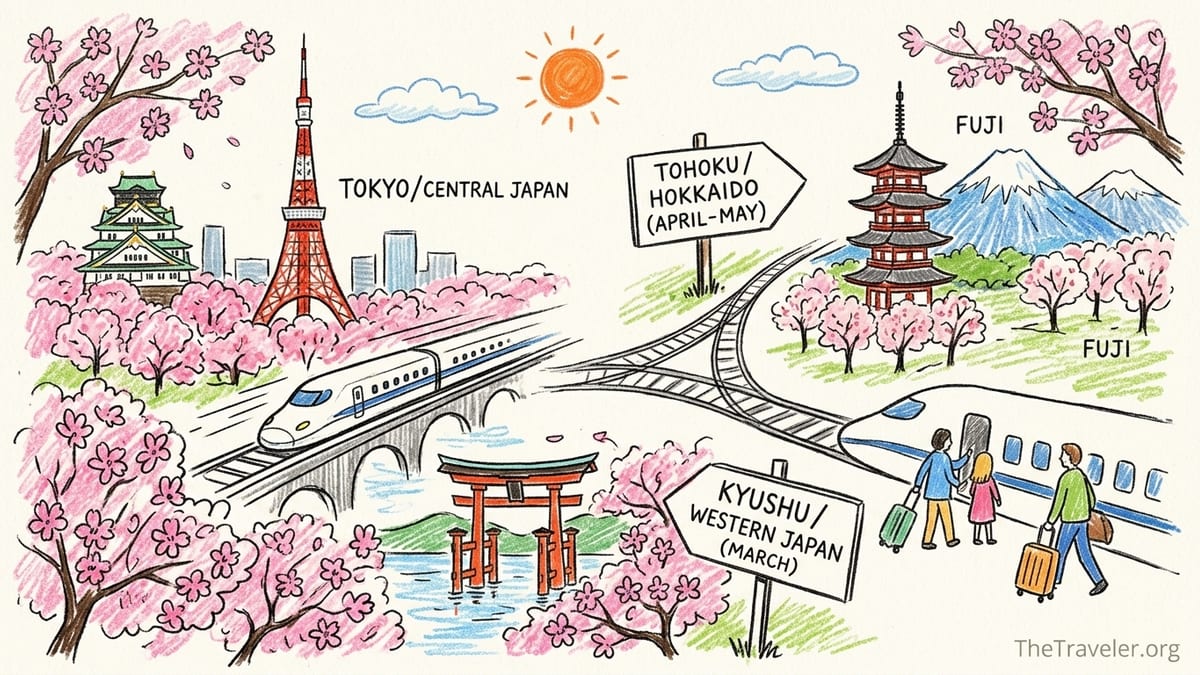
Practically, this means that for 2027 you should think in ranges rather than exact days. For the classic Tokyo and Kyoto corridor, the highest probability of full bloom will likely fall somewhere between about March 25 and April 5. In Kyushu and parts of western Honshu such as Hiroshima, target roughly March 20 to March 30. For northern Honshu cities like Sendai and Aomori, aim for mid to late April, and for Sapporo and much of Hokkaido, late April through the first week of May. Final forecasts from Japanese weather companies usually appear from late January, so travelers visiting in 2027 should plan to check updates a few weeks before departure and keep some flexibility inside Japan.
Regional Blooming Patterns: Where to Be, When
Japan’s geography stretches over 3,000 kilometers from subtropical islands to cool northern plains, and the cherry blossom front moves steadily northwards each spring. In Okinawa, especially around Nago and Motobu, deep pink kanhizakura begin to flower in late January and February. By mid March, Somei Yoshino trees in Kyushu cities such as Fukuoka and Kumamoto are typically approaching full bloom, lining riverside promenades and castle moats. Travelers who prefer milder weather and slightly thinner crowds often use Fukuoka as an entry point, visiting spots like Maizuru Park around Fukuoka Castle or Nishi Park above Hakata Bay.
On Honshu, the country’s main island, the focus shifts to the major cities. In Tokyo, average full bloom in recent decades has fallen in the final days of March or the very beginning of April. Central neighborhoods like Chiyoda, Shinjuku and Sumida all offer classic views: Chidorigafuchi’s moats near the Imperial Palace, the lawns and varied species inside Shinjuku Gyoen, and the banks of the Sumida River near Asakusa. Osaka and Nagoya typically track Tokyo quite closely, providing options for travelers following the Tokaido Shinkansen line who want to mix big city hanami with day trips to smaller towns.
Kyoto and Nara adopt a similar calendar but with greater variation in microclimates. Philosopher’s Path and the canal around Okazaki Shrine often peak in late March, while higher elevation sites like Arashiyama’s hillsides and the grounds around Kiyomizudera can lag slightly. In western Honshu, Hiroshima’s Peace Park and Shukkeien Garden usually enter full bloom in the last week of March. Farther north, Tohoku’s famous spots such as Hirosaki Park in Aomori or Kakunodate’s samurai district in Akita tend to reach their best in mid to late April, sometimes when Tokyo’s petals have already fallen. Finally, Hokkaido rounds out the season: Sapporo’s Maruyama Park and the historical buildings of the Hokkaido Shrine often peak in the last third of April, with some inland and eastern areas still blooming into early May.
Booking Flights, Hotels and Rail for Spring 2027
By late 2026, many international flights into Tokyo and Osaka around late March 2027 were already pricing higher than shoulder season dates. Major carriers from North America and Europe, including Japan Airlines, All Nippon Airways, Delta, United and several European flag airlines, routinely raise economy fares into the 1,200 to 1,800 US dollar range for round trips that land between roughly March 20 and April 10, compared with lower prices a few weeks earlier or later. For travelers with fixed vacation dates, securing flights 8 to 10 months in advance can make a noticeable difference, while those with flexibility can save by flying into secondary airports such as Nagoya’s Chubu Centrair or Fukuoka instead of Tokyo Haneda or Narita.
Accommodation in popular cherry blossom cities sees intense demand. Well located mid range business hotels in Tokyo’s Kanda, Ueno or Shinjuku areas, which might offer rooms under 120 US dollars per night in November, often quote rates closer to 180 to 250 US dollars during late March weekends. In Kyoto, small ryokan and guesthouses around Gion or Higashiyama can sell out many months ahead, and even basic city hotels near Kyoto Station regularly exceed 200 US dollars per night during peak bloom. Travelers targeting weekends under the blossoms should look at cancellable bookings as early as summer 2026 and adjust later as forecasts firm up.
Rail passes and intercity tickets also deserve early attention. After price revisions scheduled for October 1, 2026, the standard 7 day nationwide Japan Rail Pass is set to cost noticeably more when purchased through overseas agents than it did a few years ago. As of late 2026, the official online price for an ordinary class 7 day pass remained under 50,000 yen, while some travel agencies quoted higher amounts after currency conversion and commission. For 2027 trips, travelers planning multiple long Shinkansen legs, for example Tokyo to Hiroshima to Kyoto to Tokyo within a week, should compare the pass price with individual tickets bought from JR Central or JR East. In some cases, regional passes such as the JR East Tohoku area pass or JR West Kansai Hiroshima pass, which focus on specific zones, offer better value for blossom chasers targeting one region intensely.
Designing a Smart 2027 Sakura Itinerary
The key to a rewarding cherry blossom trip is building in redundancy. Because full bloom in any one city may shift by a few days, itineraries that rely on a single weekend in Tokyo or Kyoto leave little room for error. A more resilient plan for 2027 might allocate three or four nights in the Tokyo area, followed by three or four nights in Kansai and two or three in a cooler region such as Tohoku or Hokkaido. This way, even if Tokyo’s peak arrives early, you could still encounter blossoms at higher latitudes later in the trip.
For example, a two week journey in late March and early April 2027 could start in Fukuoka, where parks near Fukuoka Castle and Ohori Park often reach full bloom a few days before Tokyo. After two nights, travelers could ride the Sanyo Shinkansen to Hiroshima for one or two nights, enjoying blossoms around the Peace Memorial Park and Miyajima’s Itsukushima Shrine. From there, continue to Osaka or Kyoto for three or four nights focused on Kansai highlights. This southern to central progression raises your chances of intersecting at least one region at peak.
Another strategy is to pair an early blooming region with a late one inside one trip. A traveler arriving in Tokyo around March 22 might spend several days in the capital, then head north to Sendai, Morioka or Akita for the second week. By the time Kyoto’s petals start to fall, cherry trees in Tohoku’s castle towns and parks are often just opening. In 2026, for instance, Sapporo’s full bloom on April 24 occurred almost four weeks after Tokyo’s, illustrating how the same trip dates can capture multiple distinct peaks if you move with the advancing front.
Beating the Crowds at Famous Cherry Blossom Spots
Iconic locations such as Ueno Park in Tokyo, Maruyama Park in Kyoto and Osaka Castle Park have undeniable atmosphere but can be extremely crowded in peak season. On fine weekend evenings during late March, it is common to see nearly every patch of ground in Ueno Park occupied by hanami parties by midday, with convenience stores in the area running low on popular picnic foods and drinks. Lines for photo spots beneath low hanging branches or in front of castles can easily stretch several people deep, and reserving restaurant seats near waterfront promenades often requires advance planning.
To experience these classic venues more comfortably, timing is everything. Early morning visits, especially right at opening for paid gardens like Shinjuku Gyoen or Rikugien, offer a dramatically different ambiance, with soft light and relatively few people. Weekdays are generally less congested than Saturdays and Sundays. In Kyoto, wandering the Philosopher’s Path at dawn or heading to Maruyama Park soon after sunrise avoids the midday tour bus rush and lets you appreciate the blossoms with temple bells and birds instead of only camera shutters.
At the same time, many alternative sites offer equally memorable views with lighter crowds. In Tokyo, the Meguro River’s tree lined banks west of Nakameguro Station have become popular but still feel calmer if you walk away from the station core, while residential stretches of the Kanda River or the canals in Monzen Nakacho provide intimate local scenes. Around Kyoto, suburban neighborhoods like Fushimi and parklands such as the Kyoto Botanical Gardens see fewer mass tour groups than Gion or Arashiyama. In Tohoku, Hirosaki Park is well known among domestic travelers yet remains more spacious than Tokyo’s central parks, with moats covered in petals and ample room to circulate.
Alternative Destinations for a Different Cherry Blossom Experience
If your 2027 dates do not perfectly match the expected peak in Tokyo or Kyoto, or you simply prefer quieter places, Japan offers a wide range of alternative cherry blossom destinations. Kanazawa on the Sea of Japan coast usually blooms slightly later than Tokyo, often at the cusp of March and April. Its Kenrokuen Garden, one of Japan’s three celebrated landscape gardens, lights up selected trees in the evenings, and the historic Nagamachi samurai district gains a particularly atmospheric feel when soft petals collect along the earthen walls and narrow canals. Hotel rates here in late March can still be significantly below Kyoto’s for comparable comfort.
Farther north, Tohoku’s smaller cities reward travelers willing to ride a Shinkansen for a few extra hours. Aomori’s Hirosaki Park features thousands of cherries framing a feudal era castle, along with boat rentals on the moats for close up viewing. In Akita Prefecture, Kakunodate preserves a samurai district lined with drooping shidarezakura, or weeping cherries, that usually reach their best in the second half of April. Because international tour groups often stop at more famous southern sites, accommodation in these northern towns can remain available and more affordable even within a month or two of travel.
Hokkaido offers yet another flavor of sakura travel. Sapporo’s Maruyama Park and Hokkaido Shrine combine blossoms with open lawns and forest paths, while further south in Hakodate, Goryokaku Park’s star shaped former fortress fills with pale pink from late April into early May. For travelers planning trips that extend into Japan’s Golden Week holidays at the end of April, Hokkaido can be an excellent way to catch late season blossoms after central Japan’s have finished. Because evening temperatures remain cool, packing extra layers and expecting a different, brisker atmosphere than in balmy Fukuoka or Hiroshima will ensure the experience feels comfortable rather than surprising.
Practical Tips: Weather, Costs and On-the-Ground Logistics
Spring weather in Japan is changeable, and planning for 2027 should account for both chilly and warm conditions. In Tokyo and Kyoto, late March mornings can start near 5 to 8 degrees Celsius, warming to around 15 degrees in the afternoon on sunny days, while rain fronts can drop temperatures and bring gusty winds that knock petals from the trees. Pack a light but waterproof jacket, a compact umbrella and layers that you can remove as the day warms. In northern regions such as Sendai or Sapporo, gloves and a hat may still be welcome for evening strolls under illuminated blossoms.
Daily costs rise slightly in blossom season, but careful choices keep budgets manageable. Convenience stores such as 7 Eleven, Lawson and FamilyMart sell ready made bento boxes, onigiri rice balls and drinks ideal for impromptu hanami picnics, usually for under 1,000 yen per person. Many city parks like Ueno or Osaka Castle Park do not charge admission, while landscaped gardens including Tokyo’s Shinjuku Gyoen or Kanazawa’s Kenrokuen levy modest entrance fees, often in the 300 to 600 yen range. For transportation inside cities, prepaid IC cards like Suica, Pasmo or Icoca streamline hopping on and off local trains and buses and can be easily topped up at station machines.
On the ground, flexibility pays off. When updated cherry blossom forecasts indicate a region will peak earlier than expected, it is often possible to reorder your planned stops by swapping a Tokyo and Kyoto segment or inserting a side trip. Japan’s Shinkansen network allows same day moves over long distances; for example, you can ride from Tokyo to Hiroshima in roughly four hours on a Nozomi service, then continue to Fukuoka in about an hour more. In 2027, seat reservations on popular holiday and weekend trains during late March and early April will remain advisable, especially for larger groups. Making these bookings a few weeks ahead, once your accommodation is set, will give you greater freedom to follow the blossoms without anxiety.
Planning Around Crowds While Respecting Local Customs
As more international visitors return to Japan, local authorities and residents are paying closer attention to crowd management and etiquette in popular neighborhoods. In 2023 and 2024 Kyoto introduced measures in areas such as Gion to discourage disruptive tourist behavior, while Tokyo’s ward offices have periodically reminded hanami partygoers to limit noise and properly dispose of trash. By 2027, similar guidelines are likely to still be in place or expanded, especially in historic districts and residential zones where narrow streets easily become congested.
Visitors can contribute positively by choosing less intrusive viewing styles. Instead of staking out large tarps in ultra busy parks, consider walking based hanami, moving slowly through alleys and along rivers, pausing for photos and snacks rather than sitting in one place for hours. Where you do picnic, avoid blocking main paths or shrine approaches, and carry your garbage back to your hotel or a station bin if park facilities are overwhelmed. In temples and shrines, follow staff instructions on restricted areas and photography; some historic wooden structures now limit tripods to reduce crowding.
Finally, consider spreading your spending to nearby neighborhoods. For instance, after viewing blossoms along the Sumida River by Asakusa, you might continue across to Mukojima’s quieter streets and support small family run soba shops or kissaten coffee houses there. In Kyoto, pairing headline spots such as Kiyomizudera with time in lesser visited western districts like Uzumasa or Nishioji distributes tourism and often leads to more rewarding interactions. This approach not only softens the pressure on the most famous cherry blossom viewpoints but also creates a more varied and sustainable 2027 sakura journey.
Conclusion: Building a Flexible, Rewarding 2027 Sakura Journey
Planning for Japan’s cherry blossom season in 2027 starts with understanding the arc of the flowers from south to north and recognizing that exact peak dates can shift by nearly a week. Using recent years as a guide, travelers aiming for Tokyo and Kyoto should target the window from late March to early April, while pairing those cities with either earlier blooming Kyushu or later blooming Tohoku and Hokkaido creates a safety net if the season runs early or late. Booking flights and accommodation well ahead, yet keeping some room to adjust internal routes, allows you to respond to updated forecasts without losing your place under the blossoms.
By combining marquee locations with alternative destinations, choosing off peak hours for the most crowded parks, and respecting local customs at temples, shrines and in residential neighborhoods, you can enjoy hanami in ways that feel both memorable and considerate. The reward is not only a gallery of photographs but also mornings of near silence beneath pale petals, evenings of lantern lit branches over canals, and train rides that trace the moving front of spring itself. With thoughtful planning and a willingness to move with the flowers, Japan’s cherry blossom season in 2027 can become a richly layered journey rather than a rushed race to catch a single fleeting day.