


More news on this day
Railway Gazette International’s August 2026 coverage points to a rail sector in transition, with high-speed expansion, military mobility, climate resilience and new financing models reshaping long-term investment priorities worldwide.
Get the latest news straight to your inbox!
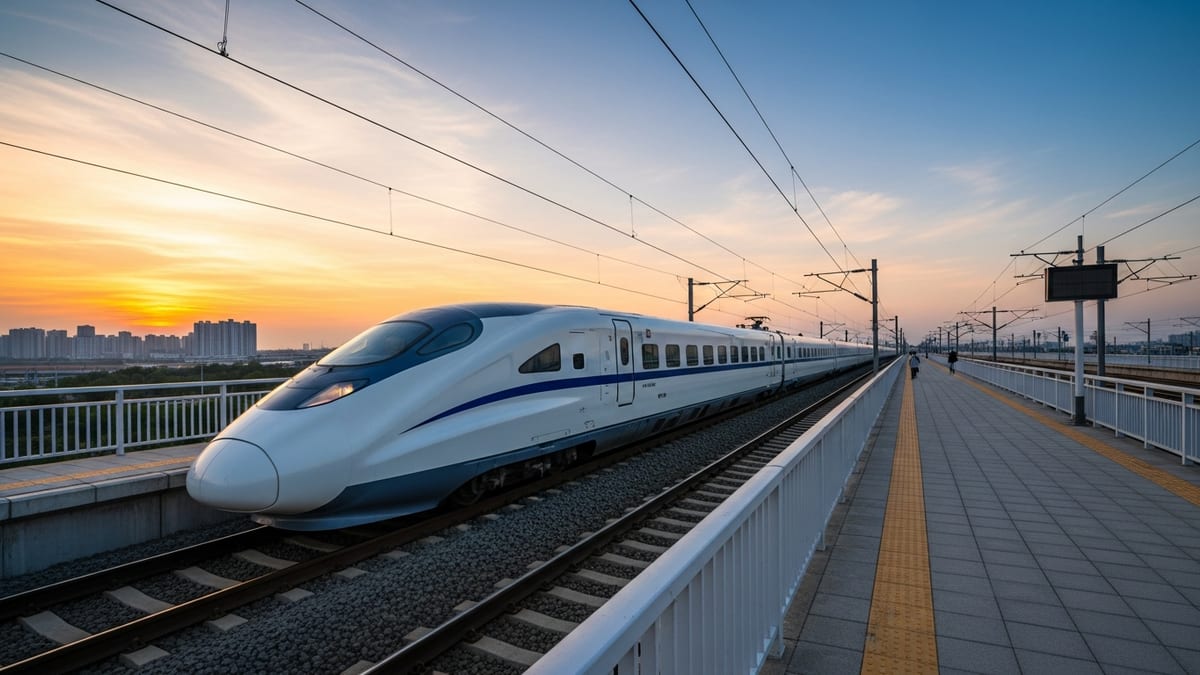
High-speed rail expansion accelerates on multiple fronts
Recent reporting associated with Railway Gazette International’s 2026 coverage highlights how governments and operators are using high-speed rail to relieve saturated conventional networks and to compete more effectively with short-haul air travel. National plans in Europe outline thousands of kilometres of new or upgraded lines designed for speeds around 300 to 350 km/h, reflecting a wider shift in transport policy towards lower-carbon intercity links. Programmes in central and eastern Europe, as well as in parts of Asia, are moving beyond isolated showcase routes and towards integrated networks intended to reshape domestic travel patterns.
In Italy and Spain, high-speed passenger services continue to stimulate rolling stock investment, with operators turning to new generations of trainsets that offer higher capacity and lower energy consumption. Industry-focused coverage notes that private open-access operators in particular are using new fleets to add frequencies on popular corridors, in some cases entering secondary markets that were previously dependent on slower intercity services. This competitive dynamic is increasingly seen as a test case for how liberalised passenger markets might function elsewhere in Europe.
Outside Europe, long-running debates over the viability of high-speed rail projects remain very much alive. In North America, publicly available information shows that state agencies and private consortia are still working to finalise alignments, funding packages and delivery models for flagship schemes. In Asia, meanwhile, several countries are revisiting earlier technology and signalling choices as they seek greater interoperability and long-term supplier diversity. The evolving balance between imported technologies and domestic industrial policy is emerging as a central theme for the coming decade.
Technical advances are also shaping how high-speed infrastructure is specified. Recent research and industry briefings referenced by specialist media point to growing interest in open digital signalling standards, automated inspection and predictive maintenance, as well as energy-efficient traction power systems. These developments are being framed as essential to keeping whole-life costs under control as route-kilometres of high-speed lines continue to rise.
Military mobility and strategic corridors reshape European priorities
One of the more striking themes highlighted in recent Railway Gazette International coverage is the intersection between civilian rail investment and military mobility within the European Union. Analytical pieces describe ongoing negotiations over how rail corridors can support the rapid movement of heavy equipment in a deteriorating security environment. The discussion centres on bridge loading limits, profile clearances, marshalling capacity and cross-border interoperability, all of which have direct implications for how conventional freight and passenger traffic will be managed.
Publicly available commentary suggests that these debates are exposing several “fault lines” between member states. Some countries emphasise the need to reinforce existing main lines and terminals to handle heavier trains, while others argue for new alignments that bypass capacity bottlenecks altogether. Funding mechanisms are another area of contention, with transport and defence ministries seeking to align, or at least sequence, budgets that have traditionally been planned separately. The outcome of these talks is expected to influence the next generation of EU rail funding instruments.
The strategic focus on military mobility is also reshaping thinking about cross-border freight flows. Analysts have noted that routes previously viewed mainly as commercial corridors are being reclassified as dual-use infrastructure of high strategic value. This is prompting renewed interest in resilient signalling, cyber security, and redundancy in key nodes such as marshalling yards, ports and logistics hubs. For the wider rail sector, the discussions are reinforcing the argument that investment in robust, interoperable infrastructure can serve both security and climate objectives.
For passenger operations, the same corridors are often expected to carry growing volumes of long-distance and regional services. Railway-focused media point out that balancing military requirements with day-to-day commercial timetables will demand more sophisticated capacity planning tools and closer coordination among infrastructure managers. This technical and organisational challenge is increasingly seen as an important subtext to what might otherwise appear to be purely geopolitical debates.
Private capital and new consortia in high-speed rail finance
Reports connected with Railway Gazette International’s 2026 output highlight an intensifying search for private finance in large passenger rail projects. In particular, new consortia bringing together infrastructure investors, rail operators, engineering specialists and systems integrators are being formed to assess options for extending high-speed corridors beyond their initial segments. These groups typically explore a mix of availability payments, real-estate development, and ancillary revenue streams in an effort to reduce reliance on traditional public borrowing.
Case studies from North America and parts of Asia illustrate how complex these arrangements can be. Published coverage describes multi-stage processes in which feasibility studies, environmental reviews and early design work are bundled with preliminary financial modelling, often under framework agreements that stop short of full concession contracts. The goal is to give public sponsors clearer visibility on long-term risk allocation before they commit to specific funding models or construction timelines.
For institutional investors, high-speed rail assets are being positioned as long-duration infrastructure with potential inflation-linked returns, provided that construction risk and political uncertainty can be contained. Industry analysis notes that financiers are particularly sensitive to governance structures, demand forecasts and regulatory stability. As a result, many of the new consortia are putting unusual emphasis on transparent project data, open-book procurement and staged investment decisions aligned with construction milestones.
This trend is prompting discussion about how public agencies can build internal capacity to negotiate complex public-private partnership structures. Railway-focused journals report growing demand for advisory expertise in contract design, risk sharing and dispute resolution, reflecting a recognition that the success or failure of such schemes will influence the broader reputation of rail as an investable asset class.
Climate resilience and digitalisation move up the agenda
Climate adaptation and digitalisation emerge as recurring themes in the technical reporting associated with the August 2026 rail news cycle. Several European and Mediterranean networks are having to contend with more frequent landslips, floods and heat-related speed restrictions, which are affecting punctuality and asset life. Infrastructure managers are therefore investing in monitoring systems, slope stabilisation, bridge renewal and upgraded drainage as part of wider climate resilience strategies.
Publicly available information from national rail infrastructure companies indicates that funding is increasingly being directed towards projects that combine traditional civil engineering with digital decision-support tools. Examples include the use of remote sensors to track ground movement, thermal expansion and track geometry, with data fed into central platforms that can predict where maintenance crews are most urgently needed. Research partnerships are also exploring how simulation environments can model complex network disruptions, giving planners new insights into the knock-on effects of extreme weather events.
Digitalisation is not limited to infrastructure monitoring. Railway-focused coverage outlines how traffic management systems, crew rostering and timetable planning are gradually moving onto integrated platforms that promise more efficient use of track capacity. Some national networks are trialling machine-learning tools to optimise path allocation and recovery strategies after incidents, with early results suggesting potential gains in both reliability and energy efficiency.
For passengers, these back-end improvements are complemented by more visible changes, such as real-time information, multimodal journey planning and digital ticketing. Specialist media note that railways are under pressure to deliver a user experience that can compete with air and road travel, particularly on heavily contested intercity routes. As climate policy tightens and carbon pricing evolves, the expectation is that rail’s environmental advantages will be reinforced by a progressively more digital, data-driven operating model.
Global metro and regional rail projects continue to advance
Beyond the headline stories of high-speed rail and strategic freight corridors, Railway Gazette International’s wider 2026 coverage points to steady progress on metro and regional rail schemes across multiple continents. Network extensions in major Asian cities, including new orbital lines and infill stations, are being brought into service with the aim of reducing congestion and supporting dense urban development. At the same time, design and procurement activity remains strong in emerging metropolitan regions where rail-based mass transit is still at an early stage.
In Europe and North America, many of the most active projects involve upgrading or electrifying existing commuter corridors rather than building entirely new metros. Public documents from transport agencies show ongoing investment in expanded platforms, higher-capacity signalling and modern rolling stock with level boarding and improved accessibility. These incremental improvements are often framed as crucial to attracting car users, particularly in suburban areas where service frequency and reliability remain key concerns.
Recent months have also seen renewed interest in regional rail connections to airports and major logistics hubs. Aviation and freight stakeholders are increasingly involved in discussions about timetable coordination, station design and last-mile access, reflecting a broader recognition that rail can play a central role in multimodal networks. Railway-focused outlets report that several airport links under development are explicitly targeting mode shift from short-haul flights or private car use.
Taken together, these developments suggest that 2026 is shaping up as a year in which rail strategies are being reconsidered at multiple scales, from local metro extensions to continent-spanning high-speed networks. The themes highlighted in Railway Gazette International’s August-focused reporting underscore how investment choices made now will influence not only passenger convenience and freight efficiency, but also security policy, climate resilience and the long-term competitiveness of national economies.