


More news on this day
A German tourist’s successful claim for compensation over lack of poolside sun loungers at a resort on the Greek island of Kos is rapidly emerging as a test case for how far European package holiday providers must go to guarantee on-site amenities and pay out when the experience falls short.
Get the latest news straight to your inbox!
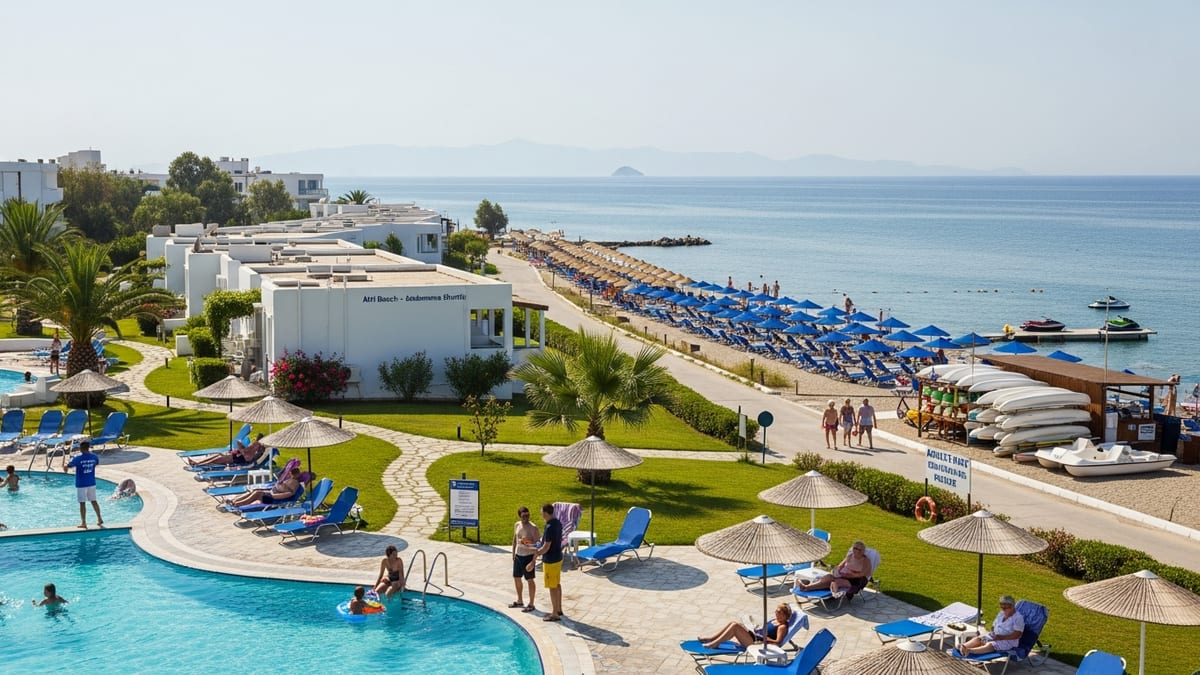
Hanover ruling turns “towel wars” into legal precedent
According to reports in German and Greek media, a district court in Hanover found that a package holiday sold to a German family for 7,186 euros was legally defective because they were effectively unable to use the hotel’s pool area during an August 2024 stay on Kos. Each morning, virtually all sun loungers were already occupied or reserved with towels by around 6 a.m., leaving the family searching for a place to sit and their children often lying on the hard surface around the pool.
The court ruled that the lack of reasonable access to loungers amounted to a material shortcoming of the package, rather than a minor inconvenience. The judges increased the compensation initially offered by the tour operator from about 350 euros, roughly 5 percent of the package price, to 986.70 euros, close to 15 percent. The holiday was deemed not to have the character the buyers were contractually entitled to expect when booking an all inclusive family resort stay built around pool relaxation.
Publicly available information on the judgment indicates that the tour operator, not the hotel, was held liable because it had sold the trip as a package, bringing it squarely under the EU’s package travel rules. The court accepted that the operator could not guarantee a lounger for every guest at every moment, but concluded that it had an obligation to ensure a system was in place with the hotel that prevented systematic blocking of loungers and maintained a reasonable ratio of beds to guests.
Legal commentary in Germany has characterized the ruling as a notable extension of how courts interpret package travel contracts, turning the long running “towel wars” over sunbeds into a question of contractual performance and consumer rights rather than merely holiday etiquette.
How EU package travel rules underpin the case
The Hanover decision is rooted in the European Union’s Package Travel Directive, which gives consumers enhanced protection when they buy combined travel services such as flights, transfers and accommodation in a single contract. Under this framework, tour operators are generally responsible for ensuring that the overall holiday corresponds to what was advertised and contractually promised, and that serious shortcomings can trigger partial refunds.
Recent guidance from EU institutions and national consumer agencies stresses that a package is not limited to transport and a bed, but encompasses the wider set of services and amenities that shape the holiday experience. Publicly available explanations note that where a pool, beach access or particular leisure facilities are central to a package’s marketing, serious or persistent loss of use can be treated as a travel defect in its own right, supporting a claim for a reduction in price.
In the Kos case, media reports highlight that the court considered the pool area a core element of the contracted holiday. The inability to find sun loungers on most days was therefore interpreted as a systematic restriction on a key feature, rather than sporadic inconvenience. By quantifying the price reduction at around 15 percent, the court signaled that non transport amenities can carry substantial weight when assessing how badly a holiday was impaired.
Legal analysis in specialist publications suggests the judgment reflects a broader trend in European case law, where courts increasingly scrutinize not only whether a trip took place, but whether the quality and accessibility of promised services matched reasonable customer expectations formed by brochures, online descriptions and package itineraries.
Implications for tour operators and resort hotels across Europe
Industry observers note that the Kos ruling will likely prompt tour operators throughout the European Union to revisit how they manage on site amenities that are central to their offers. Holiday companies may now face stronger incentives to negotiate clearer rules with partner hotels on matters such as reserving loungers, queuing systems for popular facilities, and monitoring of guest behavior that undermines shared access.
Travel law specialists point out that the decision reinforces the principle that tour operators cannot simply point to the independence of hotels or local customs when complaints concern the practical usability of core amenities. Where a resort’s selling point is relaxation by the pool, they may need to demonstrate that effective organizational measures were in place to give package customers a fair chance to enjoy those facilities without unreasonable effort.
For hoteliers, particularly in busy Mediterranean destinations, the case underscores the commercial and legal risks of informal practices that allow early morning reserving of loungers or chronic overcrowding around pools. While the Hanover court did not rule on the hotel directly, the outcome increases pressure on properties to implement and enforce policies that prevent long term blocking of shared facilities by a minority of guests.
Analysts suggest similar reasoning could be applied to other high demand amenities highlighted in marketing materials, from kids’ clubs and spa facilities to beachfront cabanas and waterparks. Where access is routinely frustrated in a way that substantially detracts from the promised holiday experience, tour operators may find themselves facing claims for partial refunds or future litigation referencing the Kos precedent.
Part of a wider shift in European holiday compensation law
The Kos decision arrives amid a broader tightening of protections for European travelers. In late March 2026, EU governments signed off on a revised directive on package travel that aims to strengthen safeguards for consumers purchasing complex holiday products. The reforms follow years of disputes over cancellations, bankruptcies and quality shortfalls in mass market tourism.
Across Europe, courts have in recent months ordered tour operators to grant significant price reductions for problems that go beyond classic transport disruptions, including severe luggage issues and missing services that were central to cruise or adventure trips. Legal databases show a pattern of judges treating these shortcomings as travel defects justifying meaningful compensation where they materially altered the nature of the holiday.
Consumer advocacy groups argue that decisions like the Kos case confirm that the package travel regime is evolving from a narrow focus on getting travelers to and from their destination toward a more holistic view of the holiday product. Under this approach, what matters is not only arrival but whether the combination of services delivered corresponds to what was advertised and reasonably expected when the package was booked.
For travelers, this shift suggests that complaints concerning serious and sustained loss of use of key amenities may increasingly be taken seriously by courts and alternative dispute bodies, provided that the issues are properly documented and raised with both the hotel and the tour operator during the stay and after returning home.
What the ruling means for future holidaymakers
Travel experts say the Hanover judgment is likely to be cited in future disputes as a benchmark for when inconvenience crosses the threshold into compensable loss of enjoyment. While isolated difficulties in finding a lounger or sporadic overcrowding are unlikely to justify a refund, persistent inability to access a core facility can now more readily be framed as a breach of contract under EU aligned package travel law.
Holidaymakers are being encouraged by consumer advice outlets to pay close attention to how packages are marketed, to keep records of on site conditions and to report serious problems promptly to both hotel staff and tour representatives. Photo evidence, written complaints and logs of repeated issues can play a significant role if a claim later reaches a court or arbitration body.
Experts also caution that the ruling does not grant travelers a right to perfection, but rather to the standard and character of holiday they were led to expect. In practice, that means operators and hotels may increasingly specify in their terms that access to certain amenities is subject to capacity and that fair use rules apply, while still bearing responsibility to prevent systematic exclusion of guests from headline facilities.
As Europe heads into another peak summer season, the Kos sunbed judgment is likely to resonate well beyond one family’s dispute. It marks a clear statement that seemingly small practical issues, when persistent and central to a package, can trigger meaningful financial redress and help redefine what counts as a successful holiday in the eyes of European law.