


Few rivalries on the French Riviera are as enduring as the quiet contest between Cannes and Nice, embodied in their signature waterfronts: La Croisette and the Promenade des Anglais. Both curve along the same glittering Mediterranean, yet they deliver very different moods, from Cannes’ red-carpet sheen to Nice’s broad, lived-in seaside stage. Choosing where to base yourself, or even which promenade to prioritize on a short trip, can shape your entire Riviera experience.
Get the latest updates straight to your inbox!
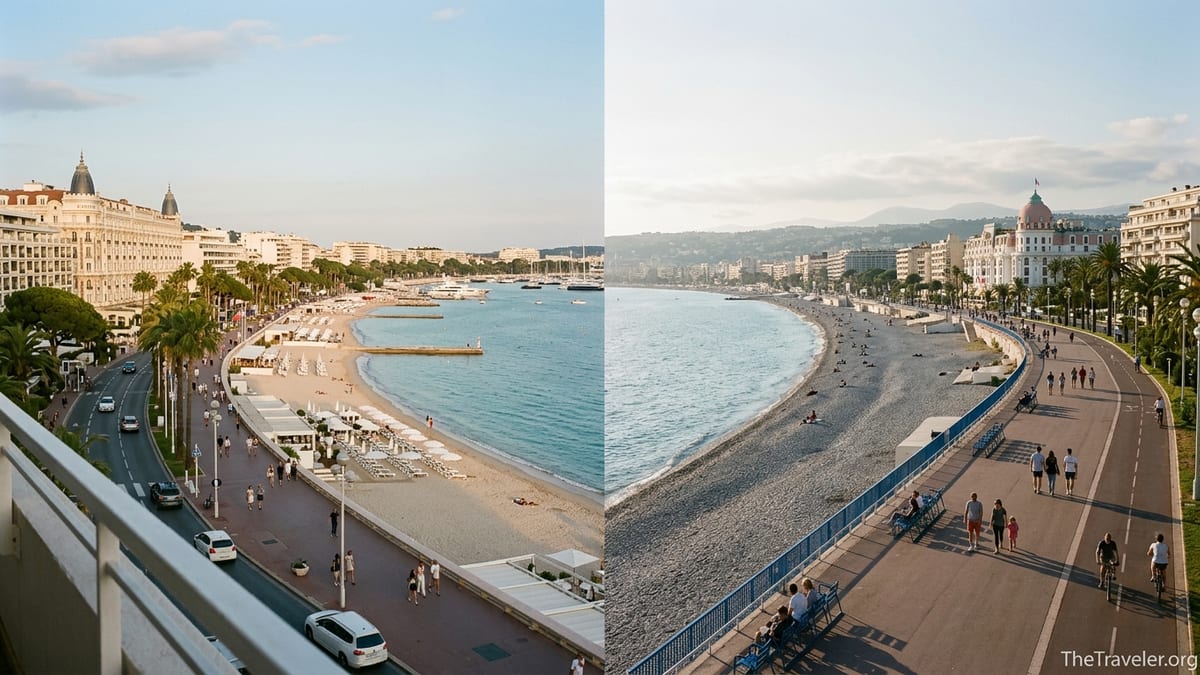
First Impressions: Glamour Versus Grandeur
La Croisette in Cannes is a compact, concentrated hit of glamour. Roughly 3 kilometers long, it runs from the Palais des Festivals et des Congrès, home of the Cannes Film Festival, out toward Palm Beach at the tip of the peninsula. On one side you have pale sand and beach clubs, on the other a parade of palace hotels like the Carlton, Martinez, and Barrière Majestic, with luxury boutiques tucked at street level. Walking here feels a little like strolling the lobby of an open-air five-star hotel.
The Promenade des Anglais in Nice offers a completely different scale. This waterfront sweep stretches for about 7 kilometers along the Baie des Anges, from the airport area in the west to the edge of the Old Town in the east. It is broad, open, and democratic, busy from dawn joggers and cyclists to late-night strollers licking gelato. The architecture is grand but more mixed, from Belle Époque icons like the Hotel Negresco to regular apartment blocks and city beaches that locals use year-round.
Emotionally, La Croisette feels curated. Flower beds are manicured, palm trees line a relatively narrow strip, and everything is arranged to highlight the hotels and the bay. Nice’s promenade feels like the city’s public living room, where tourists and residents share the same benches, bike lanes, and pebble shore. If you crave a movie-set atmosphere, Cannes immediately seduces; if you want a big, airy city seafront that you can simply inhabit, Nice makes a quieter, longer-lasting impression.
For first-time visitors to the Riviera, this initial contrast often decides their favorite. Those dreaming of film festival glamour gravitate to La Croisette, while travelers who imagine long, unhurried seaside walks with plenty of local life tend to fall for the Promenade des Anglais.
Beach Experience: Sand in Cannes, Pebbles in Nice
The most tangible difference between the two seafronts is under your feet. Along La Croisette you will find mostly sandy beaches, both public and private. The public stretches are interspersed between hotel concessions, especially toward the eastern end near Port Canto and Plage Bijou. Families appreciate the soft sand and generally gentle slope into the water, which makes paddling and sandcastle-building straightforward even for toddlers.
In Nice, the Promenade des Anglais backs a string of wide, rounded-pebble beaches. The stones are beautiful and give the water extraordinary clarity, but barefoot walking is uncomfortable and entering the sea can be tricky in small waves. Most locals bring thick beach mats or rent loungers. The payoff is that the water often appears a deeper, clearer turquoise than in Cannes, particularly on calm days, and the pebbles mean you leave the beach without sand clinging to everything you own.
Price-wise, Cannes’ private beach clubs on La Croisette are typically more expensive. In high season it is common to see a front-row sun lounger and umbrella at a major hotel club costing around 50 to 80 euros for the day, and more during peak festival periods. Some of the most exclusive clubs associated with palace hotels can push higher, especially if you want prime placement and waiter service to your chair. Public beaches are free, though simple municipal options such as Zamenhof Beach offer basic loungers and parasols at more modest rates that can sit around single-digit to low double-digit euros for a half-day rental.
On the Promenade des Anglais, private beach clubs are still a splurge but tend to be somewhat less eye-watering than the most famous Cannes addresses. Typical midrange clubs in Nice often charge roughly 25 to 40 euros per lounger in summer, with towels extra, while budget-conscious travelers simply spread towels on the public sections at no cost. For many visitors, Nice offers the better value if they plan to swim daily and do not mind pebbles; Cannes offers the more indulgent experience if they are happy to pay for soft sand, attentive service, and proximity to legendary hotels.
Atmosphere and Crowd: Who Each Seafront Is For
La Croisette’s atmosphere shifts throughout the year but always retains a sheen of exclusivity. During the Cannes Film Festival in May and events like the Cannes Lions advertising festival or the yachting festival in early autumn, the promenade swells with delegates in lanyards, photographers, and onlookers hoping for a glimpse of celebrities climbing the red steps of the Palais. Even outside event weeks, shoppers drift in and out of designer boutiques, and luxury cars cruise slowly past the hotel facades.
That said, La Croisette is not only for the ultra-wealthy. In the evenings you see local families pushing strollers, teenagers on electric scooters, and cruise passengers taking their one big Riviera walk before returning to the tender boats. You might grab a takeaway crêpe from a stand near the Palais and eat it on a public bench just as easily as you might sip a 20-euro cocktail on the Carlton’s terrace. The crowd, though, tends to skew toward well-dressed couples, conference attendees, and visitors who are comfortable in a polished, slightly performative environment.
The Promenade des Anglais feels more varied. Here you will see retirees chatting on benches, students rollerblading between blue chairs, runners training along the bike lane, and families with fold-up chairs settling in for a full day on the pebbles. While there are certainly well-heeled holidaymakers staying in seafront hotels, much of the promenade’s life is resolutely local. Pickup football games on the beach, kids’ scooters, and picnic dinners at sunset are commonplace, especially in early summer and late August when French vacationers fill the city.
If you enjoy people-watching, both seafronts deliver, but in different registers. Cannes offers a study in curated glamour: crisp linen shirts, carefully chosen sunglasses, and designer shopping bags. Nice offers a cross-section of daily life in a Mediterranean city: commuters cycling home, families gathering on the stones, and tourists mixing with locals at the evening promenade. For some travelers, Nice feels more relaxed and authentic; for others, Cannes delivers the thrill they imagined when they first heard the words French Riviera.
Food, Drink, and Nightlife Along the Water
Dining directly on La Croisette often comes with a price premium, but it is also where Cannes shines. Many private beach clubs transform into full-service restaurants at lunchtime, serving dishes like grilled sea bass, salade niçoise interpreted through a gourmet lens, and plates of local prawns or lobster. A typical beach-club main course can range from around 30 to 50 euros, with desserts and cocktails extra. Terraces at palace hotels serve afternoon tea and carefully mixed drinks, ideal for travelers who want one luxurious splurge during their stay.
For more accessible options, you can cut a block or two inland to find brasseries and pizzerias where mains hover around the mid-teens to low twenties in euros, often with fixed-price lunch menus. Around the Palais and the side streets leading toward the old quarter of Le Suquet, small bistros serve Mediterranean plates at more casual prices. Many visitors end up starting their evening with a walk on La Croisette, then ducking into the narrower streets uphill for dinner in a less formal setting.
On the Promenade des Anglais, the food scene is more mixed. Some beach clubs offer solid menus focused on grilled fish, salads, and pasta, with main dishes commonly in the 20 to 30 euro range. Others keep things simple with burgers and fries aimed at beachgoers who want to maximize time in the sun. Because Nice’s Old Town and Cours Saleya market area sit just behind the eastern end of the promenade, many travelers choose to stroll the seafront at sunset and then head a few minutes inland for socca, pissaladière, or other local specialties at more traditional addresses.
Nightlife also differs sharply. Cannes has a compact but intense cluster of upscale bars, hotel lounges, and a few high-end clubs within a short walk of La Croisette. During major events, terraces buzz late into the night, and reservations for the most fashionable spots are essential. In Nice, nightlife along the promenade is more low-key, focused on evening walks, casual beachside drinks, and occasional live music in summer. Livelier late-night bars and clubs are found off the promenade in the Old Town and surrounding streets, catering to a more mixed, often younger crowd.
Where to Stay and How It Shapes Your Experience
Staying directly on La Croisette is a statement in itself. Rooms with full sea views in hotels like the Carlton, Martinez, or Majestic can command several hundred euros per night in high season, and suites rise far above that. In exchange you gain immediate access to private beach clubs, concierge services that can secure hard-to-get restaurant tables, and the simple pleasure of stepping out the front door directly onto one of the Riviera’s most iconic boulevards.
More budget-conscious visitors to Cannes often choose hotels or apartments a few streets back from La Croisette or around the train station. Rates here can be significantly lower, especially outside major events, while still allowing an easy 10 to 15 minute walk to the seafront. The trade-off is that you experience La Croisette more as a place to visit than as your front yard, which some travelers actually prefer; they can dip into the glamour and then retreat to quieter, more residential surroundings.
On the Promenade des Anglais, you will find a wider spread of accommodation styles and price points. There are luxury options with direct sea views, but also midrange chain hotels and smaller independent addresses dotted along the waterfront and parallel streets. Sea-view rooms typically cost more than city-facing ones, yet there is often a noticeable price advantage compared with top-tier Cannes properties. Many visitors choose to stay near, but not necessarily on, the promenade, opting for places in or near the Old Town where narrow streets, markets, and restaurants are right at their doorstep while the seafront is only a short walk away.
In practical terms, basing yourself in Nice generally suits travelers who want to explore the Riviera by train or bus, with easy day trips to Monaco, Antibes, and even Cannes itself. Basing in Cannes and La Croisette suits those who prefer a resort-like environment, perhaps with fewer side trips and more time spent simply enjoying the beach clubs, shopping, and relaxed promenading.
Practicalities: Getting Around, Safety, and Seasonality
Both promenades are straightforward to reach without a car. La Croisette sits a short walk from Cannes train station, which is connected to Nice, Antibes, and other Riviera towns by frequent regional services. If you arrive in Cannes by cruise ship, you will usually be tendered close to the Old Port, from where it is only a few minutes on foot to the Palais des Festivals and the beginning of La Croisette. Once there, the promenade is entirely walkable; many visitors cover the full 3-kilometer stretch in about 30 to 40 minutes without rushing.
The Promenade des Anglais is even more integrated into the city’s transport network. The airport sits at the western end, and tram lines plus local buses make it easy to transfer into the center in around 15 to 25 minutes, depending on traffic and the stop. Numerous bus routes and bike-share stations line the promenade, and a clearly marked bike lane runs along much of its length. You can comfortably walk from the Old Town to the iconic Hotel Negresco area in 15 to 20 minutes, or rent a bicycle to ride the longer 7-kilometer stretch in under an hour with photo stops.
Safety is broadly similar in both places. Pickpocketing can occur, especially around busy festival days in Cannes or summer evenings in Nice, so standard big-city precautions apply: keep bags closed, phones in front pockets, and avoid leaving belongings unattended on the beach. Late at night, main sections of both promenades are usually busy and well-lit, though quieter stretches further from the centers can feel more isolated. Solo travelers often report feeling comfortable walking until fairly late, especially in high season when there is a constant flow of people.
Seasonality may tip the balance. In July and August, both seafronts get crowded, but Nice generally has more space to absorb visitors, while parts of La Croisette can feel intense due to its smaller size and the number of private concessions occupying the sand. In shoulder seasons like late April, May (outside festival dates), June, September, and early October, both are lovely. Winter brings a milder, almost contemplative mood: locals wrapped in coats stroll the Promenade des Anglais under crisp blue skies, while La Croisette becomes a peaceful setting for slow walks and coffee on sheltered terraces.
So Which Riviera Seafront Actually Feels Better?
Ultimately, deciding whether La Croisette or the Promenade des Anglais feels better depends on the kind of Riviera story you want to live. If you close your eyes and imagine yourself in sunglasses, stepping out of an ornate hotel lobby onto a palm-lined boulevard with the possibility of spotting a familiar face from cinema or fashion, then La Croisette is likely your match. The experience there is more concentrated: a short but potent strip of sand, hotels, and boutiques that distills the French Riviera’s glamorous image into a walkable arc.
If, instead, your Riviera dreams involve long, meditative seaside walks, casual swims after a morning of exploring markets and historic streets, and watching locals go about their routines against a backdrop of sea and mountains, the Promenade des Anglais will feel more natural. It serves as an extension of the city rather than a stage set, and its length and breadth ensure you can usually find a quieter corner, even on busy days.
For many travelers with a week or more, the most satisfying solution is not to choose at all. You might base yourself in Nice, enjoying the promenade each morning, then spend a day in Cannes, walking La Croisette from the Palais des Festivals to Palm Beach and back with a lunch stop at a beach restaurant. Alternatively, you might splurge on one or two nights in a seafront Cannes hotel to savor that cinematic atmosphere, then move to a more budget-friendly place in Nice to use as a hub for wider exploration.
The good news is that both promenades stand up to their reputations. La Croisette delivers the upscale fantasy many people expect, while the Promenade des Anglais offers an expansive, accessible, and surprisingly local-feeling seafront. The better one is simply the one that feels more like your version of the Riviera.
The Takeaway
La Croisette in Cannes and the Promenade des Anglais in Nice frame the same sea but different experiences. Cannes’ seafront is compact, intensely curated, and steeped in film-festival mythology, with sandy beaches and high-end beach clubs that reward travelers ready to indulge. Nice’s promenade is broad, long, and woven into the fabric of daily life, with pebble beaches, more varied price points, and a relaxed, year-round rhythm.
If you love polished glamour, private sun loungers, and the feeling of being part of an exclusive scene, La Croisette will likely win your heart. If you prefer an open, lived-in city waterfront where you can jog, cycle, picnic, and still retreat into historic streets only a few blocks away, the Promenade des Anglais may become your Riviera home base. Either way, planning time for at least one unhurried, end-to-end walk along each seafront is one of the most rewarding decisions you can make on a Côte d’Azur itinerary.
FAQ
Q1. Which promenade is better for budget travelers, La Croisette or the Promenade des Anglais?
For most budget travelers, the Promenade des Anglais in Nice works better. There are more midrange hotels and apartments within walking distance of the seafront, and public pebble beaches are extensive and free. Beach clubs still cost money, but overall prices for accommodation and everyday dining tend to be lower than on La Croisette, where many of the properties facing the water are luxury hotels.
Q2. Is the water clearer in Cannes or Nice?
Water clarity varies with weather and sea conditions, but many visitors notice that Nice often appears especially clear and turquoise because the rounded pebbles do not stir up sand. Cannes has sandy bottoms near La Croisette, which can make the water look slightly more opaque when waves are active, though on calm days both spots can offer beautifully transparent, swimmable sea.
Q3. Which seafront is better for families with young children?
Families with young children often prefer La Croisette because of its sandy beaches and generally gentle entry into the water, which makes playing by the shore and walking barefoot much easier. Many Cannes beach clubs also provide amenities like changing cabins, showers, and shaded loungers. Nice can work for families too, but parents usually bring sturdy water shoes or thick mats to deal with the pebbles.
Q4. Can I visit both La Croisette and the Promenade des Anglais in one day?
Yes, it is possible to visit both in one day if you plan carefully. Regional trains between Nice and Cannes typically take under an hour, and both promenades are within walking distance of their respective stations. Many travelers start with a morning walk and swim in Nice, catch a late-morning or midday train, then spend the afternoon and evening strolling La Croisette before returning.
Q5. Are there free beach areas on both promenades?
Both seafronts include free public beaches. Along La Croisette, public sections are interspersed between private clubs, especially toward the eastern end and near Plage Bijou. In Nice, large stretches of the pebble shore along the Promenade des Anglais are public, with occasional private concessions in between. Loungers and umbrellas cost extra at private clubs, but simply laying a towel on the public areas is free.
Q6. Which promenade has better access to historic neighborhoods?
The Promenade des Anglais has slightly easier access to a historic core. Its eastern end flows directly into Nice’s Old Town, with narrow streets, markets, and baroque churches only a few minutes from the water. La Croisette is close to Cannes’ old quarter of Le Suquet, but you will need to walk around the Old Port and then up into the hillside streets, which takes a bit longer and involves some uphill paths.
Q7. Is one promenade safer than the other at night?
Both promenades are generally considered safe, especially in the main central sections where there are plenty of people, lighting, and nearby hotels or restaurants. As with any busy tourist area, pickpocketing can occur, and quieter stretches further from the center can feel more isolated late at night. Standard precautions, such as keeping valuables secure and avoiding poorly lit areas, are advisable in both Cannes and Nice.
Q8. Which seafront is better if I do not plan to rent a car?
If you are traveling without a car and plan to explore the wider region, the Promenade des Anglais in Nice has an edge. Nice is a major transport hub with frequent trains and buses to Monaco, Antibes, Cannes, and inland hill towns. Staying near the promenade means you can enjoy daily seaside walks while still being a short tram or bus ride from the main station. Cannes is also accessible by train, but Nice offers more options and connections.
Q9. Where will I find a more local atmosphere, La Croisette or the Promenade des Anglais?
While both attract visitors from around the world, the Promenade des Anglais generally feels more local in everyday use. Residents jog, cycle, walk dogs, and meet friends there year-round, and many families use the public beaches as their neighborhood playground. La Croisette certainly sees local strollers too, but its concentration of luxury hotels, boutiques, and major events means the ambiance leans more toward an international resort setting.
Q10. If I only have time for one, should I choose La Croisette or the Promenade des Anglais?
If your image of the Riviera centers on film festival glamour, palace hotels, and sandy beaches, choose La Croisette. If you picture a broader seafront with space to walk, run, or cycle, easy access to an atmospheric Old Town, and a mix of locals and visitors sharing the same shoreline, choose the Promenade des Anglais. Both are memorable; the better choice is the one that matches how you most want to feel on the Côte d’Azur.