


From the ground in Piazza del Campo, Siena feels intimate, almost enclosed by its curved brick facades and sloping shell shaped square. It is only when you start climbing the Torre del Mangia, step after narrow medieval step, that Tuscany slowly unfurls around you and the city reveals its true scale. That ascent changed how I understood Siena, and in many ways how I saw Tuscany itself.
Get the latest updates straight to your inbox!
Meeting the Tower at Street Level
The Torre del Mangia does not dominate Siena the way Florence’s Duomo dominates its skyline. You walk into Piazza del Campo and it rises almost casually from the corner of the Palazzo Pubblico, a slender 14th century brick tower tied to the life of the city rather than set apart from it. Built between the 1320s and mid 1340s as the civic bell tower, it still feels connected to the daily hum of the square below.
On a typical morning today, you will find a modest ticket office tucked under the arches on the right side of the Palazzo Pubblico, a few steps from the main entrance of the Museo Civico. Tickets for the tower alone are usually around 10 euro per adult, with combined passes that include the museum and sometimes Santa Maria della Scala costing closer to 15 to 20 euro, depending on the current city museum offers. You pay, choose a time slot, and wait for your group to be called, because only a limited number of people are allowed in the tower at once.
There is nothing grand about the way the climb begins. A staff member checks tickets, reminds you to leave large backpacks behind, and guides you into a low, stone passage. You pass a small, almost modest landing that hints at the tower’s medieval origins. No elevators, no glass, no theatrical lighting. Just bare walls, echoing footsteps, and the awareness that somewhere far above, a bell has measured Siena’s days for nearly seven hundred years.
At street level, Siena’s terracotta and stone feel charming but contained. Cafes serve cappuccinos for three or four euro along Via di Città, shop windows display contrada scarves and hand painted ceramics, and tour groups cluster in the square. It is only when you step into the tower and leave the bustle behind that you begin to sense how a vertical perspective might rearrange all of this.
The Physical Reality of the Climb
Guidebooks like to mention the numbers: roughly 300 to 400 steps, depending on how they count the landings, and a height of about 87 to 102 meters including the upper crown and lightning rod. What matters more in the moment is that the staircase quickly narrows to a single file passage, with rough stone on one side, brick on the other, and small windows that drip light into the gloom every few turns. If you are even mildly claustrophobic, this is where you feel it.
The city limits how many visitors can be inside the tower at once, often around two dozen on the top platform, which means the line at busy times can stretch across the loggia. In high summer, showing up at 10 in the morning can still mean a long wait; locals recommend the very first slot of the day or a late afternoon ascent. The tower may close in bad weather, especially if strong wind or storms make the upper terrace unsafe, so it is worth checking the night before at your hotel reception or directly at the museum ticket desk.
The climb itself demands a slow, steady rhythm rather than athletic prowess. Children race up the first fifty steps and then quickly learn to pause at the small openings in the walls, where glimpses of Siena’s roofs appear like preview images. Older visitors hold the iron handrail and negotiate each irregular step with care. Sneakers or flat shoes make a real difference here; those who attempt it in leather sandals or wedges often regret it by the halfway point.
What stays with you is the soundscape: the overlapping echoes of footsteps, the occasional murmur of Italian from a family ahead, the ring of a phone quickly silenced. As you climb, the square’s noise falls away and is replaced by a muffled quiet broken only by the bell when it strikes the hour. For a few minutes, you inhabit the same spiral path once used by the campanari who climbed to ring those bells manually, long before electric mechanisms took over the daily rhythm.
First Glimpse: Siena From Above
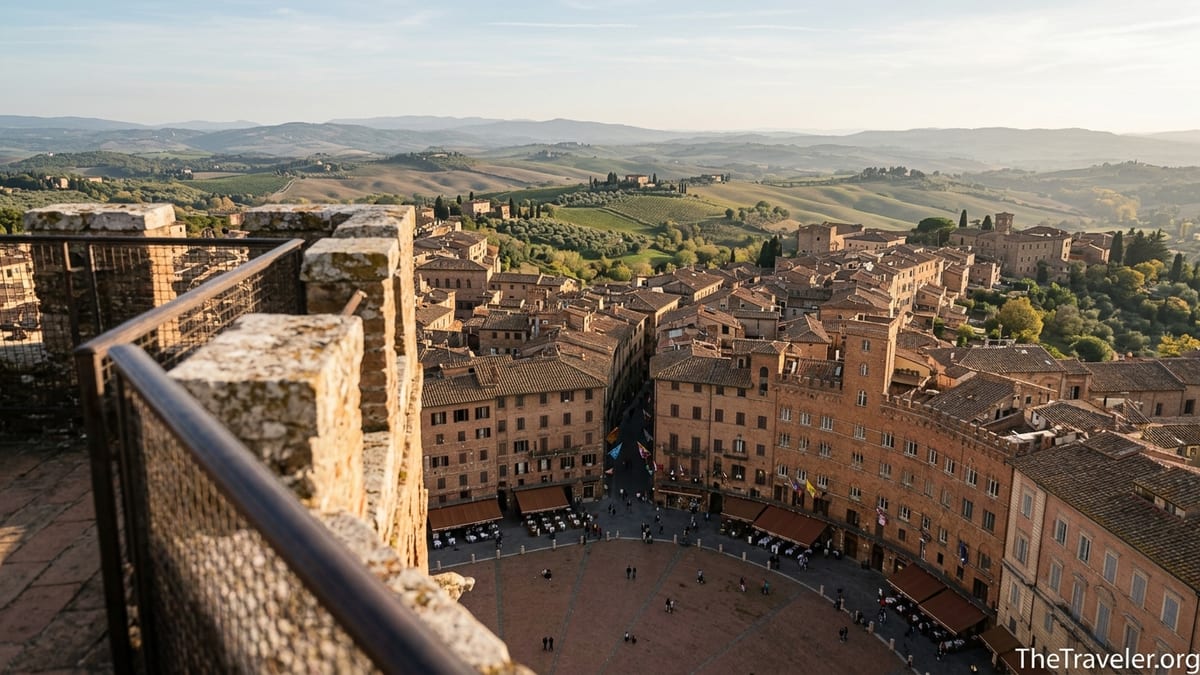
There is a small doorway just before you reach the top terrace where the light becomes abruptly brighter and the air cooler. Stepping through it is one of those travel moments that rewires your mental map. Piazza del Campo, which felt large and enveloping when you stood on its sloping bricks, now folds into a precise shell below, divided into nine distinct slices that recall the medieval governance of Siena.
From the tower, the square’s famous curve is no longer just a pleasant quirk; it becomes a diagram of urban design. You can see how streets funnel down from the surrounding neighborhoods, the contrade, into the open space, like channels drawing people toward a common civic heart. Cafes along the perimeter shrink to thin lines of white awnings. The Fonte Gaia, the marble fountain that anchors the upper side of the piazza, is suddenly just a pale rectangle in the brick sea.
Look up and the skyline explains Siena’s layers of power and faith. To one side rises the black and white striped dome of the Cathedral, the Duomo di Siena, its unfinished nave walls still visible as a ghostly reminder of an ambitious expansion halted by plague and financial crisis. Beyond that, the long brick walls of Santa Maria della Scala stretch along the ridge, one of Europe’s oldest hospitals now converted into a vast museum complex. Turn slightly and you can pick out the red brick bulk of the Medici Fortress at the edge of town, now a peaceful park with its own views back toward the tower you are standing on.
It is here that Siena stops being only a charming medieval town and becomes something more complex: a carefully choreographed balance of civic pride, religious devotion, and everyday life. Seeing the Duomo and Palazzo Pubblico in a single sweep from above makes it clear that Tuscany’s story is not only about vineyards and villas, but about cities that once competed for power, wealth, and prestige.
Beyond the Walls: Tuscany in 360 Degrees
What surprised me most on the Torre del Mangia was not the square below, which I expected to be beautiful, but the way Tuscany’s countryside pressed up against the city’s edges. Once you step to the outer side of the platform and look beyond the rooftops, the hills roll out in every direction. Patches of vineyard, silvery rows of olive trees, and long, tree lined farm tracks appear between small villages and isolated farmhouses.
To the south and east, on a clear day, you can often make out the darker outline of distant hills, sometimes including the direction of Monte Amiata, a volcanic peak about 80 kilometers away that anchors the southern Tuscan landscape. To the north, ridges lead the eye toward the Chianti region, where many travelers drive later for tastings at wineries around Castellina or Radda. From this height, the distinction between city break and countryside escape feels suddenly artificial; Siena is plainly a part of the same landscape people associate with vines and cypress lined drives.
Details on the rooftops reinforce this connection. Satellite dishes sit next to medieval chimneys, laundry flutters above terracotta tiles, and tiny roof terraces planted with lemon pots hint at private domestic worlds. Somewhere below, someone is hanging washing, another person is stirring a pot of ragù, unaware that visitors are looking down from nearly one hundred meters above. Tuscany becomes less of a postcard and more of a lived in place, stitched together by work, habit, and ritual.
For photographers, this is the moment to pull out a wide angle lens or set a smartphone to its widest field of view. The combination of vertical drop to Piazza del Campo and horizontal spread across the hills is difficult to capture in a single frame, but worth the attempt. Shooting in late afternoon when the sun is lower gives the brick a deeper, almost burnt color and throws the ridges of the countryside into soft relief.
How the Climb Changes Your Experience of Siena
Once you have seen Siena from the Torre del Mangia, walking back through the streets becomes a different experience. Routes that felt like a confusing maze on arrival now make more sense, because you have watched them converge on the square from above. When you stroll along Via di Città or Via Banchi di Sopra, you can picture exactly where the rooflines sit relative to the tower and which direction the hills roll away beyond the stone walls.
This new mental map changes small decisions. Instead of choosing the first visible terrace for lunch, you might search out a trattoria on a side street where a glimpse between buildings offers a sudden view of the tower’s white crown. You become more aware of the contrada flags hanging from windows and how each neighborhood marches down toward the Campo like a slice of the shell. The Palio, Siena’s celebrated horse race held each July and August, shifts in your imagination from romantic spectacle to a ritual that physically relies on this very layout.
Many travelers pair the Torre del Mangia with another vertical experience, such as climbing the unfinished Facciatone at the Duomo museum complex, or walking the walls of the Medici Fortress at sunset. Having stood above the city, you start to notice how often the best views in Tuscany involve a negotiation between effort and reward: a stairwell, a hilltop town approached on foot, a vineyard reached by a dusty lane. The tower becomes your first training ground in that logic.
Back in Piazza del Campo after the descent, prices and practicalities also feel different. Paying three or four euro for a coffee at one of the cafes that face the square no longer seems like a tourist surcharge, but the price of sitting in the very space you have just observed from nearly one hundred meters above. The city’s decision to limit numbers in the tower, charge a modest entrance fee, and invest in preservation starts to look like part of a broader effort to balance access and protection.
Planning Your Own Ascent
For visitors planning a climb, timing is the first key decision. In spring and early autumn, when days are mild and skies often clear, the earliest morning and the last hour before closing are typically the most pleasant times. In July and August, Siena can be hot and crowded, and the tower’s narrow staircase warms quickly; starting your day with the climb, before exploring the Duomo or Santa Maria della Scala, is usually the wisest approach.
Ticket structures change periodically as the city adjusts museum combinations, but as of recent seasons a standalone tower ticket has hovered around 10 euro for adults, with reductions for children, students, and seniors. Combined tickets that include the Civic Museum or other municipal sites may offer better value if you enjoy frescoes and historic interiors. It is sensible to confirm current prices on arrival at the official ticket counter in Palazzo Pubblico rather than relying on information from older guidebooks.
The tower has a reputation for narrow passages, but there are regular landings where you can pause, catch your breath, and let others pass. This is not an accessible attraction for visitors with significant mobility issues or those who rely on wheelchairs, and there is no elevator, a consequence of the building’s medieval structure and heritage protections. For families with younger children, the climb can be an adventure, but parents should be prepared to supervise closely on the top platform, where railings are secure but the drop is very visible.
Pairing the tower with a slow lunch can make the day feel less rushed. After your descent, one option is to exit the square along Via del Porrione and walk ten minutes to Orto de’ Pecci, a green garden space on the site of medieval vegetable plots where a simple restaurant serves local dishes under the trees in good weather. From its lawns you can look back at Siena’s skyline, tracing the tower you just climbed and appreciating how it anchors the city without overwhelming it.
Tuscany Seen From a Single Tower
Climbing the Torre del Mangia changed how I thought about Tuscany because it condensed so many of the region’s themes into one experience. In a single hour, you confront medieval engineering in the stone staircase, civic ritual in the bell tower’s connection to the Palio and city life, and the seamless transition from tight urban fabric to rolling countryside that defines central Italy.
Many travelers arrive in Tuscany with images of vineyards near Montalcino, the cypress lined road in the Val d’Orcia, or the towers of San Gimignano. Standing on the Torre del Mangia, you see how Siena fits into that wider picture, not as a stopover between countryside drives but as a historic power that once rivaled Florence. The brick facades and striped marble of the Duomo become part of the same story as the farmhouses and olive groves far beyond the walls.
Even the name of the tower hints at everyday life underneath the grand history. “Mangia” refers to a 14th century bell ringer nicknamed for his love of food and good living. Legends say he spent his earnings too quickly, a reminder that this tall, elegant structure is not only about politics and piety, but about the humans who kept it running, climbing those same cramped stairs centuries before visitors arrived with cameras and guidebooks.
In the end, what stays with you is not a single postcard view but a new way of reading the landscape. Each time you later drive past Siena on the highway between Florence and the southern Tuscan towns, you can pick out the line of the tower and remember how the city, the fields, and the distant hills all locked together beneath your feet. That memory quietly reshapes every vineyard, every hilltown, and every square you visit afterward.
The Takeaway
Travelers often treat viewpoints as quick box ticking stops: a photo, a few seconds of admiration, and then on to the next attraction. The Torre del Mangia invites a slower, more reflective approach. Between the ticket queue, the careful climb, and the limited time on the platform, you are forced to consider not just what you see but how you arrived there and who built the path.
For anyone planning time in Tuscany, setting aside an hour for this tower in Siena can change the tone of an entire trip. It anchors the region in your mind with a specific geometry: the shell of Piazza del Campo, the sweep of the hills, the line of the Duomo’s dome. Later, when you sip a glass of Chianti in a farmhouse outside Castellina or watch the sun set over the Val d’Orcia, you may find yourself tracing an invisible line back to that brick tower and the city it watches over.
If Tuscany is often sold as a landscape of gentle beauty, the Torre del Mangia reminds you that it is also a place of ambition, resilience, and layered history. Climbing it is more than a test of your legs. It is an invitation to see the region from a vantage point that blends past and present, city and countryside, into one unforgettable view.
FAQ
Q1. How many steps are there in the Torre del Mangia, and how hard is the climb? The tower has just over 300 narrow steps arranged in a spiral staircase. Most reasonably fit visitors can manage it with pauses on the landings, but the steps are steep and the space is tight, so it can feel strenuous if you are not used to climbing.
Q2. How much does it cost to climb the Torre del Mangia? Recent seasons have seen adult tickets for the tower around 10 euro, with reduced prices for children, students, and seniors. Combined tickets that include the Civic Museum or other city museums typically cost more but can offer better overall value if you plan to visit multiple sites.
Q3. Do I need to book in advance, or can I just show up? Many visitors simply buy tickets on the day at the Palazzo Pubblico ticket office, but during busy months time slots can sell out for peak hours. If you are visiting in high summer or around Palio dates, it is wise to inquire about advance reservations through official channels or to arrive early in the day for more flexibility.
Q4. What is the best time of day to climb for views and light? Early morning and late afternoon usually offer the most flattering light and more comfortable temperatures, especially in summer. Morning tends to be a bit quieter, while late afternoon and early evening can give warmer tones on the brick and long shadows across the hills.
Q5. Is the Torre del Mangia suitable for people with vertigo or claustrophobia? The interior staircase is narrow and enclosed, and the top platform, although protected by sturdy railings, has very open views and a clear sense of height. Visitors with strong vertigo or claustrophobia may find the experience uncomfortable and should consider their limits carefully before starting the climb.
Q6. Are children allowed to climb, and is it safe for families? Children are generally allowed to climb when accompanied by adults, and many families do it together. Parents should be prepared to manage the steep steps and keep a close eye on younger kids on the top terrace, where the barriers are secure but the drop is very visible.
Q7. What should I wear and bring for the climb?Comfortable, closed toed shoes with good grip are strongly recommended, as the steps can be worn and uneven. Bring a small bottle of water and a camera or phone for photos, but avoid bulky backpacks because space in the staircase is limited and large bags may need to be left at the entrance.
Q8. Is the tower ever closed due to weather or other conditions?The Torre del Mangia may close temporarily in bad weather, such as strong winds, heavy rain, or storms, when conditions on the top platform are unsafe. It can also close for maintenance or special events, so checking current information at the ticket office or with your hotel the day before is sensible.
Q9. How long should I plan for a visit to the tower?Most visits take about 45 minutes to an hour, including waiting for your time slot, climbing up, enjoying the views at the top, and descending. During peak periods, additional waiting time in the piazza before your scheduled entry is possible.
Q10. How does the Torre del Mangia compare with other viewpoints in Tuscany?The tower offers one of the most complete urban and rural panoramas in the region, combining Siena’s medieval skyline with a broad sweep of surrounding hills. Other viewpoints, such as the Facciatone at the Duomo museum or hilltop towns like San Gimignano, are also memorable, but the Torre del Mangia is unique in the way it ties a major city square directly to the Tuscan countryside below.