


It was only when I slowed down and walked the length of La Croisette that Cannes finally made sense. The famous Riviera city had always been a collage of images in my mind: red carpets, yacht parties, the flash of camera bulbs each May during the film festival. But on foot, with the Mediterranean glinting to my right and a wall of grand hotels to my left, the glamour of Cannes stopped feeling like a movie backdrop and revealed itself as something carefully built, day after day, along this waterfront promenade.
Get the latest updates straight to your inbox!
First Steps on the Riviera’s Most Famous Promenade
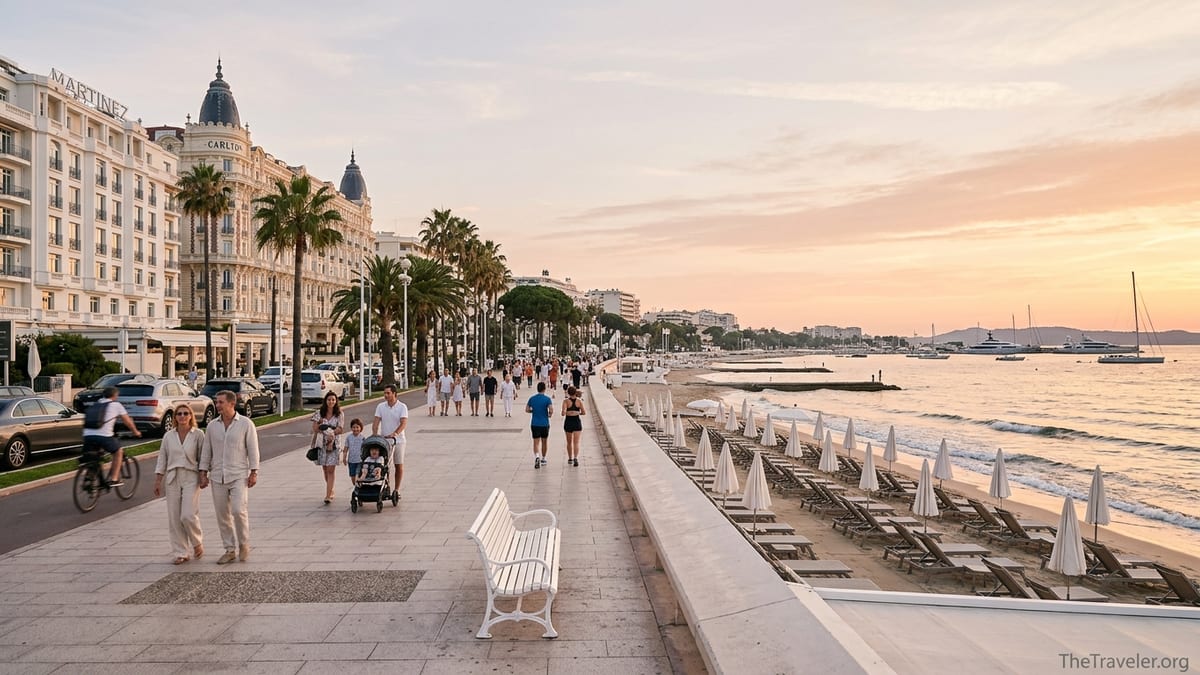
La Croisette is not long by big-city standards, roughly two kilometers curving around the Bay of Cannes, but it concentrates an extraordinary amount of theater into that short distance. The promenade itself is a broad, pale walkway edged with palms and pines, divided between joggers, people walking tiny dogs, and visitors like me trying to look as if we belong. On one side, the sandy beach runs almost uninterrupted, dotted with neat rows of sun loungers and parasols. On the other, a continuous façade of Belle Époque and Art Deco hotels, polished boutiques and manicured gardens forms a kind of open-air set.
Starting near the Palais des Festivals, where the red carpet appears each May, you immediately feel the city’s obsession with presentation. Even on a quiet weekday morning outside festival season, workers were hosing down pavements, polishing railings and rearranging café chairs so that every terrace faced the sea at a perfect angle. There is a sense that this stage must be ready at any moment for a photographer or a film crew to appear, and that discipline, more than any celebrity, is part of what makes Cannes feel glamorous.
Within a few minutes of walking, small but telling details start to accumulate: the creamy stone balustrades without a chip in sight, the perfectly painted beach huts, the impossibly shiny sports cars rolling slowly along the boulevard. Nothing about La Croisette feels accidental. Behind the relaxed holiday atmosphere lies a deliberate effort to keep this promenade looking like the French Riviera people pay to dream about.
Grand Hotels and the Architecture of Glamour
The true guardians of La Croisette’s image are the legendary hotels that line its northern side. Within a 20-minute walk you pass some of the most storied names in European hospitality: the Carlton Cannes, a Regent Hotel with its twin domes and cream façade; the Art Deco bulk of the Hôtel Barrière Le Majestic facing the Palais des Festivals; and further east, the Hôtel Martinez, part of the Hyatt group, stretching along the boulevard with its white, tiered balconies. Each property has its own personality, but together they form an unbroken statement about what Cannes wants to be.
Even if you are not staying in one of these hotels, simply watching life unfold around them feels like free admission to an exclusive club. Outside the Majestic, chauffeurs idle beside black sedans while guests in linen suits and silk dresses drift out to the terrace for late-morning coffee. At the Carlton, whose recent renovation restored its Belle Époque details to a bright, almost film-set sharpness, staff in tailored uniforms move at a measured pace that suggests urgency without visible haste. The message is clear: here, nothing is rushed and nothing is out of place.
Step a little closer and you notice how carefully these hotels manage the transition between private luxury and public spectacle. Wide terraces are raised just enough to allow diners sea views and privacy, yet low enough that passersby can still glimpse the silver buckets of chilled rosé and the plates of grilled sea bass. Private jetties and beach clubs extend from each hotel over the sand, bridging boulevard and sea. For the price of a sun lounger, which in high season can easily exceed 70 euros per day at the most exclusive clubs, anyone can buy a temporary share in this carefully curated version of Riviera life.
Beach Clubs, Sun Loungers and the Price of a Perfect View
If the hotels provide the backdrop, the beach clubs on La Croisette supply much of the day-to-day glamour. Each stretch of sand in front of the big properties is branded with the hotel’s name on parasols and towels, creating parallel worlds just meters apart. At the Martinez’s beach club, the loungers are tightly spaced and the soundtrack leans toward laid-back house music. In front of the Carlton, the setup feels more classical, with teak decking, white canvas and a clientele that seems to move from lounger to restaurant table with little urgency.
For travelers, the first surprise is often the price. Renting a pair of sun loungers and a parasol at a central Croisette beach club in summer can easily run to 100 to 150 euros for the day, especially if you want a front-row spot closest to the water. Some clubs linked to the flagship hotels prioritize or entirely reserve access for their own guests during peak periods, meaning independent visitors either have to book far ahead, arrive early to secure limited non-guest availability, or walk further east along the promenade toward Port Canto, where public stretches of sand become more generous and slightly less crowded.
Yet once you settle in, it is clear what people are paying for. Service is efficient yet discreet: iced water appears as soon as you unfold your towel; a laminated menu offers club sandwiches for roughly 25 to 30 euros, salads piled high with grilled prawns for a similar price, and glasses of Provence rosé starting around 10 to 12 euros. Staff thread their way between loungers in immaculate polo shirts, delivering fruit platters, Aperol spritzes and occasional bottles of champagne to tables discreetly tucked between sunbeds. The sea is calm, shallow and sandy underfoot, a notable contrast with the pebble beaches in nearby Nice, and the view across to the Lérins Islands provides a constant, gently shifting backdrop.
For those watching their budget, walking the promenade reveals where the atmosphere begins to soften. Public beaches slip between private concessions, especially toward the eastern end of La Croisette. Here, you can spread a towel for free, perhaps rent a paddleboard for an hour or two, and still look back at the same skyline of palm trees and palace hotels that defines Cannes’ luxury image. The glamour seeps outward; it is not confined to those willing to pay top-tier prices.
Shopping Windows and the Catwalk of Everyday Life
La Croisette is often said to have one of the highest densities of luxury boutiques in the world, and a slow walk along its inland side supports that reputation. Between the grand hotels, you pass display windows for almost every major fashion and jewelry house: Chanel, Dior, Louis Vuitton, Cartier, Hermès and more. Handbags rest on illuminated shelves like museum pieces, diamond necklaces are staged against matte black backgrounds, and limited-edition sneakers sit under spotlights as if they were sculptures. Even if you have no intention of buying, it is difficult not to slow down and look.
What makes this retail stretch feel glamorous is not just the brands themselves, but the choreography around them. Doors open automatically as customers approach, and inside, staff in black and white move with a kind of precision that resembles a minimalist ballet. Outside, people treat the boulevard as a catwalk. Locals in pressed chinos and pastel shirts stroll with small dogs that look as though they have their own grooming contracts; visitors pose against palm trees in linen dresses and wide-brimmed hats, angling their phones to capture both themselves and the bay. It is hard to tell who is actually shopping and who is simply trying on the lifestyle for an afternoon.
If the flagship boutiques feel intimidating, neighboring streets like Rue d’Antibes offer a more accessible version of Cannes style. Here, mid-range international brands sit alongside independent shoe shops and perfumeries, and you can step out of the filtered world of La Croisette for a coffee that costs closer to 3 euros than 7. Yet returning to the promenade, you realize that part of the glamour lies precisely in this contrast: La Croisette is where the city leans fully into its role as a playground for those who can afford it, while the rest of Cannes quietly supports the show.
Moments Between the Yachts: Everyday Scenes Along the Bay
For all the money circulating along La Croisette, what ultimately makes it feel glamorous are the everyday scenes that play out against such an extravagant backdrop. Early in the morning, before beach clubs open, you see residents power-walking in sportswear, pausing to stretch using the railings while delivery trucks unload crates of fruit and chilled seafood at hotel kitchens. Gardeners trim hedges and sweep fallen petals from flowerbeds so that by the time late risers arrive for coffee, everything looks naturally perfect.
Later in the day, as the sun climbs higher, families push strollers along the promenade, stopping so children can run down to the water’s edge or climb the low steps that separate boulevard from beach. Elderly couples sit on white benches facing the sea, watching paddleboarders trace gentle arcs across the bay. Cyclists weave past carefully painted bike symbols on the pavement, and every few minutes another convertible glides by, its driver slowing just enough to enjoy the possibility of being noticed.
Toward the eastern end, near Port Canto, the mood changes subtly. The hotels thin out and the focus shifts to the marina, where rows of yachts tug gently at their moorings. Here, the glamour takes on a more nautical tone. You might pass a crew in matching deck shoes rinsing down the hull of a yacht while a delivery van unloads boxes of fresh flowers or cases of wine. The promenade feels less crowded, the air saltier, and you sense that this is where Cannes locals come when they want a slice of waterfront life with a little more breathing room.
From Golden Hour to Nightfall: When La Croisette Truly Shines
It is in the evening, however, that La Croisette fully justifies its reputation. As the sun slides toward the horizon, its light turns the facades of the hotels a soft honey color, and the bay becomes a sheet of metallic blue. People emerge from side streets dressed up for dinner, and the promenade fills with a slow-moving parade of outfits and perfumes. Street lamps flicker on, casting a gentle glow that feels almost cinematic, although nothing about it is staged beyond the city’s meticulous maintenance.
Terraces along the boulevard become observation decks. Order a glass of rosé or a simple espresso at one of the seafront cafés, and you can watch the evening unfold as if it were a continuous fashion show. A group of friends might arrive at a beach club bar wearing coordinated linen; a couple might pause on the low wall for a selfie as the sky turns pink and then purple. Out at sea, the navigation lights of anchored boats begin to show, tiny red and green points against the darkening bay. Somewhere behind you, a live band starts playing jazz standards in a hotel lounge.
Prices, again, are part of the experience. A cocktail on La Croisette can easily cost 18 to 25 euros, and some restaurants impose minimum spends that make walk-in dining a considered choice rather than an impulse. Yet for many visitors, one indulgent drink with a front-row view of the sunset feels like an acceptable price of admission. The glamour here is not only about luxury services; it is also about being present in a place that has spent decades perfecting how it looks at precisely this hour.
Practical Ways to Experience the Glamour Without a Celebrity Budget
Walking La Croisette taught me that Cannes’ glamour is as much about access as it is about exclusivity. You do not need to stay in a palace hotel or rent a private cabana to feel part of the scene. One of the simplest strategies is to time your visit. Early mornings and late evenings are ideal for soaking up the atmosphere without the midday heat or the densest crowds, and many of the most glamorous elements, from the architecture to the sea views, cost nothing to enjoy.
If you want a taste of the hotel experience, consider visiting for a coffee or a drink on the terrace rather than an overnight stay. Sitting under the striped awnings of a beachfront bar, watching staff glide between tables, gives you an hour inside the world those grand lobbies advertise. Similarly, booking a single sun lounger for half a day at a mid-range beach club toward the eastern or western edges of La Croisette can bring prices down while still granting access to showers, changing cabins and beachside service.
Another way to connect with the city’s glamour is to wander just behind the façade. A few streets inland, especially around the old quarter of Le Suquet and the market at Marché Forville, everyday Cannes takes over: stalls selling tomatoes from the hinterland, elderly residents chatting in the shade, simple bistros offering fixed-price lunches. Returning to La Croisette afterward, with a scoop of pistachio gelato in hand from a side-street glacier, you perceive the waterfront’s carefully edited version of reality more clearly. The contrast deepens the sense of spectacle rather than undermining it.
The Takeaway
By the time I reached the far end of La Croisette, near the rose gardens and the Palm Beach area, Cannes had shed its reputation as a postcard stereotype and taken on the texture of a real place. Yes, the city trades aggressively on glamour: on famous hotels, designer windows, beach clubs where a single afternoon can cost more than a modest week’s rent elsewhere. But walking the promenade revealed that this glamour is not merely a surface effect. It is the result of constant, meticulous care for how the city meets the sea, for how pavement, palms, façades and beach clubs fit together into a single, seductive frame.
In the end, what made Cannes feel glamorous to me was not the occasional sight of a luxury car or a familiar fashion logo, but the way life along La Croisette unfolds as if everyone knows they are part of a long-running performance. Some are on stage, staying at five-star hotels and sailing out to moored yachts. Others, like most visitors, are in the audience, strolling the promenade with an ice cream or a takeaway coffee. Yet for a few hours along this waterfront, almost everyone steps a little lighter, dresses a little better and looks out at the bay as if they, too, have just stepped out of a film.
FAQ
Q1. How long does it take to walk the full length of La Croisette?
At a relaxed pace with photo stops and a coffee break, most people can walk the main stretch of La Croisette in about one to two hours each way.
Q2. Is La Croisette good for budget travelers, or is it only for luxury visitors?
La Croisette is famous for luxury, but budget travelers can still enjoy the promenade, public beaches, and sea views for free, and then eat or drink on nearby backstreets where prices are lower.
Q3. When is the best time of day to walk along La Croisette?
Early morning offers cooler temperatures and a calm local atmosphere, while the hour before sunset is ideal if you want to see the hotels and bay at their most photogenic.
Q4. Are there public beaches along La Croisette or only private beach clubs?
There are both. Private beach clubs occupy many central sections, but public sandy areas appear between them and especially toward the eastern end, where anyone can spread a towel without paying.
Q5. Do I need a reservation for the beach clubs on La Croisette?
In high season and during major events, it is wise to reserve a lounger in advance at popular clubs, especially those linked to big hotels, while in shoulder seasons walking up early in the day often works.
Q6. How expensive are drinks and meals on La Croisette?
Prices vary, but it is common to pay around 6 to 8 euros for a simple coffee on a prime terrace, 10 to 12 euros for a glass of wine, and 20 to 30 euros for a main course at seafront restaurants.
Q7. Is La Croisette safe to walk at night?
La Croisette is generally well lit and busy in the evening, especially in season, and most visitors find it feels safe, though standard city precautions such as watching your belongings still apply.
Q8. What should I wear to blend in along La Croisette?
A smart-casual look works well: light dresses, linen shirts, tailored shorts and comfortable but neat shoes, with a slightly dressier outfit if you plan to visit higher-end bars or restaurants.
Q9. Can you see famous people while walking La Croisette?
Sightings are most likely during the Cannes Film Festival and major events, when industry guests and celebrities move between hotels, the Palais des Festivals and beach parties along the promenade.
Q10. How do I reach La Croisette from the Cannes train station?
From the main station it is roughly a 10-minute walk: you exit toward the center, head down the streets leading to the sea, and soon emerge near the Palais des Festivals at the western end of La Croisette.