


Most travelers arrive in Vatican City with one image in mind: Michelangelo’s painted ceiling in the Sistine Chapel. Yet many leave talking instead about two other works by the same artist that affect them more directly. One is La Pietà, the intimate marble sculpture of Mary cradling the dead Christ in St Peter’s Basilica. The other is The Last Judgment, the vast turbulent fresco filling the altar wall of the Sistine Chapel. Both are among the most visited artworks on earth, but they offer radically different kinds of impact. If you have limited time or energy in Rome, which Renaissance masterpiece is more likely to stay with you long after the flight home?
Get the latest updates straight to your inbox!
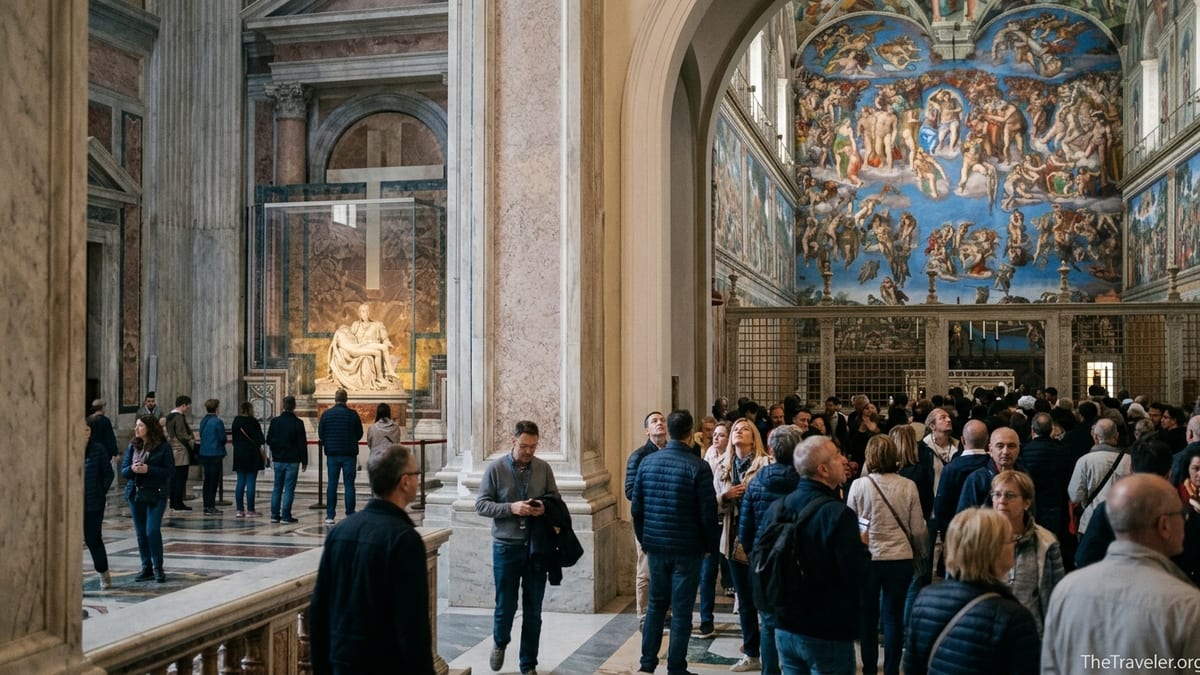
Two Masterpieces, Two Very Different Encounters
La Pietà and The Last Judgment were created by Michelangelo decades apart and live just a few hundred meters from each other inside Vatican City. La Pietà, carved around 1498–1499 when Michelangelo was in his early twenties, is a single block of Carrara marble polished to a soft glow. It sits in the first chapel on the right inside St Peter’s Basilica, behind a bulletproof glass screen installed after a vandal attack in 1972. Visitors today typically see it from several meters away as they’re swept along with the crowd entering the basilica.
The Last Judgment came much later, painted between 1536 and 1541 on the altar wall of the Sistine Chapel. It is not a sculpture you circle but a wall that engulfs you, populated by more than 300 twisting, muscular figures. To reach it you must walk through large portions of the Vatican Museums, then enter the famous chapel where visitors’ eyes usually shoot straight up to the ceiling before slowly drifting to the blazing blue altar wall.
From a traveler’s point of view, these differences matter. La Pietà is quiet, accessible without a ticket, and part of a living church that opens early in the morning. The Last Judgment requires advance planning, timed-entry tickets, and patience with crowded galleries. The impact you feel is shaped not only by the art itself but by the route, the noise level, the security checks, and how exhausted you are when you finally reach each work.
Understanding how each piece works in its setting helps you decide where to focus your attention and how to schedule your visit so that you experience them at something close to their full emotional power.
La Pietà: Intimacy, Grief, and the Power of Silence
Walk into St Peter’s Basilica during the early morning opening hours, when tour groups are still lined up outside security, and the atmosphere around La Pietà can be unexpectedly calm. The cool marble underfoot, the low echo of footsteps, and the scent of incense from an earlier Mass all frame the work as something more than a museum piece. Even from behind glass, the sculpture’s intimacy is startling. Mary’s face is young and serene, her grief contained rather than theatrical. Christ’s body lies across her lap with a softness that contradicts the hardness of the marble.
Travelers often describe this as a work you “lean into” emotionally. You may find yourself unconsciously slowing down as you approach the chapel, stepping around clusters of people taking quick photos, then pausing longer than you planned. Because La Pietà is at eye level and only slightly elevated, your gaze meets Mary’s bowed head rather than craning upward. Even if you are not religious, the theme of a parent holding a dead child is universally legible, which makes the first impression immediate and personal.
The impact is heightened if you give yourself time to see the sculpture in changing light. On bright days, natural light from high windows catches the folds of Mary’s robe and the smooth skin of Christ’s chest, emphasizing Michelangelo’s technical wizardry. On overcast afternoons, the atmosphere grows more introspective, and the sculpture reads almost like a black-and-white photograph, drawing attention to contour rather than shine. Many visitors pair their viewing with a few minutes of quiet in nearby pews, letting the noise of groups drift behind them. This is one of the rare world-famous artworks where you can still choose to step a bit aside and simply sit with your thoughts.
For travelers sensitive to crowds, La Pietà can deliver a deeper impact precisely because you can control your experience more easily. Entry to St Peter’s Basilica is free, and if you arrive close to opening time or late in the afternoon outside peak season, security lines are relatively short. You can return more than once during a trip, seeing the work rested and unhurried, which is harder to achieve with The Last Judgment.
The Last Judgment: Scale, Drama, and the Shock of the Crowd
By contrast, The Last Judgment is confrontation at full volume. After navigating the Vatican Museums’ long halls of ancient sculptures, gilded ceilings, and map-lined corridors, you finally step into the Sistine Chapel and feel the energy spike. Guards urge visitors to keep moving. Recorded messages periodically call for silence. Dozens of tour groups cluster in the center, their guides speaking softly into headsets. In this charged atmosphere, the colossal blue wall behind the altar exerts a gravitational pull.
The fresco presents the moment of final judgment: Christ at the center, muscular and twisting, right arm raised in a gesture that seems to both condemn and command; Mary curled protectively beside him; saints and martyrs circling with their attributes; the saved rising on the left; the damned dragged down on the right. Unlike the static calm of La Pietà, everything here is motion. Figures spiral, wrestle, cling to one another, or cover their faces. The physicality can be overwhelming, especially when viewed after the more orderly classical sculptures in the rest of the museum.
Modern visitors also contend with a sensory overload that Michelangelo never anticipated. The chapel now welcomes millions of people each year, and even with improved climate control and LED lighting, the air can feel warm and heavy at busy times. You are asked not to take photos and to remain quiet, but the low roar of whispers inevitably builds until another shushing announcement cuts through. The result is a mix of awe and frustration: some travelers leave exhilarated, others exhausted, and many feel both at once.
When you do manage to focus, The Last Judgment can deliver a jolt unlike anything else in Renaissance art. Details such as the flayed skin held by Saint Bartholomew, widely thought to contain a self-portrait of Michelangelo, or the demons clawing at the ankles of the damned, reward long looking. But the reality is that most travelers get only a few intense minutes before being nudged along by the flow of people around them. Planning your visit to minimize that pressure is crucial if you want this work to resonate rather than blur into the memory of a crowded room.
Accessibility and Practicalities: How Your Route Shapes Your Reaction
From a traveler’s perspective, access can heavily influence which masterpiece leaves a bigger mark. La Pietà, being inside St Peter’s Basilica, is reachable without buying a ticket. You simply pass through security on St Peter’s Square and enter the basilica. Early morning entry, around the opening time, is often the most peaceful, especially outside the height of summer. If you happen to be staying nearby in the Prati or Borgo neighborhoods, it is realistic to pop in more than once during a stay, catching the sculpture when the nave is relatively quiet.
The Last Judgment is more logistically demanding. Because the Sistine Chapel sits at the end of the Vatican Museums circuit, you must purchase a museum ticket or join a tour that includes it. Standard timed tickets generally start in the 8:00 a.m. hour and run through late afternoon, with early slots usually selling out first in busy months. Even with “skip-the-line” options, you will still walk 20 to 30 minutes through the galleries before reaching the chapel, sharing the route with thousands of others. By the time you stand in front of The Last Judgment, you may already be footsore and overstimulated.
These practicalities shape emotional impact. A traveler who arrives jet-lagged and undercaffeinated for a midday Vatican Museums slot in July, then fights their way through packed halls, may find it difficult to feel anything except relief on finally exiting. The same person could experience La Pietà the next morning after a coffee at a nearby bar on Piazza San Pietro, walking into the cool basilica just as the sun hits the dome. In that scenario, the sculpture has a far better chance of landing with full force.
On the other hand, those who plan carefully for the Sistine Chapel can engineer a much more powerful encounter with The Last Judgment. Booking the earliest museum entry available, walking briskly through less essential sections, or choosing a small-group “early access” tour can mean entering the chapel before it has filled, when guards are more relaxed and the room feels almost contemplative. In those rare quieter minutes, the wall becomes less a backdrop and more a live drama playing out in front of you.
Emotional Resonance: Personal Grief vs Cosmic Judgment
Impact is not only about logistics; it is also about emotional language. La Pietà speaks in the language of personal grief. The scale is close to life-size, the forms human and touchable. Mary’s expression is controlled, almost inward-looking. Instead of screaming or fainting, she seems to accept what has happened with a depth of sorrow that many visitors instantly recognize from their own losses. Even travelers who do not know the Biblical story often read the sculpture instinctively as a depiction of a mother and son, until they notice Christ’s wounds and the cross symbol carved on the base.
The Last Judgment, by contrast, addresses humanity on a cosmic scale. Here the theme is not one person’s suffering but the final fate of every soul. The emotion is not quiet grief but fear, hope, and anxiety about judgment. Some travelers are riveted by this drama. They describe standing in the chapel and feeling their own life choices flash before them as they look at the rising and falling figures. Others, particularly those less attuned to religious narratives, may find the imagery harder to interpret quickly in the crowded setting, which can blunt its initial impact.
Another key difference lies in the direction of empathy. La Pietà invites you to empathize with Mary, whose lap and arms form a kind of shelter for the lifeless body she holds. The Last Judgment asks you to project yourself into the anonymous souls scattered across the wall, imagining where you might end up when the trumpet sounds. The first is about one intimate relationship; the second is about the destiny of thousands. Depending on your personality and mood on the day of your visit, one of these registers may hit much harder than the other.
For many modern travelers, especially those who come with family, La Pietà tends to resonate more immediately. Parents often report being unexpectedly moved, sometimes to tears, by the idea of losing a child. Younger visitors, meanwhile, may be more drawn to the energy and athleticism of the Sistine figures, seeing The Last Judgment almost as a monumental graphic novel in fresco form. Recognizing these emotional dynamics before you arrive can help you notice your own reaction in the moment.
Artistic Innovation and Historical Shock Value
In terms of art history, The Last Judgment arguably carried the bigger original shock. When it was unveiled in the 1540s, its dense tangle of nude, muscular bodies swirling over the altar of the pope’s private chapel caused a furor. Some church officials objected to the nudity and the unconventional, almost chaotic arrangement. Over subsequent decades, sections were painted over with added draperies, and the work became a lightning rod in debates about religious art during the Counter-Reformation.
La Pietà, by contrast, was admired from the start for its beauty and technical perfection rather than controversy. Commissioned for a French cardinal’s funerary chapel, it showcased a revolutionary tenderness in marble. Michelangelo made Mary younger than her son, an artistic choice that has sparked centuries of commentary, but there was no comparable scandal. The shock for contemporaries lay in the astonishing polish and the way the sculptor pulled flowing fabric and soft flesh from what had been a rough stone block.
For twenty-first-century visitors, the historical controversies around The Last Judgment can still color its impact. Knowing that parts of the fresco were censored or altered may sharpen your awareness of how daring Michelangelo’s original vision was. Signs and audio guides often point out small details, such as the stern figure of Minos with donkey ears in the lower right, whose face was modeled on a contemporary critic of the work. These touches bring the fresco down from abstract theology into the realm of human quarrels and egos, which many travelers find engaging.
At the same time, our visual culture has changed dramatically. People who grew up with graphic novels, superhero films, and digital fantasy landscapes sometimes find that the scale and muscular exaggeration of The Last Judgment feel familiar rather than shocking. By contrast, the quiet realism and emotional restraint of La Pietà can seem more unusual, especially in a world where public grief is often dramatized. In this sense, La Pietà might produce the greater surprise for today’s viewers, while The Last Judgment impresses as a towering achievement but not always as a personal revelation.
Planning Your Visit: Maximizing the Impact of Each Work
If your goal is to feel the strongest possible impact from both masterpieces, the order and timing of your visits matter. One effective strategy is to see The Last Judgment first, as early in the day as you can secure access to the Vatican Museums. Aim for a timed entry close to opening, move purposefully through the galleries, and resist the temptation to linger too long before you reach the Sistine Chapel. Once inside, stand near the back wall as soon as space opens, so you can see the full sweep of the fresco without craning your neck.
After the museum visit, give yourself a break: lunch at a simple trattoria in the nearby Prati district, a walk along Via Cola di Rienzo, or a rest back at your hotel. Then plan to enter St Peter’s Basilica later in the afternoon or early evening, when the biggest daytime tour groups have thinned. On many days, the security line on the square is shortest in the last hour before the basilica closes, giving you a calmer approach to La Pietà.
Another approach is to spread the two experiences over separate days. For example, you might book the Vatican Museums for your first full morning in Rome, when you are still full of energy and curiosity, then visit St Peter’s on a quieter weekday morning later in the trip after you have adjusted to the city’s rhythm. This separation prevents visual overload and allows each work to settle in your memory without immediate comparison.
Regardless of schedule, small choices can amplify impact. Bring simple binoculars or a compact opera glass to better appreciate the high details of The Last Judgment. Download an audio guide or a reputable podcast episode in advance instead of relying solely on the brief explanations offered on site. In St Peter’s, step sideways to the less crowded edges of the chapel containing La Pietà, and allow yourself at least ten slow breaths just looking, without taking photos. These are minor adjustments, but travelers who make them often report deeper, more lasting impressions.
The Takeaway
So which Renaissance masterpiece tends to leave the bigger impact on modern travelers: La Pietà or The Last Judgment? In purely visual terms, The Last Judgment is the more spectacular. It is harder to ignore a wall of bodies the height of a building, glowing under carefully tuned lighting in one of the most famous rooms on earth. Visitors often describe it as the moment when the scale of Michelangelo’s ambition becomes fully real.
Yet when you listen to people reminiscing about their time in Rome months or years later, it is surprising how often they mention La Pietà first. The memory they carry is not of crowds and noise, but of a fleeting stillness in the corner of an enormous basilica: the curve of Mary’s hand under Christ’s shoulder, the impossibly delicate carving of his ribs, the sense that for a brief moment the tourist whirlwind stopped and something human and timeless came into focus.
In the end, the “bigger” impact is deeply personal. Travelers who thrive on drama, history, and monumental scale may find that The Last Judgment overwhelms everything else they see in Rome. Those drawn to quiet emotion and intimate human stories are more likely to be pierced by La Pietà. Ideally, you will experience both in ways that give each space to work on you. With thoughtful planning and a willingness to slow down, Vatican City offers not one but two encounters with Michelangelo that can redefine how you think about art, faith, and what moves you.
FAQ
Q1. Where are La Pietà and The Last Judgment located in Vatican City?
La Pietà is in the first chapel on the right as you enter St Peter’s Basilica. The Last Judgment covers the altar wall inside the Sistine Chapel at the end of the Vatican Museums route.
Q2. Do I need separate tickets to see both works?
You do not need a ticket for La Pietà, only to pass through security for St Peter’s Basilica. You do need a Vatican Museums ticket or qualifying tour to see The Last Judgment in the Sistine Chapel.
Q3. Which should I visit first for the best experience?
Many travelers prefer to visit the Vatican Museums and Sistine Chapel early on a separate morning, then see La Pietà in St Peter’s Basilica either later that day or on another day when they are less rushed.
Q4. How crowded does the Sistine Chapel get?
The Sistine Chapel can be extremely crowded, especially mid-morning and in peak season. At busy times you will be shoulder to shoulder with other visitors and may have only a few minutes of relatively clear viewing of The Last Judgment.
Q5. Can I take photos of La Pietà and The Last Judgment?
You can usually take photos of La Pietà from behind the protective barrier, respecting the sacred setting. Photography is not allowed inside the Sistine Chapel, so you cannot legally photograph The Last Judgment.
Q6. What is the best time of day to see La Pietà more quietly?
Early morning after St Peter’s Basilica opens and the last hour before closing on non-holiday weekdays tend to be calmer, with shorter security lines and more space around the chapel containing La Pietà.
Q7. Is there a dress code to see these artworks?
Yes. Both St Peter’s Basilica and the Sistine Chapel require modest dress: shoulders and knees covered for all genders. This is enforced at the Vatican Museums and basilica entrances.
Q8. How long should I plan to spend with each masterpiece?
In practice, most visitors manage around 10 to 20 focused minutes in front of The Last Judgment, depending on crowds. With La Pietà, you can linger longer if you step slightly aside from the main flow and may wish to spend 15 to 30 minutes including quiet reflection.
Q9. Is either work currently under restoration or partially covered?
Restoration schedules can change, and scaffolding occasionally affects visibility, especially for The Last Judgment. It is wise to check recent visitor reports or official Vatican announcements shortly before your trip to confirm the current situation.
Q10. If I have limited time or mobility, which artwork should I prioritize?
If you must choose, La Pietà is generally easier to access with less walking and no ticket purchase. For many travelers with limited time or mobility, this sculpture offers a powerful experience without the physical strain of navigating the full Vatican Museums.