


Most visitors see Michelangelo’s Pietà for barely a minute, jostling for space in front of the bulletproof glass at the first chapel of St Peter’s Basilica. They take a quick photo, whisper that it is beautiful, and move on toward the dome. Yet this small marble group, carved by a 20-something Michelangelo in 1498–1499, rewards the kind of close, patient looking that modern tourism rarely allows. Beneath its serene surface lie deliberate distortions, hidden symbols, and traces of the sculptor’s hand that almost no one in the crowd ever notices.
Get the latest updates straight to your inbox!
The First Surprise: Where and How You Actually See the Pietà
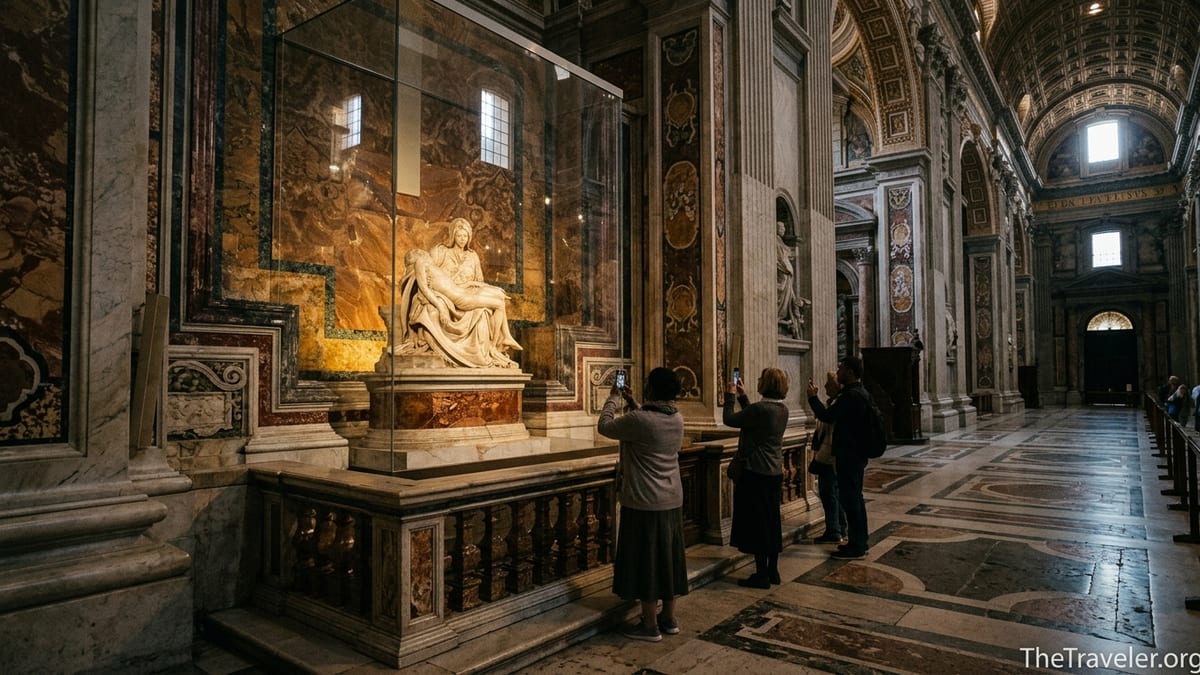
Nothing in guidebooks quite prepares first-time visitors for the viewing conditions of the Pietà. It stands in the Chapel of the Pietà, just inside the main entrance of St Peter’s Basilica on the right, raised on a high pedestal and sealed behind thick bulletproof glass installed after a hammer attack in 1972. Today, you view the sculpture from a distance of roughly 6 to 7 meters, through reflections from side windows and the basilica’s bright nave. Many travelers report that their first impression is not the artistry, but how far away and small the work appears in such a vast church.
That distance has a subtle but important effect: it flattens details. From the central aisle, visitors see a calm, pyramidal composition, perfect and almost too smooth. To notice what makes the Pietà extraordinary, you need to move purposefully. The best vantage point is slightly off-center, toward the left side of the chapel barrier, where the lateral window light falls more directly on Mary’s face and Christ’s torso. Early-morning visitors who enter the basilica soon after opening time often find that, before the main tour groups arrive, they can linger there long enough for their eyes to adjust and details to emerge.
Even then, you must work against the rhythm of modern sightseeing. Organized Vatican tours tend to pause in front of the Pietà for only a minute or two. If you are visiting independently, it is worth stepping aside from the flow, letting a group pass, and then reclaiming a place at the rail. As your vision adjusts to the marble’s subtle shadows, the sculpture changes character. What first looked like a static devotional image becomes an intricate study of anatomy, fabric, and emotion that is far more daring than the postcard view suggests.
Mary’s Youthful Face and the Theology Hidden in Marble
The most remarked-on “oddity” of the Pietà is one most visitors notice but rarely understand: Mary looks far younger than the approximately 50-year-old woman she would have been when Christ died. Her face is smooth and idealized, with the delicate features of a young woman in her twenties, carved with a polish that makes the marble almost luminous under the chapel lights. In photographs it can even look like porcelain. On site, if you stand slightly left of center, you can see how the soft light from the side window skims across her cheeks and down the ridge of her nose, emphasizing the unlined serenity of her expression.
Michelangelo’s decision was not a historical mistake but a deliberate theological statement. Renaissance viewers would have recognized Mary’s youthful face as a symbol of her incorruptible purity and eternal spiritual motherhood. Rather than show a mother ravaged by grief and age, he presents a woman whose beauty is untouched by time, suggesting that her suffering is inward, not written in wrinkles. Visitors used to more dramatic Baroque depictions of the Pietà, with distraught expressions and contorted bodies, often underestimate how radical this quiet approach was at the end of the 15th century.
Look closely at her eyes and mouth. Even at a distance, the corners of her lips are slightly turned down, but not quite in visible sorrow, and her gaze seems to fall not on Christ’s wounds but somewhere beyond, into a contained interior space. Many travelers miss this nuance because they focus entirely on Christ’s exposed body. Yet Mary’s face is the emotional anchor of the composition. Experienced guides sometimes recommend bringing a small pair of opera-style folding binoculars or using the highest optical zoom on your phone to study her features from the railing. With magnification, you can make out the delicate carving of her eyelids and the faint sense that she is absorbing grief rather than displaying it.
The Impossible Body: Michelangelo’s Quiet Distortions of Scale
Another of the Pietà’s most extraordinary aspects is something the brain feels before the eye consciously sees it: the sculpture’s proportions do not make literal sense. At a glance, the group appears naturally balanced, with Mary seated, Christ stretched across her lap. But if Mary were to stand up, her figure would be improbably tall and broad. Michelangelo subtly enlarged her lower body and drapery while keeping her head small, hiding a nearly monumental framework beneath the folds of cloth. From the main viewing point you only sense this if you compare the scale of her hands with the width of her torso and the spread of her lap.
This distortion allows Michelangelo to solve a practical problem. A life-size adult male body laid across the lap of an anatomically correct woman would either spill awkwardly off to one side or look cramped and unbalanced. By amplifying Mary’s hidden hips and legs, he creates an invisible platform that supports Christ in a graceful diagonal. If you look at the deep V-shaped fold of fabric between Mary’s knees, you can see how the drapery does much of the structural work: it is carved as thick, architectural planes disguised as cloth.
Travelers who see reproductions of the Pietà in smaller churches or museums later often experience a jolt. In some modern casts or scaled-down replicas, the sculptor or foundry restores more “natural” proportions, and the composition suddenly looks ordinary. Returning to photographs of the original, you begin to appreciate how Michelangelo’s manipulation of scale is as daring as anything in his Sistine Chapel figures. It is a reminder that what feels harmonious and realistic is sometimes the product of careful, even audacious artifice.
Drapery as Architecture: The Folds Most People Never Really See
From the basilica’s aisle, the heavy folds of Mary’s robe can appear almost decorative, a general impression of rich fabric appropriate to the mother of Christ. But if you move your gaze slowly from her left shoulder down to her knees, you will see that the drapery behaves less like soft cloth and more like a series of constructed planes. Broad, flattened ridges alternate with deep, shadowy cuts, particularly over her lap and along the front of her legs. These are not casual details. Michelangelo uses the folds like buttresses and beams, distributing weight and directing the viewer’s eye.
Notice the thick diagonal fold that runs from Mary’s right knee down toward the edge of the base, just under Christ’s legs. It forms a kind of marble ramp, catching light along its upper edge and dropping into darkness beneath. This creates the illusion that Christ’s body is gently sinking into soft fabric, even though the marble there is structurally solid. On site, when sunlight from the nave is bright, that fold throws a strong shadow that changes as clouds move, producing a subtle sense of motion across what is in fact static stone.
Art historians have long pointed out that these folds also echo Gothic sculpture traditions that Michelangelo would have seen in Northern European works arriving in Italy in the late 1400s. For travelers, a useful comparison is to look at other statues in St Peter’s with billowing garments from the 17th century and then return to the Pietà. You will notice that later Baroque drapery often aims for dramatic surface movement, while Michelangelo’s folds are more structural, almost architectural. Standing in the chapel, trace with your eyes the main lines of the cloth, and you will feel how they create a stable triangular composition that anchors the emotional content of the scene.
Christ’s Flesh, Veins, and the Illusion of Weight
Perhaps the most astonishing details in the Pietà are found in Christ’s body, but the bulletproof glass and distance mean most visitors never see them clearly. Photos taken before the 1972 attack or close-up conservation images reveal that Michelangelo carved faint veins on the back of Christ’s right hand and along his forearm, and differentiated textures so that the skin appears soft and alive even in death. Today, from the railing, you can still sense this by watching how light slides across his chest and abdomen. The surface is finished to an almost silky smoothness, broken only by the shallow groove of the spear wound and the subtle modeling of muscles.
Michelangelo also stages a lesson in gravity. Look at Christ’s right arm, which falls loosely toward the front of the sculpture, his hand hanging open. The wrist is slightly bent, and the fingers relax in a way that feels completely natural, as if the last tension has left the body. At the same time, Mary’s left hand, positioned under Christ’s shoulder and side, presses upward just enough to suggest the effort of supporting his weight. Many travelers miss this relationship because they look at each figure separately. Try instead to imagine how the weight would shift if Mary moved her hand a few centimeters. The entire balance of the group would change.
In person, the illusion of weight is strengthened by the polished surface of Christ’s skin against the more complex textures around him. Visitors who move laterally along the chapel rail can watch how reflections on his torso change: from one angle his ribs and abdomen seem softly rounded, from another the same area takes on a sharper modeling. This is not accidental. Michelangelo understood that pilgrims would view the work from multiple positions, and he shaped the marble to maintain a sense of living flesh in changing light. It is one reason why, even separated by glass and crowds, the sculpture still has the power to stop people mid-step.
The Signature, the Sash, and the Story Carved After Dark
Michelangelo’s Pietà is the only work he ever signed, and most visitors never see the signature at all. It runs across the sash that crosses Mary’s chest, carved in elegant capitals: “MICHAEL ANGELUS BONAROTUS FLORENTINUS FACIEBAT.” In the current lighting and at the distance imposed by the glass, the inscription is difficult to read with the naked eye. Still, if you know where to look, you can sometimes catch the way light grazes the incised letters, especially when the chapel is less crowded and you can stand nearly opposite Mary’s torso.
According to early accounts, Michelangelo added this signature after hearing onlookers attribute the finished sculpture to another artist while it was on display in the old St Peter’s. Stung by the misattribution, he returned at night and carved his name into the sash. The anecdote may have acquired embellishments over time, but the signature itself is very real, and its placement is striking. Rather than hide it on the base, he threads it across Mary’s body, integrating authorship into the devotional image. For a modern traveler, spotting that faint line of text becomes a game and a reminder that even in the heart of Christendom’s greatest basilica, questions of artistic pride and reputation were very human.
Practically speaking, if you want to glimpse the signature, a small monocular or compact binoculars can help. Some visitors find that zooming with a modern smartphone and then enlarging the photo offers another route; digital sensors often pick up contrast that the naked eye cannot. However you see it, remembering that this is Michelangelo’s only signed work adds a layer of intimacy to your encounter. You are not just looking at a canonical masterpiece; you are seeing the place where a 24-year-old sculptor literally inscribed his presence into the marble.
Traces of Trauma and Restoration After the 1972 Attack
One of the most significant episodes in the Pietà’s modern history is almost invisible to casual visitors: the extensive damage inflicted on 21 May 1972, when an assailant struck the sculpture repeatedly with a hammer. Contemporary reports and photographs show that Mary’s nose and part of her eyelid were shattered, her left arm was severely damaged, and fragments of marble flew across the chapel. The Vatican responded with an intensive restoration effort that relied wherever possible on recovered fragments, supplemented with marble dust and resin, and the eventual decision to place the work behind protective glass.
Today, standing in the chapel, you are unlikely to notice any overt scars. The restoration was intentionally discreet, aimed at returning the sculpture as closely as possible to its pre-attack appearance. Yet specialists and keen-eyed visitors sometimes point out that Mary’s nose, reconstructed from multiple small pieces, has a slightly different translucency under certain light. When strong side lighting hits her face, the transition between original marble and restored areas can appear just perceptibly smoother or less sharply defined. Without knowing the history, a viewer might simply read this as a quirk of the stone.
For travelers, the attack explains both the presence of the glass and the sometimes frustrating sense of distance from the sculpture. It also adds a layer of poignancy to the experience. You are looking at a work that has survived not only five centuries of devotional use and environmental change, but also a sudden act of violence. Conservators chose not to re-carve missing parts from fresh marble in a visibly different tone, as earlier generations might have done, but to preserve as much original material as possible. Knowing this, the near-perfection of the Pietà today feels less like untouched antiquity and more like a fragile, carefully maintained continuity between Michelangelo’s hands and our own time.
How to Look Longer: Practical Tips for Seeing the Details
Because access to the Pietà cannot be intimate in the literal sense, the key to appreciating its extraordinary details is not proximity but strategy. Time of day matters. St Peter’s Basilica usually opens early in the morning, and independent travelers who arrive within the first hour often find the right-hand aisle relatively quiet. This is when you are most likely to secure a front position at the chapel rail and hold it for several minutes. Midday, when large tour groups flow in from the Vatican Museums, the area can become packed, and you may only manage a brief, partial view from behind other visitors’ shoulders.
Lighting conditions also change your experience. On bright days, strong natural light from the nave windows creates high contrast on the marble, which can make certain details, like the folds of Mary’s robe and Christ’s musculature, more vivid but also increase glare on the glass. On overcast mornings, the softer, more diffuse light tends to reveal subtle modeling in Mary’s face and hands. If your itinerary allows, passing by the chapel twice, at different times of day, can turn a single encounter into a richer visual study.
Finally, go prepared to look actively rather than passively. Before your visit, studying high-quality reproductions or museum casts can train your eye to seek out specific features: the scaling of Mary’s body, the line of Christ’s arm, the architecture of the drapery. Once in front of the original, resist the reflex to photograph first and look later. Take thirty seconds just to let your gaze move slowly from the top of Mary’s head to the base, noting where your attention naturally lingers. Only then raise your camera, ideally using it as a tool to zoom in on particular areas rather than simply as a device for a quick snapshot.
The Takeaway
For most travelers, the Pietà appears briefly, as part of a larger checklist: basilica facade, dome, baldachin, tombs, and out again into the Roman sun. Yet Michelangelo carved this sculpture to be a sustained encounter, not a fleeting one. Its most extraordinary qualities lie not in the surface impression of beauty that anyone can register in a second, but in the slow realization that the figures are subtly distorted, that drapery functions as invisible architecture, that flesh carved in stone can appear to retain warmth and weight, and that even in a devotional image, the artist’s personal signature and pride are quietly present.
Standing amid crowds and security glass, it is easy to feel that you are too far away, that real intimacy with the work belongs to another era. The truth is more encouraging. By adjusting where you stand, when you visit, and how you look, you can still discover details that many visitors never notice: the gentle press of Mary’s supporting hand, the almost imperceptible veins in Christ’s arm, the inscription tracing across a marble sash. In a city overflowing with masterpieces, the Pietà rewards those who give it what it most deserves and most rarely receives: unhurried, attentive time.
FAQ
Q1. Where exactly is Michelangelo’s Pietà located inside St Peter’s Basilica?
The Pietà is in the Chapel of the Pietà, the first chapel on the right as you enter the main nave of St Peter’s Basilica from the front doors.
Q2. How close can visitors get to the Pietà today?
You view the Pietà from behind a barrier several meters away, with bulletproof glass in front of the sculpture, so you cannot approach the marble directly or walk around it.
Q3. What is the best time of day to see the Pietà’s details?
Early morning, soon after the basilica opens, usually offers the calmest conditions and softer light, giving you a better chance to stand at the front rail and observe details.
Q4. Why does Mary look so young in the Pietà?
Michelangelo intentionally depicted Mary with a youthful, idealized face as a symbol of her purity and spiritual perfection, rather than her literal age at the time of the Crucifixion.
Q5. Can you see Michelangelo’s signature on the Pietà?
Yes, the sculpture is signed on the sash across Mary’s chest, but the letters are faint and distant, so you may need optical zoom or binoculars to make them out.
Q6. Was the Pietà damaged in the past?
In 1972 a man attacked the sculpture with a hammer, severely damaging parts of Mary’s face and arm; expert restorers later repaired it and added the protective glass you see today.
Q7. Is it allowed to take photos of the Pietà?
Non-flash photography is generally allowed inside St Peter’s Basilica, including the Pietà, but you should respect signage, staff instructions, and other visitors when taking pictures.
Q8. How long should I plan to spend in front of the Pietà?
If crowds allow, plan at least five to ten minutes so your eyes can adjust and you can study key details like Mary’s expression, the drapery, and Christ’s arm and hand.
Q9. Are there good reproductions of the Pietà to see up close elsewhere?
Several churches, museums, and universities around the world display high-quality casts or replicas, which can be viewed at close range and used to study details obscured in the original.
Q10. Do I need a guided tour to appreciate the Pietà’s hidden details?
A knowledgeable guide can be helpful, but you can also appreciate many details on your own by visiting at a quiet time, looking slowly, and using images or notes as a visual checklist.