


Every traveler to Rome has seen La Pietà long before they reach Vatican City. It appears on postcards, coffee-table books, and museum posters, so familiar that it risks becoming visual wallpaper. Yet the moment you step into St Peter’s Basilica and glimpse Michelangelo’s marble group glowing softly to the right of the entrance, that overreproduced image suddenly feels startlingly new. Seeing La Pietà in person does not just confirm Michelangelo’s genius. It makes it tangible, physical, and unexpectedly intimate. Here is how to understand that moment, and how to plan your visit so you can really feel it.
Get the latest updates straight to your inbox!
Meeting La Pietà for the First Time
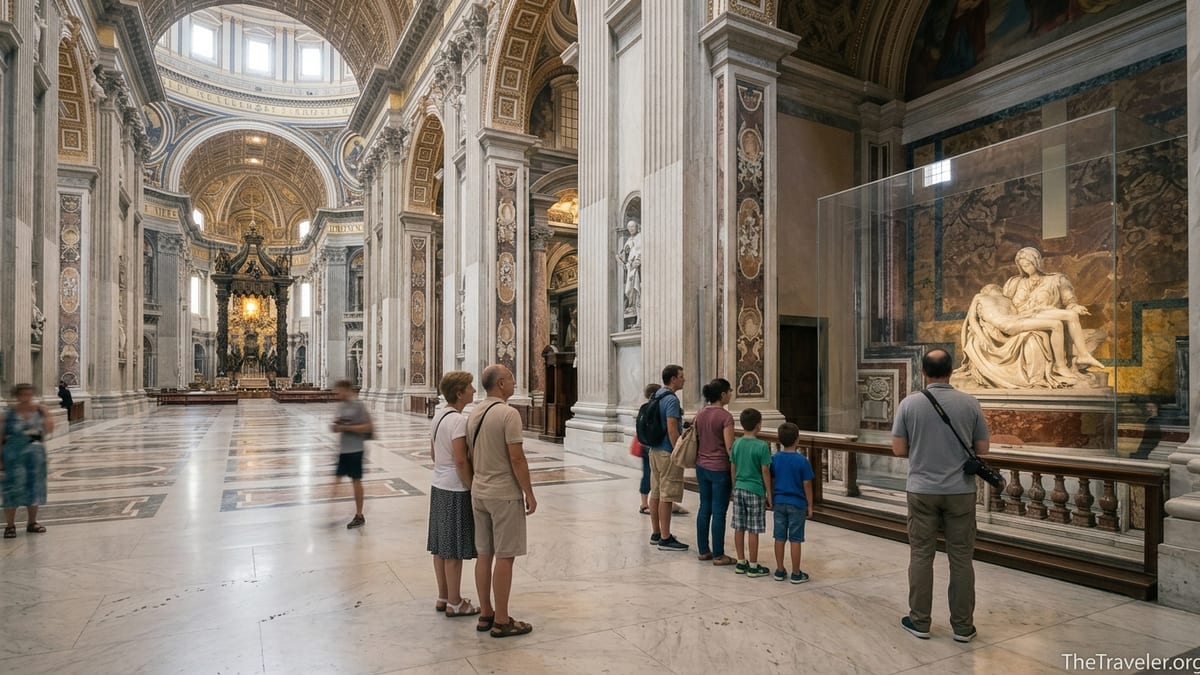
Most visitors encounter La Pietà within minutes of passing the security check and walking through the massive bronze doors of St Peter’s Basilica. The sculpture sits in its own side chapel to the right of the main entrance, behind a wall of clear bulletproof glass installed after a 1972 attack and modernized in 2024. From a distance, the marble almost seems to emit its own soft light. The figures of Mary and Christ are carved from a single block, but in person they read like separate, breathing bodies sharing a single, unbearable moment.
What tends to surprise first-time viewers is the scale. Photographs often make La Pietà feel monumental, like the colossal figures on the basilica’s facade. In reality, it is life-size, almost modest compared with the enormous setting around it. Christ’s body appears delicate and weighty at once, draped across Mary’s lap. Her face, younger than his, is composed and grief-struck, a combination that can be difficult to register fully until you stand in front of it and feel how close it is to your own height, your own human scale.
Equally striking is the way the surrounding crowd quiets near the sculpture. Even on a peak-season afternoon, with tour groups streaming past and camera shutters clicking toward the main altar, the space in front of La Pietà often falls into a soft murmur. Many travelers describe an instinctive habit of lowering their voice or moving more slowly, not because anyone asks them to, but because the marble itself feels like a person you have just met rather than an object to check off a list.
If you are used to consuming art on screens, the first in-person impression can be disorienting. The polished marble skin has a softness no photograph captures. The folds of Mary’s robe create deep shadows that shift as you move your head a few centimeters. The veins on Christ’s arm catch the light for a second, then disappear. These minute changes are what make Michelangelo’s genius feel less like legend and more like a living, observable fact.
How the Reality Differs from the Photos
In guidebooks, La Pietà is usually cropped tightly: Mary, Christ, and nothing else. In person, you cannot avoid seeing it within the vast nave of St Peter’s. The scale of the basilica is overwhelming, and against that backdrop, Michelangelo’s decision to keep the sculpture relatively compact feels deliberate. It requires you to step closer, to leave the central aisle and press gently toward the glass with the other visitors.
From that position, details emerge that rarely appear in reproductions. You notice how Mary’s left hand remains open beneath Christ’s shoulder, not gripping but offering, a gesture of both presentation and surrender. You see the fine edge of her veil where it meets her forehead, and the subtle twist in Christ’s torso that suggests the heavy, unconscious weight she must support. Perhaps most revealing is the almost invisible signature carved into Mary’s sash, the only time Michelangelo is known to have signed a sculpture.
The viewing conditions also change the emotional tone. Because the chapel is roped off several meters from the glass, you never experience La Pietà alone. Instead, you stand shoulder to shoulder with strangers from around the world: a Brazilian family whispering in Portuguese, a group of Korean pilgrims reciting a prayer, an American couple nudging one another to look at the same curve of marble. This shared experience creates a kind of communal witnessing. It feels less like inspecting an art object and more like attending a quiet vigil.
Practical details shape this encounter in very real ways. Morning light filtering through the basilica can give the marble a cool, bluish clarity. By late afternoon, especially in summer, the interior grows warmer and more golden, softening the contours. Travelers who visit twice in one day often remark that the same sculpture feels like two different works, simply because the light and crowd rhythms have shifted.
Planning Your Visit to St Peter’s Basilica
To see La Pietà without spending half your day in a queue, it pays to plan carefully. Entry to St Peter’s Basilica itself is free, but every visitor must pass through airport-style security in St Peter’s Square. In 2026, typical waits range from 15 to 30 minutes right at opening time to an hour or more between about 9:30 a.m. and early afternoon during the May to October high season. Arriving before 7:30 a.m. on a regular weekday can mean walking almost straight in, particularly outside major religious holidays.
The basilica’s posted opening hours usually run from 7:00 a.m. until early evening, with slightly shorter winter hours and occasional closures or restricted access during papal events. If your dates fall around the 2025–2026 Jubilee celebrations or important liturgical feasts such as Easter, expect tighter security and heavier crowds. Many travelers choose to check local Vatican bulletins or Rome-focused news outlets the week before their visit to confirm there are no unscheduled closures.
You can still walk in for free, but companies now sell timed-entry products that bundle a reserved security slot with options like an audio guide or access to the dome. Prices often start around 7 to 10 euros for a basic audio guide package that uses a separate, faster-moving security line, and climb to 30 euros or more for small-group guided tours that include the basilica and dome. These do not eliminate security checks, but they can easily save you 30 to 60 minutes in peak season, which can matter if you are visiting with children or in hot weather.
Once inside, resist the urge to rush past La Pietà on the way to the main altar. Although it is the first masterpiece you encounter, it rewards time. You can always circle back after exploring the rest of the basilica, but many travelers find that spending their freshest minutes of attention here, before visual fatigue sets in, makes the sculpture’s impact much stronger.
Dress Code, Security, and What to Expect on the Day
St Peter’s Basilica has one of the strictest dress codes in Europe, and it is actively enforced in the security line. Men and women must have shoulders and knees covered. Sleeveless tops, low-cut shirts, short shorts, and skirts above the knee are frequently turned away. Leggings worn as pants can be considered too form-fitting, and hats must be removed inside. The rules apply equally to children. Guards can and do deny entry to anyone dressed inappropriately, even after a long wait, and there is no on-site cloakroom for stored items like large umbrellas or tripods.
In practical terms, that means planning your outfit the way you would for a moderately conservative workplace. Lightweight linen trousers, below-the-knee skirts, short-sleeved shirts, or T-shirts are all fine. Many visitors carry a thin scarf or travel shawl in a daypack to cover bare shoulders over a summer dress. If you forget, makeshift cover-ups are sold by vendors on the streets leading to the square, typically simple cotton shawls or wraparound skirts for about 5 to 10 euros. While not stylish, they are often the quickest solution for travelers who realize too late that their outfit does not pass muster.
Security itself functions very much like an airport. You will pass through metal detectors, run your bag through an X-ray machine, and may be asked to open it for inspection. Large suitcases are not allowed, and rules about knives, tools, and similar objects are strict. Because there is currently no general-purpose cloakroom for the basilica, it is wise to travel light: a small backpack, day bag, or camera bag is usually acceptable, but anything larger can delay you or even prevent entry.
Photography is permitted in most of St Peter’s, including in front of La Pietà, but only without flash. The glass shield in front of the sculpture will reflect bright light and camera screens, so if you want a clear photograph, turn off your flash and raise your camera slightly above eye level. That said, there is value in putting the lens down. Many travelers report that their clearest memory is the minute they stopped trying to capture the perfect shot and simply looked quietly at Mary’s face through the glass.
Reading Michelangelo’s Genius Up Close
Standing in front of La Pietà allows you to observe core elements of Michelangelo’s genius in real time: his understanding of anatomy, his command of marble, and his instinct for emotional restraint. From a few meters away, Christ’s body looks completely relaxed. The muscles are defined but not exaggerated, the ribs barely visible under the skin. Yet there is nothing of the heroic athleticism you see in his later David. Here, the body is vulnerable, marked by subtle signs of weight and collapse that are difficult to appreciate in photographs alone.
Mary’s face is perhaps the greatest revelation. In images, her youth can seem puzzling. In person, the smoothness of her features reads not as immaturity but as a kind of eternal composure. You can walk from one side of the viewing area to the other and watch her expression change: grief from one angle, serenity from another, a complicated mixture if you pause halfway between. The folds of her cloak frame her face like an architectural niche, guiding your eye to her downcast gaze.
Equally impressive is Michelangelo’s manipulation of the marble surface. Certain areas, such as Christ’s torso and Mary’s face, are polished to a luminous sheen. Others, like the deeper folds of the drapery, retain a slightly rougher texture, absorbing rather than bouncing light. This contrast makes the figures feel three-dimensional even from a distance. You can trace the imagined path of the sculptor’s tools: the broad strokes that roughed out the general block, the finer chisels that carved fingers and eyelids, the abrasives that produced the final, skin-like finish.
When you know that Michelangelo carved La Pietà in his early twenties, before creating the David and the Sistine Chapel ceiling, the experience can be humbling. Many visitors find themselves thinking not about art history as a list of dates, but about what it must have felt like for a young sculptor to persuade a cold stone to convey such tenderness. In that sense, standing before La Pietà is less about admiring technical skill and more about witnessing an improbable human achievement.
Connecting La Pietà to the Rest of Your Rome Trip
Seeing La Pietà in person often changes how travelers look at other art in Rome. After encountering such a finely balanced composition, you may walk into the Vatican Museums and suddenly notice how other Renaissance works handle bodies and drapery, or how later Baroque artists like Bernini push emotional expressiveness even further. The marble angels on the Ponte Sant’Angelo, the Ecstasy of Saint Teresa in Santa Maria della Vittoria, and the colossal statues in Piazza del Campidoglio all feel part of a lineage that La Pietà helps you recognize.
Within St Peter’s itself, La Pietà can become a reference point for everything else you see. As you move toward the main altar and the bronze baldachin, you may find yourself comparing the intimate scale of the sculpture with the colossal dimensions of the basilica. Climbing the dome, which requires either a paid elevator-and-stairs combination ticket or a full stair climb, you can look down at the spot where the sculpture sits and realize how deliberately it was placed to greet every incoming visitor.
Some travelers build an informal “Pietà trail” through Italy after seeing the Vatican version. Michelangelo’s later Pietà works, such as the unfinished Rondanini Pietà in Milan’s Sforza Castle, approach the same theme with radically different energy. Where the Vatican La Pietà is smooth and harmonious, the later version is almost skeletal, rough, and anguished. Experiencing both can deepen your sense of Michelangelo not as a mythical master who produced a single flawless icon, but as a working artist who revisited the same grief across decades of his life.
Even if your itinerary does not allow for that broader circuit, the memory of La Pietà tends to linger as you move through Rome’s more everyday scenes. You may notice, for instance, how the drapery on a simple street-side Madonna statue echoes Michelangelo’s folds, or how the weight of someone asleep on a park bench recalls the slackness of Christ’s arm. It is in these unexpected moments that the sculpture’s genius feels most real: not just as a masterpiece in a basilica, but as a lens that quietly alters how you see bodies, gestures, and grief in the world around you.
The Takeaway
Seeing La Pietà in person is not just another stop on a Vatican checklist. It is an encounter that can recalibrate how you think about art, devotion, and human skill. The sculpture’s impact lies partly in its beauty and partly in the way it resists full capture by cameras and reproductions. You have to stand there, in the echoing half-light of St Peter’s, and let your eyes adjust to the marble’s softness, the crowd’s murmur, and the quiet composure in Mary’s face.
Practically, this means giving La Pietà time and attention in your schedule. Dress in a way that respects the basilica’s rules so you are not turned away. Arrive early or choose a quieter season if you can, and consider whether a timed-entry product will make your day smoother. Travel light enough to glide through security, yet prepared with a scarf or shawl if needed. Once inside, allow yourself to move slowly, to walk from one side of the viewing area to the other, and to look without rushing.
More than five hundred years after Michelangelo laid down his tools, La Pietà remains one of the most compelling arguments for making the journey to Rome in person. No high-resolution image on a museum wall can replace the small shock you feel when real light meets real marble in real space. That shock is the moment Michelangelo’s genius stops being a story you have heard and becomes something you have actually seen.
FAQ
Q1. Where exactly is La Pietà located inside St Peter’s Basilica?
La Pietà is in a side chapel immediately to the right as you enter the main doors of St Peter’s Basilica. Look for the glass-protected sculpture on the right-hand wall as you step inside.
Q2. Do I need a ticket to see La Pietà?
No separate ticket is required to see La Pietà. Entry to St Peter’s Basilica is free, and the sculpture is visible from the public area behind the glass barrier once you have passed security.
Q3. What is the best time of day to visit if I want a calmer view of La Pietà?
The first hour after opening, typically around 7:00 to 8:00 a.m., is usually the quietest, especially on weekdays outside major religious holidays. Late afternoon can also be calmer than midday, though it varies by season.
Q4. How close can I get to the sculpture?
Visitors must remain behind a barrier several meters from the bulletproof glass that protects the sculpture. You cannot step into the chapel itself, but from the viewing area you can still see facial details and much of the fine carving.
Q5. Is photography allowed in front of La Pietà?
Yes, non-flash photography is generally permitted. Flash and tripods are not allowed, and it is considerate to keep your photo-taking brief so others can enjoy an unobstructed view.
Q6. How strict is the dress code for visiting La Pietà and the basilica?
The dress code is strictly enforced. Shoulders and knees must be covered for all visitors, including children. Those wearing sleeveless tops, very short shorts, or skirts above the knee may be denied entry at security.
Q7. Can I sit and contemplate La Pietà for a while?
There are usually no seats directly facing the sculpture, and the area can be busy. However, you can stand for several minutes without any problem, or step back along the side aisle to reflect in a slightly quieter spot.
Q8. Is La Pietà accessible for visitors with mobility issues?
Yes. The main floor of St Peter’s Basilica, including the area in front of La Pietà, is accessible to visitors using wheelchairs or with limited mobility. The security area and entrance have ramps and wide passages.
Q9. Are there guided tours that focus specifically on La Pietà?
Many Vatican and St Peter’s Basilica tours include a stop at La Pietà and offer commentary on its history and symbolism, though few focus solely on the sculpture. If this is a priority, look for small-group or private tours that emphasize Renaissance art.
Q10. How long should I plan to spend in front of La Pietà?
Most visitors spend 5 to 10 minutes, but allocating 15 to 20 minutes lets you move around the viewing area, observe the sculpture from different angles, and appreciate the changing light and details more fully.