


For many travelers, seeing Michelangelo’s Pietà in St Peter’s Basilica is a once‑in‑a‑lifetime moment. In reality, that moment usually takes place after airport‑style security, a long shuffle in a dense crowd and a quick glimpse through bulletproof glass. With a bit of planning, though, you can give this masterpiece the calm, contemplative viewing it deserves. Here is what you should know before you go.
Get the latest updates straight to your inbox!
Understanding La Pietà and Why It Is Behind Glass
Michelangelo carved the Pietà between 1498 and 1499, when he was barely in his twenties, from a single block of Carrara marble. It shows the Virgin Mary cradling the dead body of Christ just after the Crucifixion. Unlike later, more tortured depictions of the same scene, this Mary is young and composed, her face more resigned than anguished. Even in the crush of modern tourism, visitors often fall silent when they first see how delicately Michelangelo rendered the folds of fabric and the slack weight of Christ’s body.
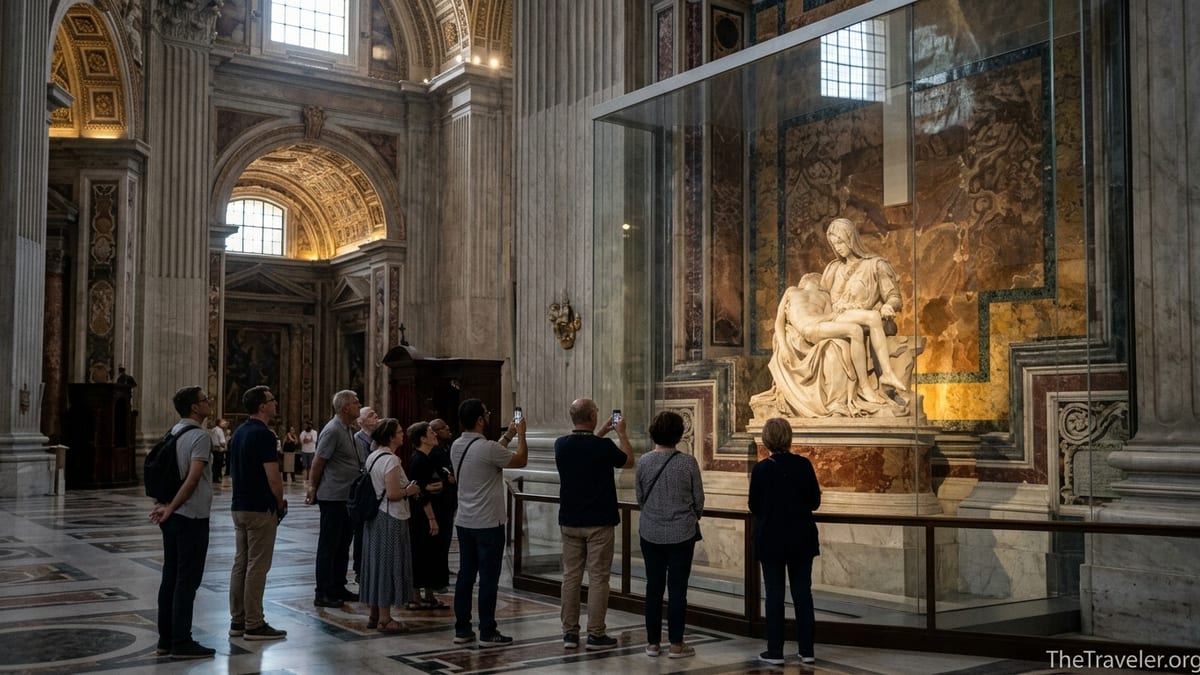
The sculpture sits in the first side chapel on the right as you enter St Peter’s Basilica, known as the Chapel of the Pietà. Originally intended as an altarpiece, the work is now a world‑famous icon, drawing millions of people each year. That fame comes with a practical consequence: the Pietà is kept several meters back, behind a high barrier and a wall of bulletproof glass. If you imagine yourself standing right beside the marble, you need to adjust your expectations before you arrive.
The glass is not just for climate control or conservation. In May 1972, a man attacked the Pietà with a hammer, shouting that he was Jesus Christ. Several blows shattered Mary’s nose and eyelids and chipped her arm. Vatican conservators spent months painstakingly restoring the statue from fragments. When it returned to public view, it did so permanently separated from visitors by protective glass. Knowing this story adds context when you see people pressed up to the rail, phones raised. The barrier is the price of still having the original sculpture in front of you at all.
Today, the glass has subtle reflections and a slight tint that you will notice in photos, especially from oblique angles. To the naked eye, however, you can still appreciate the sculpture’s details if you give your eyes a minute to adjust and take time to look rather than only snap a quick picture.
Finding the Pietà Inside St Peter’s
Once you clear security and step into the basilica, you are not far from the Pietà, but it is easy to be distracted by the sheer scale of the nave. As you enter through the central doors and walk past the holy water fonts, keep to the right‑hand side. The Pietà is in the very first chapel along that wall, behind a low barrier that usually has a loose crowd in front of it.
The chapel itself is not a separate room you walk into, which surprises many visitors who picture an intimate side space. Instead, you view the sculpture from the main aisle in front of the glass. At busy times, you will see a knot of people six or eight across, often with tour groups stopping briefly while the guide speaks quietly into headsets. If you do not know what you are looking for, you might walk right past, assuming that such a famous work must be deeper in the church.
The basilica is free to enter and there are no separate tickets or reservations specifically for the Pietà. Whether you have come independently, with an audio guide you rented in the square, or on a full Vatican Museums and St Peter’s tour, everyone funnels to the same vantage point in front of the glass. Tours that start in the Vatican Museums and end in the basilica through the Sistine Chapel shortcut typically reach the Pietà in late morning, when the basilica is at its busiest. If you want a calmer viewing, planning to come at a different time than these big tour waves is crucial.
A practical detail: there are sometimes small signs on the pillars pointing out major works like Michelangelo’s Pietà, Bernini’s Baldacchino and the bronze statue of St Peter. These can help orient you if you arrive when the chapel temporarily looks less crowded and the sculpture is not immediately obvious from a distance.
Best Time of Day and Year to See the Pietà Calmly
In 2026, St Peter’s Basilica generally opens at 7:00 am and closes around 6:30 or 7:00 pm, depending on the season. The Pietà is visible whenever the basilica is open, but your experience changes dramatically with the time of day. Crowd trackers and recent visitor reports consistently show the heaviest queues for security between about 10:00 am and 3:00 pm, especially on peak summer days and during major church events. During those hours, simply reaching the Pietà can mean standing in the sun on St Peter’s Square for one to three hours and then jostling to get a few seconds at the front of the barrier.
If you want space to really look, aim for either the first two hours after opening or the final hour before closing. On a Tuesday or Thursday in shoulder season, arriving by 7:15 or 7:30 am can mean a security wait of 10 to 20 minutes and then relatively open aisles inside. You might share the Pietà chapel with a few quiet pilgrims and a small tour group rather than a wall of phones. A February 2026 visitor, for example, described walking almost straight through security at opening and having time to circle back twice to the chapel before the mid‑morning crowds built up.
Evening can be just as rewarding. Several travelers in June 2026 reported walking up to security at around 6:45 or 6:50 pm and entering the basilica in under five minutes, after seeing a line that wrapped around the square earlier in the day. Inside, they had roughly an hour before closing, enough to visit the Pietà unhurriedly and then wander the nave in a softer, late light. This strategy works particularly well in hot months, when the square bakes at midday.
Consider the calendar as well as the clock. Wednesdays are usually busier in the morning because of the papal audience in St Peter’s Square; the basilica and dome can be closed to regular visitors until around early afternoon, which compresses crowds into the remaining hours. Major Catholic holidays around Easter, Christmas and important feast days also bring surges of pilgrims and closures for liturgies. If your Rome dates are fixed, check the Vatican’s official calendar of ceremonies a few weeks in advance and be prepared to adjust your Pietà viewing time if a Mass or special event is scheduled that morning.
Security, Dress Code and Practical Logistics
Before you can even think about the Pietà, you must pass through airport‑style security at the edge of St Peter’s Square. Every visitor goes through metal detectors, whether they are entering on their own, with a “skip the line” basilica audio‑guide ticket, or at the end of a Vatican Museums tour. In practice, many so‑called skip‑the‑line products sold online do not bypass this security queue; instead, they sometimes use a smaller reserved entry gate that may still back up on very busy days. Recent reports from spring 2026 mention waiting over 90 minutes in the square despite having a prepaid reservation.
To make security smoother, bring as little as possible. Small daypacks, cameras, and water bottles are fine, but bulky luggage, glass bottles, pocket knives and tripods can cause delays or be refused. There is no dedicated cloakroom at the basilica entrance like at the Vatican Museums, so anything you bring must pass the scanners. Families with strollers do get through, but in tight crowds they will find movement inside the basilica slower, especially near the Pietà chapel where people bunch up.
Dress code trips up more visitors than you might expect. St Peter’s is a working church, and shoulders and knees are expected to be covered for all genders. Sleeveless tops, low‑cut shirts, very short skirts or shorts, and visible midriffs can all lead to being turned away at the security checkpoint. In summer, a practical solution is to wear knee‑length shorts or a light cotton dress and carry a thin scarf or linen shirt to cover your shoulders before you join the line. Many visitors only learn this rule when they see people ahead of them being quietly refused entry after half an hour of queuing.
Finally, build in a cushion of time. If you have pre‑booked afternoon Vatican Museums tickets or a timed dome climb, do not plan to see the Pietà just before those slots unless you are visiting very early in the day. In peak months, it is safer to treat the basilica as a half‑day experience, aiming either for early morning Pietà viewing followed by the rest of the church, or a late afternoon visit after you have finished with the museums and lunch.
How to Actually See the Sculpture Well
Because the Pietà is behind glass, at a distance and usually surrounded by people, the way you approach it matters. Once you reach the chapel, resist the urge to stay at the back and zoom in with your phone. Instead, patiently work your way forward along one side of the crowd, keeping a gentle, steady pace. In busy periods, guides often pause their groups slightly to one side of the central viewing area, leaving a narrow strip directly in front of the glass for independent visitors who move along in a slow line.
When you reach the barrier, give yourself at least a full minute simply to look with your own eyes before you think about photos. Notice Mary’s oversized lap, which Michelangelo deliberately enlarged to support Christ’s body gracefully, and the impossible delicacy of the carved veins in Christ’s arm. From a roughly front‑center position, the reflections on the glass are minimal, especially if you shade your eyes slightly with your hand. If harsh reflections from the nave’s lighting do bother you, step half a meter left or right and look again; the angle can make a surprising difference.
Photography is allowed inside St Peter’s Basilica for personal use, and you will see many visitors taking pictures of the Pietà. Flashes are discouraged, both because they create glare on the glass and out of respect for the sacred space. Tripods and large video rigs are not permitted. A modern smartphone with a good main camera or a mirrorless camera with a 35 mm or 50 mm lens will capture the sculpture clearly from the viewing distance. Avoid holding your device high above your head for extended periods, which blocks the view of those behind you and contributes to a theme‑park atmosphere.
If you know you are particularly moved by Renaissance art or by the image of the sorrowing Mary, consider planning two brief encounters rather than one long battle with the crowds. For instance, you might stop at the chapel for a few minutes early in your visit, then circle back toward the end as the basilica quiets. Many travelers find that the second viewing, when the initial excitement has worn off and the nave is calmer, is when they best appreciate the subtle emotion in Mary’s face and the polished, almost flesh‑like surface of the marble.
Respectful Behavior and the Spiritual Dimension
Although St Peter’s attracts well over ten million visitors a year, it is first of all a place of worship. The Pietà, in particular, is not just a famous artwork; it depicts one of the most painful scenes in Christian tradition, the moment when Mary receives the dead Christ from the cross. Even if you are visiting as a secular traveler, recognizing this context can change the way you experience the sculpture.
Practical respect starts with volume. Near the Pietà, voices can rise as people react, explain details to friends or translate a guide’s commentary. Try to keep your own voice low, as if you were in a library or concert hall. If you are visiting with children, a quick conversation in the square beforehand about “inside voices” and staying behind the barriers can make things smoother once you are in front of the sculpture.
Occasionally, a brief prayer service or rosary may be taking place in a nearby chapel while you are visiting. When this happens, Vatican staff may rope off sections or quietly ask visitors to move along more quickly. If you arrive at the Pietà when a group is praying directly in front of it, the respectful choice is to step back, visit another part of the basilica and return later. This can feel frustrating when you have waited a long time to get inside, but it aligns with the building’s primary role as a living church.
Take a moment, too, to notice how other visitors respond. You might see a group of pilgrims from Latin America singing softly as they gaze at the sculpture, or a solo traveler from Asia standing completely still, tears in their eyes. Observing this range of reactions can make your own experience feel less like consuming a attraction and more like participating in a shared human encounter with beauty and grief.
Combining the Pietà With the Rest of Your Vatican Visit
Most travelers do not come to St Peter’s only for the Pietà. If you are planning a full Vatican day, thinking through the order of sights will help you avoid backtracking and energy crashes. One popular strategy is to book timed Vatican Museums tickets or an official tour for early morning, spend several hours with the Sistine Chapel and galleries, and then enter the basilica via the internal passage that leads from the Sistine Chapel to St Peter’s. This route, available on many guided tours, avoids exiting back to the street and means you reach the basilica, and the Pietà, without passing through the main square’s security line again.
Another approach is to reverse the day: visit St Peter’s Basilica at opening time to see the Pietà and the main nave in relative quiet, perhaps climbing the dome immediately afterward when waits are shorter, then break for lunch in the surrounding Borgo neighborhood. Afterward, head to the Vatican Museums for a mid‑afternoon entry. This schedule works well if you are staying nearby and can be in the square shortly before 7:00 am.
Keep in mind how tiring the Vatican can be. A full lap through the Museums and Sistine Chapel, followed by St Peter’s Basilica, easily adds up to 15,000 to 20,000 steps. If the Pietà is a priority, guard a bit of mental energy for it. That might mean taking a short rest on a bench in the nave before you approach the chapel, or choosing to skip one of the less compelling side altars so you do not arrive mentally overloaded. Travelers who try to “do it all” often report barely remembering the Pietà afterward, despite having looked forward to it for years.
Lastly, remember that you can leave and return to the square itself freely, but re‑entering the basilica always requires going back through security. You cannot view the Pietà, step outside for a coffee, and then pop back in through a side door. Plan snacks, water and restroom breaks with that in mind, especially if you are traveling with children or older relatives who might not tolerate standing in line twice.
The Takeaway
Seeing Michelangelo’s Pietà in St Peter’s Basilica is not a hushed museum moment. It is a contemporary pilgrimage through security lines, crowds and camera screens to stand, for a brief time, in front of a masterpiece scarred by history and shielded by glass. The more you understand about the sculpture’s story, the basilica’s rhythms and the practical realities of Vatican logistics, the better chance you have of transforming that brief encounter into something meaningful.
Arrive early or late, dress modestly and pack light. Expect a barrier and reflections, then work patiently toward the front and give yourself a full minute to simply look before you take a photo. Stay aware that you are in a living place of worship, where the quiet grief in marble mirrors the prayers and emotions of the people around you. Do that, and your memory of the Pietà will not be of a rushed snapshot in a crowd, but of a moment when Rome’s layers of art, faith and history came together in a single, unforgettable image.
FAQ
Q1. Where exactly is Michelangelo’s Pietà inside St Peter’s Basilica?
The Pietà is in the first side chapel on the right as you enter the basilica, just a short walk from the main doors, behind a barrier and large glass screen.
Q2. Do I need a separate ticket or reservation to see the Pietà?
No. Entry to St Peter’s Basilica is free, and there is no specific ticket or time slot for the Pietà. You only need to pass through the general security line for the basilica.
Q3. What is the best time of day to view the Pietà with fewer crowds?
The calmest times are usually the first two hours after opening, around 7:00 to 9:00 am, and the final hour before closing in the early evening, outside major holidays and events.
Q4. Why is the Pietà behind glass and so far away?
In 1972, a vandal attacked the statue with a hammer, badly damaging Mary’s face and arm. After restoration, the Vatican installed bulletproof glass and a barrier to protect the sculpture.
Q5. Can I take photos of the Pietà?
Yes, personal photography without flash is generally allowed. Flash and tripods are discouraged, and you will be shooting through glass from several meters away.
Q6. What should I wear to be allowed into St Peter’s and see the Pietà?
Shoulders and knees should be covered for all visitors. Avoid sleeveless tops, very short shorts or skirts and revealing clothing, or you may be turned away at security.
Q7. How long should I plan for seeing the Pietà?
If you time your visit well, you might spend 5 to 15 minutes in front of the chapel itself, but you should allow at least one to two hours total for security and exploring the basilica.
Q8. Does a Vatican Museums or Sistine Chapel tour guarantee a better view of the Pietà?
Many museum tours end in St Peter’s, which lets you avoid re‑queuing in the square, but once inside everyone views the Pietà from the same public area behind the barrier.
Q9. Is the Pietà accessible for visitors with limited mobility?
Yes. The main floor of the basilica is largely step‑free, and you can reach the Pietà chapel area in a wheelchair or with a mobility aid, though it may be crowded at peak times.
Q10. What if there is a Mass or service while I am trying to see the Pietà?
During liturgies or special events, staff may redirect visitors or briefly restrict access. In that case, visit another part of the basilica and return to the Pietà once the area reopens.