


More news on this day
Flight operations at New York’s LaGuardia Airport faced fresh disruption today after a sinkhole discovered on one of the runways forced ground stops, diversions and delays across the regional air network.
Get the latest news straight to your inbox!
Runway damage forces rapid shutdown of departures
Initial reports from live airport status dashboards and local media coverage indicate that a section of pavement on a LaGuardia runway gave way earlier in the day, creating a sinkhole that quickly led to a suspension of departures on the affected strip. Airport condition alerts referenced “airfield surface issues” as ground crews moved to secure the area and assess the extent of the damage.
Live flight tracking platforms for LaGuardia, which normally show around four in five departures operating on time, began recording a sharp rise in delay minutes shortly after the runway issue emerged. Some departure banks shifted from minor schedule slippage to long ground holds as aircraft queued for the remaining available runway capacity.
Operational updates shared through airline channels pointed to a mix of delayed pushbacks, holds at gates and rerouted taxi patterns while the closed runway segment remained off limits. With LaGuardia’s airfield already constrained by intersecting runways and limited taxiway space, the sudden loss of a portion of pavement significantly reduced the margin for normal peak-period operations.
While no injuries have been reported in connection with the sinkhole incident, images circulating on social platforms suggested localized ground subsidence deep enough to trap at least one airfield vehicle, underscoring the need for a cautious and extended inspection before any reopening decision.
Delays and cancellations ripple through New York and beyond
The partial runway closure at LaGuardia quickly translated into a familiar pattern for New York travelers: rolling delays, aircraft out of position and scattered cancellations. According to publicly available flight status boards, a number of services were held at origin airports with “ground delay program” notations, while others remained parked at LaGuardia awaiting a departure slot.
Regional routes along the busy Northeast Corridor appeared among the first to be affected, with shuttle flights to Boston, Washington and smaller regional cities absorbing early cancellations as airlines tried to preserve long-haul connections in and out of the New York area. Aircraft headed to LaGuardia from nearby hubs such as Chicago and Atlanta were in some cases reassigned to arrive at Newark Liberty or John F. Kennedy, mirroring diversion patterns seen during previous LaGuardia disruptions.
Travelers already in the terminal reported extended waits at departure gates and crowded rebooking counters as airlines reworked schedules. Advisories issued through carrier apps and customer emails urged passengers to monitor their flight status closely, accept self-service rebookings where possible and allow additional time for connections through the wider New York airport system.
Longer-term schedule impacts remain uncertain, but operational analysts note that even a few hours of constrained runway capacity at LaGuardia can take much of the day to unwind, particularly when aircraft rotations and crew duty limits are already tight coming into the busy summer travel period.
A fragile airfield under renewed scrutiny
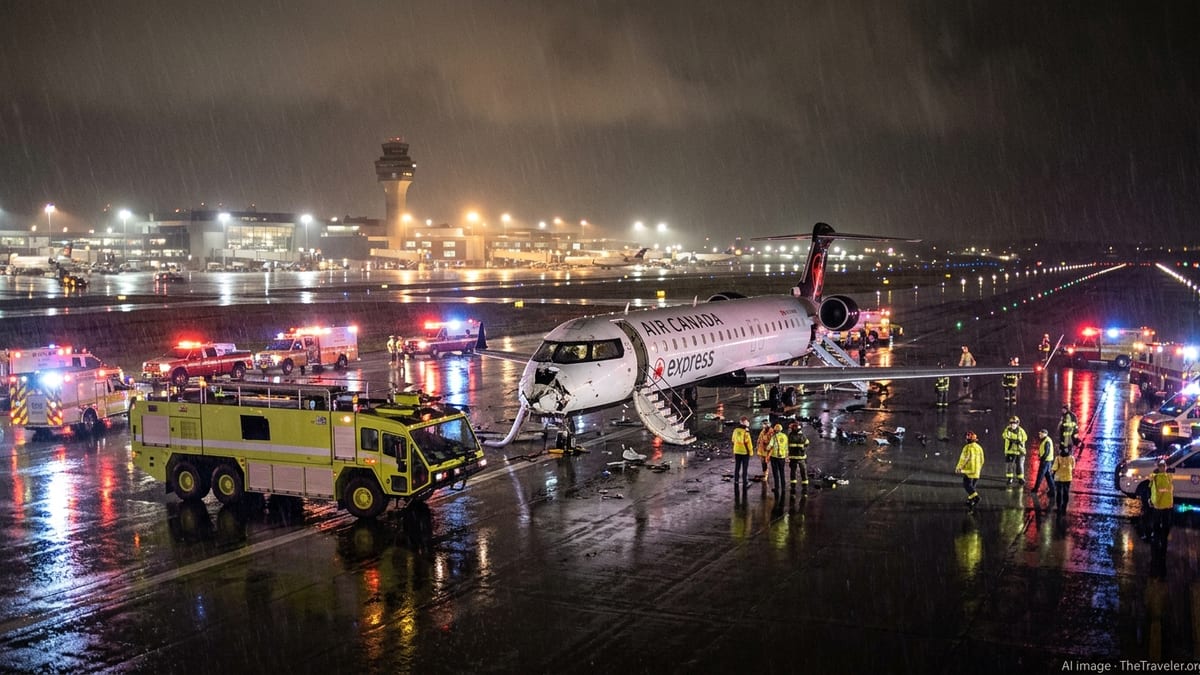
The sinkhole adds to a year of intense focus on LaGuardia’s airfield resilience and safety culture. In March, a fatal collision between an Air Canada regional jet and a firefighting vehicle on one of the runways led to a temporary airport closure, widespread cancellations and an ongoing federal investigation into surface movement procedures. That earlier shutdown highlighted how little redundancy exists across LaGuardia’s intersecting runways when even a single surface is taken out of service.
Airport infrastructure specialists have long described LaGuardia as a high-pressure environment where aging pavement, coastal soil conditions and dense operations combine to create relatively low fault tolerance. Publicly available planning documents and noise-management reports characterize the airfield as a tightly bounded site hemmed in by water, highways and neighborhoods, with limited scope for additional taxiways or expanded safety buffers.
Episodes such as today’s sinkhole and the March runway accident are likely to intensify questions about long-term maintenance strategies and capital investment priorities on the airfield itself, beyond the terminal redevelopment that has transformed the passenger experience in recent years. Transportation advocates are already pointing to the incident as another sign that the region’s busiest airports remain vulnerable to localized infrastructure failures.
Engineering assessments in the coming days are expected to focus on whether the sinkhole reflects a localized pavement problem or a wider subsurface issue influenced by drainage patterns, freeze-thaw cycles or historical fill material beneath the runway. The findings will shape how quickly the damaged section can be repaired and whether heavier structural reinforcement is required.
What travelers can expect in the hours ahead
For passengers booked to travel through LaGuardia, the most immediate effect is the likelihood of schedule changes through the rest of the day and into tomorrow. Live delay trackers already show average departure delays stretching beyond typical norms, and airlines are adjusting aircraft routings to protect their highest-demand services while trimming frequencies on shorter routes.
Based on prior disruption patterns at LaGuardia, travelers can expect a mix of rolling delays that gradually shorten as the operation stabilizes, combined with a subset of flights that are proactively canceled to give the schedule room to recover. Connecting itineraries that rely on tight turns through LaGuardia may be particularly vulnerable, especially in the late afternoon and evening banks.
Passengers who have not yet departed for the airport are being encouraged through airline alerts and local news coverage to verify their flight status before leaving home and to consider alternate New York airports if their carrier offers that option without additional fare. Same-day changes within the New York area are a common relief measure when LaGuardia experiences capacity cuts, and some airlines may waive change fees or fare differences for affected customers.
At the terminal, travelers should anticipate longer lines both at security and at customer service desks, as well as reduced spare seating near congested gates. Many carriers are directing passengers to use mobile apps and kiosks for rebooking to reduce pressure on in-person agents.
Pressure builds for more resilient New York air capacity
The latest disruption reinforces LaGuardia’s reputation among frequent flyers as one of the most delay-prone yet strategically vital airports in the United States. Aviation studies regularly cite its intersecting runways, short runway lengths and strict slot controls as key factors that leave little room for error once an incident occurs on the airfield.
Regional transportation planners have repeatedly argued that long-term relief will require a broader rebalancing of demand across the three major New York airports, as well as continued upgrades to air traffic management and surface-movement technologies. The combination of this year’s runway collision and today’s sinkhole is likely to feature in ongoing debates about how to distribute flights, prioritize infrastructure spending and design contingency plans for sudden capacity losses.
For now, however, the focus for airlines and travelers alike remains on the immediate challenge of moving thousands of passengers through a constrained operation. As inspections continue and repairs proceed, the pace of recovery at LaGuardia will offer another test of how quickly one of the country’s most congested airfields can bounce back from a localized but disruptive failure on its runways.