


More news on this day
Travel across the United States is being disrupted after a sinkhole discovered near a key runway at New York’s LaGuardia Airport forced a shutdown that has led to hundreds of flight delays and cancellations.
Get the latest news straight to your inbox!
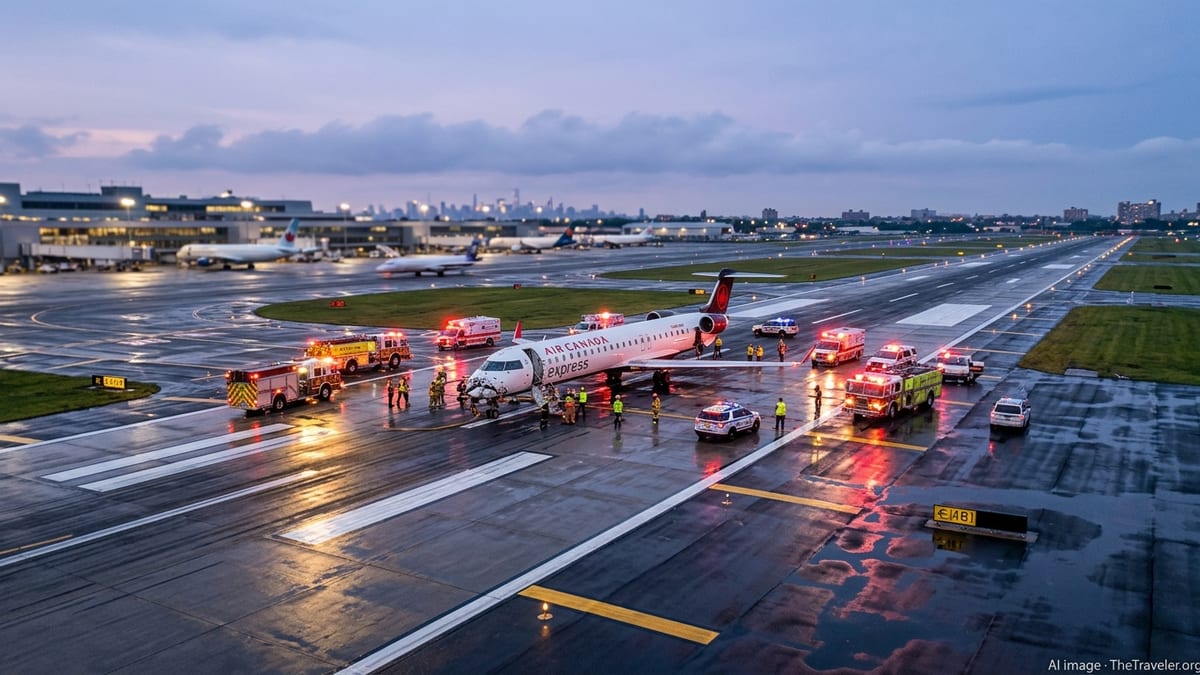
Runway 4/22 closed after routine inspection uncovers damage
Publicly available information indicates that airfield crews at LaGuardia identified the sinkhole late on the morning of Wednesday, May 20, during a scheduled inspection of the airport’s surfaces. The hole was found on a taxiway area adjacent to Runway 4/22, one of only two runways at the Queens airport, prompting an immediate closure of the strip to protect aircraft operations.
Reports describe the depression as a localized but significant failure in the paved surface near the active runway, large enough to raise concerns about the stability of the surrounding pavement under the weight of commercial jets. Images shared by broadcast outlets show construction vehicles clustered around a cordoned off section of pavement, with a large illuminated “X” marking the runway as closed to aircraft.
According to aviation coverage summarizing statements from the Port Authority of New York and New Jersey, emergency construction and engineering teams were dispatched within hours to begin assessing the extent of the subsurface problem. Their priority is to determine whether the sinkhole is confined to a small area of fill or connected to a broader void beneath the runway and taxiway complex.
While the sinkhole itself was detected off the main landing surface, the proximity to the runway threshold and the need for heavy repair equipment on the airfield left little flexibility to keep the strip partially open. Airport operations data show Runway 4/22 taken out of service for arrivals and departures as crews work in shifts to stabilize the site.
Delays, cancellations and knock on impacts for travelers
Flight tracking services and airline updates show the sudden loss of Runway 4/22 has sharply reduced LaGuardia’s capacity, leading to cascading disruption for passengers. By Thursday, May 21, aggregated data from multiple trackers indicated nearly two hundred cancellations into and out of LaGuardia and well over one hundred additional delays, with some departures held on the ground for more than an hour and a half.
The Federal Aviation Administration’s traffic management logs list LaGuardia under a ground delay program, with arrivals metered into the airport at reduced rates. The agency notes that the slowdown reflects a combination of convective weather in the New York region and the operational constraint created by the sinkhole adjacent to Runway 4/22.
Because LaGuardia functions as a high frequency hub for major airlines, the effects have extended far beyond New York City. Published coverage from aviation and travel outlets describes disruptions radiating to major connecting points including Chicago, Atlanta and Dallas, where aircraft and crews scheduled to operate LaGuardia flights have been delayed or reassigned. In some cases, travelers have reported overnight rebookings as airlines work around the limited capacity.
Passenger accounts shared on social platforms and in local media stories depict crowded terminals, long customer service lines and rapidly changing departure boards. Many airlines are advising customers booked through LaGuardia to monitor their flight status closely, to consider flexible rebooking options, and, where practical, to explore alternate airports such as Newark Liberty or John F. Kennedy for near term travel.
Intensive repair effort underway on compromised pavement
Airport construction photographs and video aired by local television outlets show crews cutting away damaged sections of asphalt and concrete near the affected taxiway, with heavy machinery removing broken material to expose the underlying base. Civil engineering experts interviewed in that coverage note that sinkholes at coastal airports often stem from long term settlement of landfill, water infiltration, or the failure of buried drainage structures.
LaGuardia’s airfield sits on a mix of historic fill and shoreline infill, a characteristic that has long required close monitoring and periodic rehabilitation of pavements. Federal aviation planning documents already identify the airport for recurring overnight closure windows during construction seasons to address runway and taxiway wear, and the current emergency work is unfolding against that backdrop of ongoing maintenance needs.
Repair teams are reportedly focused on stabilizing the subgrade before rebuilding the surface layers. That process typically involves excavating to sound material, compacting new structural fill, and installing fresh pavement capable of bearing repeated wheel loads from fully loaded aircraft. Depending on the extent of the void and the availability of materials, such work can range from a short term patch to a more substantial reconstruction of a section of taxiway.
Airport status updates suggest that, for now, there is no firm public timeline for fully reopening Runway 4/22. Operational planners are weighing how quickly the repaired area can be certified for use against the risks of returning traffic to the strip before long term stability is assured, especially heading into the busy summer travel period.
Pressure on LaGuardia’s already constrained infrastructure
The sinkhole has emerged at a moment when LaGuardia’s resilience and capacity are already under scrutiny. The airport, which serves tens of millions of passengers each year, operates with only two intersecting runways and limited taxiway routing, making it particularly vulnerable to any loss of infrastructure or periods of adverse weather.
Recent aviation safety and performance reports highlight how even routine maintenance or minor incidents at LaGuardia can quickly translate into significant schedule disruptions. In March 2026, a collision involving an Air Canada Express regional jet and a ground vehicle on Runway 4/22 prompted a temporary airport wide halt to operations, adding to congestion and missed connections across multiple airline networks.
Urban planning and transportation analysts cited in recent studies have long argued that the combination of constrained airfield geometry, heavy traffic and exposure to coastal conditions leaves LaGuardia with little margin for unexpected events. The sinkhole’s impact on national flight schedules is being viewed as a case study in how a relatively small area of damage at a critical node can ripple through the broader aviation system.
Discussion in professional forums and public debates is likely to intensify around how much redundancy and hardening is needed at aging coastal airports. Options range from more aggressive inspection regimes and preventive ground stabilization projects to broader strategic questions about regional capacity, including the balance of traffic among New York’s three major airports.
What travelers should watch for in the coming days
With emergency repairs still in progress, travel industry analysts expect continued irregular operations at LaGuardia in the short term. Airlines are anticipated to adjust schedules, swap aircraft types and consolidate lightly booked flights in an effort to make the most of the remaining runway capacity while reducing the number of passengers stranded by cancellations.
Passengers with near term bookings into or out of LaGuardia are being urged in public advisories to build in extra time, verify flight status repeatedly on day of travel, and be prepared for gate or terminal changes as operations shift. Some carriers have begun issuing flexible travel policies for New York area flights, allowing customers to move trips by a few days or reroute through alternate airports without standard change penalties.
Industry observers note that the duration of the disruption will hinge on both the pace of repair work and evolving weather patterns over the Northeast. If thunderstorms or low visibility coincide with the ongoing runway closure, arrival and departure rates could be further constrained, increasing the likelihood of extended delays.
For now, LaGuardia remains open on a reduced basis, with its remaining runway handling a compressed schedule of arrivals and departures. How quickly normal patterns resume will depend on when engineers can verify that the ground beneath Runway 4/22 and its adjoining taxiways is fully stabilized and ready to support one of the country’s busiest short haul airport operations.