


More news on this day
New York’s LaGuardia Airport has been thrust into crisis after a sinkhole near a primary runway, compounded by rounds of severe storms, triggered hundreds of flight cancellations and a ripple of travel disruption across the United States.
Get the latest news straight to your inbox!
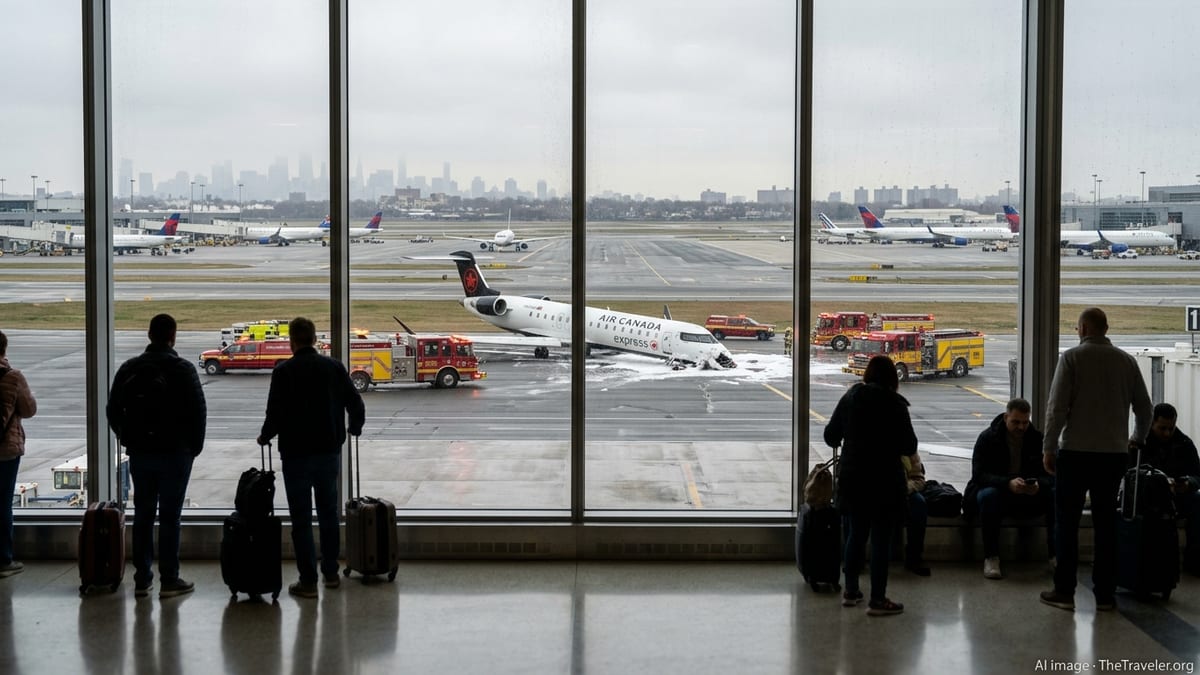
Runway 4/22 Closure Exposes Airport Vulnerability
The disruption began on Wednesday, May 20, when airfield inspections detected a sinkhole close to Runway 4/22, one of LaGuardia’s two main runways. Publicly available information shows that the depression formed near a taxiway section adjacent to the strip, but safety protocols required the runway to be taken out of service while engineers assessed the underlying pavement and soil. The closure immediately cut the airport’s arrival and departure capacity roughly in half at one of the busiest times of day.
Reports from multiple outlets indicate that the ground stop and spacing restrictions introduced after the discovery swiftly cascaded into widespread disruption. Flight tracking data cited in published coverage shows around 200 flights into and out of LaGuardia canceled on Wednesday and a similar number delayed, representing a significant share of the daily schedule. With aircraft and crews scattered out of position, the operational impact has stretched well beyond New York.
LaGuardia’s physical layout leaves little buffer when one runway goes offline. The airport sits on reclaimed shoreline and compact infill in Queens, with short, closely spaced runways and limited room for diversions on the airfield. Aviation analysts note that even routine maintenance on one runway often leads to tight operating conditions; an unexpected structural concern such as a sinkhole removes almost all flexibility from traffic management.
Engineers have begun stabilizing the affected area, but as of Thursday morning there is no definitive public timeline for reopening Runway 4/22. Published statements from airport and aviation agencies emphasize that operations on the remaining runway will continue at reduced capacity until a full structural assessment confirms that the damaged pavement and subgrade can safely support aircraft movements.
Severe Weather Turns Local Failure Into Systemwide Shock
The infrastructure failure coincided with a pattern of strong spring storms sweeping across the Northeast, turning what might have been a localized disruption into a broader aviation shock. Forecasts highlighted bands of heavy rain, low clouds, and embedded thunderstorms moving through the New York region, conditions that normally prompt flow-control measures even with all runways available.
With only one runway in service at LaGuardia, those weather-related restrictions became far more painful. Publicly available Federal Aviation Administration advisories show that inbound traffic to all three major New York airports was slowed at various points on Wednesday and Thursday to manage thunderstorm risks and low visibility. At LaGuardia, the combination of reduced runway capacity and weather delays forced airlines to trim schedules aggressively, with many flights proactively canceled rather than risk extended tarmac waits and crew timeouts.
Storm cells disrupted operations at other East Coast hubs on the same day, further complicating recovery. Delays departing from Atlanta, Washington, and Boston limited options for repositioning aircraft to New York once conditions improved. Aviation schedulers faced the twin challenge of threading flights through narrow weather windows while also working around a closed runway at one of the system’s most constrained airports.
For travelers, the interplay between the sinkhole and the storms was often opaque. Passengers described seeing clear skies at times while their flights were still classified as weather affected, a distinction that can influence eligibility for compensation or hotel vouchers. Public guidance from airlines has generally framed the disruption as a mix of necessary safety precautions and extraordinary operational constraints rather than a straightforward mechanical issue.
Passengers Confront Cancellations, Long Lines, and Limited Alternatives
The operational shock has translated into long, stressful hours for passengers across the network. Social media posts and local broadcast coverage show crowds queuing at LaGuardia’s terminal service desks, with some travelers reporting waits of several hours to be rebooked. As the day wore on Wednesday, many same-day options disappeared, leaving stranded passengers facing overnight stays in New York or forced changes to nearby airports.
New York’s multi-airport system has offered only partial relief. Airlines encouraged some customers to shift to flights at John F. Kennedy International Airport or Newark Liberty International, but the storms and broader Northeast congestion limited spare capacity there as well. With peak summer travel still weeks away, the scale of cancellations during a shoulder-season week underlined how tightly scheduled domestic fleets have become.
Travel waivers have been widely publicized, allowing many affected passengers to change dates or routes without additional fees. Even so, those options depend on available seats. Reports indicate that popular business routes to Chicago, Dallas, and Atlanta filled quickly with rebooked travelers, and some customers were reassigned to flights one or two days later than originally planned. Others abandoned air travel altogether, opting for intercity trains or long-distance buses to reach nearby destinations.
The knock-on effects have reached far beyond New York. Because LaGuardia serves as an important spoke for carriers’ national networks, cancellations on inbound flights have disrupted connections for passengers in the Midwest and South who never planned to set foot in New York. A canceled evening departure to LaGuardia from a city such as Dallas or Detroit can strand connecting travelers who were scheduled to continue on to smaller markets the following morning.
Infrastructure Risk at Aging Coastal Airports
The emergence of a sinkhole at LaGuardia has renewed attention on the vulnerability of aging coastal airports. Historical and engineering records describe how the airfield was built on filled shoreline and marshland in the 1930s and expanded over the decades with additional landfill. That geology makes subsurface monitoring and drainage management especially critical, particularly as intense rainfall events become more common in the Northeast.
Experts consulted in previous investigations into airport resilience have warned that climate change is increasing the frequency of extreme weather patterns that can stress existing infrastructure. Prolonged heavy rain, rapid freeze-thaw cycles, and rising groundwater can all accelerate the formation of voids beneath paved surfaces, especially where older drainage systems or compacted fill are already under strain. LaGuardia is not unique in facing such risks, but the latest incident illustrates how even a relatively small area of weakness can have outsize operational consequences.
In recent years, major investments have modernized LaGuardia’s terminals and roadways, with new concourses and improved passenger facilities now largely complete. By contrast, the latest crisis underscores that less visible elements of airport infrastructure, such as runway subgrades, culverts, and stormwater systems, remain essential to overall reliability. Publicly available planning documents for airports across the country increasingly reference the need for geotechnical surveys, real-time pavement monitoring, and contingency plans for rapid runway repairs.
Urban planners and transportation advocates are likely to use the LaGuardia disruption as a case study in infrastructure triage. Balancing day-to-day capacity demands against the need for proactive repair windows is a persistent challenge at land-constrained airports. The events of this week suggest that more conservative thresholds for taking pavement out of service, coupled with clearer communication to travelers, may ultimately prove less disruptive than emergency closures prompted by sudden failures.
What Travelers Can Expect in the Coming Days
As of Thursday, airlines serving LaGuardia are working through significant backlogs of displaced passengers and repositioning aircraft to support a measured ramp-up of operations on the remaining runway. Published scheduling data suggests that reduced-frequency timetables and continued delays are likely to persist for at least several days, particularly during peak morning and evening banks.
Travel industry analysts recommend that passengers booked into or out of LaGuardia in the near term build substantial flexibility into their plans. Guidance from consumer advocates emphasizes checking flight status frequently, considering alternative airports in the region, and traveling with carry-on luggage where possible to ease rebooking. Those scheduled to connect through New York may benefit from routing that avoids LaGuardia entirely until conditions stabilize.
For the broader aviation system, the episode is a reminder of how quickly multiple stressors can converge. A single infrastructure fault, when combined with fast-changing weather and tight airline scheduling, can ripple into hundreds of cancellations and thousands of disrupted journeys. With the summer travel surge approaching, the industry’s response to the LaGuardia crisis is likely to influence how carriers and airports prepare for future shocks, from sinkholes and storms to heat waves and coastal flooding.
While engineers continue on-the-ground work to restore full runway capacity, LaGuardia’s latest crisis has already reshaped the travel plans of passengers across the country. The question now is how swiftly lessons from this week’s disruption will translate into more resilient infrastructure and more predictable journeys for travelers who depend on one of New York’s most important gateways.