


Landing at Lynden Pindling International Airport in Nassau is the easy part. The real question for many travelers is how to get from the terminal to Cable Beach, home to major beach resorts like Baha Mar, Breezes, Sandals Royal Bahamian and a cluster of smaller hotels and vacation rentals. The distance is short, but your choice of transfer can affect your budget, comfort, arrival time and even how relaxed you feel when you first see the ocean. This guide breaks down each option in practical, real-world terms so you can step off the plane with a clear plan.
Get the latest updates straight to your inbox!
Understanding the Route from LPIA to Cable Beach
Lynden Pindling International Airport sits on the western side of New Providence Island, while Cable Beach lies a little farther east along the northern coast. In normal traffic, the drive from the airport to most Cable Beach resorts takes around 15 to 20 minutes by car. The route follows West Bay Street and passes through low-rise residential areas before the scenery opens up to beachfront resorts and turquoise water.
Despite the short distance, transfer experiences differ widely. A metered-style taxi with a local driver can get you to the lobby of the Grand Hyatt Baha Mar or Breezes quickly, but you might wait in a queue after a wave of arrivals. A prebooked private transfer will have your name on a sign outside baggage claim and can feel smoother, but typically costs more than a standard taxi. The public jitney bus, while very inexpensive, is slower, runs only in daytime and is not designed for heavy luggage.
Most first-time visitors underestimate how tired they will feel after clearing immigration and customs, especially on weekend afternoons when several flights land close together. Planning your ground transportation in advance, rather than deciding at the curb, can save you from standing in a long taxi line or trying to interpret jitney routes with a suitcase in hand. The sections below walk through each option with realistic expectations, sample prices and best-use scenarios.
Taxi from the Airport: Fast and Straightforward
For many travelers, a standard taxi from Lynden Pindling International Airport to Cable Beach is the most straightforward choice. Official airport guidance lists a flat zone fare from the airport to Cable Beach of about 29 US dollars for up to two passengers, with additional passengers charged a small extra fee per person. On the ground, visitors often report paying in the range of 30 to 40 dollars for a one-way ride to properties like Baha Mar, Breezes or Sandals, depending on party size, luggage and any brief stops requested.
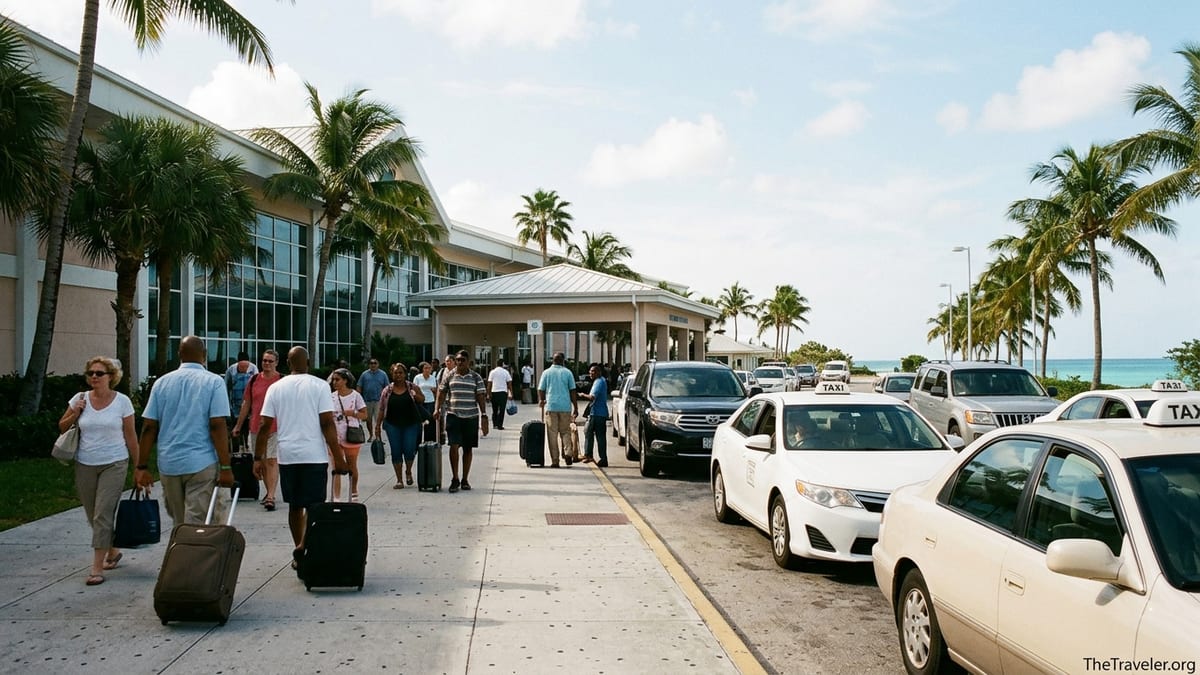
Taxi ranks are located just outside each terminal building, and there is usually an airport dispatcher helping to organize the line. After you collect your bags and exit customs, you simply follow the signs to “Taxis,” join the queue and are assigned to the next available car. Vehicles are typically sedans or minivans that comfortably fit four to six passengers plus luggage. You pay the driver directly, usually in US dollars or Bahamian dollars at par. Credit card acceptance can vary, so carrying some cash is wise.
Set fare zones mean you should not need to negotiate, but you can always confirm the approximate cost before getting in. Extra luggage beyond one suitcase and one carry-on per person can incur a small fee, and oversize items like golf bags or large boxes can be charged a bit more. If you are traveling with a family and multiple bags, that can add up slightly, but for most couples and small groups taxis remain reasonably priced for the convenience.
The main downside is potential waiting time during peak arrival windows. On Saturdays and holiday periods when several large US flights land back to back, taxi lines can stretch and waits of 20 to 45 minutes are possible. If you are arriving late in the evening, taxis still operate, but with fewer cars in rotation you might wait slightly longer. For most visitors staying at large Cable Beach resorts, taxis offer the best trade-off between cost, speed and simplicity.
Private Transfers and Resort Shuttles: Stress-Free but Higher Cost
Travelers who prefer to have every detail locked in before arrival often choose a prebooked private transfer. Several Nassau-based companies specialize in airport transportation, offering sedans, SUVs and vans with meet-and-greet service just outside customs. Operators such as Dan Knowles Tours, Moss Private Transportation, RideUp Nassau and other local car services run fixed-rate transfers between the airport and Cable Beach hotels, with clear pricing listed in advance.
Shared shuttle options typically charge a per-person rate for Cable Beach hotels, often around the mid-30 US dollar range each way when booked as part of a round trip. Private vehicles priced by car, SUV or van can range higher, especially for luxury vehicles or larger groups. Some services include a short grocery or liquor store stop on the route, which many resort guests appreciate to stock up on snacks, bottled water and beverages before checking in to properties like Grand Hyatt Baha Mar or Sandals.
The main appeal of a private transfer is predictability. Your driver monitors flight times, meets you with a sign, handles luggage and takes you directly to your hotel without waiting in a taxi line or sharing the vehicle with other passengers. For families arriving late at night, honeymooners staying at upscale resorts or groups traveling with older relatives, the smoothness and lower stress level can justify the extra cost. If your flight is delayed, reputable transfer companies generally adjust pickup times at no extra fee, as long as you have provided accurate flight information.
Some resorts occasionally bundle transfers into packages or offer partner services, but these are not consistently complimentary. Even where a resort shuttle exists, it may cost more per person than a regular taxi if you are traveling as a couple or family. Before you pay for a resort-arranged shuttle, compare the per-person price against the standard taxi fare to Cable Beach. In many cases, a regular taxi or a private car booked directly with a local operator can be cheaper or more flexible.
Jitney Buses: Budget-Friendly but Not for Everyone
Nassau’s jitneys, the local minibus system, are the most economical way to travel along the main island roads, including sections that connect the airport area and Cable Beach. A ride on a jitney generally costs only a few dollars per person, paid in cash when you exit the bus. Routes such as the number 10 and number 12 buses operate between downtown Nassau, Cable Beach and areas near the airport along West Bay Street.
However, jitneys are designed for residents, not airport travelers with large suitcases. Buses are small, often crowded at peak times, and there is no dedicated luggage rack. The airport itself does not host an organized jitney terminal, so you may need to walk out to the main road near the airport entrance to catch a bus or wait along the roadside. Schedules are informal, with more frequent service during daytime and fewer buses early in the morning or late in the afternoon and evening. Recent visitors note that the last jitneys from the airport area toward downtown often pass by in the late afternoon rather than at night.
For safety and comfort, jitneys are best suited to light-pack travelers who arrive during daylight hours and are familiar with Caribbean-style local buses. For example, a solo traveler with a backpack staying at a budget guesthouse on Cable Beach might choose a jitney from the airport, then walk a short distance from the closest stop. By contrast, a family of four arriving with roll-aboard suitcases and beach gear late in the evening would likely find the jitney system confusing and inconvenient, and might struggle to fit comfortably on board.
If you do decide to use jitneys, ask locals or airport staff which routes head toward Cable Beach, and confirm with the driver when you board that the bus will pass your hotel area. Expect a slower journey than by taxi, with more stops and a less direct route. Because jitneys generally run only during daylight and early evening, they should not be relied on for late-night arrivals or very early morning departures to the airport.
Rental Cars: Freedom to Explore Beyond Cable Beach
Renting a car at Lynden Pindling International Airport appeals to travelers who plan to explore more of New Providence beyond their resort. Several companies operate at or near the airport, including recognized brands such as Budget, Avis and Hertz Bahamas, plus a few local agencies. Rental counters or desks are typically located in or near the arrivals area, with vehicles parked in nearby lots accessed by a short walk or shuttle.
Daily rental rates vary by season and vehicle type, but compact cars are often the most economical, with SUVs and minivans costing more. Standard rental conditions apply, including the need for a valid driver’s license and a credit card. Driving is on the left side of the road in the Bahamas, which may be unfamiliar to many North American visitors. Road signage around the airport and Cable Beach is fairly straightforward, but traffic circles and local driving styles can take a bit of adjustment.
For guests staying at self-catering condos in the Cable Beach area, such as vacation rentals behind the main strip, a car can be handy for making grocery runs to nearby supermarkets or exploring beaches farther west like Love Beach and Nirvana Beach. Families planning multiple off-resort excursions, such as trips to downtown Nassau, Arawak Cay or the eastern side of the island, might find that a three or four day rental offers good value compared to repeated taxi rides.
On the other hand, if you are planning to spend most of your time inside a full-service resort like Baha Mar or Sandals, a rental car may sit idle for much of your stay, while you still pay daily fees and possibly resort parking charges. Parking in the Cable Beach area is generally available but can be busier near large hotels. Travelers arriving late at night after a long flight may also prefer not to tackle unfamiliar left-side driving in the dark. In those cases, a simple taxi or private transfer on arrival, with a short-term rental later in the trip if needed, can be a better balance.
Luggage, Families and Special Considerations
How much luggage you have, and who you are traveling with, should strongly influence your transfer choice. Standard taxis from the airport include an allowance for one suitcase and one carry-on per person, with extra or oversize items carrying a small surcharge. A couple arriving with two checked bags and two carry-ons will usually fit comfortably in a regular taxi, while larger families or groups with golf clubs, strollers and beach gear might be better served by a minivan taxi or a prebooked van through a private transfer company.
Families with young children should be aware that child car seats are not automatically provided in most taxis or shuttles. Local rules may allow younger children to ride without dedicated seats, but many parents prefer to bring a lightweight travel car seat or booster. If this is important to you, ask in advance whether a private transfer service can supply appropriate seats; some Nassau operators can arrange them on request for an additional fee. For older relatives or anyone with limited mobility, a private transfer that includes luggage assistance and door-to-door service can greatly reduce stress.
Travelers bringing sports equipment, especially golf bags for play at courses near Cable Beach or Paradise Island, should confirm capacity when choosing transport. Oversize luggage can mean extra fees in taxis and may not fit easily in smaller sedans. In those cases, a van taxi or SUV-based private transfer is usually worth the slightly higher price. Guests staying at all-inclusive resorts like Sandals or Breezes often travel with more luggage overall, so selecting a roomier vehicle ahead of time can prevent last-minute reshuffling at the curb.
Jitneys are the least suitable option if you have large or multiple bags. Even if you can squeeze them on board, narrow aisles and frequent stops make it awkward and inconsiderate to other passengers. For that reason, the jitney option really works best for minimalist travelers carrying only a small backpack or carry-on bag who are comfortable standing or squeezing into a bus during busy times.
Late Arrivals, Flight Delays and Safety
Many flights from US and Canadian cities into Nassau arrive in the afternoon, but there are also evening and occasional later arrivals. If your scheduled landing time into Lynden Pindling International Airport is after sunset, or if you are traveling during hurricane season when delays are more likely, it is sensible to think about what will still be operating when you land. Taxis are generally available into the night, though with fewer cars in circulation the wait times can be a bit longer than midday.
For late-night arrivals into Cable Beach resorts, a prebooked private transfer can be particularly reassuring. Your driver will track your flight and adjust pickup time as needed, then escort you from the terminal directly to your vehicle. This avoids standing in line outside with luggage at night or wondering whether jitney buses are still running. It also helps if you are carrying valuables or traveling with children and simply prefer a smoother end to a long day.
Public jitney buses are not recommended for late-night transfers. They operate mainly in daylight and early evening hours, and relying on them after dark risks long waits or finding that service has already wound down for the day. Even during the day, common-sense precautions apply: keep your valuables close, avoid displaying large amounts of cash and sit where you feel comfortable. The same advice holds for taxis: use the official airport taxi queue, verify that the vehicle is licensed and agree on an approximate fare for the Cable Beach zone before departing.
Overall, Nassau is accustomed to visitors, and the route between the airport and Cable Beach is one of the most heavily traveled on the island. Whether you choose taxi, private car or rental vehicle, you will be following a well-used corridor. Planning ahead and choosing the option that best matches your arrival time and comfort level will go a long way toward making the transfer smooth and safe.
Choosing the Best Arrival Plan for Cable Beach Resorts
The right transfer plan depends on your priorities: cost, convenience, flexibility or a combination of all three. For many first-time visitors staying at resorts like Grand Hyatt Baha Mar, SLS Baha Mar, Rosewood Baha Mar, Breezes or Sandals Royal Bahamian, a standard airport taxi offers the best balance. At around 30 to 40 US dollars per car for the short ride, it is affordable, readily available and requires no advance reservation. You simply follow the signs, join the queue and are on your way.
If you value a seamless, prearranged experience or are arriving late, a private transfer or shared shuttle booked in advance can be worth the extra cost. These services shine for honeymooners, multigenerational families, conference groups and anyone nervous about navigating a new destination at night. The ability to request a grocery stop on the way to your hotel can also save considerable money compared to buying all food and beverages within a resort.
Jitney buses, while extremely cheap, are a niche solution. They are best viewed as a local experience or a budget tool for confident, light-pack travelers who arrive during the day and are comfortable navigating informal transit systems. For most vacationers with baggage in tow, jitneys are more appropriate for daytime trips between Cable Beach and downtown once you are already settled in, rather than for the initial airport transfer.
Rental cars make the most sense if you plan to explore New Providence extensively, visiting multiple beaches, neighborhoods and attractions away from the main resort zone. If your stay is short, or you anticipate spending most of your time in a large beach resort, you might instead combine a taxi or private transfer on arrival with a one or two day rental later in your visit. Taking a few minutes before you travel to weigh these options against your specific plans will help you step off the plane with confidence.
The Takeaway
Getting from Lynden Pindling International Airport to Cable Beach is a small piece of your Bahamas vacation, but it can set the tone for everything that follows. The distance is short, yet there are meaningful differences between waiting in a busy taxi queue, being met by a prebooked driver, squeezing into a local jitney or finding your rental car in an unfamiliar parking lot after a long flight.
For most visitors, especially first-timers and families staying at the major resorts, an official airport taxi remains the simplest and most cost-effective way to reach Cable Beach. Travelers who prioritize comfort, predictability or late-night peace of mind often prefer to arrange a private transfer in advance. Budget-conscious, light-pack explorers may experiment with jitneys during the day, while those keen to explore beyond the resort zone may benefit from a rental car for part of their stay.
Whichever option you choose, the key is to match your transfer to your arrival time, luggage load and travel style. Plan your route before you board your flight, keep some small bills handy for tips and extras, and confirm details like approximate fare or pick-up location before leaving the terminal. With a clear plan in place, you can focus on what really matters: that first view of Cable Beach’s white sand and bright blue water as you start your time in Nassau.
FAQ
Q1. How much does a taxi from Lynden Pindling International Airport to Cable Beach cost?
Most travelers report paying roughly 30 to 40 US dollars for a standard taxi from the airport to Cable Beach resorts, depending on group size, luggage and any short stops.
Q2. Are taxis readily available at Nassau airport when I arrive?
Yes, taxis line up just outside the arrivals area throughout the day and into the evening, though you may experience a queue during busy weekend and holiday arrival times.
Q3. Should I book a private transfer in advance or just take a taxi?
If you prefer certainty, are arriving late at night or traveling with a larger group, a prebooked private transfer can be more comfortable. Independent travelers arriving in daytime often find a regular taxi sufficient.
Q4. Can I use public jitney buses to get from the airport to Cable Beach?
It is possible to reach Cable Beach using local jitney buses from near the airport area, but routes are informal, service is mostly daytime only and buses are not designed for heavy luggage.
Q5. Is it safe to travel by taxi or jitney from the airport?
Using the official airport taxi queue is generally considered safe. Jitneys are widely used by locals, but as with any public transport you should keep valuables secure and travel during daylight hours.
Q6. Do any Cable Beach resorts offer free airport shuttles?
Some resorts occasionally package transfers with certain offers, but free airport shuttles are not universal. It is best to ask your specific hotel directly and compare costs with a standard taxi.
Q7. Is renting a car at the airport a good idea if I am staying at Baha Mar or another big resort?
Renting a car is useful if you plan to explore the island, but if you expect to spend most of your time on property, a taxi or private transfer on arrival and departure is usually simpler and cheaper.
Q8. What should families with young children consider when choosing a transfer?
Families should think about child seats, luggage volume and arrival time. A prebooked private transfer or minivan taxi that can confirm car seats and extra space often provides the least stressful option.
Q9. Are ride-hailing apps like Uber or Lyft available in Nassau?
At present, international ride-hailing services such as Uber and Lyft do not operate in Nassau, so visitors rely on taxis, private transfers, jitneys and rental cars.
Q10. What is the best overall arrival plan for most visitors heading to Cable Beach?
For most first-time visitors, the best plan is to use the official taxi queue on arrival, pay the standard zone fare to Cable Beach and consider private transfers or rental cars only if they better fit specific needs.