


Lynden Pindling International Airport in Nassau looks like the perfect place to start saving money on transport. After all, New Providence is covered by inexpensive local jitney buses. Yet the reality on the ground is more complicated: there is no official airport bus terminal, routes can be confusing, luggage is an issue, and many visitors are better off paying for a taxi. This guide explains the budget options and hard limits so you can decide, with clear real-world examples, whether Nassau’s jitneys are right for you.
Get the latest updates straight to your inbox!
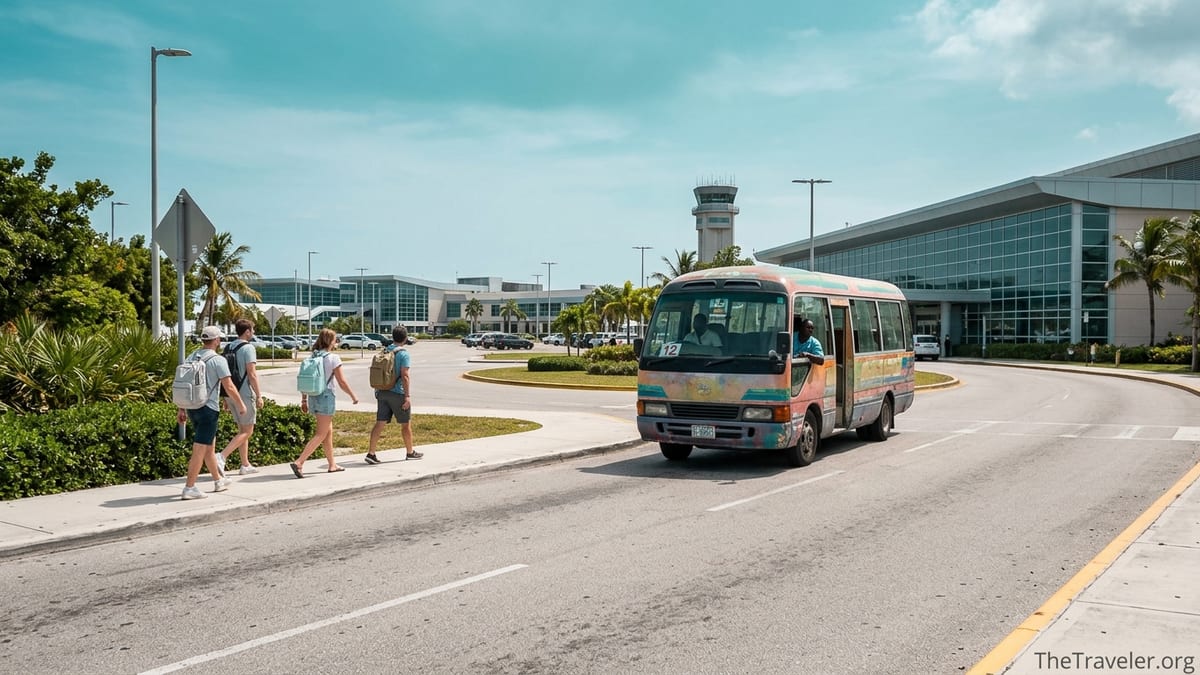
Understanding Jitneys in Nassau: What They Are and How They Work
On New Providence, public transport is almost entirely provided by jitneys, privately owned minibuses that run on fixed routes around Nassau and Cable Beach. They are cheap, social, and used heavily by locals for commuting and errands. Fares are typically paid in cash to the driver when you get off, and exact change is expected. A short ride along Bay Street downtown might cost close to the base fare, while a longer run out toward the western suburbs or near the airport edge costs a bit more, but still only a few dollars per person.
Jitneys are licensed, numbered by route, and usually show a route number and basic destination signs in the windshield, for example “10 – Downtown / Cable Beach” or “12 / 12B – Downtown / Airport West.” They stop wherever passengers request along the route, not just at marked stops. This “hail and ride” system works well for residents who know the city, but it can feel confusing for new visitors who are used to formal bus stops and printed timetables.
Schedules are approximate rather than exact. Most jitneys start running around 6:00 to 7:00 in the morning and generally wind down by early evening, with some routes finishing around 7:00 to 8:00 pm. There is usually no service late at night. At busy times you might see a jitney every 10 to 15 minutes on central stretches such as Bay Street, but waits of 30 minutes or more are not unusual, especially further west toward the airport edge or on Sundays.
For budget travelers staying in central Nassau or along Cable Beach, jitneys can be a very economical way to move between major hotels, beaches, and the downtown waterfront once you are already on the island. The challenge is that they do not function like a dedicated airport shuttle, and getting from the airport terminal onto a jitney route introduces several important limits.
Airport Access Reality: There Is No Official Airport Bus Terminal
Despite what you may read in older guidebooks or on outdated blogs, Lynden Pindling International Airport does not have a formal public bus station at the terminal doors. The official tourism information and airport guides emphasize taxis, prebooked shuttles, and rental cars. Public jitneys run along the main road outside the airport perimeter, not directly into the terminal arrivals area. That means anyone hoping to take a jitney must first walk out to the main road.
In practice, most visitors who do attempt the jitney option walk from the arrivals forecourt to a nearby roundabout on the access road. From there, westbound and eastbound jitneys, most commonly on Route 12 or 12B, pass along the main road toward Gambier in one direction and downtown Nassau in the other. There is usually no marked bus stop or shelter; you simply stand where locals gather and signal to the driver as the minibus approaches.
The walk from the terminal to the main road is not extreme for a fit traveler with light baggage, but it can feel hot and exposed, especially in the afternoon sun. Pavements can be uneven, and there is regular traffic entering and leaving the airport. Rolling a large hard-shell suitcase along this stretch is awkward and draws the line between realistic budget travel and false economy for many people.
This lack of a proper airport bus facility is why many local tourism authorities and cruise-port briefings still recommend using taxis from the airport, even for people who are happy to ride jitneys later in their stay. It is technically possible to use a jitney to and from the airport area, but doing so is not as simple as stepping out of the terminal and onto a clearly signed public bus.
Routes Toward Nassau, Cable Beach, and the Western Suburbs
For most visitors, the useful jitney routes near the airport are those that link the western end of New Providence with downtown Nassau. The most commonly discussed are variations of Route 12, such as 12 or 12B, which run between the western suburbs near the airport approach road and the city center around Bay Street. These buses pass areas like Gambier and parts of Cable Beach on their way east toward town.
A typical example: a budget traveler landing in midafternoon with only a backpack might walk out to the main road and hail a Route 12 jitney heading east. After boarding, they pay the driver the standard fare in cash when getting off downtown, often near the British Colonial area or close to the cruise port. From there, they can walk to a budget guesthouse or transfer to another jitney heading toward Paradise Island or eastern neighborhoods.
For Cable Beach, jitneys on Route 10 are the classic choice from downtown. These run along West Bay Street, serving many resorts and public beach access points in the Cable Beach corridor. Many visitors staying at midrange hotels in Cable Beach will take a taxi from the airport to their hotel on arrival, then use Route 10 jitneys to go back and forth to downtown during the day. For example, a couple might pay around 30 US dollars by taxi to reach a Cable Beach hotel from the airport, then spend only a few dollars total in jitney fares to visit the Straw Market and waterfront on another day.
Toward the far west of the island, closer to residential neighborhoods and small local beaches, jitneys become less frequent, especially outside weekday commuter times. Travelers staying in small guesthouses toward Gambier or in remote Airbnb rentals should not assume that jitneys will be a reliable primary mode of transport late in the evening or on Sundays. Many locals in those areas rely on a combination of jitneys, informal lifts, and taxis rather than buses alone.
Fares, Payment, and How Much You Actually Save
Jitneys are by far the cheapest wheeled transport option on New Providence. Recent fare updates from the Bahamian authorities and local reporting suggest that standard adult fares on Nassau jitneys are around 1.50 Bahamian dollars for shorter inner-city trips, with higher fares on longer runs toward the island edges. In practice, travelers often report paying between 1.50 and about 2.50 dollars per person for journeys that reach the airport-adjacent area or the Gambier end of the route.
Payment is almost always cash, in Bahamian or US dollars at par. Drivers expect small bills and coins, and may not be able or willing to break large notes like 50s or 100s. The usual habit is to board quietly, take a seat, then walk forward when you are ready to get off and hand the driver your fare through the open space beside his seat. Some locals simply call out “Bus stop, driver” and then pay as they shuffle forward. There is no ticket or receipt.
By contrast, taxi fares from Lynden Pindling International Airport are regulated and much higher, but still predictable. Official tourism information gives approximate typical fares of about 30 dollars from the airport to Cable Beach and around 36 dollars to downtown Nassau, with higher fares to Paradise Island and the eastern end of the island and small supplements for additional passengers or oversized baggage. A family of four going to Paradise Island might realistically spend 45 to 60 dollars in a taxi, including the bridge toll and tip.
That means the potential savings from using a jitney are real but modest in the context of an international vacation. For example, a solo backpacker going from the airport edge to downtown at a jitney fare around 2 dollars instead of a 36 dollar taxi clearly wins on budget. But a group of four adults would pay perhaps 8 to 10 dollars total on jitneys compared with around 36 dollars in a taxi, a smaller difference when split four ways. Once you factor in the walk, heat, and lack of space for luggage, many groups conclude that taxis or prebooked shuttles are worth the extra cost on arrival and departure days.
Luggage Limits and Practical Comfort Issues
Jitneys are not designed for airport-style luggage. Locals mostly carry small bags, groceries, or backpacks. The aisle is narrow, seats are close, and there is no dedicated rack for suitcases. Drivers and regular passengers generally tolerate a small wheeled carry-on or a large backpack, especially if the bus is not crowded. But full-size checked suitcases or multiple pieces of baggage quickly become a nuisance to everyone on board.
Several recent visitors who successfully used the jitney from the airport reported that drivers or fellow passengers made it clear that big suitcases are not really welcome. In some cases, drivers may refuse boarding if your luggage clearly blocks the aisle or would prevent other riders from moving safely. Even when you are allowed on, you might be asked to hold your bag on your lap, wedge it between your knees, or stand in a cramped position for the journey.
Comfort is also basic. Jitneys are usually not air-conditioned to the standard of modern airport coaches. Windows slide open for ventilation, and interior temperatures can rise quickly on hot days, especially at midday when the sun is strong. If you have just come off a long-haul flight, the combination of heat, close quarters, and travel fatigue can feel punishing. Taxis, on the other hand, almost always run air conditioning and allow you to sit in relative calm with your luggage in the trunk.
Because of these practical limits, using the jitney from the airport works best for very light packers: for instance, a solo traveler with a single carry-on backpack, arriving during daylight, who is heading to a downtown guesthouse and is comfortable standing among locals. Families with strollers, older travelers with mobility issues, or anyone hauling dive gear and multiple checked bags should treat the jitney as an in-town budget option rather than an airport transfer solution.
Safety, Timing, and When Tourists Should Avoid the Jitney
By regional standards, Nassau’s jitneys are generally considered a safe, everyday form of transport for locals. Violent incidents on the buses themselves are not commonly reported. The main issues for visitors are more about confusion, inconvenience, and being stranded than about direct crime. That said, you are still in a busy Caribbean city, so standard precautions apply: keep valuables close, avoid showing large amounts of cash, and stay aware of your surroundings.
Timing is critical. Jitneys mostly operate in daytime and early evening. If your flight arrives late at night, early in the morning before regular service starts, or during local holidays, you may find no buses passing the airport access road at all. Even during normal days, waits of 30 minutes or more are possible, especially later in the day or on Sundays, when many routes run reduced service. Standing at the side of an unshaded road near the airport after dark, hoping a bus will appear, is not a good way to start or end a holiday.
Tourists should also avoid the jitney in heavy rain or storm conditions. Streets around Nassau, including areas near the airport, can flood after strong downpours, and older minibuses can feel cramped and uncomfortable when packed with wet passengers. In such conditions, taxis and prebooked transfers are far more reliable, even if the fare is higher.
As a simple rule of thumb, if you are arriving or departing with significant luggage, after sunset, or under time pressure to catch a flight or cruise, you should avoid relying on jitneys to or from Lynden Pindling International Airport. Use them instead during relaxed daytime sightseeing between downtown, Cable Beach, and other well-traveled corridors, when schedules are less critical and getting off one stop late is an inconvenience rather than a crisis.
How To Actually Ride a Jitney: Step by Step From the Airport Area
If you decide that a jitney from the airport area makes sense for your situation, it pays to understand the process in concrete terms. After collecting your baggage and exiting customs, you pass the official taxi rank, where dispatchers organize cabs. To access the jitney, you ignore the taxi queue and instead walk along the exit road leading away from the terminal complex, following the traffic toward the main road.
After several minutes of walking, you will reach a large roundabout near the edge of the airport property. Local workers and a few budget-conscious travelers often wait here. There may be no formal bus stop sign. You position yourself where you can see approaching minibuses on the main road and watch the route numbers in the windshield. When you see a 12 or 12B heading east toward town, you step toward the curb and raise your arm to signal. The bus pulls over if there is space and the driver is willing to take you.
On board, avoid blocking the doorway. Slide into an available seat as quickly as possible, keeping your bag on your lap or between your legs. There is no announcement system, so you watch for key landmarks, such as the transition from suburban areas to the more built-up zone near Cable Beach and the hotel clusters, and later to downtown Nassau with its cruise ships and colonial-era buildings. If in doubt, ask the driver or a nearby passenger to tell you when you are close to your intended stop, for example “downtown, near the British Colonial” or “Cable Beach hotels.”
When you are ready to get off, say “Bus stop, please” clearly, then walk forward as the bus slows and hand your fare to the driver. If you are paying with US dollars, confirm the amount beforehand in a low-key way, such as quietly asking a fellow passenger or the driver when you first board, to avoid any confusion at the last moment. Once you step off, the jitney pulls away and you continue on foot to your final destination.
The Takeaway
Lynden Pindling International Airport sits on an island where jitneys are an essential part of daily life, yet the airport itself is not truly integrated into the public bus network. There is no official jitney terminal at the arrivals doors, no printed schedules, and little tolerance for large suitcases. To reach a jitney, you must walk out to the main road and board a minibus that is fundamentally aimed at local commuters, not tourists hauling luggage after a long flight.
For certain travelers, this can still be a smart budget move. A solo backpacker with only a daypack, arriving in daylight and heading to a central guesthouse, can save a substantial amount compared with taxi fares by walking out to the roundabout and hopping on a Route 12 jitney into downtown. Once checked in, the same traveler can use Route 10 and other jitneys to explore Cable Beach, local food spots, and the city waterfront for the price of a cup of coffee per ride.
But many visitors are better served by treating the jitney as an in-town tool rather than an airport transfer solution. Families, cruise passengers with tight schedules, older travelers, and anyone carrying significant baggage will nearly always be happier paying for a licensed taxi or prebooked shuttle between the airport and their hotel, then switching to jitneys for short daytime hops once they are settled. Seen this way, Nassau’s bus system becomes a colorful, budget-friendly layer of local life, not a risky bottleneck at the very start or end of your Bahamas adventure.
FAQ
Q1. Can I take a jitney directly from Lynden Pindling Airport into downtown Nassau?
Not directly from the terminal. There is no official bus stop at arrivals. You must walk out to the main road near the airport roundabout and flag down a jitney, usually on Route 12 or 12B, heading toward town.
Q2. How much does the jitney cost compared with a taxi from the airport?
Recent reports suggest a jitney ride from the airport area into town costs only a few dollars per person, while a regulated taxi fare from the airport to downtown is typically around the mid 30 dollar range, and slightly less to Cable Beach. The savings are largest for solo travelers and smaller when split among a group.
Q3. Is it safe to ride the jitney with luggage?
Jitneys are generally safe, but they are not designed for large suitcases. A small carry-on or backpack is usually acceptable, while big checked bags can block aisles and annoy fellow passengers. Drivers may refuse you if your luggage is clearly too bulky.
Q4. Do jitneys run at night from the airport area?
Service is mostly in the daytime and early evening, with very limited or no late-night operation. If your flight arrives after dark or very early in the morning, you should plan on using a taxi or prebooked transfer instead of relying on jitneys.
Q5. Which jitney route should I use to reach Cable Beach?
For most hotels and public beaches in the Cable Beach corridor, Route 10 from downtown Nassau is the most useful. Some Route 12 variants pass near western parts of Cable Beach, but many visitors simply taxi from the airport to their Cable Beach hotel and then use Route 10 jitneys during the day to go downtown and back.
Q6. Do jitneys accept credit cards or mobile payments?
No. Jitney fares are paid in cash, usually in Bahamian dollars, though US dollars at par are widely accepted. Drivers expect small bills and coins, and they may not have change for large notes.
Q7. Are jitneys air-conditioned like airport coaches?
Some jitneys may have basic air conditioning, but many rely on open windows for ventilation. Expect a warm, sometimes crowded ride, especially in the afternoon heat. If you want a cool, quiet trip after a long flight, a taxi is a more comfortable choice.
Q8. Can I use jitneys to get to Paradise Island from the airport?
You cannot reach Paradise Island in one direct jitney ride from the airport. A typical budget route would involve taking a jitney from near the airport into downtown Nassau, then either walking or transferring to another jitney or taxi across to the Paradise Island bridge area. Many visitors simply take a taxi door to door between the airport and Paradise Island hotels.
Q9. Is it easy to find route maps or a timetable for Nassau jitneys?
Official maps and timetables are limited and often out of date. Most locals rely on experience, asking drivers, or word of mouth. As a visitor, you will probably get the best results by confirming your route and destination with the driver before you sit down.
Q10. When is it smarter to avoid the jitney altogether as a tourist?
It is usually best to skip jitneys when you have large luggage, are traveling with young children or older relatives, arrive late at night, or are under tight time pressure to catch a flight or cruise. In those cases, a licensed taxi or prebooked transfer from Lynden Pindling International Airport is the safer and more reliable option.