


More news on this day
Manchester Airport has issued a public update to passengers after a weekend runway interruption and a separate wave of air traffic control problems contributed to delays and cancellations affecting flights across the UK, with knock-on disruption extending into the start of the new week.
Get the latest news straight to your inbox!
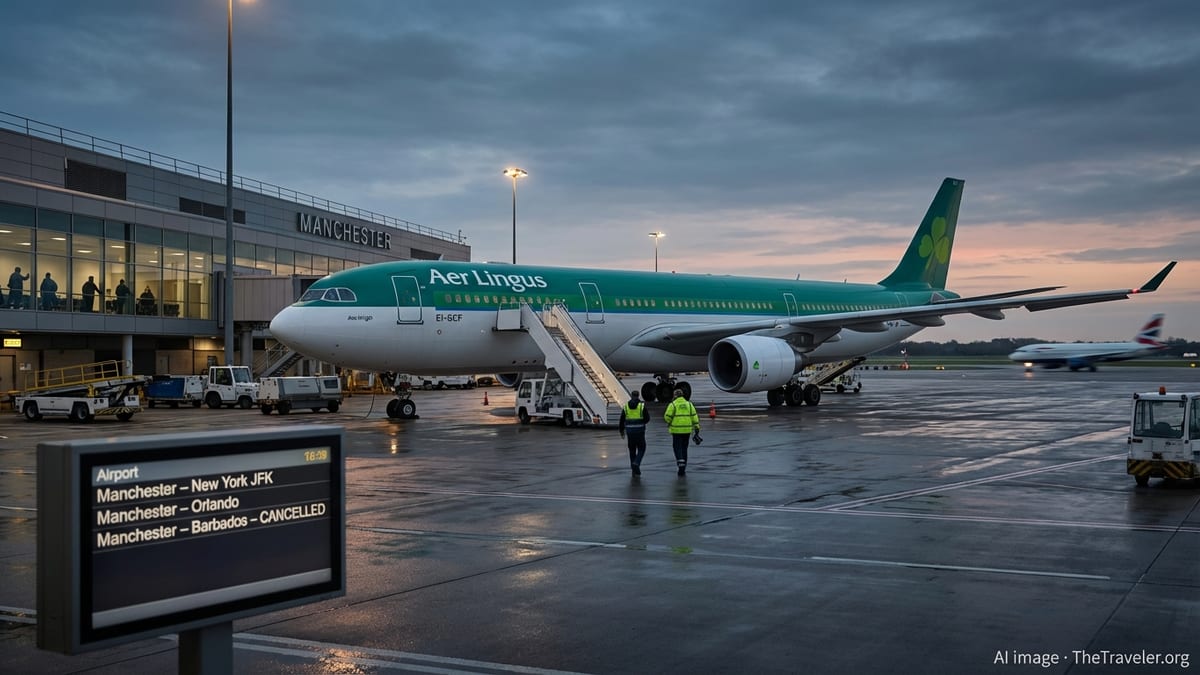
What happened at Manchester Airport and why delays can linger
Published coverage indicates Manchester’s latest operational disruption began on Saturday, September 19, 2026, when one of the airport’s runways was temporarily taken out of service. Reports circulating at the time referenced a runway surface issue, described in some coverage as a “hole in the runway,” though the airport’s message framed the closure as a short period of routine maintenance before the runway reopened.
While the immediate interruption was reported as brief, airports and airlines often face longer recovery times after a runway restriction because arrivals, departures, and aircraft rotations are tightly scheduled. When a runway reopens, the backlog does not automatically clear, and later flights can still be affected by displaced aircraft, crew duty limits, and tighter slot availability.
Manchester Airport’s publicly shared guidance during the disruption emphasized that passengers should check directly with their airline for the latest status before traveling to the airport. That approach reflects how flight-by-flight decisions are typically managed by airlines, including whether to delay, divert, swap aircraft, or cancel services as a schedule recovers.
Fresh disruption across the UK as NATS reports another technical problem
On Monday, September 21, 2026, airlines and airports across parts of the UK reported further disruption after National Air Traffic Services (NATS) introduced restrictions linked to a technical issue at its Prestwick centre in Scotland. NATS publicly described the problem as a connectivity issue affecting part of its systems network, and said the affected element was restored, though delays were expected to continue as operations normalized.
The geographic impact was not uniform. Coverage of NATS updates indicated airports south of Manchester were broadly unaffected, while flights heading north and services departing Scottish airports were subject to delays. Even so, travelers in other parts of the UK can still feel effects when aircraft and crews are out of position after earlier delays, especially on routes that connect through northern airspace.
Data cited in published reporting from aviation analytics firm Cirium indicated more than 200 flights were canceled across the UK by later in the day, with Manchester and several airports in Scotland and Northern Ireland among those seeing the heaviest disruption.
Why two separate issues can combine into wider UK travel knock-on effects
For passengers, the past several days highlight how different types of disruption can stack. A runway interruption at a major airport can produce immediate local delays and diversions, while a national air traffic control restriction can slow traffic flows across large regions, creating secondary impacts even at airports that were not at the center of the original issue.
The timing also matters. The UK aviation network was still sensitive after an earlier major disruption on Tuesday, September 8, 2026, when a technical issue affecting NATS’ flight planning systems led to widespread delays and cancellations across the country. NATS later published a preliminary report on that September 8 incident, describing how restrictions had to be applied more broadly to restart systems and reload flight data, even if the triggering software issue was localized within the broader network.
With multiple incidents close together, airlines can face a compounded task of re-positioning aircraft, re-accommodating passengers, and resetting crew schedules. That can turn what looks like a limited delay early in the day into a longer disruption by evening, particularly on high-utilization routes where there is little spare capacity.
Passenger rights and practical steps if your flight is delayed or canceled
UK Civil Aviation Authority guidance published in connection with the September 21 disruption reiterates that airlines must provide “care and assistance” during lengthy delays. This can include meals and refreshments appropriate to the wait, and hotel accommodation plus transport when an overnight stay becomes necessary, depending on the circumstances and delay length.
Compensation rules are more complex when disruption stems from air traffic control issues, because those are often treated as circumstances outside an airline’s control. Even where compensation is not due, published CAA guidance emphasizes that the duty of care can still apply, meaning passengers should keep receipts for reasonable expenses and follow airline instructions on how to claim reimbursement where eligible.
For travelers departing Manchester or connecting through it, the most useful immediate step is to monitor airline notifications closely and re-check status before leaving for the airport. When disruption is driven by airspace restrictions or a runway constraint, the fastest-changing information is typically your airline’s latest gate and departure time, rebooking options, and any instructions about baggage, check-in, or connection protection.