


Landing at Marrakech Menara Airport can feel chaotic, especially if it is your first time in Morocco and you are unsure what a taxi should really cost. Between official fare boards, insistent drivers and late-night arrivals, it is easy to overpay or start your trip stressed. This practical guide explains how the airport taxi system works in 2026, what you should expect to pay to popular areas, how to negotiate without conflict, and how to spot the difference between official taxis and informal drivers.
Get the latest updates straight to your inbox!
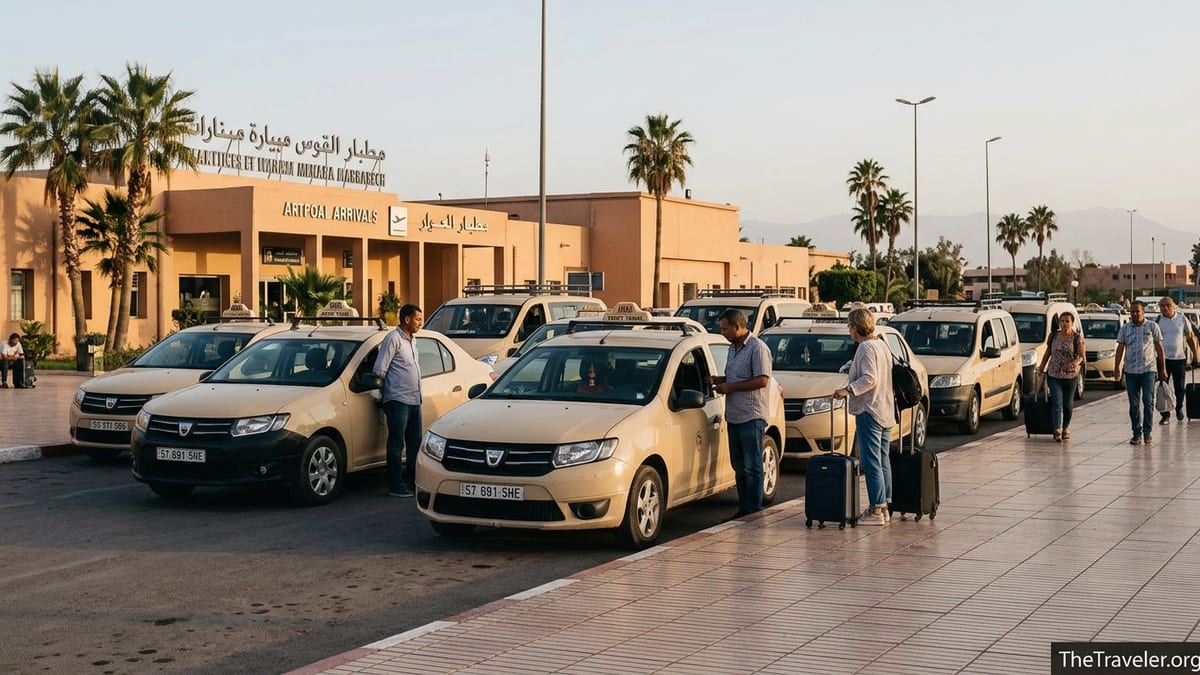
Understanding Marrakech Airport Taxis in 2026
Marrakech Menara Airport sits roughly 3 to 6 kilometers from most central districts such as the medina, Guéliz and Hivernage, so taxi rides are short but can feel confusingly priced. Two main types of taxis operate here: beige petit taxis, which are city cabs limited to three passengers, and larger grand taxis, usually beige or off-white sedans or vans that can take more people and luggage. At the airport, many vehicles that look like regular city taxis work on fixed or negotiated fares rather than the normal metered system you see in town.
In 2026, there is an official taxi area directly outside the arrivals terminal. After leaving customs, you walk through the sliding doors, pass the currency exchange and ATMs, then exit onto the forecourt. Across the first lane of traffic you will see a signed taxi rank and, at busy times, a small kiosk or desk where staff coordinate rides and quote fixed prices to different zones of the city. This official area is where you should go first, instead of accepting offers from individuals who approach you inside the terminal building.
Within Marrakech itself, petit taxis are supposed to use a meter, called a compteur in French. By law, there is a daytime tariff and a higher night tariff, with a minimum fare and a roughly 50 percent supplement at night. At the airport, however, taxis often argue that they work on a separate flat-rate system because they are waiting in a dedicated queue and paying airport fees. As a visitor, you should treat airport rides as semi-fixed fares with room for light negotiation rather than perfectly metered city trips.
To put this into context, locals using a metered petit taxi for a similar distance within the city might pay around 15 to 35 Moroccan dirhams during the day, depending on traffic and route. At the airport rank, the same distance is commonly sold to visitors for somewhere between 70 and 150 dirhams, depending on destination, time of day and negotiation. Understanding this gap helps you recognize when you are being offered a fair tourist price versus an exaggerated one.
Typical Fares: Day vs Night and Realistic Price Ranges
Official guidance and recent local transport resources suggest that a standard airport taxi fare in 2026 from Marrakech Menara Airport to the medina or Jemaa el Fna area is in the range of about 70 to 100 dirhams during the day. After 20:00 or 21:00, when the legal night tariff applies, that can rise to around 120 to 150 dirhams. These figures apply to a regular beige taxi carrying up to three passengers with normal luggage. If you are quoted 300 dirhams for a straightforward daytime ride to the medina, you are being asked far above what most travelers pay.
For Guéliz, which is slightly closer by road than the deepest parts of the old town, typical day fares from the official rank might fall between 70 and 90 dirhams, and 100 to 130 dirhams at night. For Hivernage, with its cluster of hotels such as the Sofitel and other large properties, the difference is small: expect similar pricing to the medina, especially after dark when nightlife traffic increases. The key point is that anything around 70 to 100 dirhams by day and 100 to 150 dirhams by night for central areas is broadly in line with current practice.
If you are traveling as a family or a group of four or more, you may be directed toward a grand taxi or a larger minivan. These vehicles often quote higher flat fees, for example 150 to 200 dirhams from the airport to the medina at night for four to six passengers with several suitcases. While this is noticeably more than a single petit taxi, splitting the cost between travelers can still be reasonable, especially if your hotel is inside the medina and the driver needs to navigate narrow streets and traffic.
It is important to remember that all these numbers are guide prices, not a strict tariff you can always enforce. At very late hours, such as arrivals after midnight, or during major events, quoted fares can creep higher. However, if you keep the ballpark ranges in mind, you will be able to recognize a reasonable offer quickly. For example, if you land at 23:30 and a driver at the official rank quotes 130 dirhams to a riad near Jemaa el Fna, that is acceptable. If another driver inside the terminal whispers an offer of 250 dirhams for the same ride in an unmarked car, you can confidently decline.
Using the Official Taxi Area and What to Expect on Arrival
Once you exit into the public arrivals hall, you may immediately encounter men asking “Taxi? Medina? Hotel?” and offering to carry your bags. These are usually informal touts or drivers working outside the official system. To avoid confusion, ignore these offers politely and continue walking straight outside until you see the clearly marked taxi rank and, if operating that day, the small booth where a staff member may ask your destination and assign a driver.
At the official rank, the experience is generally more structured. In some recent traveler reports, the system worked as follows: you tell the booth staff your hotel or neighborhood, they show or quote a fixed price, you pay them in cash, and they hand you a slip or ticket which you give to your driver. The driver then receives payment later from the kiosk. In other cases, the booth simply writes down an agreed price and you pay the driver directly at the end of the journey. Processes can vary slightly over time, so watch what other arriving passengers are doing and do not hesitate to ask “Do I pay here or to the driver?”
If there is no booth operating when you arrive, join the line at the head of the taxi rank and state your destination to the first available driver. You can ask “Combien pour médina, s’il vous plaît?” or “How much to Guéliz?” in English. The driver will likely quote a flat price. Use the ranges above to decide whether to accept or counter-offer. For example, if you arrive at 14:00 and the driver says “150 dirhams to medina,” you might respond calmly with “That is too much, I know the usual price is around 80 or 100. Can we do 100?” Be ready to walk to the next taxi if the first driver insists on an unrealistic figure.
During busy afternoons, it is normal to wait 5 to 15 minutes in the taxi queue. At night, especially after several late flights land close together, queues can look chaotic, but they advance steadily. Keep your luggage close and avoid handing your bags to anyone except your actual driver. If someone who is not clearly your driver grabs a suitcase and walks ahead, stop and say “No, thank you, I carry it” to avoid later requests for a tip for unrequested service.
Negotiation Strategies and Handling Common Scenarios
Taxi negotiation in Marrakech is part of daily life for locals, and being prepared discourages inflated tourist prices. The most important step is to know an approximate fair range before you start. For example, if you know that most visitors currently pay around 80 to 100 dirhams from the airport to the medina during the day, you can comfortably reject a 200 dirham demand. When quoting your counter-offer, stay within realistic limits; going too low can lead to frustration and refusal from drivers who also need to cover their own costs and airport fees.
A simple negotiation script might look like this in practice. You arrive at 21:00, heading to a riad near Bab Doukkala in the medina. At the rank, the driver says “150 dirhams.” You respond gently: “That seems high. I have friends who paid 100 last week. Can we do 120?” After a brief pause, the driver might nod, or suggest 130 as a compromise. If you agree at 130, you have achieved a fair late-evening price without an argument. If you feel uncomfortable, you can step back and address the rank coordinator or kiosk staff, saying, “He is asking too much, what is the official price?”
Once you are in the taxi, particularly if it is a petit taxi in the city rather than at the airport, always ask the driver to switch on the meter by saying “Compteur, s’il vous plaît.” In central Marrakech, the meter normally starts at a small base fare and adds a few dirhams per kilometer, with a 50 percent supplement at night. Some drivers may claim the meter is broken or that the minimum price is very high; if that happens and you have not yet started moving, you can simply step out and find another taxi. Locals do this regularly, and it is often enough to encourage a new, more honest driver to stop.
If a dispute arises at the end of the journey, stay calm. Suppose you had agreed verbally to 120 dirhams from the airport to a hotel in Guéliz, and upon arrival the driver asks for 180, saying there was traffic. You can respond, “No, we agreed 120 before we left, and that is what I will pay.” Have the exact amount ready in cash to avoid complicating the situation with change. Arguments rarely escalate if you are firm but polite, and knowing that there is an official complaints process in Morocco gives you additional confidence, even if you never need to use it.
Luggage, Group Travel and Late-Night Arrivals
Most airport taxis in Marrakech expect one suitcase and one small bag per person and do not charge a separate luggage fee, especially for typical holiday trips. However, if you have very large items such as golf bags, surfboards or several oversized suitcases, be prepared for the driver to ask for a small supplement, especially if a grand taxi or minivan is required. In practice, an extra 20 to 40 dirhams for noticeably bulky luggage is a common add-on, though it is best to confirm any supplement before you load everything into the car.
For small groups, grand taxis are a practical option. Imagine a group of five friends arriving at 23:00 with checked luggage each, heading to a riad near Bahia Palace. A single petit taxi cannot legally take more than three passengers, and squeezing with five plus bags would be unsafe. Instead, you might be steered toward a grand taxi or minivan that quotes 200 dirhams. Divided between five people, this is only 40 dirhams per person, a good deal compared with separate cabs and a manageable price for a late-night arrival.
Late-night or very early morning arrivals require a bit more flexibility on price and extra attention to safety. Flight schedules into Marrakech often include arrivals after 22:00, and taxis know that tired passengers with no public transport alternative are more likely to accept higher fares. If you land at 01:30 and are quoted 150 to 180 dirhams into the medina by an official airport taxi, it is often not worth haggling hard over the last 20 dirhams. Your priority at that hour should be choosing a clearly licensed taxi from the official rank, confirming the price upfront and making sure the driver knows the exact location of your riad or hotel.
Because many riads are located in car-free alleys, your taxi ride might end at a nearby gate or small square rather than at the front door. Some drivers call the riad to request someone to meet you and guide you on foot with your luggage, especially late at night. In other cases, an unofficial porter may appear with a cart and offer to take your bags through the alleyways. This service is common around areas like Bab Doukkala or near Jemaa el Fna; if you accept, agree a modest fee in advance, for example 20 to 30 dirhams, and keep an eye on your belongings as you walk.
Giving Hotel Addresses and Ensuring You Reach the Right Place
One of the most common sources of confusion in Marrakech is that many riads share similar names and are hidden in small side streets that do not appear clearly on basic map apps. To avoid a long search, have your accommodation details ready before you get into a taxi. A practical combination is the hotel name, the nearest gate or landmark, and a screenshot of the map in French or Arabic. For example, instead of saying only “Riad Jasmine,” you might say “Riad Jasmine near Bab Doukkala, close to Bab Doukkala mosque” and show the driver the location on your phone.
Most experienced drivers know the main hotel clusters by heart: the big international hotels in Hivernage, the streets around Avenue Mohammed V in Guéliz, and the most popular riad areas near Jemaa el Fna, Bab Doukkala, Bab el Ksour or Bahia Palace. If your property is inside a particularly narrow alley, the driver may park at the closest accessible point and point you toward the lane. If you are unsure, ask them to call the hotel number printed on your booking so that reception can guide both of you. Many riads are used to this and answer with directions like “Tell the driver to drop you at Dar el Bacha, we will meet you there.”
When you agree the fare at the airport, make sure the driver understands the address clearly. If your riad is far on foot from the usual drop-off point, such as deep in the northern medina, mention this early. Occasionally, a driver may try to charge an extra amount upon arrival, claiming the riad was “very far inside” or that he needed extra time to call and wait for staff. You can avoid this by clarifying before departure that the quoted price includes reaching the nearest accessible point and reasonable waiting while the riad sends someone to help you.
On your return to the airport, most hotels and riads offer to arrange a taxi pickup at a set price. For example, a riad in the medina might quote 150 dirhams for a pre-booked early morning transfer with a trusted driver who knows exactly where to meet you in the car-free alleys. This is often slightly more than hailing a metered petit taxi on the street, but pays for the convenience and reduces stress when you are leaving.
Avoiding Informal Drivers, Scams and Unnecessary Stress
Although many Marrakech taxi drivers are honest and work hard, airport arrivals are a favored place for a minority to overcharge or bend the rules. The simplest way to protect yourself is to avoid any offer made inside the terminal building or in the car park that does not involve the clearly signed taxi rank or a recognizable, licensed taxi. Informal drivers may approach you near the baggage carousel or customs exit, offering cheaper prices or a “private car” directly to your hotel. These rides can involve unlicensed vehicles, unclear pricing and no recourse if something goes wrong.
One common pattern reported by travelers is the “disappearing agreement,” where a price is agreed quickly outside the official rank, only for the driver to claim a higher amount at the end of the ride. Another variation is a driver who insists midway through the journey that your hotel is “very far” or “difficult to access,” implying a supplement is now required. By starting your interaction at the official taxi area and, if possible, getting the agreed fare written on a slip from the kiosk, you significantly reduce the risk of such disputes.
Ride-hailing apps exist in parts of Morocco, but their status in Marrakech is complicated, and they can be in open conflict with traditional taxi drivers, especially around sensitive locations like the airport and train station. Some visitors arrange to be picked up by a driver from a pre-booked transfer company just outside the airport grounds, for example at a nearby roundabout, in order to avoid the higher airport taxi rates. While this can save money, it also requires local knowledge and comfort with walking a short distance along a busy road with luggage. For most first-time visitors, especially arriving at night, the convenience and visibility of the official airport taxis outweigh the potential savings.
Tipping is not obligatory on Marrakech taxis, but rounding up the fare is appreciated. If your agreed airport ride costs 120 dirhams and the driver was helpful and careful with your bags, handing over 130 dirhams is polite. For shorter city rides on the meter, locals often round up to the nearest 5 or 10 dirhams. What matters more than the exact tip is setting the fare clearly at the beginning, paying that amount in cash at the end, and leaving the taxi with a clear, closed transaction.
The Takeaway
A smooth start to your Marrakech trip begins with understanding how airport taxis work and what a realistic fare looks like. In 2026, a standard ride from Marrakech Menara Airport to central areas such as the medina, Guéliz or Hivernage usually costs somewhere between 70 and 100 dirhams during the day, rising to roughly 120 to 150 dirhams at night. Grand taxis or minivans for larger groups cost more overall but can be good value per person, especially after dark or when you have plenty of luggage.
Use the official taxi rank just outside arrivals, be ready with your hotel name and nearest landmark, and agree on the total price before the car moves. If the quote is wildly above the ranges in this guide, feel free to counter politely or step back and ask a different driver or the kiosk staff. Once in the city, ask drivers to use the meter and do not hesitate to find another taxi if you feel pressured into an unfair deal.
With a bit of preparation and the confidence to say yes or no calmly, airport taxis in Marrakech can be a straightforward, practical way to reach your riad or hotel at any hour of the day. Rather than a stressful first encounter, your ride into town can become a relaxed introduction to the city’s rhythm, passing palm trees, ochre walls and glimpses of the Atlas Mountains as you head toward the heart of the medina.
FAQ
Q1. How much should a taxi cost from Marrakech Airport to the medina in 2026?
A typical, reasonable fare from Marrakech Menara Airport to the medina or Jemaa el Fna area in 2026 is around 70 to 100 dirhams during the day and roughly 120 to 150 dirhams at night, depending on traffic and your exact drop-off point.
Q2. Where is the official taxi rank at Marrakech Menara Airport?
After you pass customs and exit the arrivals hall, walk straight outside to the forecourt. The official taxi rank is across the first lane of traffic, usually marked with a sign and, at busy times, a small kiosk where staff coordinate rides.
Q3. Do Marrakech airport taxis use the meter?
Inside the city, petit taxis are supposed to use the meter, but at the airport many drivers work on fixed or negotiated fares instead. You can request the meter, but it is more realistic to treat airport trips as semi-fixed price rides and negotiate within the normal ranges.
Q4. Is there a night surcharge on Marrakech taxis?
Yes. By law, Marrakech taxis apply a night tariff that is about 50 percent higher than the daytime rate, usually from around 20:00 or 21:00 until early morning. At the airport this is reflected in higher quoted flat fares after dark.
Q5. Can I pay for a Marrakech airport taxi by card?
Most airport taxis in Marrakech still operate on a cash-only basis. A few premium transfer companies may accept cards in advance through online booking, but standard beige taxis expect payment in cash at the end of the ride.
Q6. How do I give my hotel address to the taxi driver?
Have the hotel or riad name, the nearest gate or landmark and a map screenshot ready. For example, say “Riad X near Bab Doukkala” and show the location on your phone. If needed, ask the driver to call the hotel using the number on your booking.
Q7. Are unlicensed or informal drivers a problem at Marrakech Airport?
Some informal drivers and touts approach travelers inside the terminal or car park, offering rides in private cars. To avoid problems, ignore these offers and use the clearly marked official taxi rank or a pre-booked transfer arranged by your hotel.
Q8. How many people and bags can a Marrakech taxi take from the airport?
A petit taxi can legally take up to three passengers and a normal amount of luggage, usually one suitcase and one small bag per person. Larger groups or travelers with many bags are typically directed to grand taxis or minivans, which can carry four to six passengers plus luggage.
Q9. Should I tip my taxi driver in Marrakech?
Tipping is not mandatory, but rounding up the fare is appreciated. For example, if you agreed 120 dirhams and the driver was helpful, paying 130 dirhams is a courteous gesture. For short city rides, locals often round up to the nearest 5 or 10 dirhams.
Q10. What should I do if a taxi driver changes the price at the end of the ride?
Stay calm and remind the driver of the original agreement. If you agreed 120 dirhams at the airport and are suddenly asked for more, say you will pay only the agreed amount, have the exact cash ready, and end the conversation firmly but politely.