


Arriving at Marrakech Menara Airport can feel intense: warm air, long queues at passport control and a rush of drivers and touts outside. Having mobile data and a bit of Moroccan dirham in your pocket before you leave the terminal makes the next hour far calmer. This guide walks you step by step through getting a SIM card, considering eSIM options, using ATMs and exchange desks, and making sure you have the right cash and cards ready before you walk out to the taxi rank.
Get the latest updates straight to your inbox!
What to Expect on Arrival at Marrakech Menara Airport
Most international flights into Marrakech Menara Airport arrive into Terminal 1, where arriving passengers follow a standard sequence: immigration, baggage claim, customs and then the arrivals hall. You will not find official SIM counters or bank machines before passport control, so plan to sort your connectivity and cash needs after you collect your luggage.
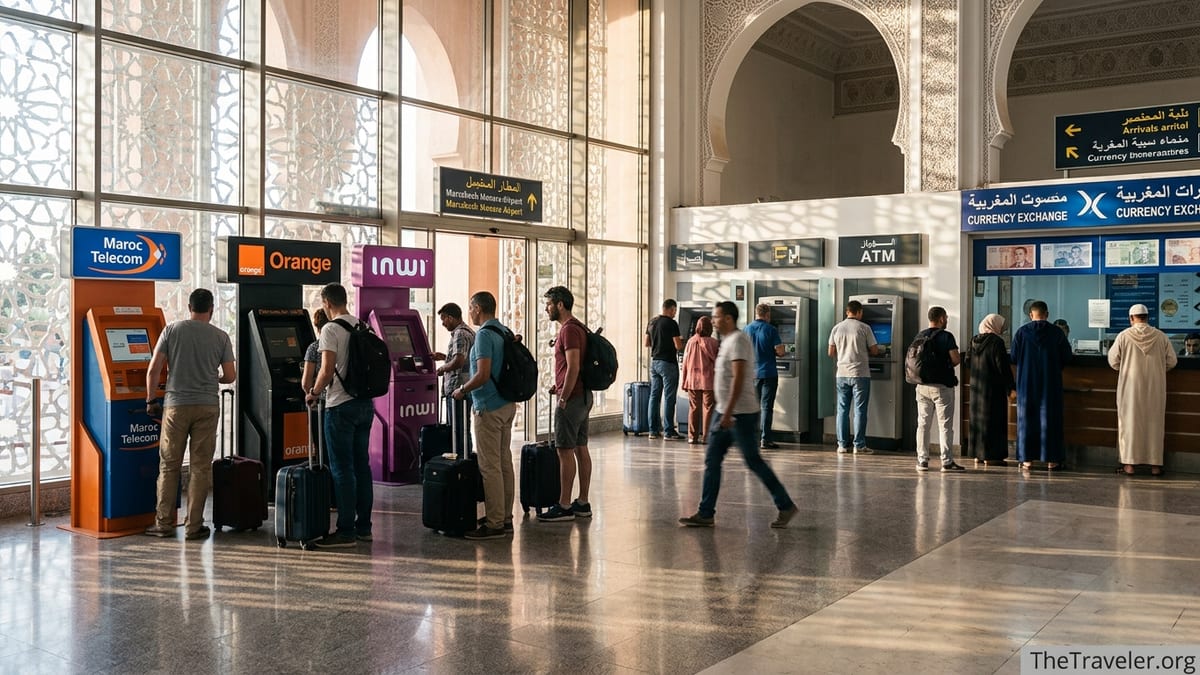
Once you pass customs, you emerge into a compact arrivals hall. Here you typically see three main things relevant to this guide: mobile operator kiosks, currency exchange counters and a line of ATMs along one side of the hall. The space can be crowded, especially after evening flights from Europe, but it is manageable if you know what you are looking for.
Outside the terminal, the official taxi area is directly opposite the exits. Drivers are used to tourists arriving without local cash, but you should not rely on being able to pay by card. Having some dirhams from an ATM or exchange counter inside the terminal gives you more control over the fare negotiation and avoids detours to off-airport cash machines.
Buying a Physical SIM Card at Marrakech Airport
Morocco has three main mobile operators that serve tourists: Maroc Telecom (also branded IAM), Orange Maroc and Inwi. At Marrakech Menara Airport all three usually have branded counters or kiosks in the arrivals hall, often side by side. These desks are aimed at new arrivals, and staff are used to activating tourist SIMs for people who may not speak French or Arabic.
Tourist-friendly starter packs change regularly, but a typical pattern is something like a 10 to 20 gigabyte data package, valid for 7 to 15 days, sold with the SIM for a modest fee in dirhams. For example, it is common to see Orange or Inwi offering around 10 GB of data for roughly the cost of a few coffees in the city. Exact prices can vary by season and promotion, and airport packages are usually a bit more expensive than in the city, but they are still reasonable by Western European standards.
At the counter, the clerk will usually ask for your passport to register the SIM, insert it into your phone, and activate the data package. Activation typically takes a few minutes; by the time you walk out of the arrivals hall, you should already have data. It is worth asking the clerk to show you that mobile data is working by opening a webpage or messaging app before you leave the desk.
Coverage among the three operators is broadly good in Marrakech itself, but many frequent visitors report slightly stronger overall reach with Maroc Telecom or Orange, especially outside major cities. If you plan only to stay in Marrakech and nearby attractions like the Ourika Valley or Agafay Desert, any of the three will be fine, so you can simply choose the kiosk with the shortest queue or clearest pricing board.
eSIM Alternatives: Arrive Already Connected
If your phone supports eSIM, you can arrive in Marrakech with mobile data already working. International eSIM providers such as Airalo and Holafly sell Morocco or North Africa regional packages that can be bought and installed before you fly. Many travelers report using these services successfully in Marrakech, typically connecting to one of the local networks such as Orange or Maroc Telecom once they land.
A common pattern is to buy, for example, an Airalo Morocco eSIM offering several gigabytes of data, valid for a set number of days, then activate it just before boarding your flight. When you land and switch off airplane mode, your phone connects automatically to the partner Moroccan network. This is particularly helpful if you want to order a ride-hail service from the curb, look up your riad’s location or message your accommodation without first hunting for a kiosk.
Dedicated Morocco eSIMs from providers like Holafly often emphasize unlimited data or higher caps, at a higher price than local SIMs. The trade-off is convenience and not needing to hand over your passport to register a physical card. If you expect to use heavy data, such as constantly uploading video or using your phone as a hotspot, compare the total cost of a two-week eSIM with the airport packages from the local operators.
One practical approach many tech-savvy travelers follow is a hybrid: they install a short-duration eSIM for immediate connectivity on day one, then pick up a local SIM in the city where choice is wider and prices can be lower. For example, you might use a 3 to 5 day eSIM to cover your arrival and first excursions, then visit an Orange or Maroc Telecom shop near Jemaa el-Fna to purchase a longer or larger data package at street rates.
ATMs in the Arrivals Area: Getting Cash in Dirhams
Moroccan dirham is a closed currency, which means you generally cannot obtain it outside the country. This makes the ATMs and exchange counters at Marrakech Menara Airport particularly important. As you walk into the arrivals hall, you will usually see several bank-branded ATMs, commonly from major Moroccan banks such as BMCE or other familiar local names, positioned near or between the exits and the currency exchange desks.
Withdrawing cash from an ATM is usually the simplest and often the best-value way to get your first dirhams, provided your home bank does not charge very high foreign withdrawal fees. Many machines allow you to select English on the screen and will display both the dirham amount and any local fee before you confirm. A practical first withdrawal might be in the range of 1000 to 1500 dirhams, which typically covers your taxi, a meal, small tips and incidentals for the first day or two.
As in many airports, some travelers occasionally report one ATM being out of service or rejecting a particular card. If that happens, simply move to another machine from a different bank in the same area. You are not required to use a specific bank’s ATM, and your international Visa or Mastercard should usually work across all of them, subject to your own bank’s limits and fraud rules.
When the ATM asks if you want to be charged in your home currency rather than dirhams, it is usually better value to decline this and choose to be charged in dirhams. That allows your home bank to perform the currency conversion, which often results in a more favorable effective rate than the “dynamic currency conversion” offered by the machine.
Currency Exchange Desks and When They Make Sense
If you prefer not to use an ATM, or if your card is declined, the airport currency exchange counters are your backup. In the arrivals area you will find dedicated exchange booths operated by specialist companies that keep long hours, often aligned with international flight schedules. They show electronic or printed boards with buy and sell rates for major currencies such as euros, US dollars and British pounds.
The convenience of exchanging at the airport comes at a cost: the rates are typically less favorable than using a bank ATM or exchanging cash at a bank branch in the city. The difference is not extreme for small amounts, but over hundreds of euros or dollars it can add up. For that reason, many seasoned travelers change just enough at the airport to pay a taxi and cover initial expenses, then use ATMs or city-center exchanges for larger sums.
If you are carrying cash, euros are generally the most straightforward to change in Morocco, followed by US dollars and British pounds. The exchange desk will usually ask for your passport, and you will receive a printed receipt. Keep this slip, as it can be useful if you want to change leftover dirhams back into foreign currency when you depart.
In practice a balanced approach might look like arriving with 100 to 200 euros or equivalent in cash. At the airport you exchange a portion of that, for example 50 to 100 euros, into dirhams to pay your taxi and first day expenses, and then rely primarily on ATMs as you get to know the city and see which method works out cheaper given your own bank’s fees.
Cash for Taxis: How Much and How to Handle It
From Marrakech Menara Airport, most visitors head either to the historic medina around Jemaa el-Fna or to the hotel areas of Hivernage or Gueliz. These areas are relatively close in distance, but the fares you are quoted can vary widely. There are posted official tariffs for airport taxis, but in reality many rides are negotiated. It is safest to assume you will need to pay in cash and to have a mix of small and medium denomination notes.
For a standard daytime ride from the airport to the medina or Hivernage, many travelers report paying a fare that would be considered moderate for a short airport-to-city transfer in Europe, sometimes a bit more at night or if you have bulky luggage. If you arrive with around 200 to 300 dirhams specifically set aside for the taxi, you can usually negotiate confidently without worrying about running short.
There is a rank of official beige taxis just outside the terminal. As you exit, ignore any aggressive touts who urge you to go with them and walk directly to the organized line. Before your bags go into the boot, clearly agree the total price in dirhams with the driver and confirm whether that includes your luggage. If the first price you hear seems unreasonably high compared with what you have read or your accommodation advised, you can politely counter with a lower figure or step back in line and ask another driver.
Some higher-end hotels and riads in Marrakech offer private transfers booked in advance, with drivers waiting in the arrivals area holding a sign with your name. These transfers are usually more expensive than a regular taxi, but the price is fixed, you can often pay by card or online in advance, and the driver knows exactly where your accommodation is in the medina’s maze of alleys. If your arrival is late at night or if you are anxious about bargaining immediately upon arrival, pre-booking a transfer can be good value simply for peace of mind.
Using Cards in Marrakech: Limits, Pitfalls and Workarounds
Once you leave the airport, you will find that card acceptance in Marrakech is mixed. Large hotels, many restaurants that cater to tourists and modern supermarkets often accept international Visa and Mastercard. However, small guesthouses, street food stalls, taxis, local hammams and market traders in the souks are still primarily cash-based. Planning your card and cash mix accordingly will save you frustration.
Before you travel, it is wise to notify your bank that you will be in Morocco on specific dates, or to verify in your banking app that your card is enabled for use there. Many banks automatically block foreign transactions from new regions as a fraud precaution, particularly ATM withdrawals. It can also help to raise your daily cash withdrawal limit temporarily if you prefer to take out a larger amount once or twice rather than making multiple small withdrawals and paying repeated fees.
If you rely heavily on a debit or credit card for spending, consider bringing at least one backup card from a different provider. A common real-world scenario is that a card works flawlessly at airport ATMs but is declined at a hotel terminal due to a technical or issuer-specific issue. Having a second card in a separate wallet or bag protects you from being stranded if one is lost, swallowed by an ATM or blocked without warning.
Finally, when paying by card in Marrakech, you may sometimes be offered the option to be charged in your home currency rather than in dirhams. As with ATMs, choosing to pay in the local currency usually provides a better overall exchange rate, as your home bank or card issuer carries out the conversion rather than a third-party service embedded in the payment terminal.
What to Do Before You Leave the Terminal
The last ten minutes in the arrivals hall are your opportunity to set yourself up for a smoother stay in Marrakech. Before you walk out to the taxi rank, take a moment to confirm that you have completed four key tasks: secured mobile data, obtained enough cash, checked your accommodation details and prepared for the taxi negotiation outside.
First, verify that your phone has working data, whether via a new local SIM, your pre-purchased eSIM or roaming from your home provider. Open your maps app and save your accommodation’s location offline. Many riads are hidden down narrow alleys; having a pinned location, a screenshot of directions or even a short text in French or Arabic with the riad’s name and nearest landmark can help your driver and avoid long searches in the medina.
Second, count your cash and separate the taxi money from the rest. For example, you might keep 200 to 300 dirhams for the ride in an easily accessible pocket and stash the remainder deeper in your bag. This makes it easier to pay the agreed fare without pulling out a thick bundle of notes, which can sometimes invite pressure for a higher price or extra “fees.”
Third, test any card you plan to rely on by making a small ATM withdrawal or, if you prefer, a low-value purchase at a café or shop in the arrivals area. If the card fails, it is far easier to resolve the issue while still at the airport, with alternate ATMs and exchange counters nearby, than after you have taken a taxi into the city.
Finally, take a breath and accept that the first hour in Marrakech may be slightly chaotic, especially if you arrive at night or during peak season. With a working phone, a pocket of local cash and a clear plan to reach your accommodation, you can step out of the terminal with confidence and start enjoying the city rather than worrying about logistics.
The Takeaway
Managing SIM cards, eSIM options and money at Marrakech Menara Airport is less daunting when you know what to expect. Local operator kiosks in the arrivals hall can quickly set you up with a physical SIM, while international eSIM providers let you touch down with data already active. ATMs from major Moroccan banks and all-hours currency exchange desks give you access to dirhams as soon as you clear customs.
The most important practical step is to secure enough local cash before you leave the terminal, especially to pay for your taxi into town and small early expenses. At the same time, understanding where cards are and are not widely accepted in Marrakech helps you decide how much to withdraw and how often. With a few minutes of preparation in the arrivals hall, you can turn what might feel like a stressful scramble into a simple routine.
By confirming that your mobile data is working, ensuring you have taxi fare in hand, testing your cards and having your accommodation details ready to show a driver, you walk out of Marrakech airport prepared rather than reactive. That small investment of time pays off quickly once you are weaving through the palm-lined roads toward the medina and the real point of your trip: experiencing the sounds, scents and colors of the Red City.
FAQ
Q1. Is it better to buy a SIM card at Marrakech airport or in the city?
Buying at the airport is more convenient and still reasonably priced, while buying in the city is usually a little cheaper but requires more time and searching.
Q2. How much cash should I withdraw on arrival at Marrakech airport?
Many travelers start with roughly 1000 to 1500 dirhams, enough for a taxi, a meal, tips and small expenses for the first day or two.
Q3. Can I pay my taxi from Marrakech airport by credit card?
Most regular taxis expect cash in dirhams. Some pre-booked hotel transfers may accept cards or online payment, but you should not rely on this for standard taxis.
Q4. Do I need my passport to buy a SIM card at Marrakech airport?
Yes, staff at the mobile operator kiosks typically ask to see your passport to register the SIM before they activate it in your phone.
Q5. Are eSIMs like Airalo or Holafly reliable in Marrakech?
Many visitors report good experiences using eSIMs in Marrakech, with coverage provided via local networks, though speeds and performance can vary by area.
Q6. Are the currency exchange rates at Marrakech airport very bad?
Airport exchange rates are usually less favorable than city banks or ATMs, but for small amounts to cover immediate needs the difference is acceptable for most travelers.
Q7. Will my foreign bank card work at Marrakech airport ATMs?
Most international Visa and Mastercard debit or credit cards work, but success also depends on your bank’s rules, daily limits and fraud controls, so check before you travel.
Q8. Is it safe to use ATMs at Marrakech airport?
The ATMs are in monitored public areas and generally considered safe, but you should follow normal precautions such as shielding your PIN and keeping cash out of sight.
Q9. Can I rely only on cards and avoid carrying cash in Marrakech?
No, many everyday transactions, especially taxis, markets and small cafés, still require cash, so you should always keep some dirhams on hand.
Q10. What should I do before walking out of the terminal in Marrakech?
Confirm your mobile data works, obtain enough dirhams, keep taxi money separate, test your main card if possible and have your accommodation address ready to show the driver.