


Landing at Marrakech Menara Airport and heading straight into the Atlas Mountains is one of the most rewarding ways to start a Morocco trip. Whether you are bound for the trekking hub of Imlil or the gentler landscapes of the Ourika Valley, the choices you make in the first hour after landing will shape the rest of your stay. This guide explains the real-world routes, transfers, costs, and timing so you can decide whether to go direct from the airport or overnight in the city first.
Get the latest updates straight to your inbox!
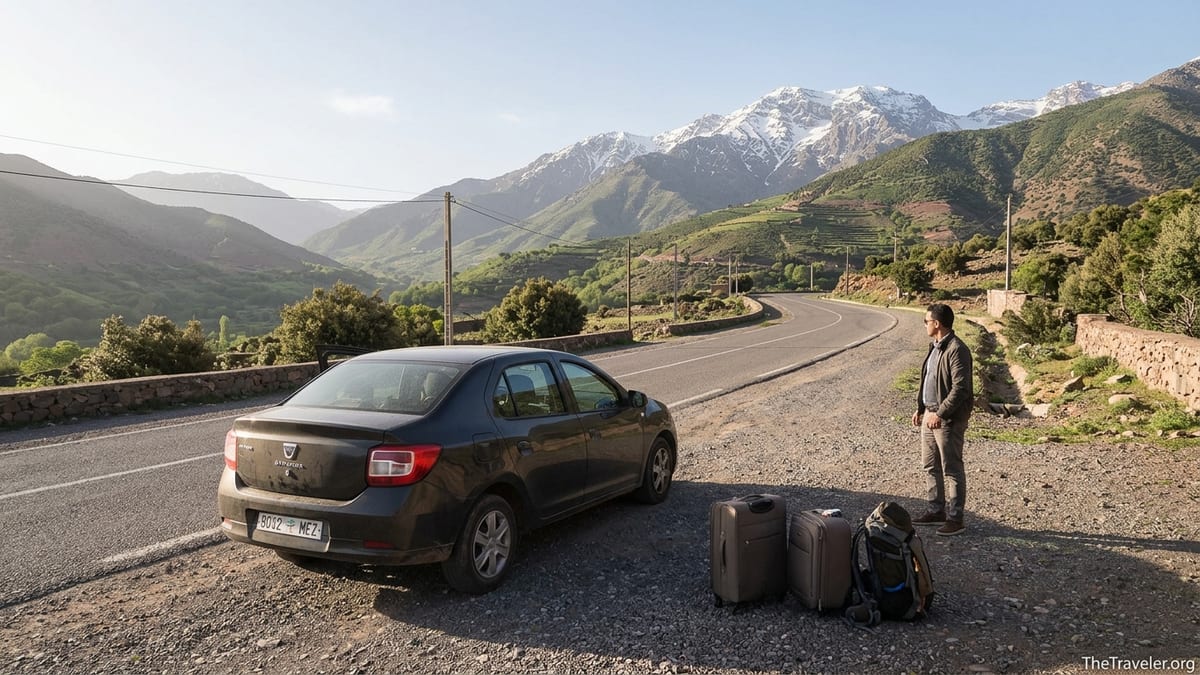
Understanding the Atlas Options: Imlil vs Ourika Valley
Imlil and the Ourika Valley both sit in the High Atlas south of Marrakech, but they offer very different experiences. Imlil is a compact village at around 1,740 meters, framed by steep slopes and terraced fields. It is the classic staging point for Mount Toubkal treks and longer hut-to-hut routes, with simple guesthouses like Dar Imlil and climber-focused lodges clustered along the valley floor. The feel is more mountain base camp than resort, and most visitors come specifically for hiking.
The Ourika Valley lies closer to Marrakech and is more about scenic day trips than serious trekking. The lower valley is threaded with riverside cafés, tajine restaurants with plastic chairs right on the water, and small guesthouses around villages such as Aghbalou and Top Ourika. At the upper end, the village of Setti Fatma acts as the gateway to short waterfall hikes and basic mountain walks. It is busy on Moroccan weekends, when local families come up to escape the city heat.
As a rule of thumb, choose Imlil if your priority is hiking, cool nights, and village life. Choose the Ourika Valley if you want an easy first taste of the Atlas, short walks, and the option to return to Marrakech the same day. Your onward plans also matter. Travelers heading east toward Ouarzazate or south toward the Sahara often treat Ourika as a one-day excursion, while those committing a few days to the mountains usually base themselves in Imlil or in luxury retreats like Kasbah Tamadot in the nearby Asni valley.
From the perspective of airport transfers, both destinations are within about two hours’ drive in good conditions. That makes it entirely realistic to land at Marrakech Menara, clear formalities, and be in your mountain riad in time for a late lunch in summer or an early dinner in winter. The difference lies more in road character and last-mile access: the Imlil road climbs more steeply and narrows near the end, while the Ourika road is gentler but can be slow through weekend traffic and village stretches.
Travel Times, Distances, and When Daylight Matters
Marrakech Menara Airport sits on the southwest edge of the city. By road, it is roughly 60 kilometers to central Ourika Valley villages such as Aghbalou or Top Ourika, and around 65 to 70 kilometers to Imlil via the Asni road. On mapping apps, both routes are often shown at about one to one and a half hours. In practice, most travelers should budget 1.5 hours to Ourika and 1.5 to 2 hours to Imlil from the airport, especially if you hit traffic leaving the city or slow-moving trucks on the climbs.
Daylight is a more important factor than distance. In summer, when it stays light well into the evening, many visitors comfortably book afternoon arrivals and keep going up to Imlil or Ourika. In winter, with sunset as early as late afternoon, the last 20 minutes into Imlil can be in near-dark, past roadside drops and unlit bends. For a first visit, families with children or nervous drivers often prefer to avoid arriving in Imlil after full dark, whereas arriving in the lower Ourika Valley in the evening is usually less demanding as the road is wider and follows the valley floor.
As a working example, consider a flight that lands at 14:30. Allow 30 to 60 minutes for immigration, baggage, and getting cash from the ATM or a currency desk. If you have pre-booked a driver, you can usually leave the airport by 15:30. On a normal day, you could arrive in Aghbalou around 17:00 or in Imlil between 17:15 and 17:30, just in time for sunset in spring or autumn. Conversely, if your flight lands at 20:30 in winter, it may make more sense to pre-book a city hotel and transfer to the mountains the next morning.
Traffic patterns also play a role. The Ourika road can back up around midday and on Sunday afternoons as locals return to Marrakech after lunch by the river. The Imlil road is generally less congested, but you may still be slowed by farmers on scooters, herds of sheep, or market days in Asni. When planning an airport-to-mountains transfer, give yourself an extra 30 minutes on top of the map estimate and avoid planning anything time-sensitive, such as a guided hike, within half an hour of your expected arrival.
Private Drivers from Marrakech Airport: Door-to-Door Ease
For most visitors heading directly from the airport to Imlil or the Ourika Valley, booking a private driver is the simplest and most reliable option. Licensed tourist transport companies and individual drivers regularly quote set prices in Moroccan dirhams or euros for these routes. As a broad current benchmark, many riads and tour operators in Marrakech quote between 700 and 900 dirhams for a private transfer from the city to Imlil for up to four passengers, with airport pickups typically costing slightly more due to parking and waiting time. Ourika Valley transfers often fall in a similar or slightly lower range, sometimes around 600 to 800 dirhams for a car carrying two to four people.
Booking through your accommodation is usually the least stressful route. If you are staying at a well-known mountain guesthouse such as Riad Atlas Panorama in Imlil or a riverside auberge in Ourika, their staff can arrange a trusted driver to meet you at the airport with a sign. Prices through accommodations can run a little higher than finding a driver independently, but the benefits are real: they know exactly where your lodge is, they can coordinate if your flight is delayed, and the driver will be used to the last steep or narrow stretch up to your front door.
Travelers on a tighter budget sometimes negotiate directly with grand taxi drivers outside the terminal. This can work, but you should be ready to agree the price clearly before departing and to pay more for night-time departures. For example, a couple arriving late in the evening might negotiate around 900 to 1,100 dirhams for a direct airport to Imlil ride in a grand taxi, while daytime rates can be lower. The lack of a meter on intercity routes means that clear, polite negotiation upfront is essential.
Compared with a rental car, the main advantage of a private driver is that you are not dealing with unfamiliar roads, jet lag, or night-time driving immediately after your flight. Drivers familiar with the route know where to slow down for hidden bends, livestock, or unmarked speed bumps, and they also know the turn-offs for small guesthouses that do not appear accurately on mapping apps. For a short stay of two or three nights in the mountains, the cost difference between a private driver and a rental car often narrows once you factor in fuel, insurance, and parking in Marrakech.
Driving Yourself: Rental Cars, Roads, and Parking
Renting a car at Marrakech Menara Airport can make sense if you want maximum flexibility or plan a longer road trip across Morocco. International brands and reputable local firms have desks in the arrivals hall. Daily rental rates vary with season and demand, but small manual cars often start from the equivalent of 25 to 40 euros per day, excluding insurance upgrades. Inspect the car carefully, take photos of any existing scratches in the parking lot, and ask the agent to show you how to operate the lights and spare tyre, as you may be driving after dark or through mountain sections with limited services.
The main roads from Marrakech toward Imlil and Ourika are paved and, in normal dry conditions, do not require a four-wheel drive. The Imlil route leaves the city in the direction of Tahannaout and Asni before climbing into the valley, while the Ourika route follows the river south-east through a chain of villages. Both involve single-carriageway roads with occasional potholes, speed bumps, and slow vehicles. Overtaking should be done cautiously, and first-time visitors are better off allowing local drivers to pass rather than trying to match their pace.
Parking at mountain accommodations is generally straightforward but varies by property. Larger lodges and midrange hotels near Imlil often have small private car parks or roadside spaces reserved for guests, while some traditional guesthouses in the older part of the village require you to park lower in the valley and walk up with your luggage, sometimes with the help of a mule. In Ourika, many riverside restaurants and auberges offer informal parking areas that may or may not be supervised. It is worth confirming parking details with your accommodation in advance, especially if you are arriving after dark or travelling with valuable sports equipment such as climbing racks or photo gear.
Fuel is easy enough to find near Marrakech, but once you leave the city you should not assume that every village will have a modern service station. A practical routine is to pick up your rental car with at least a half tank of fuel, top up at a brand-name station on the edge of Marrakech, and then drive into the mountains knowing you have ample range. As you descend on your last day, refuel again before dropping the car back at the airport, as on-airport fuel can be limited or more expensive.
Grand Taxis, Shared Seats, and Budget Options
For budget-conscious travelers, Morocco’s grand taxi system remains a workable option, though it is less convenient with luggage and after a flight. Grand taxis are typically older Mercedes or similar sedans that run set routes between towns, departing when all seats are filled. From the city, you can find grand taxis to Imlil or to Asni, where you change to another shared vehicle. In 2025 and 2026, travellers commonly report paying the equivalent of a few dozen dirhams per seat from Marrakech to Imlil when using shared local prices, but fares for tourists in private hires can be significantly higher.
Using grand taxis directly from the airport is less straightforward. There is no fixed-price shared taxi stand for Imlil or Ourika at the terminal. You would normally take a small metered taxi or a ride-hailing car from the airport to the relevant grand taxi rank in town, then change into a shared taxi heading south. This can cost-effective for solo backpackers with light bags and plenty of time, but it introduces several layers of uncertainty for families or travelers arriving late in the day.
Ride-hailing apps do operate informally in and around Marrakech, and some visitors use them to reach the taxi ranks cheaply, but they sit in a grey legal area that can cause friction with traditional drivers. For most short stays focused on Imlil or Ourika, the extra savings rarely justify the effort and negotiation compared with simply booking a private driver or arranging a transfer through your guesthouse.
If you do choose the budget route, plan it for the daytime, keep your luggage manageable, and expect to wait until your shared taxi fills up. It is normal for drivers to offer you the option of paying for the remaining empty seats to depart immediately. This can still work out cheaper than a full private hire, especially if you are travelling with a friend and want to avoid lingering at the rank.
Luggage, Gear, and Going Direct After Landing
One of the biggest practical questions for new visitors is whether to go straight from the airport to the mountains or to spend a night in Marrakech first. Your luggage load and energy levels are often the deciding factors. If you are travelling with multiple large suitcases, ski-sized duffels, or bulky trekking equipment, heading directly to a small mountain village after a long flight can feel like a logistical test. Staircases in traditional houses can be narrow, and some lanes are too tight for cars, meaning you may need to carry or mule-transfer bags for the last few hundred meters.
For travellers with a single suitcase or backpack each, going direct works very well. Many trekking-oriented guesthouses in Imlil are used to early arrivals and can store luggage safely if your room is not yet ready. It is common for guests landing on a morning flight to reach Imlil early afternoon, have a light lunch on the terrace, nap for an hour, and then take a short acclimatisation walk up to nearby villages like Aroumd. In Ourika, where many stays are one or two nights, hosts are generally happy to keep your bags while you explore the waterfalls or have lunch by the river.
If your itinerary includes nights in Marrakech before and after the mountains, ask your city riad whether they can store excess luggage. Many riads near the Medina offer to hold a suitcase or two for returning guests at no charge, which means you can head to Imlil or Ourika with only a smaller bag containing trekking layers, toiletries, and essentials. This is particularly useful if you plan to travel onward by bus or train after returning to the city, as you avoid hauling everything through multiple legs.
Energy and timing matter as much as baggage. Travelers arriving on overnight flights with significant jet lag may be safer and happier checking into a city hotel within 20 minutes of the airport, having a shower and a meal, and heading to the mountains rested the following morning. Families with small children, older travellers, or anyone who is anxious about mountain roads should lean toward a city night if their flight lands after mid-afternoon in winter or early evening in summer. On the other hand, fit couples landing around midday commonly report that the sense of arrival in Imlil at sunset or in a quiet corner of the Ourika Valley is worth a little extra effort.
Day Trips vs Overnight Stays: How to Use Your Time
If you are based in Marrakech and considering a day trip, the Ourika Valley is the more practical target. A typical private day tour picks you up at your riad around 8:30, reaches the valley and Setti Fatma waterfalls by late morning, includes a simple guided walk and lunch at a riverside restaurant, and returns you to the city by late afternoon or early evening. Private day trips from Marrakech to Ourika for small groups commonly cost the equivalent of 60 to 100 euros per vehicle, depending on inclusions and season, with lunch and local guides sometimes extra.
Imlil also works as a day trip, particularly for visitors interested in scouting trekking routes or enjoying cooler air without committing an overnight. A private car can collect you from your Marrakech accommodation around 8:00, reach Imlil mid-morning, and allow a few hours of walking to viewpoints or nearby villages with a local mountain guide. You are likely to be back in Marrakech before or just after sunset. However, the extra altitude and road time mean that Imlil truly rewards at least one or two nights, especially if you want to see the changing light in the valley and enjoy early morning views before day-trippers arrive.
From the airport, using your arrival day as a partial mountain day is also possible. For instance, a traveller landing at 11:00 could be in an Ourika lodge by 13:00, have lunch, and take a short afternoon walk along the river or to a nearby viewpoint, then enjoy a quiet evening. Similarly, an early morning arrival can put you in Imlil in time for a half-day hike to Aroumd or to the shrine at Sidi Chamharouch, returning before dark. In both cases, remember that your first day should be moderate; save longer treks or high passes for when you are fully rested and acclimatised.
When comparing day trips and overnight stays, also factor in weather. In high summer, Marrakech can feel extremely hot by midday, while the mountains remain significantly cooler. Using your first or second day for an Ourika or Imlil escape can make a big difference to how you experience Morocco, even if your overall itinerary is short. In shoulder seasons and winter, mountain evenings can be cold, so check that your chosen guesthouse has adequate heating or blankets and that you have packed a warm layer in your carry-on in case your checked bags are delayed.
The Takeaway
Traveling from Marrakech Airport to the Atlas Mountains is far simpler than many first-time visitors expect. Both Imlil and the Ourika Valley sit within two hours’ drive of the terminal, and with a pre-booked driver you can step out of arrivals and into mountain air the same afternoon. Choosing between them comes down to your priorities: serious trekking and cool, quiet evenings in Imlil, or easier walks and riverside cafés in the Ourika Valley.
For most travelers, especially on shorter trips, a private transfer directly from the airport is the most efficient use of time, provided your flight lands in daylight or you are comfortable with night driving by an experienced local. Self-driving offers freedom but demands more attention after a flight, while grand taxis and shared options work best for backpackers with flexible schedules and light bags. Whichever route you choose, planning ahead on luggage, transfer timing, and first-night accommodation will help you arrive calm and ready to enjoy the mountains instead of negotiating logistics at the curb.
If your itinerary allows, consider using Marrakech as a base before or after your mountain stay, both for luggage storage and for the contrast between medina bustle and village stillness. With a little foresight, the journey from runway to ridgeline can be seamless, setting the tone for a rewarding time in one of North Africa’s most beautiful mountain ranges.
FAQ
Q1. Is it realistic to go straight from Marrakech Airport to Imlil after landing?
Yes, if your flight arrives in the morning or early afternoon it is entirely realistic to go directly to Imlil. With a pre-booked driver, most travelers reach Imlil in about 1.5 to 2 hours from the airport, even allowing for immigration and baggage. If you land after dark in winter, or feel tired after a long-haul flight, consider spending one night in Marrakech and heading up the next morning.
Q2. How long does it take to drive from Marrakech Airport to the Ourika Valley?
In normal conditions, the drive from Marrakech Airport to central Ourika Valley villages such as Aghbalou typically takes around 1.5 hours. Mapping apps may show a shorter time, but village traffic, photo stops, and slow vehicles on the single-carriageway road often add a little. During weekends and holidays, traffic can be heavier, so allow an extra 30 minutes.
Q3. Do I need a 4x4 to reach Imlil or the Ourika Valley?
No, in dry weather a standard car is normally sufficient for both Imlil and the Ourika Valley. The roads are paved the whole way, though they can be narrow and winding near Imlil and occasionally potholed. A 4x4 can be useful in winter conditions, heavy rain, or if you plan to explore unpaved side tracks beyond the main villages, but it is not essential for the standard routes.
Q4. What does a private transfer from Marrakech to Imlil or Ourika typically cost?
Prices vary by season, vehicle type, and booking channel, but many accommodations and transfer companies currently quote in the region of 700 to 900 dirhams for a private car from Marrakech to Imlil for up to four people, with similar or slightly lower prices for the Ourika Valley. Airport pickups can be marginally higher than city pickups. Luxury vehicles, English-speaking driver-guides, or last-minute bookings often command a premium.
Q5. Is it safe to arrive in Imlil or Ourika after dark?
It is generally safe, but it can feel more challenging. The roads are not always well lit, and livestock, pedestrians, or unmarked speed bumps can be harder to see at night. If you arrive after dark, a private driver who knows the route is strongly recommended. Self-driving first-time visitors and nervous passengers are usually more comfortable arriving in daylight, particularly for Imlil where the last section of road is steeper and narrower.
Q6. Can I visit the Ourika Valley as a day trip on my arrival or departure day?
Yes, many visitors fit the Ourika Valley into an arrival or departure day. If you land before midday, you can often reach the valley in time for a late lunch and a short walk. On departure days, some travelers make a half-day trip, returning to Marrakech by late afternoon for an evening or night flight. Just make sure to leave generous buffers for airport check-in, especially in high season.
Q7. What should I do with extra luggage if I am trekking from Imlil?
If you are doing multi-day treks from Imlil, ask your Marrakech riad or Imlil guesthouse about luggage storage. Many city riads are happy to store a suitcase or two for returning guests at no extra charge. In Imlil, trekking lodges commonly hold non-essential bags in a locked room while you are on the trail. Pack a smaller duffel or backpack for the trek itself and leave city clothing, laptops, and anything you do not need safely stored.
Q8. Are there ATMs or money exchange facilities in Imlil and the Ourika Valley?
ATMs and formal currency exchange options are limited in both Imlil and the Ourika Valley. It is wise to withdraw cash at Marrakech Airport or in the city before heading into the mountains. Some midrange and higher-end lodges accept card payments, but small cafés, guides, and local drivers often prefer cash. Carry a mix of small and medium-denomination notes for tips, snacks, and short transfers.
Q9. Is it better to self-drive or hire a driver for a short mountain stay?
For a stay of just a few days focused on one base such as Imlil or the Ourika Valley, most visitors find it easier to hire a driver. You avoid navigating unfamiliar roads immediately after flying and do not need to worry about parking, insurance details, or city traffic. Self-driving becomes more attractive if you plan a longer itinerary with multiple stops across Morocco, or if you enjoy spontaneous side trips and are comfortable with rural driving.
Q10. Can I combine Imlil and the Ourika Valley in one short trip?
Yes, you can. With four to six days, many travellers spend two or three nights in Imlil for trekking and cooler air, then one or two nights in a riverside lodge in the Ourika Valley, or vice versa. You can arrange a direct transfer between the two without going back into central Marrakech, or route via a night in the city if you want a contrast between medina life and mountain quiet. Planning your transfers ahead of time helps avoid backtracking and makes the most of your limited days.