


Landing at Melbourne Airport for the first time can feel intense: four busy terminals, constant construction, new Uber ranks, and a maze of buses and hotels to figure out while you are jet-lagged. With a little preparation, though, your first arrival in Melbourne can be straightforward. This guide walks you through how the airport works today, how to get into the city, where to stay nearby, and the small real-world tips that make those first few hours in Australia much easier.
Get the latest updates straight to your inbox!
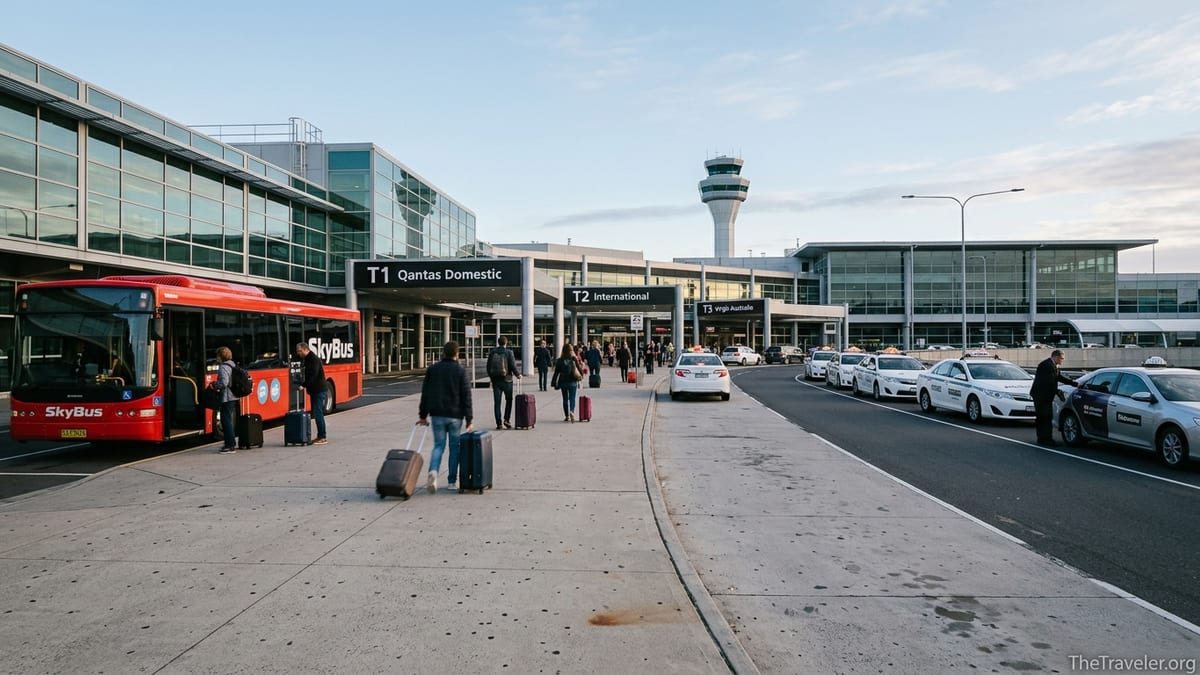
Understanding Melbourne Airport and Its Terminals
Melbourne Airport, often called Tullamarine, sits about 23 kilometers northwest of the central business district. It has a single connected terminal precinct, but four distinct terminals: T1, T2, T3 and T4. In practice, you will mostly move through one or two of these, yet it helps to know which airlines use which terminal before you land so you do not follow the wrong signage after a long flight.
Terminal 2 handles almost all international flights. If you are arriving from Asia, Europe, North America or the Middle East, you will almost certainly arrive into T2, clear immigration and customs there, and then either exit straight into the public arrivals hall or walk across to a domestic terminal for a connection. Terminal 1 is the main Qantas domestic terminal, while T3 serves Virgin Australia and some regional operators. Terminal 4 is the budget end of the building, home to Jetstar and several low-cost carriers, and is slightly separated with its own forecourt and SkyBus stop.
All four terminals are joined under one roof. Walking from the far end of T1 to T4 usually takes 10 to 15 minutes at a normal pace. This matters if you are, for example, landing internationally in T2 and connecting to a Jetstar domestic flight out of T4. There is no internal airside transfer bus between terminals. You will clear immigration and customs, come out landside into T2 arrivals, and then follow overhead signs along the concourse to your next terminal, rolling your bags the entire way.
For first-time visitors, the most confusing part is often the forecourt road layout rather than the terminal interiors. Inside, wayfinding is generally clear: color-coded signage, big overhead boards and frequent staff. Outside, the mix of paid pick-up lanes, taxi ranks, SkyBus bays, hotel shuttles and rideshare zones can feel chaotic. Taking a moment inside the terminal to find the large transport information screens or an airport staff member before walking out will usually save time and frustration.
Arriving for the First Time: Immigration, Customs and Practicalities
International arrivals into Terminal 2 follow a predictable sequence: disembark, proceed to passport control, collect luggage, and clear customs and biosecurity. Australia is strict about bringing in food, plant material and some medications. On the plane you will complete an incoming passenger card, which asks about declared items. If you forget and, for example, leave a piece of fresh fruit in your carry-on, declare it at the counter so it can be disposed of without penalty.
SmartGates handle many eligible passport holders at Melbourne Airport, particularly from ePassport countries such as New Zealand, the United Kingdom and much of Europe. If you are directed to use the SmartGate, you will scan your passport, have your face matched to your passport chip, and then proceed through to baggage claim. Families with young children and some nationalities will still use staffed counters, which can mean longer queues at busy times like early morning banked arrivals from Asia.
On the baggage carousel level, you will find free trolleys and clear signs showing where to line up for customs inspection. Biosecurity officers are visible and active. If you have items such as packaged snacks or traditional medicines you are unsure about, it is common to see officers ask questions and, when in doubt, request that items be surrendered. This process is typically efficient, but if you land around 7:00 to 9:00 in the morning when many international flights arrive, allow at least 45 to 60 minutes from landing to reaching the public arrivals hall.
Immediately after customs, you will pass duty-free stores and money exchange counters before you emerge into the public arrivals area. While it is possible to change a small amount of currency at the airport, rates are usually less favorable than those in the city. Most first-time visitors find it easier to use an ATM with a debit or travel card from their home bank. ATMs from several major Australian banks are scattered near the exits and near the SkyBus ticket counters.
Getting from Melbourne Airport to the City: SkyBus and Public Transport
For many first-time travelers, SkyBus is the simplest way to reach central Melbourne without dealing with taxis or rideshare ranks. The Melbourne City Express runs between the airport and Southern Cross Station on the western edge of the CBD, operating roughly from early morning to late night with services advertised from around 4 am to 1 am. Buses depart frequently, often every 10 minutes or so during the day, and the journey typically takes 30 to 40 minutes depending on traffic.
SkyBus stops are located directly outside Terminals 1, 3 and 4. If you arrive internationally into T2, you walk a short distance to the T3 stop. Tickets can be bought from staffed counters near the exits or from machines at the stops, and many travelers now buy digital tickets on their phones before they fly. Fares can change, but as a guide, a one-way adult ticket is typically priced in the range you would expect for a dedicated airport express in a major city, noticeably cheaper than a taxi but more expensive than a suburban bus and train combination.
Once you arrive at Southern Cross Station, you can transfer to suburban trains, trams and buses with a Myki card, which is the reusable smartcard used on public transport across Melbourne. For example, if your hotel is near Flinders Street, you can either take a short city loop train from Southern Cross or use the free tram zone that covers much of the CBD. Many first-time visitors choose hotels within walking distance of Southern Cross such as those along Spencer Street or in Docklands specifically because the SkyBus drop-off makes arrival with luggage painless.
Budget-conscious travelers who are comfortable with local buses can use the public route network from the airport. SmartBus route 901 runs between Melbourne Airport and Frankston, with a key transfer at Broadmeadows Station on the Craigieburn train line. Other local routes such as 478, 479 and 482 link the airport to nearby suburbs and shopping centers. This can cut your costs significantly, particularly if you already have a Myki card, but expect a more local experience with luggage, multiple stops and occasional crowding at peak commuter times.
Uber, Taxis and Other Ground Transport Options
Melbourne Airport has leaned heavily into managed ranks for both taxis and rideshare, and this is where first-time visitors often feel the most confusion. Instead of cars pulling up curbside outside each terminal, most commercial pick-ups are directed into dedicated zones. Taxis have their own ranks outside each terminal, clearly signposted and usually managed by marshals at busy times, with a queueing system and visible information about surcharges such as the airport pick-up fee.
Rideshare services such as Uber, Ola and DiDi use set pick-up areas labeled as rideshare or Uber zones. Uber in particular has an exclusive rank outside Terminals 1, 2 and 4, and uses a PIN system for many airport pick-ups. After you request a ride in the Uber app, you may be given a six-digit PIN rather than being matched to a specific driver on your screen. At the rank, you join the queue of passengers, the next available driver pulls up, and you read the PIN to them so they can start the correct trip on their device.
In practice, this system can work smoothly, but it has also given rise to occasional scams reported by travelers. One scenario involves a driver refusing to enter the PIN or asking you to cancel and pay cash, claiming app problems. Another involves a driver starting a different kind of Uber product than you requested, such as a higher-priced Comfort or Premium ride instead of a standard UberX. First-time visitors should insist that the driver enters the PIN and that the app shows the correct trip, vehicle and price estimate before the car leaves the rank. If something feels off, step back, let that car go and wait for another.
As a rough benchmark, a standard rideshare or taxi from Melbourne Airport to a central business district hotel typically costs significantly more than SkyBus but offers door-to-door convenience, especially late at night when you might not want to change vehicles at Southern Cross. Travel time in light traffic is often 25 to 35 minutes, but in peak hour it can stretch to 45 minutes or more. If your accommodation is in inner suburbs like Fitzroy, South Yarra or St Kilda, rideshare will usually be more straightforward than mixing SkyBus with multiple train or tram changes.
Airport Buses, Hotel Transfers and Nearby Accommodation
Not everyone wants to head straight into the city after landing. Early-morning departures, long layovers or family trips often make an airport hotel the most practical choice. Melbourne Airport has two hotels directly connected or adjacent to the terminal precinct, with several more a short shuttle ride away in the Tullamarine area. These range from international brands with full-service facilities to more modest properties aimed at overnight stays.
One of the most convenient examples is the hotel attached to Terminal 2 and 3, where you can walk from your room to the check-in counters in a few minutes under cover. This style of property typically features 24-hour reception, on-site dining and soundproofed rooms, which matters if you are trying to sleep during daylight hours between long-haul flights. A short walk across the forecourt brings you to the departure levels of all terminals, which can turn a brutal 6 am international check-in into a far more relaxed morning.
Just outside the immediate terminal area, you will find several mid-range hotels that operate complimentary shuttles to and from the airport. Properties along Melrose Drive and around Trade Park Drive, for example, commonly advertise free 24-hour shuttle buses that pick up from designated bus bays near the terminals. A typical pattern is to call the hotel after you have collected your bags and cleared customs, then wait 10 to 20 minutes for the shuttle to swing past the pick-up point.
Farther out, suburban hotels and serviced apartments in areas like Essendon Fields or the outer north often market airport packages that combine one night’s accommodation with parking for several days and a shuttle transfer. These can be attractive for families driving from regional Victoria for an overseas trip. A common real-world scenario sees a family drive to an Essendon Fields hotel the afternoon before departure, hand over their car keys for secure parking, sleep near the airport and then take the hotel’s morning shuttle straight to the departure terminal.
Navigating Departures: Check-in, Security and Time Management
For international departures, airlines at Melbourne Airport usually recommend arriving at least three hours before your scheduled flight time, and sometimes more during peak holiday periods. The check-in and bag-drop areas for Terminal 2 run in one long row with multiple airlines sharing counters. Before you line up, confirm on the overhead screens which row corresponds to your flight. Some carriers, especially larger international airlines, offer automated bag drops if you have already checked in online and printed tags at a kiosk.
After check-in, you will proceed upstairs through security and outbound passport control. Security at Melbourne Airport follows standard international protocols: laptops and larger electronics out of your bag, liquids and gels in containers of 100 milliliters or less, and occasional random explosive trace detection swabs. Lines move steadily, but if you are departing in the morning wave of long-haul flights to Asia and the Middle East, allow time for congestion and give yourself a margin after security for a quick meal or last-minute shopping.
Domestic departures out of Terminals 1, 3 and 4 generally move faster, but can still clog up during early morning and evening peaks when business travelers and commuters form long queues at security. Many frequent flyers use priority lanes, but first-time visitors without status should budget at least 60 to 90 minutes from curb to gate on a busy weekday morning. If you are transferring from an international arrival to a domestic connection, a same-day connection time under two and a half hours can feel rushed once you factor in immigration, baggage, customs, walking time and domestic security.
Food, retail and lounge options have expanded across the terminals. You will find familiar Australian coffee chains, grab-and-go sandwich counters, local bakery brands and sit-down restaurants. Prices airside are typically higher than in the city, but still within the range of what you would expect at a major international airport. Many first-time travelers underestimate how tired they will feel after flying to Australia, so it is sensible to eat lightly, hydrate and avoid overdoing alcohol during layovers or before long onward flights.
First-Time Arrival Tips and Real-World Scenarios
A common first-time scenario involves arriving in the early morning on a long-haul flight, feeling groggy and eager to reach a CBD hotel. In this case, SkyBus to Southern Cross followed by a short taxi or rideshare to your hotel is often the best mix of simplicity and cost. For example, if you are staying on Collins Street, you could take SkyBus, wheel your luggage to the taxi rank at Southern Cross and take a short cab ride up the hill, which generally adds a modest additional fare compared with taking a taxi the entire way from the airport.
If you are landing late at night, especially after midnight when SkyBus services taper off, pre-booking a private transfer or planning to use rideshare or taxis is more realistic. Some travelers arriving close to 1 am opt to stay at an airport hotel rather than travel into the city at 2 or 3 am, checking in, sleeping, and then heading into town mid-morning. This can also be a good way to sync with local time if you have flown from Europe or North America and want to avoid an exhausted early-morning arrival at a city hotel that may not have your room ready.
Families and groups with large amounts of luggage often find that a maxi-taxi or larger rideshare vehicle is most economical. Booking a taxi company’s larger vehicle or using an app option that specifies more seats can be cheaper and more comfortable than splitting into two standard sedans. For instance, a family of five staying in Carlton might order a larger vehicle via a rideshare app, stow all luggage in one go and divide the fare, rather than pay for two separate rides or fight for space on a crowded bus.
Finally, build in buffers. Melbourne’s freeway system can seize up without warning due to accidents or heavy rain, and the airport itself experiences construction-related detours that lengthen walking times between terminals and forecourt areas. For your departure, err on the side of arriving early, especially if you need to claim a tax refund, shop for duty-free, or navigate check-in with oversize baggage such as sports equipment or musical instruments. The peace of mind is usually worth far more than an extra half hour at your hotel.
FAQ
Q1. How long does it usually take to get from Melbourne Airport to the CBD?
In light to moderate traffic, the trip by taxi or rideshare is often around 25 to 35 minutes. In peak hour, especially weekday mornings and late afternoons, it can stretch closer to 45 minutes or more. SkyBus travel times are similar but can vary with freeway conditions.
Q2. Is SkyBus or Uber cheaper from Melbourne Airport to the city?
SkyBus is generally cheaper per person than a taxi or standard Uber, especially if you are traveling solo or as a couple. For three or four people sharing one vehicle, the total cost of a rideshare can be comparable to or slightly more than SkyBus, but with the added benefit of direct drop-off at your accommodation.
Q3. Where do I catch Uber at Melbourne Airport?
Uber and other rideshare services pick up from signed rideshare zones outside the terminals, not from the standard taxi ranks. Look for signs that say Rideshare or Uber, and follow the directions in your app, which will usually guide you to an exclusive rank area near Terminals 1, 2 or 4 depending on where you are arriving.
Q4. Are there scams I should watch out for with rideshare at Melbourne Airport?
Yes, you should be alert to anyone asking you to cancel your app trip and pay cash, or refusing to enter the official PIN code used for airport pick-ups. Only get into vehicles that match the number plate and car details in your app, insist that the driver starts the trip correctly, and feel free to decline a ride if something does not seem right.
Q5. Can I use public transport from the airport with a Myki card?
Yes. Public bus routes, including SmartBus 901 to Broadmeadows and other local routes like 478 and 479, accept Myki cards. You can buy or top up a Myki at many retail outlets in Melbourne, some vending machines and at staffed train stations. Using buses and trains is usually the cheapest way to reach the city, but involves more transfers and time.
Q6. Are there showers at Melbourne Airport for transit passengers?
Yes. Several airline lounges and some public restrooms in the international terminal offer shower facilities. Access to airline lounges generally requires a business-class ticket, elite status or paid entry, while public facilities are more basic. If you have a long layover, an airport hotel day room can also provide a private shower and a bed.
Q7. How early should I arrive at Melbourne Airport before my flight?
For international flights, plan to arrive at least three hours before departure, and earlier during peak holiday seasons. For domestic flights, 60 to 90 minutes is usually sufficient, but allow extra time if you are traveling at busy times, checking in baggage, or unfamiliar with the airport layout.
Q8. Is it worth staying at an airport hotel in Melbourne?
It can be, particularly if you have a very early departure, a late-night arrival, or a long layover between flights. Airport hotels connected to or near the terminals save you from navigating transport in the middle of the night and can make a 6 am international check-in significantly less stressful.
Q9. Can I walk between all terminals at Melbourne Airport?
Yes. All four terminals are connected in a single precinct, and you can walk between them landside. Walking from the far end of Terminal 1 to Terminal 4 usually takes about 10 to 15 minutes at a normal pace, so factor that in if you have a tight connection between airlines based in different terminals.
Q10. Is there a train from Melbourne Airport to the city?
As of mid-2026, there is no operating passenger rail line directly linking Melbourne Airport to the CBD. An express bus service, SkyBus, provides the main high-frequency connection to Southern Cross Station, and long-planned rail works remain in development. Travelers should plan on using bus, taxi or rideshare options for now.