


Landing at Melbourne Airport and trying to work out the best way into the city can feel overwhelming, especially after a long flight. Between SkyBus, taxis, rideshare, private transfers, rental cars and public transport, there is no single “best” option for everyone. It depends where your hotel is, how much luggage you have, what time you arrive and how much you want to spend. This guide breaks down each option with real-world examples so you can make a confident choice the moment you clear customs.
Get the latest updates straight to your inbox!
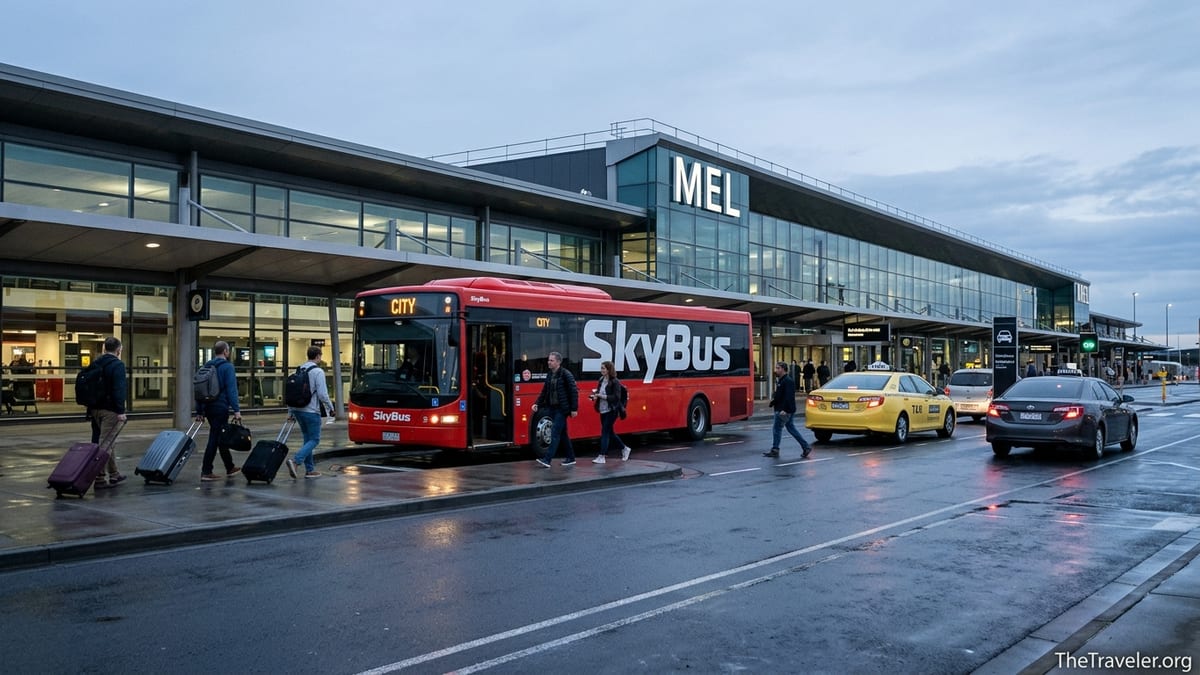
Understanding the Journey from Melbourne Airport to the CBD
Melbourne Airport, often called Tullamarine, sits around 23 kilometers northwest of the central business district. In light traffic the drive can take about 25 to 30 minutes, but in peak hour it can easily stretch beyond 40 minutes. Nearly all road routes use the Tullamarine Freeway, and most paid services will automatically include any tolls in the fare.
The majority of visitors stay in or around the CBD, Docklands, Southbank, Carlton or Fitzroy. If your hotel is near Southern Cross Station, on Spencer or Collins Street for example, SkyBus becomes very convenient because it terminates at that station. If you are staying closer to Flinders Street Station or along St Kilda Road, a taxi or rideshare that drops you at the door may be more appealing, especially late at night or with heavy bags.
There is no heavy rail link from the airport to the city as of mid 2026, despite years of discussion about an “airport rail” project. That means your choices are all road-based, and the trade-off is usually between cost and convenience. Premium options like private transfers offer door-to-door comfort, while budget options like public buses take longer and usually require changes.
For planning purposes, most visitors can expect to spend somewhere in the range of roughly 20 to 80 Australian dollars per person to reach central Melbourne, depending on travel style. Families and small groups often find that once there are three or four people, taxis or rideshares become more price-competitive with the bus services, especially when factoring in luggage and hotel transfer time.
SkyBus: Fastest Dedicated Airport Service
SkyBus is the main dedicated airport shuttle between Melbourne Airport and Southern Cross Station in the city. Buses run frequently throughout the day, typically every 10 to 15 minutes in daytime and less often in the very early morning and late at night. The journey can take around 25 to 35 minutes in normal traffic, although this varies with peak congestion on the freeway.
Tickets are priced per person, with adult one-way fares usually sitting in the moderate range for a major city airport bus. Children, seniors and families can often access discounted or bundled fares, and there are return tickets that shave a few dollars off two singles. You can buy tickets at the airport kiosks after you collect your luggage, or online before you fly. SkyBus does not require reservations for the main airport to city route, so you simply board the next bus in line.
SkyBus allows standard luggage, and you simply stow your suitcase under the coach in the luggage bays or on racks inside, depending on the vehicle. This is particularly attractive for travelers with large checked bags or odd-sized items like ski equipment, who may struggle to fit in smaller city taxis. On board you can expect basic coach-style seating, air conditioning and space to relax compared with a crowded public bus.
The main downside is that SkyBus only takes you as far as Southern Cross Station. If your hotel is on Russell Street, in Carlton near Lygon Street, or across the river in Southbank, you will still need to continue by tram, taxi, rideshare or on foot. SkyBus previously offered a connecting hotel shuttle for some CBD properties, and variants of this concept still appear periodically, but availability and coverage can change, so it is worth checking the latest details when you book.
Taxis: Easiest Door-to-Door Option
Official taxis are a familiar and straightforward option at Melbourne Airport. Ranks operate outside each terminal, and signs inside the arrivals hall guide you toward them. You simply join the queue, tell the marshal how many people are in your group and you will be directed to the next available cab, whether that is a standard sedan or a larger maxi-taxi for big groups or bulky luggage.
Taxi fares from the airport to central Melbourne are metered, with additional surcharges. There is a specific airport fee added to pickups at the terminal, and if your route uses the CityLink tollway, that toll will also be added to the meter. In practice, many visitors report paying in the ballpark of roughly 60 to 80 Australian dollars for a daytime ride to a typical CBD hotel on Bourke or Lonsdale Street, depending on traffic and exact address. Late night, public holiday or heavy congestion surcharges can push the total higher.
For travelers with two or three large suitcases, a stroller or sports gear, taxis offer the benefit of a spacious boot in standard sedans and even more room in station wagons or maxi-taxis. If you are checking into an apartment hotel in Docklands, for example, the driver can drop you right at the building entrance, so you only handle your luggage once after leaving the terminal.
The main trade-offs are cost and variability. Unlike SkyBus, where you know the fare in advance, a taxi’s meter ticks with time and distance. This can be a concern in peak hour when traffic on the Tullamarine Freeway slows to a crawl. It is wise to ask the driver for a ballpark estimate before you depart so you can compare against a rideshare quote. Also be wary of anyone approaching you inside the terminal offering a “taxi” ride; licensed cabs always wait at the official ranks outside.
Uber and Other Rideshares: Flexible for Small Groups
Rideshare services such as Uber, Didi, Ola and others operate from Melbourne Airport with designated pickup zones. For passengers arriving on Qantas, international flights or Virgin Australia, rideshare pickup is typically in a clearly signed area near the front of the main terminals. Jetstar and some regional carriers use Terminal 4, where pickup is from a multi-level transport hub connected to the terminal building. Signs reading “Rideshare” guide you to the correct lane or level.
With Uber and similar apps, you request your ride once you have collected your luggage and reached the pickup area. Pricing uses dynamic fares that can change with demand, so at 10 am on a weekday you might see a quote to central Melbourne in the range of taxi fares or slightly lower, while at 11 pm on a Saturday during a major sports event, quotes can be significantly higher. Some platforms display a fixed fare upfront, which helps with budgeting. The airport also applies a separate rideshare access fee to pickups, added on top of the app price.
For a solo traveler or couple staying in a midtown hotel near Melbourne Central station, rideshare can be a good balance of convenience and cost. Instead of transferring at Southern Cross with SkyBus and then catching a tram up Swanston Street, you ride directly from the terminal to your hotel door. Groups of three or four splitting the fare often find it comparable in total cost to individual SkyBus tickets, while gaining the benefit of door-to-door service and more privacy.
There are a few practical tips to keep in mind. Only accept rides matched through the app and avoid anyone in the terminal offering private rides, which can be unlicensed. Some recent travelers have reported confusion around “PIN pickup” systems at the airport, where riders give a code to any available driver at a designated area. If your app instructs you to use a PIN, only share it once you are in a vehicle that matches your booking details. If a driver does not move toward the pickup area or asks you to walk to a different car park, you can safely cancel and request another ride through the app.
Private Transfers and Hotel Cars: Comfort and Certainty
For those who value a seamless arrival above all else, private transfers and hotel car services provide the highest level of comfort. You pre-book a sedan, SUV or van with a company that specializes in airport transport or arrange a car through your hotel’s concierge. The driver monitors your flight, meets you in the arrivals hall or at a designated point with a sign, and escorts you and your luggage directly to the vehicle.
Pricing for private transfers varies widely based on vehicle type and inclusions. A standard sedan for two people to a CBD hotel may cost roughly double or more than a typical taxi fare, while a luxury European car or larger van for six passengers will be higher again. Some operators include tolls and waiting time in a flat rate, which can be valuable if your flight is delayed or immigration queues are long. For a family of five staying in Southbank, a pre-booked van that comfortably holds everyone and all the bags can work out as reasonable value compared with booking two separate taxis.
Private transfers also make sense for late arrivals, travelers with mobility needs, or business visitors on tight schedules. Instead of navigating the terminal to find a taxi rank, SkyBus stop or rideshare lane, you simply follow the driver. This reduces stress if you are jet-lagged or concerned about local scams. Some higher-end hotels in the CBD and Docklands maintain preferred relationships with transfer operators and can arrange door-to-door service bundled into corporate rates.
The main drawback is cost. If you are traveling light and arriving mid-afternoon, it is usually more economical to take a taxi, rideshare or SkyBus. For solo travelers and backpackers on strict budgets, private transfers are generally unnecessary. However, for honeymooners splurging on a luxury hotel near Parliament, or executives needing guaranteed Wi-Fi and workspace in the car, the premium can be justified.
Rental Cars: Best for Exploring Beyond the City
All major international and Australian rental car brands operate desks at Melbourne Airport, typically clustered near the arrivals halls or in nearby car parks. If you plan to drive the Great Ocean Road, explore wine regions like the Yarra Valley, or stay with friends in outer suburbs poorly served by public transport, picking up a hire car at the airport can be convenient.
Daily rental prices fluctuate with season, vehicle type and demand, but compact cars are often reasonably priced outside of peak holiday periods. On top of the base rate, you will need to factor in insurance extras, fuel, tolls on the Tullamarine Freeway and parking costs at your city hotel. Many CBD hotels charge substantial nightly rates for parking, which can quickly erase any perceived savings over public transport or taxis for a simple airport-to-city transfer.
Driving into central Melbourne after a long-haul flight is not for everyone. The freeway system is straightforward, but once you exit into the CBD you can encounter tram tracks, hook turns at major intersections and busy pedestrian crossings. If you are unfamiliar with left-hand driving or local road rules, it may be more relaxing to take another mode into the city and only rent a car later from a downtown depot when you are ready to head out of town.
A practical compromise is to skip the airport pickup and instead book a car from a city branch the day you plan to leave Melbourne. For example, stay two nights at a hotel near Flinders Street Station using taxis or trams to get around, then collect a rental car from a Southbank or Docklands office before driving to the Great Ocean Road. This avoids city hotel parking fees, but still gives you the freedom of a car when it matters.
Public Buses and Train Connections: Cheapest but Slowest
There is no direct public train or tram from Melbourne Airport to the CBD, but several regular bus routes connect the airport to surrounding suburbs, where you can change to trains or trams. The main orbital SmartBus route 901 runs from the airport through the northern and eastern suburbs, while local routes such as 478, 479 and others link the airport to areas like Airport West. From there, many travelers transfer to the Craigieburn or Sunbury railway lines or to tram routes that head toward the city.
Using these public buses is by far the cheapest way to travel from the airport, especially if you already intend to use Melbourne’s public transport system during your stay. Fares are paid with the state’s myki card or contactless payment methods, and a standard two-hour fare covers both the bus and your onward tram or train within the relevant zones. For example, you could ride a local bus from the airport to a nearby train station and then continue by train to Flinders Street on the same ticket, making the total cost significantly less than SkyBus or a taxi.
The flip side is time and comfort. Public buses serve local commuters and can be crowded at peak times, with limited dedicated space for large suitcases. A journey that takes 30 minutes by taxi can easily stretch to well over an hour if you are waiting for infrequent buses and then making transfers. Wayfinding is also more complex, since bus stops are located a short walk from the terminals and you need to read local timetables or use journey planner apps to find the right route.
Public buses make the most sense for budget-conscious travelers with light luggage whose accommodation is already near a train station or bus corridor served by these routes. For example, someone staying with friends in the northern suburb of Broadmeadows might use a local bus from the airport to Broadmeadows Station and then walk or catch a short connecting bus, avoiding the need to travel all the way into the CBD first.
Best Option by Hotel Area and Travel Style
Choosing the right transfer from Melbourne Airport is easier when you start with where you are staying. If your hotel is directly around Southern Cross Station, such as properties on Spencer Street or near the Docklands end of Collins Street, SkyBus is usually the most straightforward. You exit the bus at Southern Cross, walk a short distance to your hotel and avoid any further vehicles. This works especially well for solo travelers or couples arriving in daylight with rolling luggage.
If you are staying in central grid streets closer to Swanston or Elizabeth Streets, like many business hotels on Bourke or Lonsdale Streets, a taxi or rideshare often makes more sense, particularly in the evening. Instead of wheeling your suitcase several blocks from Southern Cross or learning the tram network on day one, you ride directly to the hotel entrance. For two or three people splitting the fare, the per-person cost becomes competitive with multiple SkyBus tickets.
For Southbank, including hotels along City Road and Southbank Promenade, taxis and rideshares are usually the best compromise. SkyBus to Southern Cross followed by a tram to the Arts Precinct is certainly possible, but late at night or in wet weather many visitors prefer one smooth door-to-door journey. Families with children, pushchairs and multiple bags will especially appreciate being dropped at the porte-cochere of a riverfront hotel instead of navigating tram stops.
Budget travelers staying in backpacker hostels near Queen Victoria Market, or long-stay guests in inner suburbs like Brunswick, Northcote or Footscray, might consider combining SkyBus or public buses with short tram or train rides. For instance, you could take SkyBus to Southern Cross and then jump on a free tram in the central city before transferring to a paid tram out to your suburb. Alternatively, if your accommodation sits on a direct train line from an outer suburb near the airport, you may find a local bus and train combination that gets you there cheaply, though with some extra effort.
The Takeaway
There is no single best way to travel from Melbourne Airport to the city center. The right choice depends heavily on your hotel location, budget, arrival time and how much you value convenience. SkyBus offers a reliable express link into Southern Cross Station that suits many first-time visitors staying nearby. Taxis and rideshares provide door-to-door flexibility, which becomes particularly attractive for groups, late arrivals and those with heavy luggage.
Private transfers and hotel cars unlock a stress-free arrival for those comfortable paying extra, while rental cars are best reserved for travelers planning significant driving beyond the city limits rather than as a stand-alone airport transfer. Meanwhile, public buses and train combinations remain the cheapest option for those willing to trade time and simplicity for savings.
Before you fly, it is worth checking your hotel’s exact address on a map, estimating the cost of each mode for your group size, and considering your arrival time. With a plan in mind, you can walk out of the terminal, head directly to the right rank, stop or pickup point, and start your Melbourne visit calm, organized and on budget.
FAQ
Q1. How long does it usually take to get from Melbourne Airport to the CBD?
In light traffic, the drive can be around 25 to 30 minutes, but at peak commuter times it can stretch beyond 40 minutes, regardless of whether you use taxi, rideshare or SkyBus.
Q2. Is SkyBus cheaper than a taxi for solo travelers?
For a single traveler, SkyBus is typically noticeably cheaper than a taxi for the airport to city journey, although you will still need to factor in any onward tram or short taxi fare from Southern Cross Station to your hotel.
Q3. Where do I catch Uber or other rideshares at Melbourne Airport?
Rideshares use designated pickup areas signposted as “Rideshare” near each terminal. Passengers from Qantas, international and Virgin Australia flights generally use a forecourt lane near the main terminals, while Jetstar and some regional passengers use a multi-level transport hub connected to Terminal 4.
Q4. Are taxis more reliable than rideshares at the airport?
Both taxis and rideshares are widely available, but at very busy times some travelers report longer waits and cancellations on rideshare apps. Taxi ranks usually keep moving, though queues can form after major events or during peak travel periods.
Q5. Is it safe to take public buses from Melbourne Airport with luggage?
Public buses are generally safe and used by locals every day, but they are not designed specifically for airport passengers, so space for large suitcases can be limited and journeys involve more standing, stops and transfers compared with SkyBus or taxis.
Q6. Do I need to book SkyBus tickets in advance?
You can usually just buy SkyBus tickets at the airport and board the next available bus, as the main airport to city route does not require seat reservations. However, buying online in advance can save time and occasionally secure small discounts or bundled offers.
Q7. Which option is best if my hotel is in Southbank?
For Southbank hotels, taxis and rideshares are often the most convenient because they drop you directly at the property. SkyBus to Southern Cross followed by a tram or short taxi is workable, but less comfortable if you have heavy luggage or arrive late at night.
Q8. Should I rent a car at Melbourne Airport just to reach the city?
Renting a car solely for the airport to CBD trip is rarely cost-effective once you add parking and tolls. It is better to use SkyBus, taxi or rideshare into town and only rent a car later if you plan day trips or longer drives beyond Melbourne.
Q9. How can I avoid scams when leaving Melbourne Airport?
Only use official taxi ranks, clearly marked rideshare pickup zones or pre-booked transfer services, and never accept unsolicited offers of rides inside the terminal. Always match vehicle details with your app booking before getting into a rideshare.
Q10. What is the most budget-friendly way to reach the city?
The cheapest options usually involve public buses combined with trains or trams using standard public transport fares, but for most visitors SkyBus offers a good balance of price, speed and simplicity compared with taxis or private transfers.