


More news on this day
Commercial aviation across the Middle East is entering a tentative new phase as a fragile post-war environment prompts airlines, regulators and passengers to recalibrate how they move through one of the world’s most strategically important air corridors.
Get the latest news straight to your inbox!
From Shutdowns to Selective Reopenings
Publicly available data and industry reports show that the severe airspace closures triggered by the recent Iran war and associated regional strikes have eased, but only partially. After waves of notices to air missions and conflict-zone advisories in 2024 and 2025, large sections of Gulf and Levant skies are again open to civilian traffic under tighter operational conditions.
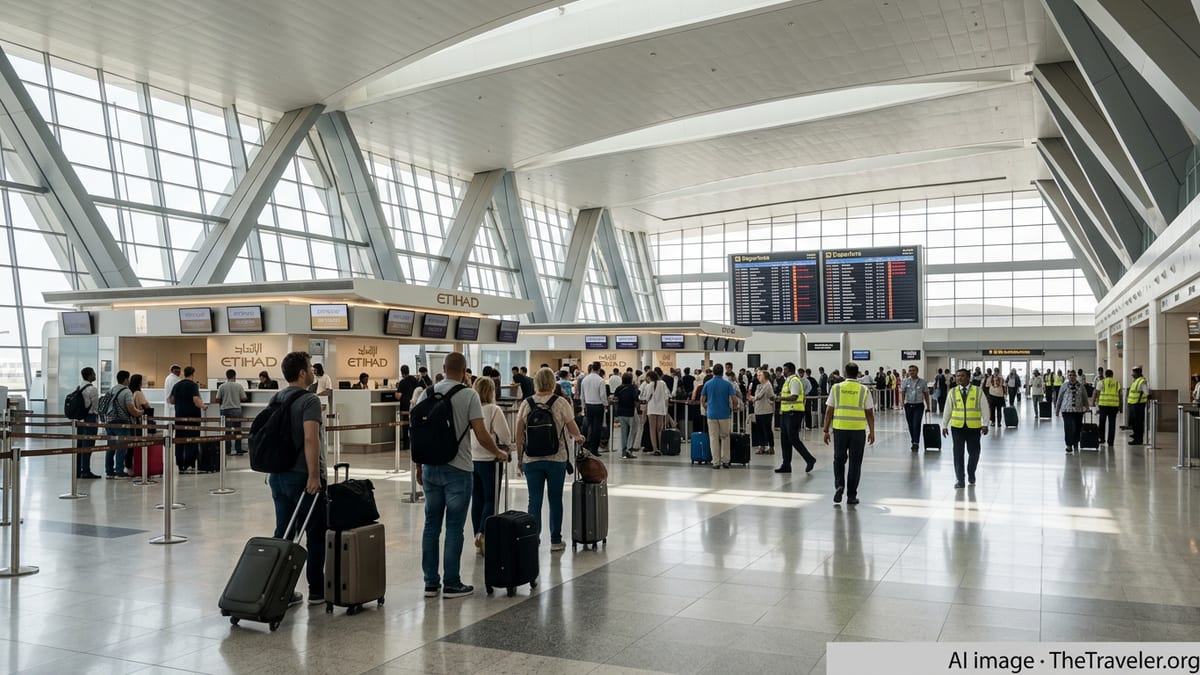
Aviation analysis indicates that by late 2025 most Gulf hubs, including those in the United Arab Emirates, Qatar, Bahrain and Kuwait, had restored a high proportion of scheduled services, even as routings avoided the most sensitive overflight areas. Traffic through these hubs has gradually recovered, underscoring their role as connective bridges between Europe, Asia and Africa.
According to recent industry assessments, the broader region remains financially fragile despite the restart. The International Air Transport Association’s latest outlook points to rising fuel costs, capacity constraints and ongoing conflict-related disruptions as factors that are expected to push Middle Eastern airlines into a collective net loss in 2026, even as global demand for air travel continues to grow.
In parallel, national aviation authorities have maintained or updated conflict-zone guidance for operators. Advisories continue to warn of residual missile, drone and GPS-interference risks over parts of the Eastern Mediterranean and Gulf, shaping flight-planning decisions even where airports and air routes are technically open.
Hub Strategies: Gulf Carriers Redraw the Map
The war and its spillover effects have forced the region’s largest network carriers to rethink how they use their hubs. Analysis of schedule filings and route maps indicates a shift toward consolidating traffic through a smaller number of secure corridors, often avoiding direct overflight of high-risk areas such as western Iran, parts of Iraq and the eastern Mediterranean coast.
Long-haul routes between Europe and Asia, historically dependent on efficient Gulf crossings, have been among the most affected. Airlines have increasingly routed flights north over Turkey and the Caspian region or south via the Arabian Sea and Red Sea, adding flight time and fuel burn. Case studies from flight-tracking and operational data suggest detours of up to several hundred nautical miles on some sectors, altering aircraft utilization patterns and connection banks at hub airports.
Gulf-based airlines appear to be using this period to rebalance their networks. Schedules show capacity being reinforced on resilient markets in South and Southeast Asia, while some marginal secondary European and African destinations remain reduced or temporarily suspended. Partnerships and alliance ties have taken on greater importance, with carriers leaning on code-share and interline agreements to maintain global coverage without re-entering all previously served points.
Freight and logistics flows have followed similar patterns. Cargo operators have reweighted volumes through safer hubs and corridors, with time-sensitive shipments shifted away from the most disrupted zones. Analysts note that while this adds cost, it also diversifies routings, making supply chains somewhat less reliant on any single stretch of Middle Eastern airspace.
Israel, Lebanon and the Eastern Mediterranean Front Line
The air travel picture remains especially complex along the Eastern Mediterranean, where hostilities involving Israel, Lebanon and non-state actors have repeatedly spilled into the air domain since 2023. Over this period, Ben Gurion Airport near Tel Aviv and Beirut–Rafic Hariri International Airport have experienced waves of cancellations and schedule reductions as airlines responded to missile attacks, border escalations and advisories from their home regulators.
In Israel, publicly released aviation updates and open data show that the main airport has generally remained operational, even through periods of intense fighting. However, international carriers have frequently pared back or temporarily halted services in response to changing security assessments and incidents such as the 2025 missile strike that damaged road infrastructure near the terminal. Local and regional airlines have often stepped in to maintain a skeletal network when foreign operators pulled back.
Lebanon’s aviation sector has been hit harder. Passenger traffic through Beirut’s airport fell sharply during the heaviest cross-border bombardments in 2024, according to tourism figures and multilateral economic monitoring. Analysts link the drop not only to direct security risks but also to travel warnings from foreign governments and the wider economic strain on Lebanon’s tourism-dependent services sector.
Recent World Bank analysis based on flight-tracking data suggests that arrivals at Beirut remain well below pre-escalation levels, even as the airport continues to function. Airlines from Europe and the Gulf cautiously reintroduced some services during lulls in fighting, but schedules have stayed thinner and more volatile than before the conflict cycle began, leaving Lebanese travelers reliant on a narrower set of options and frequent last-minute changes.
Rerouting Costs and Global Network Ripples
The war-induced disruption in Middle Eastern airspace has had consequences far beyond the region’s borders. Operational research and safety briefings describe a sustained increase in rerouting, with aircraft avoiding large swaths of airspace over Iran, Iraq, Israel and neighboring areas during peak escalation periods. Many operators have adopted more distant but lower-risk tracks as a baseline, even when restrictions are formally eased.
Independent case studies quantify the cost of these detours in additional distance, fuel and crew time. On some Europe–Asia services, rerouting around the conflict zone has added well over an hour of flight time, eating into aircraft availability and squeezing already tight schedules. Aviation consultancies highlight that these changes are cumulative, compounding with other constraints such as air traffic control bottlenecks over southeastern Europe and congestion in alternative corridors.
Industry-wide economic assessments indicate that disruption in Middle Eastern airspace has helped halve projected airline profitability relative to earlier forecasts, largely by increasing operating expenses for carriers that rely on the region’s central geography. At the same time, some Asia Pacific and Central Asian airlines have captured additional traffic by positioning themselves as alternatives on Europe–Asia flows less affected by the closures.
For passengers, the impact is visible in longer itineraries, more connections and, in some cases, higher fares on routes where detours are now baked into the timetable. Travel agents report that corporate clients in particular have updated internal policies to avoid specific waypoints or carriers on certain sectors, further reshaping demand patterns.
Ceasefire, Caution and the Next Phase of Network Planning
The latest ceasefire arrangements and de-escalation efforts have allowed airlines to roll out the first stage of a post-war rebuilding of Middle East connectivity. Reporting from regional media and aviation outlets indicates that selected carriers are reinstating flights to cities that were cut entirely during the height of the conflict, while others are upgrading seasonal or low-frequency routes back toward daily service.
Yet network planners are treating the current environment as fragile. Schedules for the second half of 2026 show a bias toward flexibility, with airlines publishing more conservative capacity and relying on short-notice equipment changes or frequency boosts when conditions permit. Many operators are also spreading risk by diversifying hubs and reducing dependence on any single conflict-exposed airway.
Regulators and multilateral aviation bodies are using this period to revisit conflict-zone risk assessments and communication practices. Analysts point to a growing emphasis on standardized advisories and clearer information-sharing among states, airlines and pilots to avoid the confusion seen during some of the fastest-moving closure episodes.
For travelers, the post-war landscape across the Middle East is likely to remain characterized by pockets of near-normal connectivity alongside corridors that continue to carry elevated risk and complexity. Industry observers suggest that while the underlying demand for travel in and through the region is strong, the new network architecture will be more conservative, with resilience and redundancy taking precedence over the absolute shortest route from A to B.