


More news on this day
Emirates is accelerating the rollout of Starlink high-speed in-flight Wi-Fi across its widebody fleet, strengthening the Dubai-based carrier’s lead in the UAE’s race to deliver free, broadband-grade internet at cruising altitude.
Get the latest news straight to your inbox!
From early deal to active high-speed service
Publicly available information shows that Emirates was among the first Gulf carriers to sign a fleetwide agreement with SpaceX’s Starlink Aviation unit, announcing plans in late 2025 to bring the satellite provider’s low-latency connectivity to all 232 Boeing 777 and Airbus A380 aircraft by the middle of 2027. The commitment was framed as a major upgrade from legacy systems that often left passengers with slow, patchy access on long-haul routes.
Reports indicate that the first commercial services began on selected Boeing 777-300ER flights from November 2025, offering complimentary access to all passengers. Industry coverage notes that Emirates opted for an aggressive installation tempo, targeting roughly a dozen 777 aircraft per month, in order to turn the high-profile announcement into visible changes on key long-haul and North American routes.
The rollout reached a new milestone in April 2026, when Emirates confirmed that its first Airbus A380 had returned to Dubai with Starlink hardware installed and certified. Aviation industry reports describe this as the first deployment of the Starlink system on the world’s largest passenger aircraft type, underscoring the carrier’s ambition to differentiate itself in the premium long-haul market.
Emirates has positioned the upgrade as part of a broader multi-year investment in cabin refurbishment, with Starlink connectivity sitting alongside new premium economy cabins and refreshed interiors. Travel and technology coverage widely interprets the Wi-Fi program as a response both to passenger expectations for seamless online access and to growing competition from other long-haul airlines adopting next-generation satellite services.
Technical leap: multi-antenna A380s and higher bandwidth
According to aviation technology analyses, Emirates’ Starlink configuration represents a significant technical step beyond earlier inflight connectivity solutions. Each retrofitted Boeing 777 is understood to carry two Starlink antennas, while the A380s have been outfitted with three antenna units, a layout that specialists say is intended to increase overall aircraft bandwidth and maintain stable coverage along complex long-haul routings.
Industry reports describing the A380 retrofit indicate that total available bandwidth on the double-decker aircraft is measured in gigabits per second, compared with the sub‑megabit capacities of some of the first-generation inflight systems the airline deployed more than a decade ago. That scale of improvement is designed to support simultaneous high-definition video streaming, cloud-based work tools, gaming and real-time messaging for hundreds of passengers on board.
Analysts following the Starlink Aviation program say the low Earth orbit constellation is central to this performance jump, reducing latency relative to traditional geostationary satellite services. For Emirates, this architecture is expected to address frequent passenger complaints about sluggish, unreliable connections on ultra-long-haul flights, particularly on polar or high-latitude segments that have historically been more challenging to cover.
Emirates has indicated that access on Starlink-equipped aircraft is free across all cabins, with a simplified, one-click login process. For the airline, the strategy effectively turns connectivity into a baseline amenity rather than a paid add-on, aligning with trends seen at several North American and European carriers that have also adopted the Starlink platform.
UAE rivals respond as connectivity becomes a battleground
The pace of Emirates’ deployment is influencing competitors in the UAE and the broader Gulf region. Shortly after Emirates announced its deal, low-cost carrier flydubai confirmed a similar agreement to equip its Boeing 737 fleet with Starlink starting in 2026. Local media reports describe plans to roll out installations across around 100 aircraft, again with an emphasis on delivering high-speed, low-latency access suitable for streaming and video calls.
For Dubai’s aviation ecosystem, the twin Emirates and flydubai programs mark a coordinated shift toward making fast onboard Wi-Fi an integral part of the city’s hub proposition. Analysts note that the two carriers share a large pool of connecting passengers and increasingly market their combined networks as a single, integrated product, which heightens the pressure to present a consistent connectivity experience regardless of aircraft type or route.
Regionally, airlines in Qatar and Saudi Arabia are also turning to Starlink for long-haul connectivity, underscoring how satellite broadband has become a new front in Gulf aviation competition. Published industry commentary suggests that Emirates’ early move on a full-fleet Starlink commitment, and its rapid transition from announcement to operational A380 service, has helped it retain a perception of technological leadership among regional rivals.
At the same time, aviation analysts caution that the competitive advantage may be time-limited. As more airlines across Europe, North America and Asia sign Starlink or rival next-generation satellite deals, the differentiation could shift from simple availability of Wi-Fi to the consistency of performance, data policies and integration with onboard entertainment platforms.
What the rollout means for passengers flying from the UAE
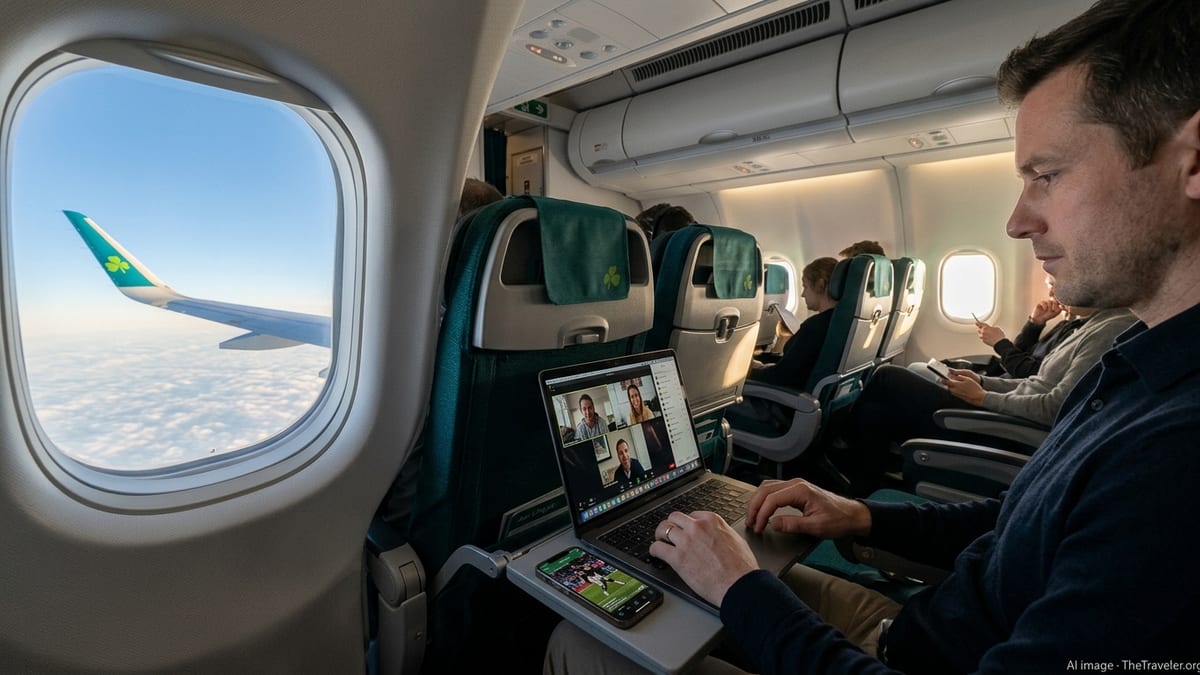
For travelers in and through the UAE, the Starlink expansion is reshaping expectations of what it means to be online at 40,000 feet. Business passengers, in particular, are likely to benefit from lower latency and higher throughput that make cloud-based productivity tools and video conferencing more viable on long sectors connecting Dubai with North America, Europe and the Asia-Pacific region.
Leisure travelers and families stand to gain from the ability to stream entertainment on personal devices without relying solely on the seatback system. Reports on early trial flights suggest that passengers are using the increased bandwidth for high-definition video, social media, messaging and online gaming, treating the cabin more like a ground-based broadband environment than a traditionally constrained in-flight network.
The offering is also expected to influence how passengers compare Emirates with other global carriers operating in and out of the UAE. As airlines increasingly promote free, high-speed Wi-Fi as a headline feature in advertising and fare bundles, analysts say connectivity could become a deciding factor for travelers weighing similar schedules and prices on competing routes.
However, industry experts note that actual passenger experience will depend on the pace of installation and the mix of equipped and unequipped aircraft over the next two years. While Emirates has begun flying Starlink-enabled A380s and 777s, a portion of the fleet still relies on older systems, meaning that travelers may see a period of transition in which inflight connectivity quality varies depending on the specific aircraft operating their flight.
A glimpse of the next phase of connected air travel
Beyond the immediate passenger benefits, Emirates’ Starlink program offers an early look at how airlines might leverage high-capacity satellite links for operational and commercial innovation. Aviation technology specialists suggest that consistent, high-bandwidth connectivity can support more dynamic cabin services, real-time aircraft health monitoring and richer data integration between cockpit, cabin and ground systems.
For the UAE, the rapid adoption of advanced inflight Wi-Fi by its flagship carrier and its low-cost partner aligns with wider national ambitions to maintain a leading role in global aviation and digital infrastructure. Commentators point out that as Dubai and Abu Dhabi airports invest in next-generation terminal facilities and biometric passenger processing, ubiquitous onboard connectivity fits into a broader narrative of seamless, end-to-end digital travel.
Looking ahead, industry watchers expect Emirates to continue fine-tuning the balance between free access and network management as more passengers discover the capabilities of Starlink-equipped flights. With data-heavy activities such as video streaming and online gaming likely to surge, how the airline manages capacity, fair use and future service tiers will be closely followed by both frequent flyers and rival carriers.
For now, the deployment of Starlink across Emirates’ widebody fleet positions the airline at the front of the inflight Wi-Fi race in the UAE, turning connectivity from a common pain point into one of its most distinctive selling points at a moment when global travelers increasingly expect to stay connected from gate to gate.