


More news on this day
Days of disruption at major UK airports following an air traffic control failure have left thousands of passengers stranded or re-routed, prompting renewed scrutiny of what travellers are legally entitled to when flights are delayed or cancelled.
Get the latest news straight to your inbox!
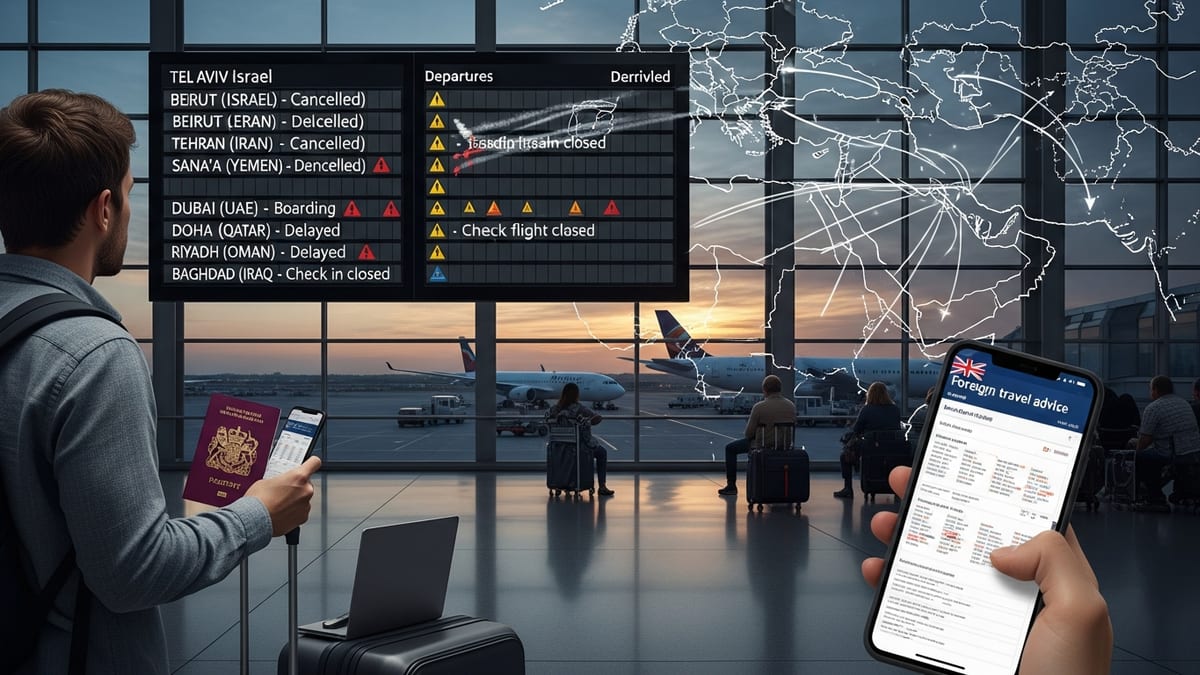
Why UK airports are facing renewed travel chaos
Recent days have seen widespread disruption across the UK aviation network after a technical problem in the air traffic control system led to the cancellation or delay of thousands of flights at airports including Heathrow, Gatwick, Manchester and Birmingham. Published coverage describes long queues, departure boards filled with cancellations and aircraft stranded out of position, creating knock-on delays well beyond the original failure.
Reports indicate that airlines are now working through a significant backlog of passengers needing new flights and overnight accommodation. With planes and crew scattered across Europe and beyond, many carriers have warned that disruption is likely to continue even after the immediate technical fault has been resolved.
The disruption has once again pushed air passenger rights into the spotlight. Since the UK’s departure from the European Union, the country has maintained its own version of the long-standing EU regime that governs payments and assistance when flights are severely delayed, cancelled or overbooked. Understanding which journeys are covered, and what airlines must provide, is critical for anyone caught up in the current chaos.
Publicly available information from the Civil Aviation Authority and consumer organisations shows that many travellers still confuse the right to practical assistance, such as meals and hotels, with the separate right to cash compensation. In large-scale incidents linked to airspace or airport problems, passengers are often entitled to one but not the other.
When UK261 applies to your disrupted flight
The main legal framework for air passenger rights in Britain is known as UK261, a retained version of EU Regulation 261/2004. Government guidance explains that UK261 applies if your flight departs from a UK airport on any airline, or if you are arriving in the UK or the European Union on a UK or EU carrier. It also covers flights from non-UK airports into the EU when operated by UK airlines.
Journeys that fall outside this scope, such as flights from a non-UK airport to a non-EU destination on a non-UK, non-EU airline, are not covered by UK261. In those cases, any rights to care or reimbursement depend on the airline’s own terms and conditions or on local laws in the country of departure.
UK261 distinguishes between three main types of problems: long delays, cancellations and denied boarding. For each, passengers can have three categories of rights. The first is a right to “care,” which means food, refreshments, communications and where necessary hotel accommodation while waiting. The second is a right to choose between a refund or re-routing if the flight no longer operates as booked. The third is a right to fixed-sum financial compensation in certain circumstances.
The rules consider not just the delay at departure but also the delay on arrival at the final ticketed destination. Court rulings cited in official guidance treat passengers who arrive more than three hours late as potentially entitled to compensation, even if the flight technically operated, provided the disruption was within the airline’s control and the other conditions of UK261 are met.
Refunds, rerouting and care: what airlines must provide
For cancellations or very long delays, UK261 gives passengers a choice between a refund of the unused parts of their ticket, a return flight to their original point of departure if the trip is no longer needed, or re-routing at the earliest opportunity. Alternatively, travellers may accept rebooking on a later date convenient to them, subject to seat availability.
Separately, airlines have what the law describes as a duty of care. If passengers are kept waiting at the airport beyond certain time thresholds, they are entitled to reasonable meals and refreshments, two free phone calls, emails or messages, and hotel accommodation with transfers when an overnight stay becomes necessary. This duty applies regardless of the cause of the disruption and is not limited by the concept of extraordinary circumstances.
In practice, carriers often provide meal vouchers or book hotels directly. Where they do not, consumer advocates advise passengers to keep receipts for essential spending and submit these for reimbursement later, as long as the costs are reasonable and proportionate. Official passenger guides emphasise that this right to care continues until travellers are transported to their final destination or receive a refund.
For those with connecting itineraries on a single ticket, the right to care and re-routing generally extends to the final destination, not just the point where the disruption occurred. Guidance from the Civil Aviation Authority notes that if a missed connection leaves a passenger stranded mid-journey, the airline responsible for the disrupted leg remains responsible for re-routing or refunding the onward travel covered by that ticket.
Cash compensation and the issue of extraordinary circumstances
Financial compensation under UK261 is separate from refunds and care. It is designed to compensate for inconvenience when the airline is responsible for a severe delay, cancellation or denied boarding. The fixed amounts vary by flight distance and range from relatively modest sums on short-haul routes to higher payments on long-haul services.
However, publicly available guidance makes clear that passengers are only entitled to this compensation if the disruption was within the airline’s control and not caused by what the law calls extraordinary circumstances. The Civil Aviation Authority explains that extraordinary circumstances are situations that could not have been avoided even if all reasonable measures had been taken. Examples can include air traffic control restrictions, airport closures, security alerts, some forms of severe weather and strikes affecting airport or air traffic staff.
When problems are linked to technical faults within the airline’s own operations, crew shortages or maintenance issues that could reasonably have been prevented, compensation is more likely to be due. Published case summaries show that disputes often arise over how airlines classify events and whether they can demonstrate that an incident was genuinely outside their control.
In the current wave of disruption, much of the chaos stems from an air traffic control technology failure rather than from issues specific to individual airlines. Consumer advice from specialist organisations has stressed that while travellers should still receive care and re-routing, they may not qualify for UK261 compensation if the cause is confirmed as an extraordinary circumstance.
How to pursue a claim or complaint after disruption
Passengers who believe they are owed a refund, care costs or compensation are generally advised to contact the airline in writing as a first step, setting out the flight details, the nature of the disruption and what they are claiming under UK261. Many carriers provide standard online forms for disruption claims.
Guidance from consumer bodies suggests attaching boarding passes, booking confirmations and receipts for food, accommodation and alternative transport. Travellers are also encouraged to keep records of any notifications received from the airline about the reason for the delay or cancellation, as this can be important if the carrier later argues that extraordinary circumstances applied.
If a claim is rejected or not answered within a reasonable timeframe, passengers can escalate the matter. Publicly available information points to two main pathways: alternative dispute resolution schemes, where available, or a complaint to the Civil Aviation Authority if the airline is not signed up to such a scheme. In some cases, travellers may ultimately choose to pursue their claim through the courts.
Separate from UK261, many travellers hold travel insurance policies that may cover additional losses such as missed connections, non-refundable accommodation or alternative transport costs. Industry analysis notes that insurers will often expect passengers to exhaust their rights with the airline first, but policies that include disruption or abandonment cover can provide an additional safety net where UK261 rights are limited or do not apply.