


More news on this day
Flight disruption across the Middle East intensified in early September 2026, with new data showing 1,617 delays and 71 cancellations in a single day, as Istanbul and Cairo emerged among the hardest-hit hubs in an already fragile regional aviation network.
Get the latest news straight to your inbox!
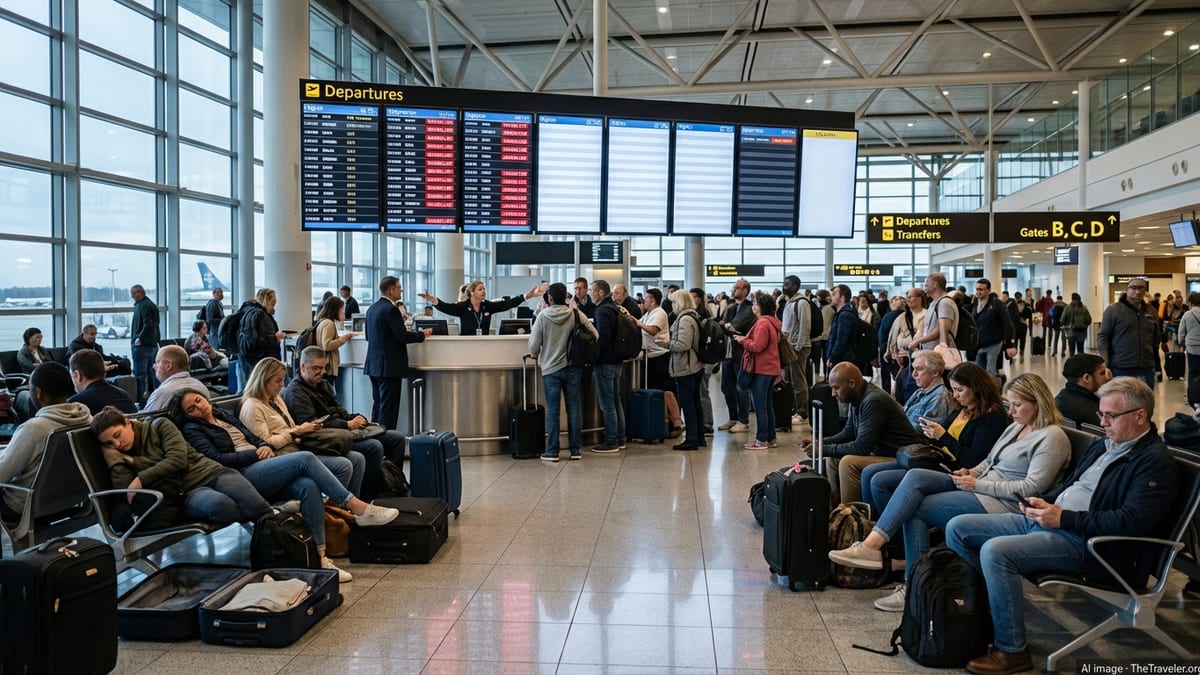
New Wave of Disruptions Centers on Regional Transit Hubs
Publicly available disruption trackers and travel advisories indicate that on 3 September 2026, network bottlenecks linked to continuing Middle East airspace restrictions generated 1,617 delayed flights and 71 outright cancellations across major hubs in the region. While Dubai recorded the single largest concentration of disrupted services, Istanbul and Cairo also featured prominently in the statistics, underscoring how strain is spreading beyond the Gulf’s traditional super-connectors.
One widely cited disruption overview attributes the surge to a combination of ongoing conflict-related airspace closures, enforced rerouting around Iran and Iraq, and localized weather fronts that exacerbated already tight scheduling margins. Aviation monitoring data compiled for that period shows that delays and cancellations were clustered around transit-heavy airports, including Istanbul Airport and Cairo International, which serve as primary gateways between Europe, Africa, and Asia.
The latest figures arrive against the backdrop of a broader Middle East aviation crisis that has been developing since late February 2026, when conflict in and around Iran triggered sweeping airspace restrictions and damage at key Gulf hubs. Industry assessments from international aviation bodies describe the region as the only major market expected to post collective airline losses in 2026, with the crisis now increasingly described as structural rather than temporary.
Istanbul’s Dual Role as Shock Absorber and Pressure Point
Istanbul has repeatedly surfaced in disruption tallies during 2026, reflecting its position as both a beneficiary and a victim of the crisis. With parts of Gulf airspace intermittently offline and some airports facing reduced capacity, long-haul itineraries between Europe and Asia have been re-routed through Türkiye, pushing additional passenger volumes and aircraft movements into Istanbul’s two main airports.
Coverage of regional delay waves in late August and early September notes that Istanbul Airport remained technically open, with airlines continuing to operate dense schedules into Europe, East Asia, and Africa. However, the same reports highlight that even modest upstream turbulence in Middle East routings can quickly cascade into Istanbul’s operations, driving up late departures and missed connections as aircraft arrive out of sequence or with extended flight times due to detours.
Separate analyses of March and summer 2026 traffic patterns show that Turkey’s airspace, and Istanbul in particular, absorbed a sharp swing in flows after the onset of the conflict. Historical data from European network monitors had already identified Istanbul as Europe’s most connected airport to Middle East destinations in terms of daily frequencies prior to the crisis. As restrictions tightened, that connectivity became a source of vulnerability, with any closure or military advisory to the south and east adding complexity to flight planning and increasing the risk of rolling delays.
Cairo’s Growing Exposure as Africa–Europe Connector
Cairo International Airport has also moved closer to the center of the disruption map as airlines look for alternatives to suspended or reduced operations at some Gulf hubs. Industry economic outlooks and route-mapping studies during 2026 have pointed to Egypt as one of the key diversion states keeping its airspace open, enabling rerouted flows between Africa, the Middle East, and Europe.
Published overviews of recent disruption episodes list Cairo among airports experiencing elevated delay and cancellation rates during peak crisis days, grouped alongside Istanbul, Kuwait, and selected Saudi Arabian hubs. The combination of heavy transfer traffic, rising demand from African markets, and the need to accommodate aircraft diverted from traditional Gulf stopovers has increased operational pressure, particularly in banked departure waves.
While Egypt’s main gateway has so far avoided the outright shutdowns or physical damage reported at some Gulf airports earlier in the conflict, the infrastructure is operating under tight margins. Travel advisories and logistics bulletins caution that irregular operations in surrounding airspace can translate into extended ground times, missed slot windows, and knock-on disruption to regional feeders connecting through Cairo.
From Short-Term Shock to Structural Crisis
Economic and industry forecasts published in mid-2026 describe the current situation as a turning point for Middle East aviation. Analysis released by the International Air Transport Association notes that disruptions and high fuel prices have effectively halved expected industry profitability, with the Middle East singled out as the only global region projected to remain in net loss territory for the year.
Complementary briefings on the global traffic impact of the Iran war emphasize that the closure of multiple Middle East airspaces has cut off or severely constrained key flight corridors between Europe, Africa, and Asia. Airlines have been forced to adopt longer routings, fly with heavier fuel loads, and adjust schedules at short notice. Some carriers have also redeployed widebody aircraft away from the region or parked capacity, which reduces the number of spare aircraft and crews available to recover from disruption when things go wrong.
These operational and financial pressures are reflected in traffic data and delay statistics. Regional airport associations report that passenger numbers at major Middle East hubs were more than halved during the worst months of March and April 2026 compared with pre-crisis expectations, while fares on surviving routes have climbed significantly. For travelers, the immediate manifestation is a higher risk of missed connections, sudden cancellations, and longer journey times, particularly on routes that would normally overfly Iran, Iraq, or adjacent conflict zones.
What the Numbers Mean for Travelers Moving Through Istanbul and Cairo
The tally of 1,617 delays and 71 cancellations in the latest disruption spike highlights the extent to which the crisis now affects travelers far beyond the immediate conflict area. Istanbul and Cairo are both heavily used as connecting points for itineraries linking Europe with East Africa, South Asia, and Southeast Asia. When regional airspace restrictions force aircraft to divert, the resulting schedule strain frequently manifests at these hubs.
Travel-focused briefings recommend that passengers connecting through Istanbul or Cairo during this period build in additional buffer time for onward flights, pay close attention to airline app notifications, and consider routings that avoid tight same-day connections if their journey crosses multiple Middle East flight information regions. Publicly available data from delay trackers indicates that even when airports remain operational, waves of late arrivals can create short-term congestion at immigration, security, and baggage reclaim, particularly during overnight peaks.
For airlines, the pattern of recurring disruption is prompting renewed scrutiny of schedules, crew positioning, and spare aircraft allocation on routes touching Istanbul and Cairo. Industry observers note that carriers with diversified networks and multiple long-haul hubs are marginally better placed to shift capacity away from volatile corridors. However, for travelers whose most practical option remains a connection through these cities, the Middle East aviation crisis of 2026 continues to translate into an elevated likelihood of last-minute changes, longer travel days, and an uncertain timeline for a full return to normal operations.
Sources: Nomad Lawyer – Middle East Aviation Disruption Alert; Nomad Lawyer – Middle East Aviation Crisis 2026; IATA – Middle East Disruptions and High Fuel Prices; EUROCONTROL – Aviation Trends 2026; AirHelp – Middle East Airspace Restrictions