


More news on this day
Rapid shifts in the Middle East crisis continue to influence security, travel and economic conditions across the region, with several developments carrying particular relevance for residents in the United Arab Emirates.
Get the latest news straight to your inbox!
1. Ongoing Gaza violence despite previous ceasefire efforts
Publicly available reporting indicates that Israeli strikes on Gaza have continued despite earlier ceasefire arrangements with Hamas, with Palestinian casualties still being recorded in recent days. Figures cited by Gaza health authorities suggest that more than a thousand Palestinians have been killed since a previous ceasefire was announced, highlighting that the conflict remains active rather than fully frozen.
For UAE residents, this means the humanitarian and security situation in the Palestinian territories remains fragile. Regional demonstrations, diplomatic tensions and calls for boycotts can flare quickly in response to new incidents reported from Gaza, which in turn may affect regional sentiment, consular messaging and the tone of international coverage of the Gulf.
Residents with family or business links to the Palestinian territories continue to face disruptions to movement in and out of Gaza and parts of the West Bank. Travel into conflict-affected zones remains highly constrained, and itineraries that connect via neighboring states can still be altered at short notice when violence escalates.
While no direct security impact is currently indicated inside the UAE, the continuation of violence underscores the need for residents to monitor official announcements from UAE authorities and their home-country embassies regarding regional security trends.
2. Rising tension around Iran and the Strait of Hormuz
Reports from regional outlets describe intense diplomatic efforts aimed at reducing tensions around Iran, with negotiations involving international powers over both the wider war and access to key waterways. Recent coverage notes that Iranian officials view the latest responses from Western governments as insufficient, suggesting that a comprehensive political settlement remains elusive.
At the same time, individual security incidents at sea continue to be reported. In one recent case highlighted by international news agencies, an Iran-linked mine explosion was reported to have sunk a commercial vessel transiting near the Strait of Hormuz. While details are still emerging, such incidents reinforce the vulnerability of shipping lanes that are critical for Gulf energy exports.
For UAE residents, heightened risk around the Strait matters because it is a primary artery for crude oil and refined products leaving the region. Any prolonged disruption could influence global energy prices and, over time, the cost of fuel, airfares and imported goods in local markets.
Shipping and logistics companies operating out of Jebel Ali and other UAE ports may adjust insurance coverage, preferred routes or cargo surcharges in response to evolving maritime risk assessments. This can affect delivery times for consumer goods and industrial materials that pass through UAE hubs.
3. Houthi attacks increase pressure on Saudi Arabia and airspace
Recent reporting documents an escalation in attacks by Yemen’s Houthi movement targeting infrastructure in Saudi Arabia, including repeated strikes against a major Saudi international airport located hundreds of kilometres from the Yemeni border. These incidents display the group’s growing long-range capabilities and add a further layer of complexity to regional airspace management.
Air navigation advisories referenced in aviation industry bulletins indicate that parts of Saudi airspace, as well as areas over Yemen and along key Red Sea corridors, are now subject to more restrictive guidance for civilian operators. Several Gulf and international airlines continue to build in additional diversions and buffers when planning routes through the western Arabian Peninsula.
For UAE residents, the primary consequence is potential disruption or elongation of flights that cross Saudi territory on the way to Europe or Africa. While UAE airports remain fully operational, some routings may take longer than they did before the latest round of tensions, and last-minute changes to flight paths are possible when new security advisories are issued.
Travellers planning holiday or business trips that rely on tight connections through regional hubs should allow more buffer time between flights and check booking details repeatedly in the 24 hours before departure, as operators may retime services to accommodate rerouted traffic.
4. Airline suspensions and complex rerouting through the Gulf
The aviation sector continues to adjust to the crisis, with several international airlines maintaining suspensions or reductions on routes into parts of the Middle East. Published timetables and public statements show that some European and Asian carriers have extended earlier cancellations of services to Riyadh and Dubai into October and, in some cases, through the upcoming winter season.
Travel industry analysis notes that while Gulf carriers based in the UAE, Qatar and elsewhere are largely continuing operations, many long-haul flights between Europe and Asia now avoid Iranian and Iraqi airspace. Operators are favouring southern corridors over Egypt, Saudi Arabia, Oman and the UAE, or northern tracks via Turkey and the Caucasus, in line with guidance from European aviation regulators.
Sector briefings indicate that Kuwait’s airspace currently remains closed to most overflights, removing a central corridor and concentrating traffic along fewer available routes. This can lead to congestion in neighbouring flight information regions and contribute to schedule padding, with some journeys between Europe and Asia extended by an hour or more compared with pre-crisis timings.
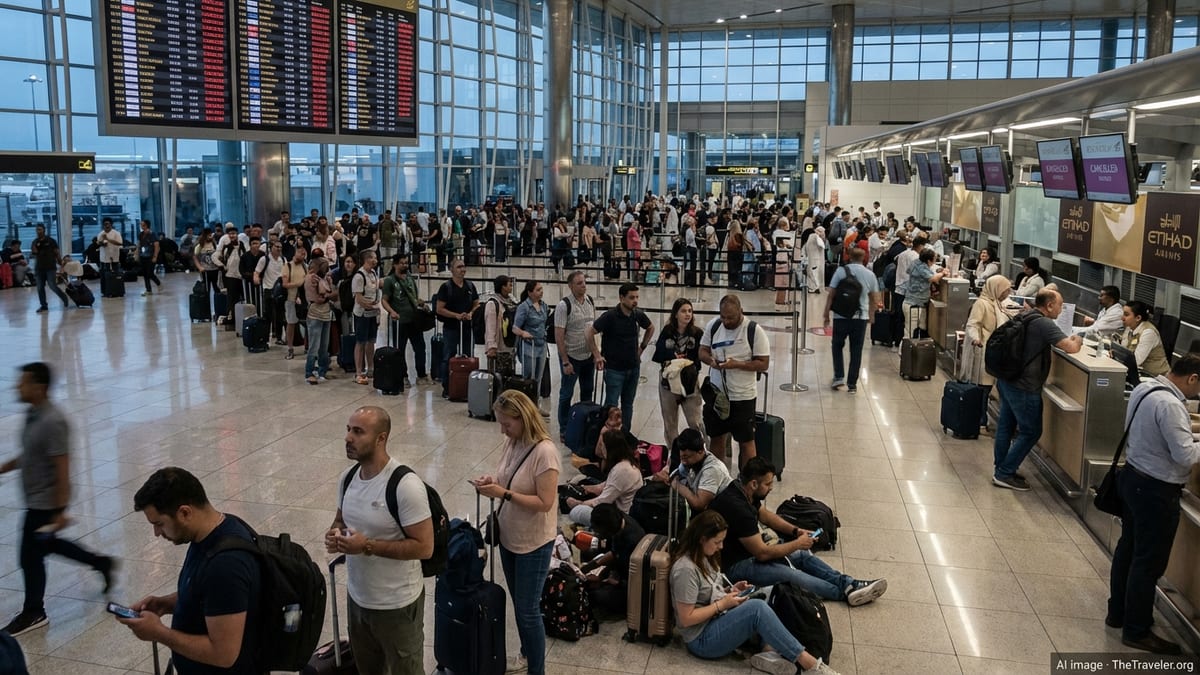
For UAE residents, the practical impact is that direct flights into and out of Dubai and Abu Dhabi may experience longer flight times, minor timing shifts or occasional cancellations by foreign carriers even if the airports themselves remain open. Passengers are advised by airlines and travel platforms to reconfirm departure times shortly before heading to the airport and to keep contact details updated so that carriers can share any last-minute changes.
5. Oil prices, household costs and currency considerations
Economic coverage of the crisis highlights a steady impact on global oil markets, with interruptions and perceived risks around Middle Eastern supply contributing to higher fuel costs. Analysts note that motorists and airline passengers are among the first to feel these pressures, as airlines grapple with higher jet fuel prices and adjust fares and surcharges accordingly.
UAE residents may see the effects in several ways. Air ticket prices on popular outbound routes can climb when airlines introduce temporary fuel surcharges or restrict lower promotional fare buckets. Logistics costs built into the price of imported groceries, electronics and other consumer goods can also rise if elevated fuel prices persist for several months.
Financial reporting points to uneven but cumulative impacts on household budgets, especially for families that travel frequently or rely on imported products. While the UAE dirham’s long-standing peg to the US dollar contributes to currency stability, residents who earn in other currencies or hold savings abroad may find that exchange-rate movements linked to global risk sentiment affect the real cost of remittances or overseas tuition payments.
Those planning major expenses denominated in foreign currencies, such as international study or property purchases, may benefit from monitoring both energy market developments and central bank commentary, as sustained tension in the region can influence broader global interest-rate and currency trends.
6. Diplomatic moves in Lebanon and broader regional realignments
Even as conflict persists in some areas, other parts of the region are seeing intensified diplomacy. Recent meetings in Beirut, covered by regional and international media, highlight new economic support pledges for Lebanon, including commitments by Qatar aimed at shoring up the country’s struggling power grid and southern reconstruction efforts.
These initiatives reflect a wider pattern of Gulf engagement in fragile neighbouring states, both to stabilise local economies and to reduce the risk that political or security vacuums spill over into the wider region. For the UAE, which has its own portfolio of aid and investment initiatives, such moves form part of an evolving map of alliances and rivalries shaped by the current crisis.
For residents, the immediate effect is less about direct security risk and more about understanding how shifting regional alignments can influence future business opportunities, tourism flows and labour markets. A more stable Lebanon, for example, could eventually revive demand for Gulf investment and professional services, while also reopening tourism and education links that many expatriates in the UAE value.
Because the diplomatic landscape is changing quickly, UAE residents with professional or personal exposure to neighbouring states are well served by following multiple reputable news sources. Official travel advisories from home governments and regional organisations should be checked regularly, as they consolidate insights from open reporting, risk assessments and consular experience into practical guidance for travellers.