


More news on this day
As international tourism returns to and in many places surpasses pre-pandemic levels, crime statistics and safety rankings are offering a sharper view of what visitors really face in some of the world’s most popular destinations.
Get the latest news straight to your inbox!
A Travel Boom Meets Uneven Safety Records
United Nations tourism figures indicate that international travel effectively recovered in 2024, with an estimated 1.4 billion international tourists recorded worldwide and overall arrivals reaching roughly 99 percent of pre-pandemic levels. Publicly available summaries of the UN World Tourism Organization’s barometer show that many established destinations in Europe, the Americas and the Middle East have already exceeded 2019 arrival numbers, underscoring how quickly demand has returned.
This surge is not evenly matched by improvements in public security. Global crime databases and national statistics offices still report significant disparities between cities and regions, even within the same country. While some nations have seen long-term declines in violent crime, tourism growth has in some cases outpaced investments in local policing, transport security and urban management, particularly in neighborhoods that attract large numbers of visitors.
Analysts note that crime trends are also shifting in composition rather than simply rising or falling. In several major urban tourism hubs, overall violent crime has remained stable or decreased, but opportunistic property offenses such as pickpocketing, bag snatching and short-term rental break-ins have become more common in the areas that travelers frequent most. This divergence between national averages and street-level experience means headline crime rates often fail to capture what tourists are most likely to encounter.
These dynamics place a renewed focus on how travelers interpret crime data and official advisories. Publicly available dashboards from organizations such as the UN tourism system, national statistics agencies and law-enforcement portals now provide more granular data than before, but they also require travelers to distinguish between risks that affect residents on a daily basis and those that typically touch visitors in specific districts or situations.
What National Crime Data Reveals about Visitor Risk
In the United States, federal crime compilations from the FBI’s Uniform Crime Reporting system show that, over the longer term, reported crime has followed a downward trend since the early 1990s, despite short-lived spikes in certain years. Recent releases covering 2024 crime submissions from more than 16,000 agencies confirm that many categories of violent and property crime remain below levels seen a decade ago, even as tourism-heavy cities receive millions of domestic and international visitors annually.
However, details buried in those same datasets and accompanying city-level breakdowns highlight a wide spread between individual urban areas. Lists comparing large U.S. cities by crime rate reveal that some destinations popular with visitors record substantially higher rates of reported violent crime and property offenses than the national average. Many of these incidents occur in neighborhoods far from convention centers, waterfronts and historic cores, but public-safety advocates advise that visitors review local statistics and police maps before assuming that a countrywide decline guarantees safety in every district.
Outside the United States, compilations of city homicide rates and national reporting to multilateral bodies show that a cluster of destinations in Latin America, the Caribbean and parts of Africa continue to experience elevated levels of lethal violence. In several coastal cities that serve as gateways to beaches and resort corridors, overall homicide rates driven by organized crime coexist with secured hotel zones, private transport and tourist police patrols. Crime against visitors in these enclaves often centers on robberies, fraud and vehicle-related theft rather than the gang-related murders that shape national statistics.
Experts in tourism security caution that travelers sometimes misread crime tables that are not designed with visitors in mind. National indicators typically aggregate offenses affecting residents, businesses and transient visitors alike, while tourism ministries and municipal observatories may produce separate reports focusing on incidents reported in hotels, attractions and transport hubs. When those sector-specific studies are available, they can offer a more realistic baseline for the types of risks that short-stay visitors are likely to confront.
Tourist Hotspots under Scrutiny: Pickpocketing, Scams and Urban Crowds
In Europe and parts of Asia, recent rankings compiled from traveler reviews and police reports place a familiar roster of major cities among the world’s hotspots for pickpocketing and petty theft. One widely cited analysis of online reviews flagged Rome and Barcelona near the top of destinations where visitors most frequently mentioned theft, reflecting both the huge volume of tourists and a measurable increase in recorded pickpocketing in recent years. In some of these cities, local crime statistics show double-digit percentage growth in reported nonviolent theft since 2019, even as other categories have stabilized.
Crowded historic centers, public transport systems and major attractions appear prominently in such assessments. Reports describe incidents of distraction theft around famous plazas, bag snatching on metro lines that link airports to downtown areas, and scams involving unofficial ticket sellers near museums or monument queues. Tourism boards and city governments have responded in various ways, from deploying more uniformed patrols around key sites to trialing public-awareness campaigns that remind visitors to wear bags across the body and keep phones out of back pockets.
Similar dynamics have been observed in long-haul destinations in Southeast Asia and North America that draw large numbers of first-time international travelers. Research that combines visitor surveys with crime statistics points to concentrations of card fraud, unlicensed taxi operations and overcharging in nightlife districts and entertainment corridors. In some resort cities, authorities and tourism operators have publicized efforts to license guides, regulate short-term rentals and expand CCTV coverage in beachfront areas after periods of rising reports of theft from hotel rooms and parked vehicles near popular beaches.
Observers stress that while these issues often dominate travel forums and headlines, they do not necessarily translate to a general breakdown in safety. The sheer number of visitors circulating in a compact urban area multiplies the opportunities for petty theft, and a spike in reports can sometimes reflect more active policing or easier online reporting rather than an entirely new crime wave. For travelers comparing destinations, understanding whether recent changes reflect improved detection or a genuine surge in offending can be as important as the headline figures themselves.
From Travel Advisories to Street-Level Decisions
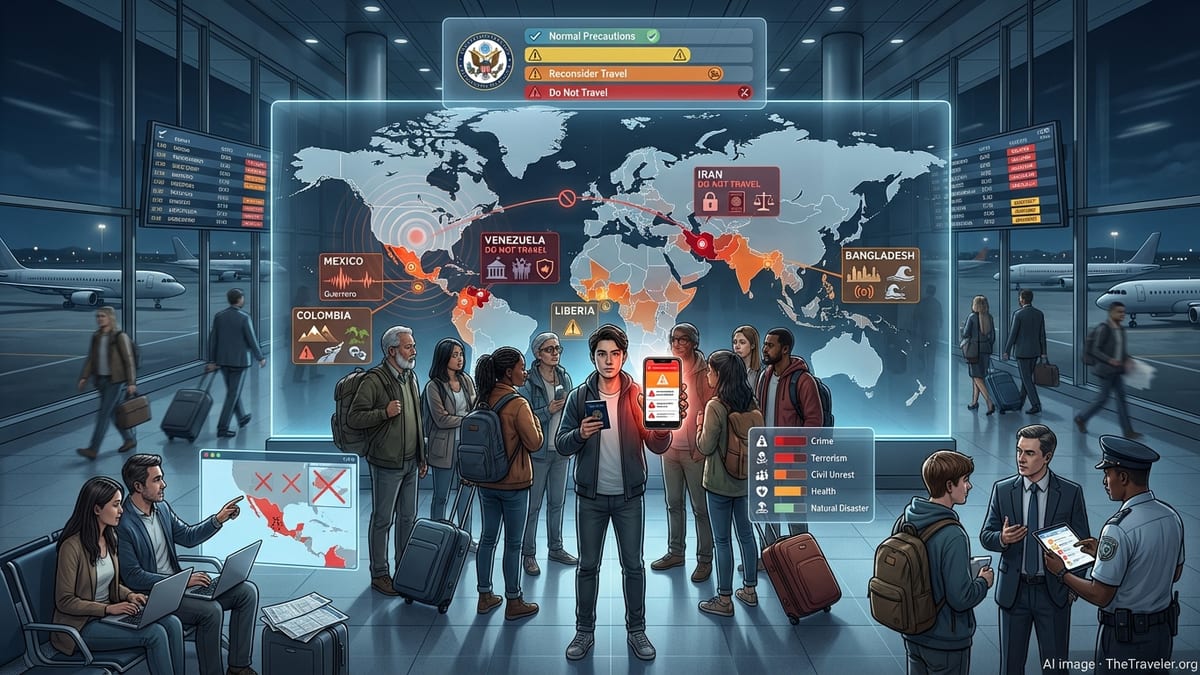
One of the most visible tools shaping traveler perceptions is the travel advisory system operated by national foreign ministries. The United States, for example, assigns countries a four-level scale ranging from normal precautions to “do not travel,” with crime listed as one of several standardized risk indicators alongside factors such as terrorism, civil unrest and wrongful detention. Public documents released to legislators explain that these advisories are based on a combination of crime data, incident reports involving citizens abroad and host-country conditions, and are updated when risk assessments change.
Country-specific advisories for tourism-dependent nations in the Caribbean and Latin America illustrate how crime data is translated into practical guidance. Some island states currently appear under “exercise increased caution” levels, with text warning of armed robberies, burglaries and sexual assaults in both tourist and non-tourist areas. For larger countries, the advisory may differentiate between states or regions, recommending that visitors avoid specific areas while noting that resort zones maintain a significant security presence. This geographic nuance reflects the fact that national crime averages can obscure relatively well-controlled enclaves built around tourism.
Beyond the United States, other governments publish their own graded systems and narrative assessments, sometimes leading to differing conclusions about the same destination. Comparative studies by academic researchers and security consultants highlight that these advisories, while not statistically identical, tend to converge on a small group of locations where violent crime, kidnapping or unrest present clearly elevated risks. In those environments, tourists are more likely to encounter armed escorts, restricted movement recommendations and warnings against using certain forms of public transport.
For travelers, the practical takeaway from these advisory systems is less about avoiding entire countries and more about aligning itineraries and behavior with specific, documented risks. Reading the full text of an advisory, consulting publicly available crime dashboards or tourism observatories where they exist, and cross-checking against local news coverage can help separate persistent structural problems from short-term spikes or sensational incidents.
How Travelers Can Read the Numbers Without Losing Perspective
Publicly accessible tourism and crime data now offer more detail than at any time in the past, but specialists caution against interpreting them in isolation. A high national homicide rate driven by organized crime does not automatically mean that visitors are likely to be targeted, just as a seemingly safe country ranking can mask well-known pickpocketing hotspots in one or two cities. Understanding the type of crimes most prevalent in the areas visitors actually use is crucial to turning statistics into practical street smarts.
Travel risk analysts often advise focusing on a few concrete indicators: recent trends in robbery and assault near transport hubs and nightlife districts, reports of scams targeting foreigners, and any documented increase in violence linked to political unrest or organized crime in regions that tourists frequent. When this information is combined with knowledge about local transport options, accommodation choices and seasonal crowding patterns, travelers can make more informed decisions about when and where to take extra precautions.
At the same time, crime data alone does not capture the full picture of a destination’s resilience. Initiatives such as tourism safety training programs, the deployment of dedicated tourist police units and investments in better lighting, surveillance and crowd management around major attractions all influence real-world risk. White papers and workshops led by tourism bodies over the past few years have emphasized crisis communication and standardized safety protocols as key pillars of keeping destinations attractive and secure as visitor numbers climb.
For now, the numbers suggest that global tourism is entering a period of strong demand combined with more visible, data-driven scrutiny of safety. For travelers, that means learning to read beyond the headline crime rate, pay attention to neighborhood-level information and align their expectations with what local statistics and advisories actually show about the streets they plan to walk.