


More news on this day
Air travel across the Gulf faced another wave of disruption on 14 May 2026, as publicly available operational data indicated 263 flight delays and 32 cancellations across key hubs in the United Arab Emirates, Saudi Arabia and Kuwait, affecting services by FlyDubai, Air Arabia, Saudia and other regional and international airlines.
Get the latest news straight to your inbox!
UAE Hubs Struggle With Rolling Disruptions
Dubai International Airport and Sharjah International Airport again ranked among the most affected airports in the region, with reports indicating more than one hundred delayed departures and arrivals and a cluster of outright cancellations concentrated in a few peak operating banks. Operational summaries for 14 May point to at least 113 delays and 15 cancellations across the two UAE hubs alone, underscoring how sensitive tightly timed hub schedules remain to regional airspace and weather pressures.
FlyDubai and Air Arabia, the main low cost carriers for Dubai and Sharjah respectively, feature prominently in the latest disruption tallies. Public tracking platforms show a succession of late departures on popular regional routes linking Dubai and Sharjah to Jeddah, Riyadh, Cairo, Mumbai and other high demand cities. Several flights were held on the ground for extended periods, while others were rerouted or trimmed from the schedule altogether as airlines sought to recover operational flow.
The new delays add to a pattern that has been building since April, when a combination of heavy rain, localised flooding around airport access roads and intermittent airspace constraints over parts of the Middle East first began to squeeze capacity. Coverage in recent weeks describes how even moderate weather or routing changes can quickly overload gate and runway availability at large transfer hubs, making knock on delays increasingly difficult to absorb.
While Dubai International continues to operate all terminals, airlines are maintaining more conservative schedules than before the recent turbulence, with some long haul services still operating at reduced frequency. Travel industry briefings suggest carriers are prioritising network stability over aggressive growth, accepting short term disruption in order to avoid more severe schedule breakdowns later in the peak summer period.
Saudi Gateways in Riyadh and Jeddah Face Continued Strain
In Saudi Arabia, Riyadh and Jeddah have also been drawn into the latest wave of delays and cancellations as regional traffic flows are adjusted. Saudia, the kingdom’s flag carrier, has been rebuilding its network to Dubai, Abu Dhabi and Amman after earlier suspensions linked to regional tensions, but publicly available information shows that services remain vulnerable to sudden changes in airspace availability.
Operational data for mid April showed Saudi airports coping with a surge in late running flights as airlines reworked routings around sensitive areas, adding flying time and complicating aircraft rotations. The new figures for 14 May, with a share of the 263 regional delays and 32 cancellations touching Riyadh and Jeddah, indicate that those pressures have not fully eased despite the partial restoration of cross border schedules.
Saudi based passengers have reported last minute timetable changes on routes to the UAE and Kuwait, with some services brought forward or pushed back by several hours and others removed from booking systems entirely. The resulting uncertainty has created additional stress for travellers connecting onward from Riyadh or Jeddah, particularly those relying on tight transfer windows to reach long haul departures to Europe, North America and Asia.
Industry analysis suggests that Saudi airports are acting as important pressure valves for the wider region, taking on diverted flights when neighbouring hubs experience temporary closures or significant constraints. This role can amplify local disruption when multiple diversions coincide with already busy departure banks, leading to congested terminals and stretched ground handling resources even when weather in Saudi Arabia itself is stable.
Kuwait City Rebuilds Capacity After Earlier Shocks
Kuwait International Airport is navigating the latest disruptions only weeks after a staged reopening of its airspace and facilities. Previous security related incidents and temporary closures forced airlines to suspend or sharply curtail operations to Kuwait City, with traffic resuming gradually from late April under a phased plan that prioritised key regional links to Dubai, Jeddah, Riyadh and selected Asian destinations.
As of mid May, Kuwait Airways, Jazeera Airways and other operators are still running a constrained timetable, and the fresh tally of delays and cancellations highlights how fragile that recovery remains. Publicly accessible schedule data indicates that a number of Kuwait City flights within the count of 263 delays have been forced into extended holding patterns or retimed departures as carriers align with evolving airspace permissions and slot availability across the Gulf.
Reports from passenger forums describe higher fares and tighter operating windows on some Kuwait routes, reflecting both limited capacity and continued caution among airlines. With many travellers still rebooking itineraries that were cancelled during the earlier suspension period, even modest new disruption can have outsized effects, filling alternative services quickly and leaving fewer same day options.
Analysts note that Kuwait’s role as both an origin and connecting point for South Asian and Middle Eastern traffic adds complexity, as delays on inbound flights can cascade into missed onward connections. This is particularly evident on itineraries linking Kuwait City with Dubai or Riyadh for long haul departures, where schedule slack is already limited.
Passengers Face Crowded Terminals and Complex Rebookings
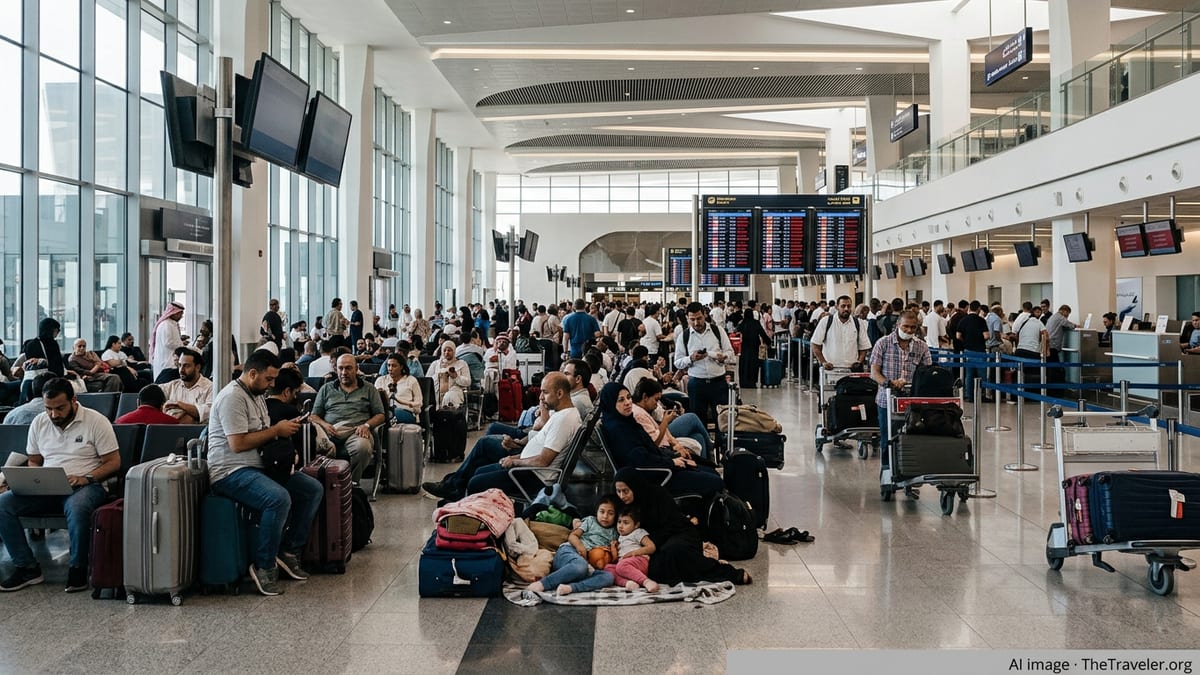
The cumulative effect of 263 delays and 32 cancellations across the UAE, Saudi Arabia and Kuwait has been most visible in crowded terminal concourses and lengthening customer service queues. Photographs and social updates over the past 24 hours show passengers waiting at departure gates in Dubai, Sharjah, Riyadh, Jeddah and Kuwait City as airlines work through rebooking lists and dispatch late running flights.
Travel rights organisations point out that the distinction between a delayed and cancelled flight is critical for passengers seeking compensation or refunds, especially on itineraries touching European or United Kingdom airports that are covered by specific consumer protection regimes. Guidance published in recent weeks stresses the importance of keeping boarding passes, booking confirmations and written notices of disruption, as documentation can determine what level of reimbursement is available.
At the same time, airlines are encouraging travellers to use mobile apps and official websites to track real time flight status, modify bookings and select alternative routings where possible. Publicly available information from carriers and airports indicates that many same day changes are now processed digitally, reducing the need to queue at physical desks but also placing a premium on travellers having reliable internet access and familiarity with self service tools.
For those already in the air when disruptions develop, rerouting can mean unscheduled diversions to secondary airports or extended time in holding patterns while destination capacity is reassessed. This has knock on effects for crew duty limits and aircraft utilisation, sometimes resulting in an aircraft being withdrawn from later rotations and creating additional downstream delays on unrelated routes.
What the Latest Figures Signal for Summer Travel
The latest snapshot of 263 delays and 32 cancellations across the three Gulf states adds to a growing body of data suggesting that Middle East air travel may remain vulnerable to sudden disruption through the early summer months. Weather patterns, regional security developments and the complex web of overflight agreements all have the potential to alter planned routings with little notice, particularly for airlines operating dense connecting banks through Dubai, Sharjah, Riyadh, Jeddah and Kuwait City.
Industry briefings circulated in recent days emphasise that many carriers are building additional buffer time into schedules and strategically reducing frequencies on select routes to improve reliability. This may help to limit the scale of single day disruption events but can also leave fewer seats available for last minute rebooking when flights are delayed or cancelled.
Travel analysts recommend that passengers planning trips through Gulf hubs in the coming weeks pay close attention to minimum connection times, consider longer layovers where feasible and monitor airline communications regularly in the days leading up to departure. Flexible tickets and comprehensive travel insurance are also being highlighted as tools that can provide more options when plans change at short notice.
For now, the new wave of delays and cancellations across the UAE, Saudi Arabia and Kuwait reinforces the message that even as airlines restore capacity after earlier shocks, operational resilience in the region is still a work in progress. Travellers connecting through Dubai, Sharjah, Riyadh, Jeddah and Kuwait City are likely to face a dynamic environment in which schedules remain subject to review until conditions across the wider Middle East settle more decisively.