


More news on this day
Air travel across the Middle East remains deeply disrupted in late August 2026, with a patchwork of route resumptions, extended suspensions and complex detours that leave travelers facing volatile schedules and higher costs.
Get the latest news straight to your inbox!
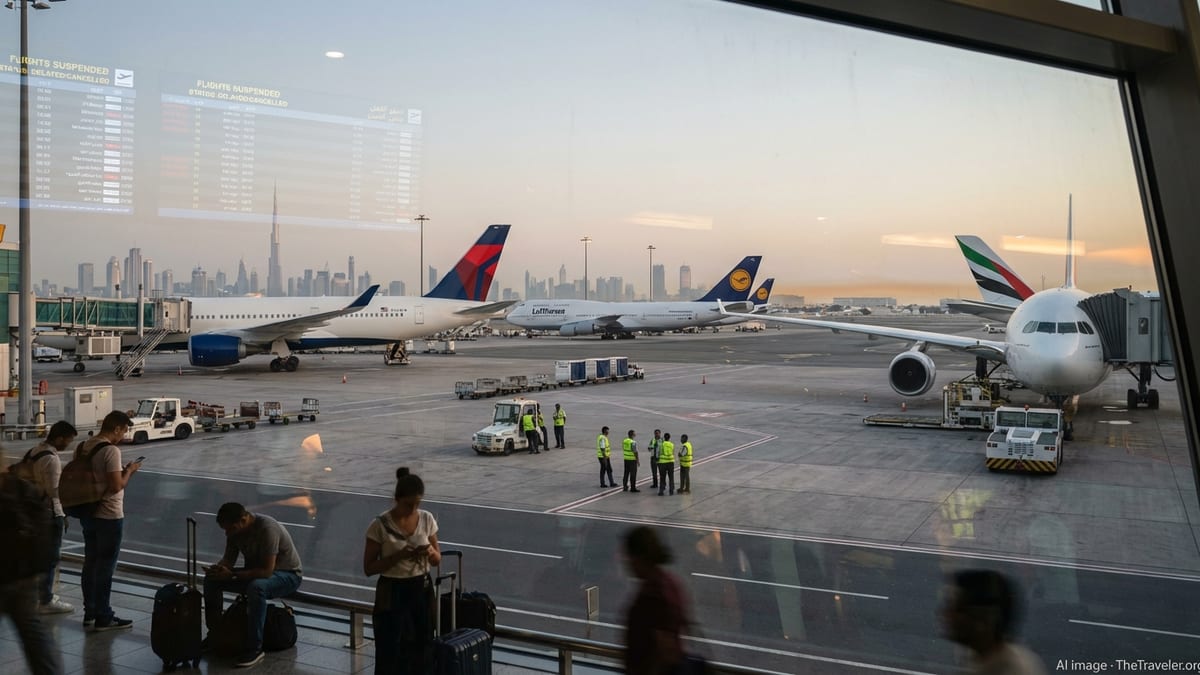
Regional conflict keeps airspace fragile
Continued tension involving Iran, Israel and neighboring states has left parts of Middle East airspace subject to sudden closures, longer routings and shifting risk assessments. Industry analysis indicates that airspace over Iran, Iraq and Lebanon remains categorized as high risk, while neighboring states including Bahrain, Israel, Jordan, Kuwait, Oman, Qatar, Saudi Arabia and the United Arab Emirates carry medium-level advisories. These warnings shape airline scheduling decisions, aircraft routing and insurance pricing across the region.
Traffic data compiled by industry bodies shows that the Middle East still accounts for a significant share of global transit passengers, but that conflicts since 2024 have triggered tens of thousands of flight cancellations or reroutings. The escalation of the U.S.–Iran conflict earlier in 2026 produced the most severe disruption to regional air travel since the pandemic, with widespread airspace closures by Israel, Iran, Iraq, Bahrain, Qatar, Kuwait and Jordan and a sharp spike in jet fuel costs.
News coverage of the late February strikes on Iran documented more than 2,800 flight cancellations across Middle Eastern airports in a single day and large numbers of passengers stranded in hubs from Dubai to Doha. While many airspaces reopened within days, the episode highlighted how quickly conditions can change and reinforced the cautious stance taken by a number of European and North American carriers.
Government travel advisories have added another layer of uncertainty. Updated guidance for Israel, the West Bank and Gaza emphasizes persistent security risks and notes that nonessential travel should be reconsidered, particularly through Tel Aviv’s Ben Gurion Airport and land crossings. Although the advisories do not directly ban commercial flights, they influence corporate travel policies, leisure demand and airline risk tolerance.
European legacy carriers extend suspensions
Several major European airlines continue to limit their exposure to the region, particularly on routes involving Israel, Lebanon and the Gulf. Reporting from European and Middle Eastern outlets indicates that the Lufthansa Group has kept most of its Middle East network offline deep into the 2026 summer and winter seasons. Austrian Airlines has restarted Vienna–Tel Aviv, but other group carriers have prolonged suspensions to destinations such as Dubai, Abu Dhabi, Riyadh, Beirut and Muscat, in some cases into October 2026 and beyond.
British Airways has taken a similarly conservative approach. Coverage in regional business media notes that the airline has suspended flights to Tel Aviv, Dubai and Bahrain at least until late October 2026, while reducing capacity on other routes such as Doha and Riyadh and discontinuing London–Jeddah altogether. These moves demonstrate how some European airlines are prioritizing network simplification and risk reduction over rapid restoration of pre-crisis capacity.
Air France and KLM have also moved carefully. Travel industry reports show that Air France has repeatedly extended the suspension of services to Israel and select Middle Eastern destinations, while KLM accelerated the halt of its Amsterdam–Tel Aviv route after the February strikes on Iran. Analysts point out that many of these carriers rely less on Middle Eastern transit flows than Gulf-based competitors, making it easier for them to redeploy aircraft to more stable markets in Europe, North America and Asia.
Canadian flag carrier Air Canada recently went further by pushing the suspension of its Dubai and Tel Aviv operations into mid-January 2027, citing the combined impact of security uncertainty and sharply higher jet fuel prices. Public statements from the airline and coverage in Gulf-based media emphasize that some long-haul Middle East routes are currently uneconomic under prevailing fuel and insurance conditions, even if demand persists.
Gulf and Turkish carriers rebuild networks
In contrast, regional heavyweights based in the Gulf and Turkey are restoring large parts of their networks, albeit with schedule tweaks and contingency planning. Aviation industry coverage shows that carriers such as Emirates, flydubai, Qatar Airways, Etihad Airways and Air Arabia have gradually resumed most operations after the late February shutdown, when Dubai’s main hub temporarily halted flights and Qatar Airways suspended services while Qatari airspace remained closed.
By mid-2026, Emirates was again operating one of the largest seat capacities in the region, although still below year-earlier levels due to rerouting around closed or high-risk airspace. Flydubai and Air Arabia have maintained extensive regional networks, accepting longer flight times and higher fuel burn on some sectors in order to preserve connectivity. Qatar Airways, meanwhile, has trimmed overall departures by around 7 percent for the upcoming northern winter schedule and continues to suspend a set of destinations, but maintains its role as a major global connector through Doha.
Turkish Airlines has emerged as another key beneficiary of the uneven recovery. Following temporary suspensions in the immediate aftermath of the Iran strikes, the carrier has leveraged Istanbul’s position on the edge of the conflict zone to attract passengers seeking alternatives to Gulf hubs. Industry observers note that Turkish Airlines and several Middle Eastern low-cost carriers have been quickest to restore capacity, contributing to what analysts describe as a two-speed recovery in regional aviation.
The strategy of Gulf and Turkish carriers appears focused on holding market share and keeping hub airports central in global traffic flows, even at the cost of lower short-term profitability. Network planners cited in specialist coverage suggest that once additional capacity is committed back into a market, airlines are reluctant to pull it again unless security conditions deteriorate sharply, because repeated schedule changes damage customer trust.
Israel, Lebanon and high-risk routes remain thinly served
Routes directly touching conflict hotspots continue to face the heaviest restrictions. Israel’s Ben Gurion Airport has seen a gradual return of some services, including the resumption of flights by certain European carriers such as LOT Polish Airlines and Austrian Airlines, according to regional travel reporting. However, the list of airlines maintaining suspensions to Tel Aviv remains long, particularly among North American and Asian carriers.
Analyst digests compiled for the travel industry indicate that some U.S. and European airlines have pushed any potential restart of Tel Aviv routes into 2027, reflecting both operational risk assessments and weak corporate demand. At the same time, Israel’s own airlines, including El Al, continue to operate outbound and inbound services, partially filling the gap for essential travel and repatriation while relying on foreign codeshare partners for onward connections.
In Lebanon, scheduled services remain significantly reduced as high-risk airspace designations and cross-border tensions persist. Reports on airline schedule filings show that several carriers have postponed the return of Beirut flights to the end of the 2026 summer season or beyond, and that some low-cost operators that once linked Beirut with secondary European cities have withdrawn indefinitely. Similar patterns apply to select markets in Syria and Iraq, where security and insurance constraints remain acute.
Travelers heading to or from these destinations often face multi-leg journeys through alternative hubs, higher fares and short-notice schedule changes. Industry commentary notes that many airlines continue to issue flexible rebooking or refund policies for itineraries touching high-risk points, but that options can narrow quickly during fresh flare-ups, leaving passengers reliant on a handful of carriers still willing to operate.
What travelers should expect in the months ahead
For passengers planning trips through the Middle East in late 2026 and early 2027, publicly available information points to a landscape of partial recovery, diverging airline strategies and persistent volatility. Capacity data suggests that overall seats departing the region have edged back above 2025 levels, supported by domestic growth, the launch of new Saudi carriers and expansion by low-cost airlines. Yet underneath this headline recovery, gaps remain on certain long-haul links and politically sensitive city pairs.
Observers highlight that airlines continue to juggle three primary constraints: security risk, airspace access and economics. Sudden airspace closures can force long detours that add hours to flight times and significantly increase fuel burn, sometimes turning marginally profitable routes into loss-makers overnight. Insurance premiums and crew safety considerations add further complexity, particularly for carriers without strong local support networks on the ground.
Given these pressures, planners expect the current split between cautious Western legacy airlines and more assertive regional carriers to persist. Travelers are likely to see more of their Middle East and connecting itineraries routed through hubs such as Dubai, Doha, Abu Dhabi, Riyadh and Istanbul, even when nonstop options technically exist on paper. Analysts also anticipate continued use of temporary suspensions and rolling schedule changes as airlines respond to shifts in conflict intensity and regulatory advisories.
For anyone contemplating travel involving Israel, Lebanon or nearby high-risk airspace, recent patterns suggest that flexibility will remain essential. Monitoring airline advisories, government travel pages and specialist aviation news in the weeks and days before departure has become a routine part of trip planning for this region, and there is little indication that this need will diminish in the near term.
Euronews Travel – Middle East flights update
Gulf News – Air Canada extends Dubai and Tel Aviv suspensions
Aviation Week – Middle East capacity rebounds amid uncertainty