


More news on this day
Major airports across the Middle East are reasserting themselves as the world’s preferred crossroads for long-haul travel, with fresh traffic records, expanded route networks and multibillion-dollar infrastructure projects signaling that the region’s hub model is firmly back in business.
Get the latest news straight to your inbox!
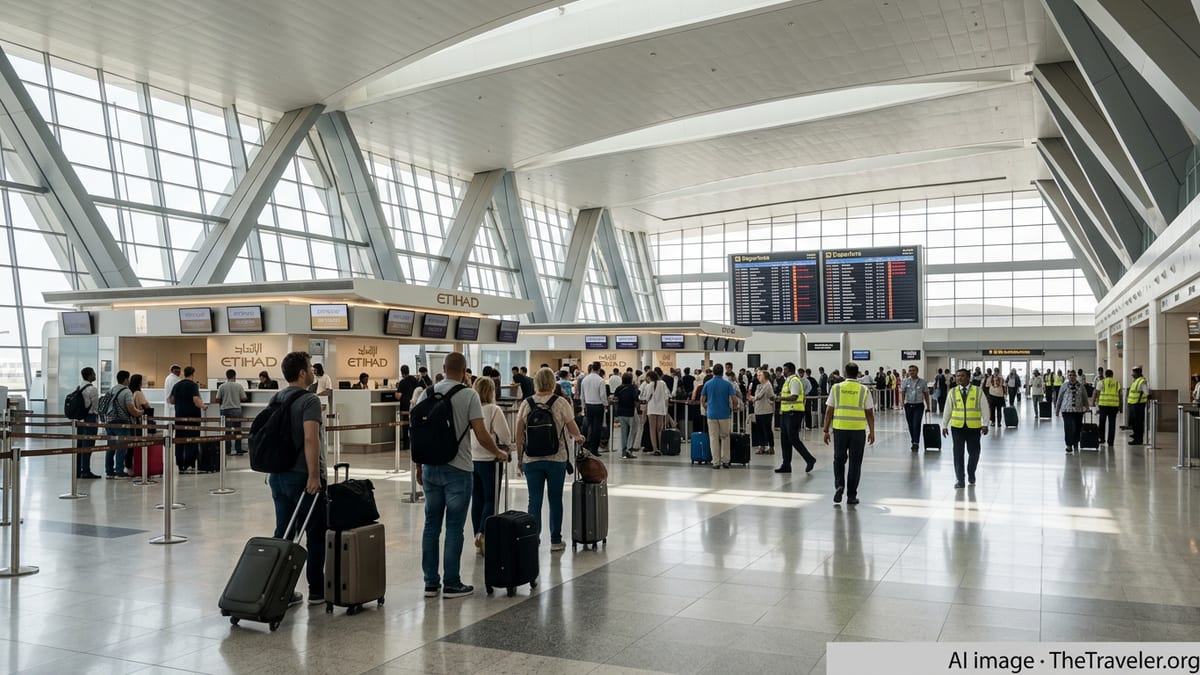
Record traffic puts Gulf hubs back on top
Passenger data from 2024 and 2025 indicates that Middle Eastern hubs have moved beyond recovery and into a new phase of growth. International aviation statistics for 2024 show that Middle East carriers and airports increased both capacity and traffic, with the region accounting for around a tenth of global international available seat kilometers and achieving load factors above 80 percent, underscoring robust demand for connecting itineraries.
Dubai International Airport has been a bellwether for this rebound. Publicly available figures show the airport handled around 92 million passengers in 2024, surpassing its previous pre‑pandemic record. More recent coverage indicates that traffic continued to climb in 2025, with more than 95 million travelers passing through its terminals and cementing Dubai’s status as the world’s busiest airport for international passengers.
Industry-wide, global passenger numbers reached fresh highs in 2024, according to summaries released by international aviation bodies, but Middle East hubs outpaced many peers by focusing on long-haul transfer traffic between Europe, Asia and Africa. Analysts note that the region’s relatively swift reopening after the pandemic, combined with aggressive schedule rebuilding by local carriers, has allowed these airports to capture market share on some of the world’s most lucrative corridors.
Dubai, Doha and Abu Dhabi double down on expansion
Gulf hubs are pairing traffic growth with ambitious expansion plans. In Dubai, planning documents and official reports describe a long-term strategy to take the city’s wider airport system beyond 100 million annual passengers by the latter part of this decade, supported by a multibillion-dollar expansion of the new Al Maktoum International facility. The aim is to eventually transfer the bulk of traffic from Dubai International to a larger, purpose-built mega-hub on the city’s southern fringe.
Doha’s Hamad International Airport has followed a similar trajectory. Since hosting the 2022 FIFA World Cup, the Qatari capital has continued to expand its terminal and concourse capacity, and route-mapping analyses based on industry timetable data show Qatar Airways operating an extensive global network from Doha that spans Europe, North America, Asia, Africa and Australasia. Recent additions in Central and Eastern Europe, as well as secondary cities in India and China, are designed to deepen the carrier’s sixth-freedom connecting traffic strategy.
Abu Dhabi has also been returning to the spotlight. The opening and ramp-up of its modern terminal, widely reported in regional aviation coverage, has given Etihad Airways a more efficient home base and additional room to grow. Passenger statistics compiled for the wider United Arab Emirates aviation system show strong double-digit growth through 2024 and into 2025, with Abu Dhabi handling tens of millions of travelers as the airport positions itself as a boutique alternative to larger nearby hubs.
Europe–Asia flows power the hub model’s revival
The resurgence of long-haul demand between Europe and Asia is central to the Middle East story. Traffic analyses from 2024 and 2025 prepared by international airline associations show that routes linking Asia to the Middle East and Europe recorded some of the fastest growth rates worldwide. Carriers based in the Gulf have been quick to add capacity on these corridors, making use of widebody fleets and dense wave-bank schedules that favor smooth connections.
For airlines such as Emirates, Qatar Airways and Etihad Airways, the ability to channel passengers from dozens of European cities through a single hub and onward to Asia, Africa or Oceania remains a structural advantage. Publicly available fleet data shows these carriers continuing to deploy high-capacity aircraft like the Airbus A380 and Boeing 777 on trunk routes, while introducing newer twinjets to open thinner city pairs that can still feed the main banks.
Travelers are responding to the restored network breadth and frequency. Industry observers report that premium-cabin demand on many Europe–Middle East and Asia–Middle East sectors has recovered particularly strongly, reflecting the return of corporate travel and high-spend leisure segments. At the same time, competitive pricing in economy cabins has helped maintain strong load factors even as overall capacity has risen.
Tourism booms ripple through destination cities
The hub resurgence is closely tied to wider tourism and economic trends in the region. Visitor statistics released for Dubai show the city attracting close to 20 million international tourists in 2025, a third consecutive record year. Similar upward trends are visible in Doha and Abu Dhabi, where new museums, waterfront districts, beach resorts and cultural festivals have been launched to broaden the appeal beyond short transfer stops.
Officials across the Gulf have publicly outlined strategies to diversify local economies, with aviation and tourism positioned as central pillars. The rapid growth of airport traffic is feeding directly into hotel occupancy, retail sales and real estate development in surrounding districts. New hotels, convention centers and mixed-use neighborhoods are being marketed to international investors as extensions of each hub’s global connectivity.
For travelers, the impact is increasingly visible on the ground. Enhanced terminal facilities, more sophisticated transfer products and streamlined immigration processes are aimed at reducing connection times and encouraging stopovers. Campaigns promoting multi-night stays in hub cities are being rolled out in key source markets, with airlines and tourism boards aligning schedules, fares and packages to convert transit passengers into destination visitors.
Competition and sustainability shape the next phase
Despite the strong momentum, Middle East hubs face intensifying competition and structural challenges. Major European and Asian airports are investing heavily in their own infrastructure, while new ultra-long-haul aircraft give some airlines the ability to bypass intermediate hubs entirely. At the same time, airspace constraints and geopolitical tensions around the region can reshape flight paths and operating costs with little notice.
Sustainability is another defining test. Global aviation bodies report that, although passenger numbers have surpassed pre-pandemic levels, the industry is under mounting pressure to curb emissions in line with national climate commitments. Middle East carriers and airports are increasingly highlighting investments in fleet renewal, fuel-efficient operations and early-stage sustainable aviation fuel projects, but observers note that concrete supply of low-carbon fuels in the region remains limited compared with Europe or North America.
There are also questions about how far the hub model can stretch. Forecasts published by international organizations project steady global traffic growth over the next two decades, yet they also point to the need for careful capacity planning, slot management and intermodal integration to avoid congestion. For Middle East hubs, the challenge will be to continue capturing long-haul flows while maintaining service quality and meeting emerging environmental benchmarks.
For now, the numbers suggest that the strategy is working. With record passenger totals, expanding route maps and large-scale airport projects either in progress or on the drawing board, the Middle East’s mega-hubs have moved firmly back to the center of global aviation, shaping how millions of travelers will cross continents in the years ahead.