


Milford Sound / Piopiotahi is one of those rare places that lives up to its hype. Sheer cliffs plunge straight into deep black water, waterfalls pour from rainforest-hung ledges, and dolphins sometimes race the bow of passing boats. Yet travelers face a surprisingly tricky decision when planning a visit: should you experience Milford Sound on a classic boat cruise, or get closer to the water on a guided kayak tour? Each option delivers a very different feel, pace, and level of effort, and your choice can shape the whole day. This guide breaks down both experiences in practical detail so you can decide which is better for your style, budget, and itinerary.
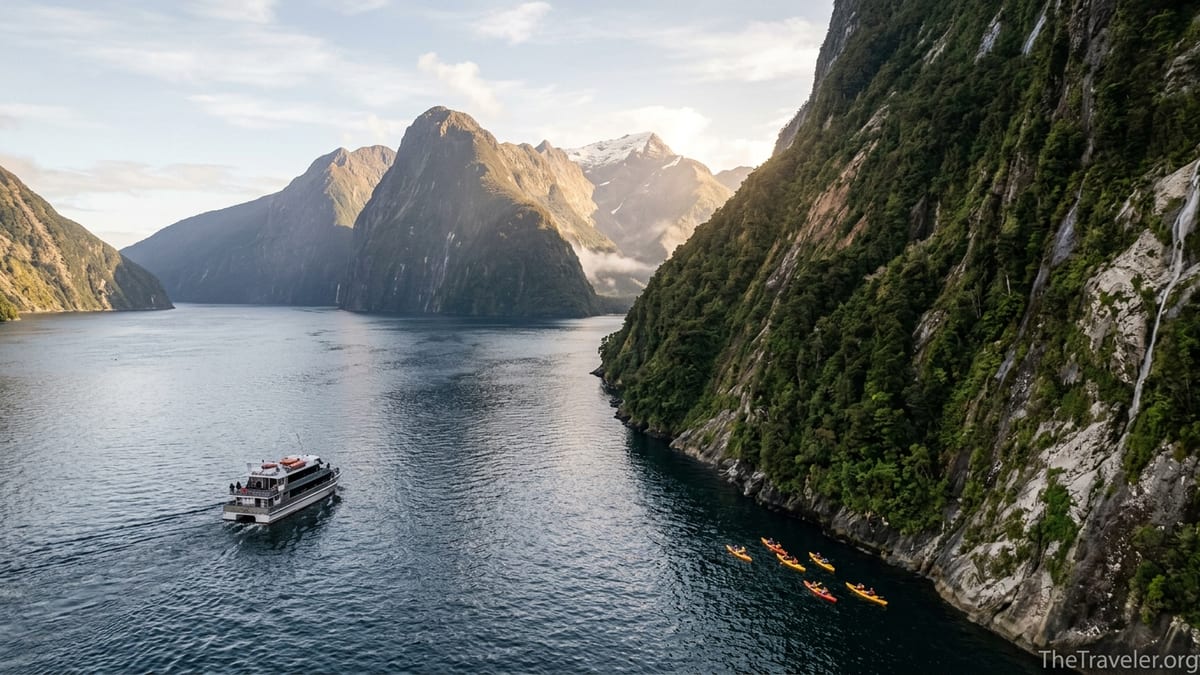
The Setting: What Makes Milford Sound Unique
Milford Sound / Piopiotahi sits in Fiordland National Park on New Zealand’s South Island, roughly 4.5 hours by road from Queenstown or about 2 hours from Te Anau. The road into the fiord passes through steep-sided valleys, avalanche paths and the narrow Homer Tunnel before emerging at sea level among towering peaks. Almost all visitors arrive on a day trip, either by coach and cruise from Queenstown or Te Anau, or by driving themselves and joining a boat or kayak tour at the terminal.
The fiord itself is relatively small, about 15 to 16 kilometers from the harbor out to the Tasman Sea, but the vertical scale is immense. Mitre Peak rises more than 1,600 meters almost directly from the water, and permanent waterfalls like Bowen Falls and Stirling Falls pour from hanging valleys into the fiord. Annual rainfall is measured in meters rather than millimeters, so even on fine days you can often see dozens of temporary cascades on the cliff faces.
Conditions are highly changeable. A blue-sky morning can turn to low cloud and driving rain by lunchtime, and vice versa. That variability is part of the appeal: on a sunny day, light picks out every ridge and glacier-carved detail, while on a wet day the fiord feels moody and primeval, with mist hanging in the beech forest and waterfalls in full flood. Both cruises and kayak tours run year-round, but operators may adjust routes or cancel departures if winds and waves in the outer fiord become unsafe.
Because Milford Sound lies inside a national park with tightly controlled development, facilities are limited. There is a lodge and campground on the edge of the settlement, a small cafe near the terminal and basic services, but no large town. This means most travelers must factor the long return journey into their choice between a low-effort boat cruise and a more physical kayak tour.
What a Milford Sound Boat Cruise Is Really Like
Most visitors experience Milford Sound on a boat cruise, and for good reason. Several companies run modern sightseeing vessels from the main terminal, typically offering 1 hour 45 minute to 2 hour 15 minute sailings that follow a similar circuit along one side of the fiord to the Tasman Sea and back along the opposite shore. A common pattern is a late morning or early afternoon cruise for those arriving by coach from Queenstown or Te Anau, and slightly quieter early morning and late afternoon departures for self-drivers.
On board, you can expect large viewing decks, indoor lounges with big windows, and commentary that explains the geology, Maori history and wildlife. A standard day-cruise on a larger vessel from a mainstream operator usually costs somewhere in the range of NZD 130 to 190 per adult if you make your own way to Milford Sound, with separate coach and cruise packages from Queenstown or Te Anau starting around the mid-200s for a full-day trip. Smaller “nature cruise” boats with fewer passengers and more focus on wildlife observation often sit at the higher end of that range.
A typical cruise might nose right up to Stirling Falls so that spray drenches the bow, pause near seal haul-outs on rocky ledges, and slow down if dolphins appear. Many boats have open foredecks where you can stand rail-side for photographs, and upper decks that give a wider view back toward Mitre Peak and the inner fiord. If the weather turns, you can retreat inside and still see most of the scenery through panoramic windows, making cruises a comfortable choice in all but the roughest conditions.
Because you are seated or moving casually around the vessel, the experience is physically easy. Travelers in their 70s and 80s, families with small children, and anyone with limited mobility can usually enjoy a cruise without difficulty. That accessibility, combined with predictable timing, makes it straightforward to layer a cruise into a long day of coach travel from Queenstown or a self-drive loop that includes stops at Mirror Lakes and the Eglinton Valley along Milford Road.
Inside a Milford Sound Kayak Tour
Kayaking in Milford Sound is a more intimate, slower and more demanding way to explore the fiord. Instead of standing on a high deck looking down, you sit at water level in a tandem sea kayak, feeling the slight swell and hearing the sound of your paddle dipping in and out of the water. Guided tours, often operated by specialist companies based at Milford, typically last between 3 and 5 hours on the water, with total trip times of half a day or more once briefings and gear fitting are included.
Prices for guided kayak trips usually fall somewhere around NZD 150 to 280 per person, depending on the length and style of tour. Shorter, “taster” trips that explore the inner fiord close to the harbor tend to be more affordable and require less paddling experience. Longer routes that push further toward Stirling Falls or out toward the Tasman Sea command higher prices, reflecting both the extra guide time and the need for stable conditions.
Before launching, guides outfit you with a drysuit or wetsuit, thermal layers if needed, a spray skirt, buoyancy aid and spray jacket. You receive a safety briefing covering paddle technique, what to do if the kayak capsizes and how to manage in cold water. Many operators use stable, tandem sea kayaks so that less confident paddlers can share the workload with a stronger partner. You then launch from sheltered water, often near Deepwater Basin or the inner harbour, and paddle as a group with a guide at the front and another sweeping the rear.
Out on the water, the density of the cliffs and forest becomes more apparent. You can hear individual waterfalls and birdsong, and see seals in the water at almost eye level. In calm conditions, the surface can be mirror-smooth, reflecting Mitre Peak and the hanging valleys above. Guides often pause to explain local ecology, such as the dark tannin layer on the surface that makes the fiord’s water appear inky black and allows deep-water species to survive closer to the surface. Compared with a cruise, there is a stronger sense of being part of the landscape rather than an observer passing through.
Boat Cruise vs Kayak: Experience, Comfort and Crowd Levels
From a pure comfort perspective, boat cruises have the clear edge. You have shelter from rain and wind, access to toilets and often hot drinks or simple snacks on board. The motion is generally gentle inside the sheltered fiord, and you can sit or move around as you please. On a cold, horizontal-rain winter day in Fiordland, that enclosed lounge with big windows can feel like a blessing. Travelers who are prone to seasickness sometimes prefer the larger boats, which handle any chop better than a small vessel or kayak.
Kayak tours involve more exposure. You will almost certainly get damp from paddle splashes and light spray, and if there is any swell further out, the kayaks will rise and fall with each wave. In winter, despite the protection of drysuits, hands and faces can feel the cold, especially on longer routes. There are no toilets on the water, so tours build in shore breaks when possible. For some travelers, that rawness is part of the adventure, but others find it tiring, particularly when combined with a long drive back to Te Anau or Queenstown.
Crowd levels differ as well. Even in high season, a kayak group might consist of 6 to 12 people paddling in small clusters. Once you spread out along the cliff line or into side coves, it can feel surprisingly quiet, especially on early morning departures before the big Queenstown coach groups arrive. In contrast, the main cruise terminal can be busy around late morning and early afternoon, with multiple vessels boarding and disembarking hundreds of passengers. Some operators offer smaller “boutique” boats that cap numbers significantly below capacity, but even then you are sharing the experience with dozens rather than a handful of people.
Visually, both options deliver the core icons: Mitre Peak, Bowen Falls, Stirling Falls and the sheer rock walls of the fiord. Cruises cover more distance in less time, so you are more likely to see the mouth of the fiord and look out toward the Tasman Sea. Kayaks usually stay in the more sheltered inner sections for safety, though some advanced itineraries may venture farther if conditions allow. If you want the classic wide-angle views with multiple peaks and waterfalls in frame, a cruise gives you those perspectives quickly. If you care more about noticing small details such as tiny tree avalanches on the cliffs or the texture of moss on rock, the slower pace of a kayak suits that curiosity.
Time, Logistics and Weather: How Your Itinerary Shapes the Choice
For many travelers, the practicalities of getting to Milford Sound weigh just as heavily as the on-water experience. From Queenstown, most coach-and-cruise day tours depart between about 6:30 and 7:30 in the morning and return between 7:30 and 8:30 in the evening. That 12 to 13 hour day usually includes a 1.5 to 2 hour cruise slot, plus scenic stops at places like Eglinton Valley, Mirror Lakes, and the Chasm. Fitting a 3 to 5 hour kayak tour plus safety briefing into that same timeframe would be unrealistic, so serious kayaking is generally best paired with at least one night in Te Anau or Milford itself.
If you base yourself in Te Anau, a common pattern is to drive the approximately 120 kilometers along Milford Road in the morning, stopping for short walks and photo spots, then join a mid-morning or early afternoon cruise or kayak tour and return to Te Anau by early evening. Because the drive from Te Anau typically takes around 2 hours with no stops, this still makes for a full but manageable day. Self-drivers should factor in road conditions, possible temporary closures for avalanche control in winter, and the absence of fuel stations between Te Anau and Milford Sound.
Weather is another key variable. Cruise operators can generally run in rain, mist and low cloud, and those conditions often produce spectacular waterfalls and atmospheric photographs. Strong winds or high seas out at the Tasman entrance might cause routes to be shortened, but cancellations are relatively rare inside the sheltered fiord. Kayak tours, by contrast, are more sensitive to wind, chop and visibility. A stiff headwind can make progress slow and exhausting, and guides will cancel if they judge conditions unsafe. If you only have one day in Milford Sound locked in months ahead, a cruise gives you a higher chance that something will run in whatever conditions you get.
Seasonality matters too. In mid-summer, long daylight hours and milder temperatures make both cruises and kayak tours pleasant, though sandflies on shore can be vigorous. In winter, snowy peaks, low sun and persistent rain create a very moody landscape that many photographers love, but the cold on exposed hands and faces can be a deterrent for kayaking. Budget travelers visiting in shoulder seasons like October or April can sometimes find discounted cruise fares, while specialist kayak operators often keep relatively stable pricing year-round due to small group sizes and fixed staffing needs.
Who Should Choose a Boat Cruise?
A boat cruise is the better choice for travelers who prioritize comfort, accessibility and simplicity. If you are visiting Milford Sound as a long day trip from Queenstown with children, older relatives or a mixed-ability group, a cruise threads the needle between delivering big scenery and keeping everyone safe, warm and fed. You can sit indoors, buy a hot drink, and step outside for photographs when the boat approaches waterfalls or wildlife, then retreat again to rest during the transit sections.
Cruises also work best for travelers with very limited time. If you only have one spare day in a South Island itinerary that already includes Queenstown, Wanaka and perhaps a Great Walk, slotting in a coach-and-cruise package from Queenstown is logistically straightforward. The tour company handles road safety, weather calls and timing for you. Companies that operate multiple departures daily can shift you to a different sailing in case of a road delay or minor disruption, something that is harder to arrange with a single small kayak group.
Photographers who like to move around freely, switch lenses and keep gear dry often find cruises more flexible. You can bring a tripod or long telephoto lens, use upper decks for wide vistas, and duck inside to change batteries or cards. On a kayak, everything must be in dry bags, and space is tight. For travelers with back or shoulder issues, the gentle pace of a cruise is easier on the body than hours of paddling, even if you are reasonably fit.
Budget also plays a role. While high-end small-boat “nature” cruises and overnight vessels can be expensive, a standard day cruise purchased with a self-drive option often comes in slightly cheaper than a comparable half-day kayak tour, especially when booked in advance or bundled with other activities. Travelers trying to stretch funds across multiple days in Fiordland might decide that the price difference covers an extra night in Te Anau or a meal out, while still delivering the headline scenery.
Who Should Choose a Kayak Tour?
A kayak tour suits travelers who are reasonably active, comfortable on the water and looking for a more immersive, less mediated encounter with Milford Sound. If your idea of a good day is hiking, cycling or paddling rather than riding a bus, then a half-day or longer guided kayak will likely feel more rewarding. You are not just watching the landscape from a distance but moving through it under your own power, which often creates a stronger emotional connection and sharper memories.
Kayaking is particularly appealing for those who have already taken scenic boat cruises elsewhere in New Zealand, such as on Lake Wakatipu or in Doubtful Sound, and want something that feels distinct. Paddling quietly past a rock ledge to observe New Zealand fur seals, or drifting silently under a thin waterfall, offers a very different feel from leaning on a railing between dozens of other passengers. Many travelers describe kayak tours as the highlight of their entire South Island trip, precisely because they involve a bit of effort and risk of getting damp.
From an educational perspective, small group sizes allow for deeper conversation with guides. You can ask detailed questions about how tree avalanches shape the forest, why black coral lives so shallow here compared with tropical seas, or how local conservation projects are tracking populations of Fiordland crested penguins. Guides often share personal stories of living and working year-round in Fiordland’s extreme weather, something harder to communicate over a loudspeaker on a large vessel.
That said, suitable participants need a baseline level of fitness and joint health. You do not have to be an athlete, and many itineraries welcome beginners, but you should be able to sit upright and paddle for several hours with short breaks. Anyone with serious shoulder injuries, chronic back issues or limited mobility may struggle, especially if conditions turn breezy. Non-swimmers are usually allowed on guided tours, as you wear buoyancy aids, but they must be comfortable with the idea of being on the water for extended periods.
Costs, Safety and Practical Tips for Both Options
In broad terms, a self-drive day with a standard boat cruise will usually be the lower-cost option once you factor in tour price, fuel and parking. A traveler driving from Te Anau, paying for a mid-range cruise and a few simple food items might spend less overall than someone booking a half-day guided kayak. Full coach-and-cruise packages from Queenstown or Te Anau, which bundle transport, commentary and a boat ticket, run higher but remove the need to rent a car or navigate the sometimes challenging Milford Road.
Kayak tours justify higher prices with small group ratios, specialized gear and experienced guides who can read changing conditions minute by minute. Most operators provide all technical equipment, so you only need to bring base layers, socks and perhaps a fleece or light down jacket depending on the season. Choosing a reputable, long-established kayak company is worth a small premium, as these outfits generally have robust safety procedures, dependable gear maintenance routines and clear cancellation policies if weather turns.
Safety considerations differ between the two experiences. On a cruise, risks center mostly on slips on wet decks, temporary discomfort in rougher seas and the long coach ride to and from Milford Sound. Following crew instructions, using handrails and wearing appropriate non-slip footwear will mitigate most issues. On a kayak, exposure to cold water is a bigger concern, especially in shoulder seasons and winter. Even in calm conditions, guides will brief you on what to do if a kayak capsizes and will carry communication devices and emergency gear. Listening closely, dressing warmly and being honest about your abilities during booking helps operators match you with the right tour.
Whatever your choice, a few common-sense tips make the day smoother. Book your cruise or kayak in advance during the peak December to March period, particularly if you need a specific departure time that aligns with bus schedules. Allow generous buffer time between your scheduled activity and any onward travel, as road delays from weather or traffic are possible. Bring insect repellent for sandflies at shore stops, and pack snacks even if your trip includes a light meal, as options in Milford Sound itself are limited and often sell out on busy days.
The Takeaway
There is no single “better” way to see Milford Sound, only the experience that best matches your energy, time and tolerance for the elements on the day you visit. A boat cruise delivers the archetypal fiord vistas with maximum comfort and minimum effort, fitting neatly into long day trips from Queenstown or Te Anau and welcoming almost every type of traveler. A kayak tour trades that convenience for intimacy, quiet and physical engagement, appealing to those who prefer to feel the cold spray, hear their paddle strokes and linger under overhanging cliffs.
If you can spare at least one night in Te Anau and enjoy active days, a guided kayak is an unforgettable way to connect with Fiordland’s scale and silence, particularly on a calm morning when the water lies glassy and the only sounds are waterfalls and the occasional distant boat. If your schedule, health or comfort preferences lean toward an easier outing, a well-timed cruise, perhaps on a smaller “nature” vessel, will still reveal the essence of Milford Sound’s drama and beauty.
Some travelers solve the dilemma by doing both on separate days or trips, using a cruise to grasp the full geography and a kayak to savor its finer textures. Whether you stand on a deck with a hot drink in hand or sit low in a kayak with cool spray on your face, Milford Sound has a way of making even seasoned travelers feel small, humbled and very glad they made the journey.
FAQ
Q1. Is a Milford Sound boat cruise or kayak tour better for first-time visitors?
For most first-time visitors, especially on a tight schedule, a boat cruise is the better starting point. It covers more of the fiord in less time, works in almost all weather, and fits easily into a day trip from Queenstown or Te Anau. A kayak tour is ideal if you have extra time, are reasonably fit, and want a more immersive follow-up experience.
Q2. How fit do I need to be for a Milford Sound kayak tour?
You do not need to be an athlete, but you should be able to sit and paddle steadily for several hours with short breaks. If you regularly walk a few hours, cycle or do light exercise and have no serious shoulder or back issues, you will likely manage fine on a beginner-friendly guided tour. If in doubt, talk honestly with the operator before booking so they can recommend the right itinerary.
Q3. What happens if the weather is bad on the day of my tour?
Boat cruises generally run in rain and low cloud and may even be more dramatic with extra waterfalls, but routes can be shortened if winds or seas are high near the Tasman Sea. Kayak tours are more weather dependent and may be canceled or rescheduled if wind, swell or visibility make paddling unsafe. Reputable operators explain their weather policies at booking and will outline options for refunds or alternative activities if conditions do not cooperate.
Q4. Can I do a Milford Sound kayak tour as a day trip from Queenstown?
In theory it is possible, but in practice it makes for an extremely long and tiring day, often 14 hours or more including transport and paddling. Most travelers who want to kayak choose to base themselves in Te Anau or stay overnight near Milford Sound so they can enjoy the experience without rushing, and still have enough energy and daylight for the return drive.
Q5. Are Milford Sound cruises and kayak tours suitable for children?
Standard boat cruises are generally very child friendly, with space to move around, indoor seating and short overall durations. Kayak tours usually have minimum age limits, often in the early teens, and require children to share a tandem kayak with a capable adult. Families with younger kids typically find a cruise more practical, perhaps paired with short walks along Milford Road to burn off energy.
Q6. Will I see wildlife on a cruise or kayak tour?
Both options offer good chances of spotting wildlife, including New Zealand fur seals on rocky ledges and several seabird species. Occasional visits from dolphins or, more rarely, Fiordland crested penguins are possible on either experience, though never guaranteed. Kayak groups may feel closer to individual animals because they are quieter and smaller, while cruises cover more area and may cross paths with more pods or flocks in a single outing.
Q7. What should I wear for a Milford Sound boat cruise?
Layer for changeable weather: a moisture-wicking base layer, warm mid-layer and waterproof jacket, along with comfortable trousers and sturdy, non-slip footwear. Even in summer the breeze on deck can feel cool, and in winter it can be very cold. A hat, gloves and scarf are useful in colder months, and sunglasses are helpful year-round when the sun reflects off water and wet rock.
Q8. What should I bring for a Milford Sound kayak tour?
Most operators supply drysuits or wetsuits, spray skirts and buoyancy aids, so your focus should be on warm, quick-drying base layers such as merino or synthetic tops, thermal leggings, wool socks and a fleece. Bring a beanie, sun hat, sunscreen, a small water bottle and any personal medications, plus a compact camera or phone in a waterproof case if you plan to take photos. Avoid cotton, which stays cold and damp.
Q9. Is it worth doing both a cruise and a kayak in Milford Sound?
For travelers with the time and budget, doing both can be very rewarding. A cruise helps you grasp the full layout of the fiord and see more distant headlands quickly, while a kayak tour lets you slow down and appreciate textures, sounds and small details. Many visitors who return to Fiordland on a second trip choose the option they skipped the first time, or plan an itinerary that includes a cruise one day and kayaking the next.
Q10. How far in advance should I book a Milford Sound cruise or kayak tour?
In the busy summer months from December to March, it is wise to book at least several days to a couple of weeks in advance, especially for kayak tours with small group limits or for specific cruise times that must match bus connections. In shoulder seasons, you may find more last-minute availability, but pre-booking still reduces stress and helps you choose the departure that best fits your overall South Island route.