


More news on this day
Across North America and Europe, a season of winter rail disruptions has exposed a widening gap between what operators promise on paper and what passengers experience when trains grind to a halt in subzero conditions.
Get the latest news straight to your inbox!
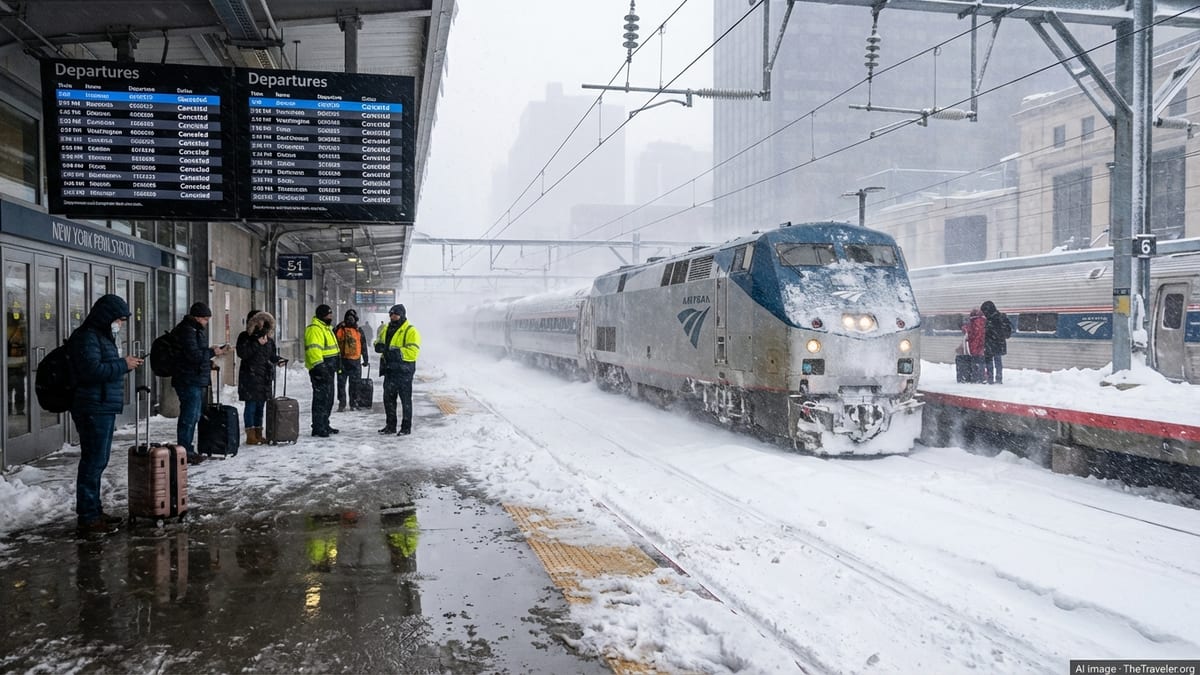
Cold, Dark Carriages and Confused Messages
Recent incidents reported in North America and the United Kingdom highlight how quickly a routine delay can turn into a welfare crisis when communication breaks down. Passengers describe trains halted for hours in freezing temperatures, with failing heating systems, dark carriages and little clear information about what will happen next.
In one widely discussed case this spring, riders on a long distance service in the United States recounted sitting overnight in cars where several internal doors were frozen open, leaving compartments exposed to the outside cold. Online accounts describe temperatures dropping sharply, limited access to blankets and no clear timeline for when assistance or alternative transport would arrive. Similar narratives appear on passenger forums in Canada, where a stalled intercity service left travelers without heat or working toilets for several hours while they waited for a rescue train.
Published coverage from regional broadcasters in the northeastern United States points to the same pattern on commuter and light rail systems. When trains lose power in extreme weather, passengers are often left standing in unheated cars while staff attempt to interpret evolving instructions from control centers, local emergency services and infrastructure managers. Conflicting or delayed announcements can leave travelers unsure whether to stay aboard, walk along the tracks, or wait for buses that may never materialize.
Across these cases, the immediate technical cause may differ, ranging from frozen switches and broken rails to power failures and flooding on the tracks. What they share is a sense among riders that the flow of information is slow, inconsistent and focused on explaining the disruption rather than addressing basic comfort and safety while they are stranded.
Regulators Focus on Welfare, Not Just Operations
In response to high profile stranding incidents, regulators and watchdogs have been trying to push passenger welfare higher up the agenda. In Britain, the Office of Rail and Road has published research and guidance emphasizing that operators should treat stranded trains as welfare emergencies as much as operational problems. The regulator’s recent consumer report stresses that companies must plan explicitly for heat, lighting, toilets, drinking water and safe evacuation when trains are immobilized for long periods.
The research commissioned with the passenger watchdog Transport Focus found that many travelers felt “abandoned” when trains were stuck between stations, especially at night or in severe weather. Publicly available documents recommend better coordination between infrastructure managers and train operators, clearer decision making about whether to move or evacuate passengers, and specific triggers for distributing water, blankets or other basic supplies.
North American advocates are making similar arguments. The Rail Passengers Association in the United States has repeatedly highlighted cases where riders on long distance services endured hours without heat or food during cold snaps. The group’s updates and newsletters call for stronger standards around emergency provisioning and more transparent explanations of what support travelers can expect when things go wrong.
Despite these efforts, the policy focus has often remained on punctuality statistics, capacity constraints and infrastructure funding. Comfort for stranded travelers is usually addressed through broad service quality commitments or voluntary charters, which can be difficult to enforce in the middle of a winter storm when resources are stretched.
Why Better Information Still Leaves Riders in the Cold
Transport agencies have invested heavily in digital alerts, social media feeds and real time dashboards over the past decade. The aim has been to help passengers make informed choices before they travel and receive timely updates when disruptions hit. Yet the recent cold weather failures suggest that information alone is not enough to keep stranded riders safe and reasonably comfortable.
Academic work on disruption management in urban rail systems points out that guidance about alternative routes or departure times helps only when the network remains broadly functional. Once trains are immobilized and stations overcrowded, the priority shifts from choice to basic welfare. In that setting, precise delay estimates or detailed technical explanations matter less than concrete steps to conserve heat, ensure access to toilets and coordinate a safe evacuation if necessary.
Miscommunication can also stem from the way rail companies frame their customer messages. Internal communication guidance in some European networks has encouraged frontline staff to “speak the customer’s language” and maintain upbeat tones, even during major incidents. Critics argue that this approach can downplay the seriousness of a situation, leaving passengers feeling that their discomfort is being minimized rather than acknowledged and addressed.
There is also a structural issue: responsibility for passenger care is often fragmented among infrastructure managers, operating companies, subcontracted onboard crews and external emergency responders. When an incident unfolds quickly, that fragmentation can translate into passengers hearing one thing from the onboard team, another from a social media feed and something different again from station announcements.
Comfort Upgrades Remain a Low Priority
While rail operators in several countries are investing in new rolling stock and digital ticketing, much of this spending is directed toward capacity, energy efficiency and accessibility rather than comfort in disruption scenarios. Upgrades such as better seating, higher quality climate control systems and reliable onboard power tend to be marketed as enhancements to everyday travel, not as resilience measures for emergencies.
Survey data from passenger advocacy groups in the United States suggests that travelers do place a high value on amenities such as comfortable seating, dependable Wi Fi and working power outlets. At the same time, respondents indicate that fares and schedule convenience still dominate their choice of mode, which can make it harder to justify spending on less visible features like backup heating, emergency lighting or additional insulation.
Budget pressures compound the problem. Publicly available statements from rail executives and transport authorities often frame new investments in terms of cost recovery and long term capital needs. In that environment, retrofitting older trains with more robust environmental controls or stocking additional emergency supplies may be seen as discretionary rather than essential. As long as the majority of journeys run without major incident, the case for comfort focused upgrades can be overshadowed by competing priorities such as track renewal or digital signaling.
For passengers who have endured hours in unheated carriages, that logic is hard to square with their lived experience. From the traveler’s perspective, the value of a rail ticket includes not only reaching the destination but doing so with a basic level of dignity and physical comfort, even when events are outside the operator’s direct control.
Growing Pressure for Clearer Standards
The accumulation of winter stranding stories is beginning to prompt broader questions about what passengers should reasonably expect when the system fails. Advocacy organizations are calling for clearer, enforceable standards covering maximum time limits without heat or light, thresholds for providing blankets or hot drinks, and automatic compensation when disruptions cross certain welfare related benchmarks.
Some regulators already require operators to publish contingency plans for severe weather and major incidents. However, these documents are often technical and difficult for the public to interpret. Campaigners argue that rail companies should translate these plans into plain language commitments, setting out in advance what kind of support will be offered if travelers are stuck on a cold train for several hours.
There are signs that operators and infrastructure managers are starting to respond. Industry workshops in Europe and North America have brought together managers, regulators and passenger groups to review recent stranding incidents and identify best practices in welfare management. These discussions typically highlight straightforward steps such as pre positioning emergency kits with blankets and water, improving training for frontline staff on welfare triage, and building closer links with local authorities for rapid deployment of buses or shelter.
Yet many of these measures remain at the recommendation stage. Until they are backed by stronger standards, dedicated funding and consistent oversight, passengers are likely to continue encountering a familiar reality in winter: they may receive more notifications about delays and cancellations, but they should not count on meaningful comfort upgrades if they find themselves stranded in the cold.