


More news on this day
A freight train derailed into a wetland in southwest Calgary on Monday, sending several Canadian Pacific Kansas City railcars into the water and triggering an investigation into what went wrong along the busy rail corridor.
Get the latest news straight to your inbox!
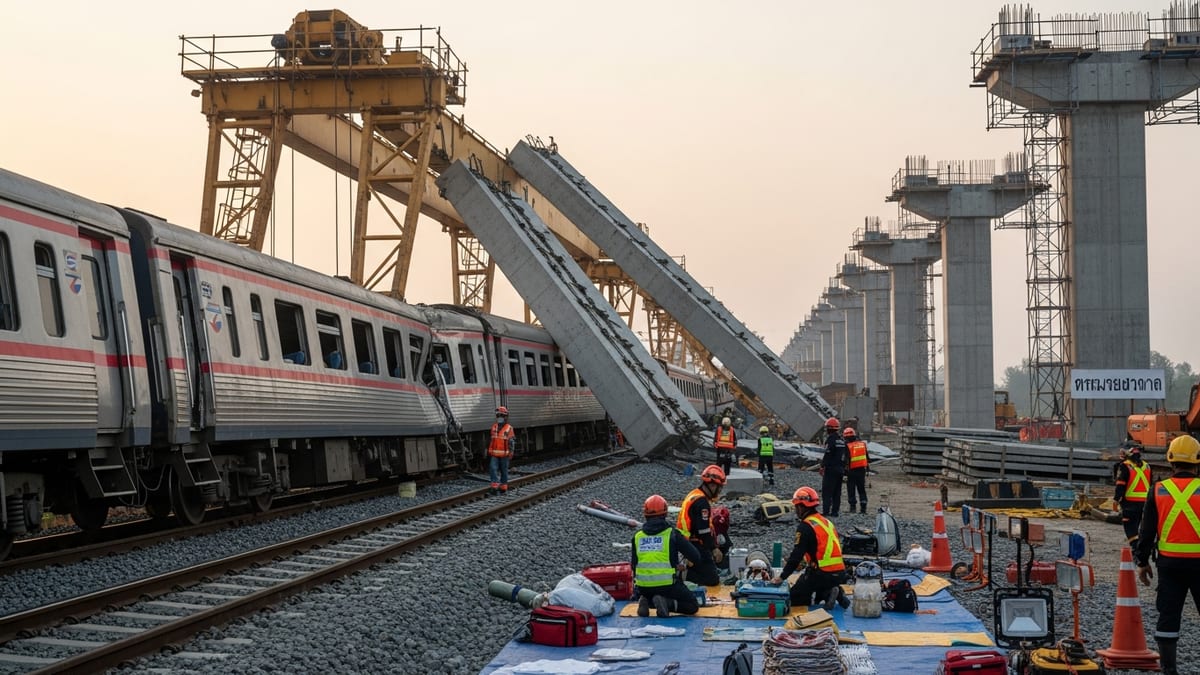
Rail cars off the tracks near Priddis Slough
Published coverage indicates the derailment occurred in the early hours of July 13 near Priddis Slough, a large pond and wetland complex on Calgary’s southwestern fringe. Images from the scene show multiple freight cars tipped on their sides or partially submerged, with rail equipment scattered along the embankment at the water’s edge.
Reports describe the train as a Canadian Pacific Kansas City freight consist travelling through the area when a section left the tracks close to the shoreline. Initial tallies suggest around a dozen railcars were involved, several coming to rest in the water while others derailed on adjacent land.
Local emergency crews responded alongside company recovery teams, with fire and specialized hazardous materials units staging around access roads leading to the slough. Publicly available information indicates that responders moved quickly to assess any leaks, contain debris and secure the derailed equipment from shifting further.
By mid‑day, photographs shared by residents and news outlets showed cranes, work trucks and containment booms positioned around the site as crews began the careful process of stabilizing cars and planning heavy‑lift operations out of the pond.
Hazardous cargo concerns and environmental checks
Early attention focused on what the derailed train was carrying and whether any release of fuel or industrial products had occurred. According to published coverage, some of the affected cars were tankers, prompting precautionary monitoring of air quality and the surrounding water.
Initial reports suggest that any product releases, if present, were limited and localized, with no immediate large‑scale spill identified in surface water at Priddis Slough. Nevertheless, the combination of overturned tank cars and a sensitive wetland ecosystem has kept environmental impacts squarely in the spotlight.
Environmental contractors working with public agencies and the railway have been observed taking samples and deploying floating booms. These measures are intended to capture any sheen that may develop on the water and to prevent debris from dispersing into smaller channels used by birds and other wildlife.
The wetland’s proximity to residential communities and recreational trails adds an extra layer of scrutiny. Even in the absence of a significant spill, residents have been watching closely for information about potential impacts on local waterfowl, amphibian habitat and downstream water quality.
Investigation focuses on track, train handling and conditions
The cause of the derailment remains under active review. Publicly available information from transportation safety agencies shows that investigators in similar rail incidents examine a range of factors, including track condition, train speed, mechanical performance and operating practices at the time of the event.
In recent Canadian freight derailments, federal safety reports have highlighted issues such as track geometry defects, problems with rail joints or ballast, and train handling that can generate high in‑train forces on curves and grades. These patterns are likely to inform how experts frame their work at the southwest Calgary site while they collect data, download onboard recorders and review maintenance histories.
Weather and ground conditions can also play a role. The rail line bordering Priddis Slough runs beside soft, moisture‑rich terrain, where drainage, embankment stability and seasonal ground movement are all considerations. Investigators typically document these elements while the scene is intact, before heavy recovery equipment significantly disturbs the area.
According to background material from the Transportation Safety Board of Canada, full investigations into main‑track derailments can take many months, with preliminary safety observations sometimes issued earlier if an urgent risk is identified across the broader rail network.
Travel disruptions and local community response
For travellers and residents in southwest Calgary, the derailment translated into visible disruptions along nearby roads and paths as emergency vehicles and rail cranes converged on the narrow access routes leading to Priddis Slough. Motorists reported temporary slowdowns, and some recreational users were kept away from portions of the wetland as a safety precaution.
Passenger rail services do not typically operate along this freight corridor, but rail movements through the area were affected while crews worked to clear the line. According to regional media coverage of past incidents, freight derailments can lead to temporary traffic bottlenecks elsewhere on the network as trains are rerouted or held until tracks are declared safe.
Nearby residents described hearing rail activity overnight and waking to the sight of emergency lights reflected on the water. Many turned to local news outlets and community forums for updates on what cargo was involved and whether any evacuation orders might be necessary. As information filtered out indicating no major release and no serious injuries, the focus shifted toward how long the cleanup and investigation would last.
The incident has also prompted renewed community interest in understanding what types of goods regularly pass along the line skirting the wetland, and how emergency plans would operate in a more severe scenario involving significant hazardous materials.
Rail safety record and implications for future travel
The Calgary derailment comes amid ongoing national discussion about freight rail safety, particularly where long trains pass close to populated areas and sensitive environments. Data from Canadian transportation safety publications show that while the overall number of serious derailments has declined in recent years, high‑profile events continue to raise concerns about risk management and infrastructure maintenance.
For travellers, these incidents rarely translate into direct danger, but they can disrupt itineraries and influence perceptions of rail as a reliable, environmentally friendly mode of transport. When main freight arteries are blocked, passenger services in other corridors may face delays or equipment shortages, and road traffic can be affected by detours around cleanup operations.
Industry studies on hazardous materials transport note that robust inspection regimes, detailed route planning and real‑time monitoring of train performance are central to reducing derailment risk. As investigators piece together what happened beside Priddis Slough, safety advocates are likely to watch for any recommendations that could reshape operating practices or infrastructure investments across western Canada.
For visitors passing through Calgary or exploring its southwest green spaces, the scene of derailed cars in a quiet wetland is a stark reminder that major transport routes often share a corridor with recreation areas and wildlife. How the aftermath is managed, and what lessons are drawn from the investigation, may influence how comfortably travellers view rail lines threading close to the city’s natural attractions.